Translate

Monday, November 11, 2013

How Jesus will conquer the world - Revelation 6-11


Revelation 11:15-17 "Then the seventh angel sounded; and there were loud voices in heaven, saying, “The kingdom of the world has become the kingdom of our Lord and of His Christ; and He will reign forever and ever.” 16 And the twenty-four elders, who sit on their thrones before God, fell on their faces and worshiped God,17 saying, “We give You thanks, O Lord God, the Almighty, who are and who were, because You have taken Your great power and have begun to reign."

Introduction:
A couple of days ago I blogged concerning a seven-fold outline of Revelation that attempted to take into consideration key words and ideas (http://pastormahlon.blogspot.com/2013/11/a-seven-fold-outline-of-book-of.html ).  
The particular key words in the outline had to do with John seeing a sequence beginning with persons or activities "in heaven" followed by the outworking of Divine decrees here on earth. So for example we noticed the first visionary sequence of Revelation as being Revelation 1-3, with Jesus being the Lord over His church and thus exercising His reign over the church through her history and in every place. The first visionary sequence answers the question: What is Jesus doing and what is His relationship now to the church?
Today I want us to look specifically at the second sequence we proposed: namely Revelation 4-11. This second sequence begins with a dramatic vision of the Father (4) and the Lamb (5) on the throne, ready to unfurl the judgments contained within the title deed to planet earth. John's point is to demonstrate the Lamb is worthy to break open the seals and to retake what is rightfully His - namely the title deed to planet earth. In order to do this, Jesus Christ, the New Adam, the Lamb of God will need to conquer the Kingdoms of this world. And so in this second visionary sequence, we will be asking this question: how will Jesus conquer the world?

How Jesus will conquer the Kingdoms of man or the world
We know that this question is the main focus of Revelation 6-11 in particular because of what is said in Revelation 11:15 - "Then the seventh angel sounded; and there were loud voices in heaven, saying, “The kingdom of the world has become the kingdom of our Lord and of His Christ; and He will reign forever and ever.” The larger context of Revelation in 6-19 unfolds in a repetition of various events in the same general period of time - the final seven-year tribulation period. In this particular section of chapters 6-11, the groundwork is laid by John for the realization of this general time period, its character, the Lamb's activities from heaven to earth and the reactions of the people living on earth at that time. 1 

So in looking at Revelation 6-11, how will Jesus conquer man's kingdoms? Lets propose three general headings in answer to that question:

1. Period of the Tribulation 
As we saw in yesterday's post, Daniel's seventieth week will be a time of unprecedented fulfillment of prophetic events. 

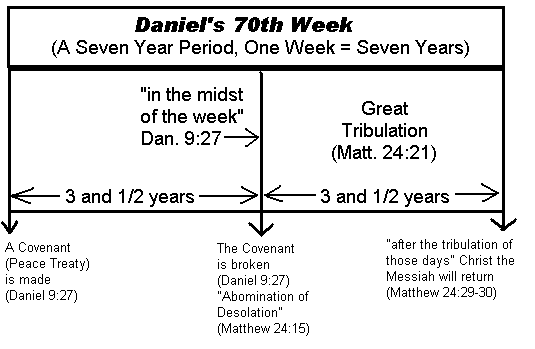
Daniel 9:26-27 gives us the specific time frame of this period - seven years. This period, according to Daniel's prophecy and repeated by Jesus in His final sermon, the Olivet Discourse of Matthew 24, Mark 13 and Luke 21, will be subdivided into two parts. The first 3 1/2 years appears to be (relatively speaking) the less severe, with the second 3 1/2 years being termed by Jesus in Matthew 24:21 "The Great Tribulation".

Why this final seven year period prior to Christ's return? Revelation 6-11 ties together two main reasons that we find throughout other scriptures that also speak of the whole Tribulation period:

a. Pour out increasing judgment on the earth.
We see this in the seven seals of Revelation 6:1-8; 8:1-5 and the seven trumpets of 8:6-11:19.

b. Prepare Israel for her coming King.
The appearance of the 144,000 Jews from every tribe of Israel in this period is but a sampling of what the Lord intends to do in Israel.  The Bible says in Romans 11:25-26 that all Israel will be saved.  For now she has been set aside to give Gentiles, chosen and called from every nation to believe and be saved in this current age. (Romans 11) However the day is coming when Israel, having been prepared and purified will look upon the one whom they pierced and acknowledge Jesus Christ at His second coming as their Lord and Messiah. (Zechariah 12:10; John 19:37; Revelation 1:7)2

And so Jesus Christ will use the period of the Tribulation as His theater in which to bring about His conquering of man's kingdoms.  But note secondly...

Power of answered prayer. Revelation 8:1-5
I love Revelation 8:1-5 because it gives the reader a much needed pause in the midst of the havoc that will ensue during the Tribulation period. Every prayer, of every saint, prayed in every age will be used of God and the Lord Jesus Christ to bring to pass His purposes. God's Sovereign purposes are like a train traveling on the rails of His Spirit and prayer. Both run parallel and in sync with one another, with the Spirit being the believer's intercessor here on earth and prayer being shaped by the Spirit who initiates it. The railroad ties upon which God's Sovereign purposes and steel rails of the Spirit and prayer ride are the words of scripture. 

Whenever you read Revelation 8:1-5 in light of other scriptures, you see how Jesus includes prayer in the accomplishment of His victory over man's kingdoms. Luke 18:1-8, a marvelous passage on prayer, concludes with this statement in 18:8b "However, when the Son of Man comes,will He find faith on the earth?” Jesus instructs us to pray in Matthew 6:10 "Your kingdom come.Your will be done,
On earth as it is in heaven." Then of course the final prayer of the Bible that demonstrates Christ inclusion of prayer in His victorious return - Revelation 22:20 "He which testifieth these things saith, Surely I come quickly. Amen. Even so, come, Lord Jesus."

So Jesus Christ, in bringing about what will be His conquering of man's kingdoms, will utilize the period of the tribulation and prayer, but notice lastly:

Power of His Word. Revelation 10-11
Revelation 10-11 make references to the ways in which Jesus Christ will utilize the power of the Word of God to conquer the kingdoms of this world.  In Revelation 10 we see John describing Jesus in the Old Testament imagery of the Angel of the Lord, mirroring the imagery used by Ezekiel 1:22-3:3.  Clearly with Jesus Divine nature in view, John describes Jesus Christ speaking forth in peals of thunder in Revelation 10:3-4. Then in Revelation 10:10-11 we read - "I took the little book out of the angel’s hand and ate it, and in my mouth it was sweet as honey; and when I had eaten it, my stomach was made bitter.11 And they *said to me, “You must prophesy again concerning many peoples and nations and tongues and kings.”  In Revelation 11 we see two witnesses, presumed by many to be a re-appearance of Moses and Elijah in the latter half of the Tribulation period. For the final 3 1/2 years or Great Tribulation period, both men will preach for the Word of God. Despite the best efforts of unbelieving man at that time, God's resurrection power will enter both men and they will be taken up. 

2 Thessalonians 2:8 reminds us - "Then that lawless one will be revealed whom the Lord will slay with the breath of His mouth and bring to an end by the appearance of His coming." Revelation 19:15 records what will be the same time frame - "From His mouth comes a sharp sword, so that with it He may strike down the nations, and He will rule them with a rod of iron; and He treads the wine press of the fierce wrath of God, the Almighty." 

Conclusion:
We have witnessed today a summary of Revelation 6-11, aiming to answer the question: How will Jesus conquer man's kingdoms? We witnessed three answers given by the text: period of the tribulation, power of answered prayer and the power of His word. 

Endnotes:
1. Revelation 6-11 is critical because of the reminder that it is not ultimately Satan in Revelation 12, nor Anti-Christ in chapters 13-14 nor the evils of mankind that will determine the course of history's end - but rather Christ Himself.  Revelation 6-11 lays down the necessary substrata of what will be the later visions of Revelation 12-14 and 15-19. 

2.  A note on Revelation 6:9-11 & 7:9-17 is in order, since it is contended by this blogger that the 144,000 Jews are evangelists whom are used by God to take the Gospel forth throughout every nation.  Clearly John's vision here includes people getting saved during the Tribulation period in the first 3 1/2 years and perhaps into the second half.  Several opinions exist as to the identity of these people, with no decisive and fool-proof evidences given beyond what the text presents.  All we know is that they can cling to the promise of not having to endure the wrath of God that will be poured out in full measure as one goes further and further into the Tribulation.  Clearly after Revelation 7, we do not see any saints or believing Jews mentioned, telling us that the Lord's promise of no direct, unmingled wrath on the saints in that future time will stand as it is promised to Christians in the church at this present time. (compare 1 Thessalonians 1:10; 5:9) 

Sunday, November 10, 2013

Daniel's seventy weeks in summary


Daniel 9:23-24 "At the beginning of your supplications the command was issued, and I have come to tell you, for you are highly esteemed; so give heed to the message and gain understanding of the vision. 24 “Seventy weeks have been decreed for your people and your holy city, to finish the transgression, to make an end of sin, to make atonement for iniquity, to bring in everlasting righteousness, to seal up vision and prophecy and to anoint the most holy place."

Introduction
In today's post I want to give the reader a summary of one of, if not the most amazing prophecy in all the Bible - Daniel 9:23-27. I encourage the reader to use the chart above to help visualize what will be an unfolding of this significant passage of scripture.1

A quick fly over of Daniel's seventy weeks - 3 main divisions
The prophet Daniel, writing some 600 or so years before Jesus' coming, speaks of God's Divine time table for Israel, prophecy and this world.  The prophecy of Daniel 9:23-27, often termed "Daniel's seventy weeks", is regarded by many scholars to be the most amazing prophecy of God's Word.1  Daniel's prophecy reveals a 490 year period of time that constitutes God's Divine dealings with Israel in particular and the world in general.  In all three particular divisions can be briefly noted about this prophecy:

1. Division #1 49 years (seven sevens) in Daniel 9:25.  We know from secular history begins from Artaxerxes decree to rebuild Jerusalem on March 14, 445 b.c until its completion in 396 b.c.  That first leg of the prophecy also roughly marks the end of the Old Testament era of Divine revelation, especially in Malachi.

2. Division #2 434 years (sixty two sevens) in Daniel 9:25.  Again from a combination of predictive prophecy and secular historians we see Daniel speaking of the period of time extending between the testaments - the so-called "silent years". The "silent years" are called such because of God not revealing any new revelation nor inspiring any Bible books during that time.  When the books of Malachi and Esther were finished, the Old Testament Canon closed.  In this period of time (396 b.c to Jesus' days), four world empires arose and fell as predicted also by Daniel in his prophecies: Babylon-->Persia-->Greece-->Rome. 

Whenever you add the 49 years (from 445 b.c-396 b.c) and 434 years (396 b.c. - 32 A.D) together, you arrive at a total of 483 years. Remarkably, Daniel's prophecy begins at the decree to rebuild Jerusalem in March 14, 445 b.c to Jesus' riding into Jerusalem on April 6, 32 A.D. Daniel 9:26 then predicts what is most likely the crucifixion of Jesus Christ on that same week! - "Then after the sixty-two weeks the Messiah will be cut off and have nothing...."

3. Division #3 The final "week" or seven years, i.e Daniel's seventieth week in Daniel 9:26b-27. This third division of Daniel's prophecy, thought the shortest portion in God's prophetic time clock, yet receives the most focus in the prophecies of scripture.  

A more specific look at division #3 of the prophecy - Daniel's final 70th week or final seven years
As you look closer at the final "week" (seven years) of Daniel's prophecy, some details emerge.  First of all, Daniel 9:26b gives a general statement about the final seven years of history - "and the people of the prince who is to come will destroy the city and the sanctuary. And its end will come with a flood; even to the end there will be war; desolations are determined."  In this general statement of Daniel's seventieth week in 9:26b we see six elements:

1.  The people = The followers of the "prince"

2.  The prince = He is coming and is different from the Messiah who was cut off - namely Jesus Christ.

3.  The city = Jerusalem, the central city of the prophecy

4.  The sanctuary = A temple that will exist in Jerusalem in this final seven year period.  Most likely some sort of Jewish Temple built in the Tribulation period

5.  Its end = the prophecy has an end point in mind, corresponding to the conclusion of God's prophetic 490 year period set for Israel in relationship to His judgment of the world

6.  War = A final war will be waged with accompanying desolations or Divine judgments near the end of this seven year period of Daniel's seventieth week.   

A very detailed look at the last half of the seventieth week of Daniel
Daniel 9:27 states - 27 "And he will make a firm covenant with the many for one week, but in the middle of the week he will put a stop to sacrifice and grain offering; and on the wing of abominations will come one who makes desolate, even until a complete destruction, one that is decreed, is poured out on the one who makes desolate.” If we take the last three and one half years as the main focus of Daniel 9:27, we can note four elements of what is now a very detailed view of Daniel's seventieth week (seven years) and its latter half (3 1/2 years):

1. he - The Prince who comes and the same one spoken of in Daniel 9:26.

2. "firm covenant with the many for one week". The prince makes a peace covenant with the many, that is the Jews specifically and the world in general.  The covenant is promised by the prince to last the entirety of the seven years spoken of by Daniel, however....

3. "middle of the week he will put a stop to sacrifice". Evidently there will be sacrifices occurring at this temple during this seven year period, however this prince will suddenly interrupt the ceremonies and break covenant with the people at the 3 1/2 year mark.

4. "will come one who makes desolate, even until a complete destruction, one that is decreed". The true character of this prince, called elsewhere in scripture "false Christ" (Matthew 24:15, Mark 13:22); "the son of perdition" (2 Thessalonians 2); "anti-Christ" (1 John 2:18-19); "the beast" (Revelation 13-14), will blaspheme God and lead the whole world astray.  2 Thessalonians 2 summarizes the desolation spoken of here in Daniel, namely the true Christ, the Son of God, will destroy Anti-Christ, the prince, by the breath of His mouth. 

Conclusions and applications
We have aimed to summarize what is perhaps the most amazing prophecy in the Bible - Daniel 9:23-27.  First we noted its three main divisions which when added all together equal a 490 year period of time decreed by God for the Jewish people. Secondly, we noted how the prophecy focuses more closely on the third division, a final seven year period that has yet to occur and will include God's judgment on the world prior to the second coming of Jesus Christ. Thirdly we saw that the prophecy focuses even further on a figure called the Anti Christ who will make a covenant with the Jews for seven years, only to break that covenant mid-way and garner the wrath of God.  Fourthly, we saw a few of the New Testament passages that utilize Daniel 9:23-27 in identifying this future archenemy of God's people and the Lord Jesus Christ.  

The application of Daniel 9:23-27 is seen in two ways: first in how the passage describes the coming future judgment of God on this world, and how unbelievers need to believe and repent now. Secondly we see how accurate the scriptures are in their predictions and thirdly e see that God will keep His promises to His people the Jews, which of course means He will keep His promises to His people the church.   

Endnotes:
1. You can find the chart at http://www.middletownbiblechurch.org/oldtesta/oldtes10.htm

2. A most recent example of this continuing trend is the current sermon series being preached by Dr. Robert Jeffress of 1st Baptist Dallas entitled: "The Perfect Ending", wherein He comments on Daniel 9:23-27. 

Saturday, November 9, 2013

A seven-fold outline of the Book of Revelation


Revelation 1:1  "The Revelation of Jesus Christ, which God gave Him to show to His bond-servants, the things which must soon take place; and He sent and communicated it by His angel to His bond-servant John."

Introduction - ways in which to outline Revelation
In past blogs I have introduced the reader to ways in which we can outline of the Book of Revelation. The most common way of course is to take Revelation 1:19 as one's cue for understanding the Book in terms of it chronological unfolding - i.e a chronological outline:


1. "Therefore write the things which you have seen... (referring to Jesus' initial revelation of Himself in chapter 1)

2. "and the things which are".... (referring to the seven churches of chapters 2-3, as well as possibly 4-5)

3. "and the things which will take place after these things." (possibly chapters 4-5 and most definitely 6-22)

A second way to outline Revelation is through a thematic outline of the Book. Hence an example of a thematic outline that this blogger has used in times past would be as follows:

1. Jesus & His church. Rev 1-3
2. Jesus & His throne. Rev 4-5
3. Jesus & History. Rev 6-19
4. Jesus & His coming reign. Rev 19-20
5. Jesus & His Bride in eternity. Rev 21-22

In today's post I would like to introduce a third possible way - namely through key words and patterns in the text of Revelation itself.


A seven-fold pattern to outlining Revelation
Many commentators, pastors and scholars alike have looked at key words or patterns in the Book of Revelation as a key to understanding the book. In this post I would like to suggest two such patterns: the number "seven" and the idea of John seeing visions "in heaven" followed by an unfolding of events occurring here on earth as a result of something coming out of heaven.

Explaining a little further as to why these patterns are being used as guides for outlining Revelation
The number "seven" dominates the Book of Revelation, being found over fifty times in the Book. We won't take time today to look at where those are found, however the sheer number of the occurrences is what prompts this blogger to suggest utilizing that number in a proposed outline. The Holy Ghost's inspiration of the book included this number in both the contents and structure of the book.The second pattern, as already mentioned, deals with John first seeing something occur "in heaven", followed by a sequence of events occurring here on earth. Such switching back and forth between heaven and earth moves the book forward. As John wrote what he wrote, he would had repeated the particular set of events in order to add detail and depth, as well as to convey what will be the intensity of the events prior to Christ's second coming.


A seven-fold outline of the Book of Revelation
With those thoughts clearly in mind, I propose an outline of the Book featuring those two main patterns:

1. Vision sequence #1 Christ in Heaven, followed by His church here on earth. In this first sequence the question is answered: What is Jesus' doing now in relationship to His church?  Revelation 1:1-20; 2:1-3:22


2. Vision sequence #2 The Father and Son on the throne in heaven, followed by Christ's unfurling of the seals and trumpets here on earth. This second sequence helps us answer the question: How will Jesus defeat the kingdoms of man? Revelation 4-5; 6:1-11:19


3. Vision sequence #3 God's program for Israel set forth in Heaven, with its Old Testament History, Christ's incarnation and remaining history until Christ's return unfurled. This third sequence answers the question of how Jesus will defeat Satan and his man, the Anti-Christ. Revelation 12:1-18; 13:1-14:20


4. Vision sequence #4 God's relationship to creation & judgment on the nations articulated in heaven, followed by the final judgment of the world system Babylon the great.  This fourth sequence answer the question: How Jesus will defeat the evils of man (15:1-4; 15:5-18:24)

Thus far Revelation is presenting in sequences #2, #3 & #4 the same time frame in repeated fashion, with each vision superimposing details upon the previous vision. We can liken this characteristic of John's Revelation to what happens when multiple sets of transparency overheads are laid atop one another, producing a full and complete picture. 

5. Vision sequence #5 Christ bring to bear God's judgment on the nations as He makes His return (19:1-10).  Because of the prior seven year tribulation period and all the judgments, history and the earth are now ready for the King to come and set up His 1,000 year kingdom.


6. Vision sequence #6 Christ's second coming followed by His Millennial Reign and Great White Throne Judgment of unbelievers. Revelation 19:11-21; 20:1-15


7. Vision sequence #7 The Eternal State, with the New Heavens and New Earth joining together and God and the Lamb being at the center of redeemed believers in eternity. Revelation 21:1-22:21. 


Friday, November 8, 2013

P4 Guest Blogger Deborah Smith - Relational, Emotional and Spiritual Effects of Insecurities in Women


Genesis 1:27 "God created man in His own image, in the image of God He created him; male and female He created them."

Introduction: Guest Blogger Debi Smith
My wonderful wife Debi Smith has been featured in the past as a guest blogger on "Growing Christian Resources". Currently Debi is doing her Bachelors Degree in Christian Counseling at Liberty University. Recently I asked her if she would allow me to post her most recent paper that she did entitled: "Relational, Emotional, and Spiritual Effects of Insecurity in Women". I believe this topic is very important and that my wife's recent research and writing can provide an invaluable resource to the Body of Christ and readers of this blog. With that said we will be finishing today what Deb wrote, with the goal of concluding this very important series of posts on the issues surrounding women's insecurities. I now present to you once more, our guest blogger Deborah Smith:

Relational, Emotional, and Spiritual Effects of Insecurity in Women (continued)

Can an Insecure Woman Find Hope and Security in Jesus Christ?

The Bible is the answer book for all men and women who have a personal relationship with Jesus Christ. If a person has surrendered their life under Jesus Christ’s Lordship, then the answer is a resounding “Yes!” There is most definitely hope. It is not an easy path to overcome insecurities. Healing and changing an unhealthy mindset does not happen overnight, however, Philippians 4:13 says, “I can do all things through Him who gives me strength” (NIV). What are some steps to overcoming the faulty thinking of insecurity?

Develop God-esteem, Rather than Self Esteem
The Bible has much to say about what a man and a woman’s identity is in Christ. In Dr. Neil T. Anderson’s book, “The Bondage Breaker”, he addresses that after a person comes to a saving knowledge of Jesus Christ, meaning that they have recognized their need for a Savior and turned their hearts towards Him, every man and woman now can be secure in their “new identity”. In Christ all are accepted (John 1:12; John 15:15; Romans 5:1), all are secure (Romans 8), 2 Corinthians 1:21, 22), all are significant (Ephesians 2:10; Ephesians 3:12) (Anderson, 2000). 

Recognize That Only God Can Fill the Void
All people have the need to be accepted and loved. God created people to be this way on purpose. Everyone has a void that is like a vacuum that cannot be satisfied by any person or thing. Only God Himself can meet this need and fill that empty place within every heart. Only He can give the unfailing love people desperately crave and desire (Moore et al, 2003). Not only does God fill the “love and acceptance” void in the heart of every one of His followers, but He promises that He will never disappoint. “Kings will be your foster fathers, and their queens your nursing mothers. They will bow down before you with their faces to the ground; they will lick the dust at your feet. Then you will know that I am the Lord; those who hope in me will not be disappointed” (Isaiah 49:23, NIV). He invites everyone to “taste and see that the Lord is good; blessed is the one who takes refuge in him” (Psalm 34:8, NIV).

Allow God to Heal the Past 
In regards to the past traumas and hurts that women have experienced, God can help move a person past the pain and into a wonderfully healthy relationship with Him. “Listen, daughter, and pay careful attention: Forget your people and your father’s house. Let the king be enthralled by your beauty; honor him, for he is your Lord” (Psalm 45:10-11, NIV). Regarding one’s past, He also says, “See, I am doing a new thing! Now it springs up; do you not perceive it? I am making a way in the wilderness and streams in the wasteland” (Isaiah 43:19, NIV). 

Put God’s Approval above the Approval of Man
In the quest for acceptance, it is imperative that the approval that is sought out is God’s and not a mere human’s. Even the apostle Paul needed to remind himself of Whom He served and sought out to please. “Am I now trying to win the approval of human beings, or of God? Or am I trying to please people? If I were still trying to please people, I would not be a servant of Christ” (Galatians 1:10, NIV). 

In conclusion, insecurity can originate from the deepest, darkest places inside a woman. Past traumas and hurts can serve as chains to hold one down. An unhealthy self-image and pride can perpetuate insecurities as well. Insecurity destroys relationships and devalues the person who harbors it. Insecurity can keep a person in an endless cycle of relationships that harm. However, through a saving relationship with Jesus Christ, insecurity’s power over a woman’s mind and heart can be broken. Self-esteem can be replaced by God-esteem. He alone can heal the past and enable His daughters to move forward in a new identity. Through God, the insecure can indeed become secure once and for all.

References
Anderson, N. T. (2000). The Bondage Breaker. Eugene, Oregon: Harvest House Publishers.

Anderson, N. T. (2000). Victory Over the Darkness. Ventura, California: Regal books.

Berger-Stassen, K. (2011). The developing Person Through the Life Span 8th Edition. New York, New York: Worth Publishers.

Bleske-Rechek, A., & Lighthall, M. (2010). Attractiveness and Rivalry in Women's Friendships with Women. Hum Nat, 82-97.

Daly, R. (2010). Spotlight Shined on Hollywood's Unrealistic Portrayal of Women. Psychiatric News, 13,30.

Furman, R., Collins, K., Garner, M. D., Montanaro, K. L., & Weber, G. (2009). Using Social Work Theory for the Fascilitation of Friendships. Smith College Studies in Social Work, 17-33.

Holman, T. B., Galbraith, R. C., Timmons, N. M., Steed, A., & Tobler, S. B. (2009 30:413). Threats to Parental and Romantic Attachment Figures' Availability and Adult Attachment Insecurity. Journal of Family Issues, 413-429.

Moore, B. (2010). So Long Insecurity. Carol Stream, Illinois: Tyndale House Publishers, Inc.

Moore, B., Briscoe, J., Wilson, S. D., Hart, K., Hager, D., & Wells, T. L. (2003). A Woman and Her God. Brentwood: American Association of Christian Counselors.

Quigg, S. L., & Want, S. C. (2011). Highlighting Media Modifications: Can a Television Commercial Mitigate the Effects of Music Videos on Female Appearance Satisfaction? Elsevier, 135-142.

Smart, C., Davies, K., Heaphy, B., & Mason, J. (2012). Difficult Friendships and Ontological Insecurity. The Sociological Review, 91-109.

Walker, K. (1994). Men, Women, and Friendship: What They Say, What They Do. Gender and Society, 246-265.

Want, S. C. (2009). Meta-analytic Moderators of Experimental Exposure to Media Portrayals of Women on Female Appearance Satisfaction: Social Comparisons as Automatic Processes. Elsevier, 257-269.

Thursday, November 7, 2013

P3 Guest Blogger Deborah Smith - Relational, Emotional and Spiritual Effects of Insecurities in Women


Genesis 1:27 "God created man in His own image, in the image of God He created him; male and female He created them."

Introduction: Guest Blogger Debi Smith
My wonderful wife Debi Smith has been featured in the past as a guest blogger on "Growing Christian Resources". Currently Debi is doing her Bachelors Degree in Christian Counseling at Liberty University. Recently I asked her if she would allow me to post her most recent paper that she did entitled: "Relational, Emotional, and Spiritual Effects of Insecurity in Women". I believe this topic is very important and that my wife's recent research and writing can provide an invaluable resource to the Body of Christ and readers of this blog. With that said we continue from where we left off yesterday and will focus today on the side effects of insecurity. I now present to you our guest blogger Deborah Smith:

Relational, Emotional, and Spiritual Effects of Insecurity in Women (continued)

What are the Side Effects of Insecurity?

Ruined Friendships
Previously this paper looked at the danger of women comparing themselves to unrealistic images of women through the media. It was mentioned that such comparisons can result in depression and eating disorders. Comparisons made with non-media related women can also have ill effects. Comparisons affect who an insecure woman chooses as a friend. This quote was made after observing a survey of college aged women: “Because men place a premium on physical attractiveness, competition among women to attract men centers heavily on their level of attractiveness; thus women should not want a friend to be much more attractive that they are because then they might look less desirable in competition in comparison to their friend, but at the same time women should not want a friend to be much less attractive that they are because that might inhibit their ability to gain attention or interest from men when together” (Recheck & Lighthall, 2010, p.84). 

Insecure women compare themselves in more areas other than appearance. In the workplace a rivalry with other women often keeps women from forming friendships within their profession. This was especially true in male-dominated workplaces. The other females that worked alongside them were viewed as competition (Walker, 1994). Insecurities also cause women to destroy good friendships - needed friendships – out of jealousy (Moore, 2010). In an example on how insecurity destroys friendships, Beth Moore shares an account of a woman who had had a disagreement with a friend. She wrote an email apology to this friend and when she didn’t hear back, she assumed her friend was angry and proceeded to write another email, followed by another asking her friend to forget the former emails. Insecurity causes people to make fools of themselves out of desperation to protect or fix a relational problem that is perceived (Moore, 2010).

Unhealthy Relationships, Rejection, and Shame
Insecurity also throws women into the arms of people that can hurt them and continue the cycle of insecurity. 

“We end up putting ourselves in one messed-up relationship after another trying to find someone who will take care of us. Someone who will not disappoint us. And it never works. For one thing, that kind of motivation draws us to the wrong kind of people” (Moore, 2010, p.66).

When rejection or betrayal occurs, whether in a love relationship or in a friendship relationship, an insecure woman experiences shame and guilt. It is as though she should’ve known better than trusting someone in the first place. This is demonstrated in a personal account from a study done on Ontological Insecurity. The woman interviewed tells of how she friended another woman she met in a class and grew close. After joining this new friend several times at her family’s home, the woman began feeling as though she were the source of an inside joke. Soon after, the relationship was severed and the two no longer communicated. She expressed guilt and shame that she should’ve been able to “read” the persons character better (Smart, Davies, Heaphy, & Mason, 2012).

Insecurity Leads to Self-Defeat and Distorted View of Identity
In healthy friendships in children, “there is greater involvement in school, a sense of acceptance by peers, and positive self-esteem” (Furman, Collins, Garner, Montanaro, & Weber, 2009, p.19) The opposite of this is “isolation and alienation which leads to social dislocation and depression in individuals” (Furman, Collins, Garner, Montanaro, & Weber, 2009, p.19). When insecurity wiggles its way into a relationship it can manifest through self-defeating thoughts and messages. For example, “Nobody wants to hear from me” or “No one cares about me” (Furman, Collins, Garner, Montanaro, & Weber, 2009, p. 28). 

More tomorrow........


Wednesday, November 6, 2013

P2 Guest Blogger Deborah Smith - Relational, Emotional and Spiritual Effects of Insecurities in Women


Genesis 1:27 "God created man in His own image, in the image of God He created him; male and female He created them."

Introduction: Guest Blogger Debi Smith
My wonderful wife Debi Smith has been featured in the past as a guest blogger on "Growing Christian Resources". Currently Debi is doing her Bachelors Degree in Christian Counseling at Liberty University. Recently I asked her if she would allow me to post her most recent paper that she did entitled: "Relational, Emotional, and Spiritual Effects of Insecurity in Women". I believe this topic is very important and that my wife's recent research and writing can provide an invaluable resource to the Body of Christ and readers of this blog. With that said we continue from where we left off yesterday.  I now present to you our guest blogger Deborah Smith:

Relational, Emotional, and Spiritual Effects of Insecurity in Women (continued)


Where Do Insecurities Come From? 

By no means does this paper look to supply an exhaustive list of all the causes and reasons behind female insecurities. However, the following possible causes surfaced more frequently in the research of this paper. Some of the prevalent causes of insecurity in women are family struggles and/or trauma experienced during their childhood, rejection in relationships, unhealthy self-image, and the basic sinful nature all humans are born with. 

Past Traumas
Everyone has a past. Some have more turbulent pasts than others, but to say that one’s past does not affect their present state of mind is not always accurate. Dr. Neil T. Anderson says, “Some Christians assert that the past doesn’t have any effect on them because they are new creations in Christ…Either they are extremely fortunate to have a conflict free past or they are living in denial. Those who have had major traumas and have learned to resolve them in Christ know how devastating past experiences can be” (Anderson, 2000, p.187). Various studies have shown that the first five years of development is instrumental in a person’s mental health and self-concept. Within the first 18 months of life the emotions of contentment, laughter, curiosity, anger, fears, self-awareness, pride, shame, embarrassment and security emerge (Berger, 2011). It is in the first two years of life that a child develops stranger wariness and separation anxiety. Also, within the first two years a child develops attachments to their caregivers and/or parents. Psychoanalyst Erik Erikson referred to this time frame in a child’s development as a crisis of life called the “Trust vs. Mistrust” stage. This is “when infants learn whether the world can be trusted to satisfy basic needs” (Berger, 2011, p.187). “If social interaction inspires trust and security, the child (and later the adult) confidently explores the social world” (Berger, 2011, p.187). Therefore, the role of caregivers and parents are crucial in developing the security in a child. How secure a child feels in his or her developing years will play a huge part in how secure the individual is as an adult. 

To decide whether insecurity issues derived from one’s childhood, it is reasonable to evaluate the relationship or lack thereof between an individual and their caregivers and/or parents. Theorist John Bowlby developed the attachment theory (Holman, Galbraith, Timmons, Steed, Tobler, 2009). This theory defines attachment as “a feeling of confidence, safety, and security in the knowledge that an attachment figure will be available when desired or needed” (Holman, Galbraith, Timmons, Steed, Tobler, 2009, p. 413). The idea of the word “availability” means that the one an individual attaches to will be “both accessible and responsive” (Holman, Galbraith, Timmons, Steed, Tobler, 2009, p. 414). If a child grows up in a home where there is turmoil, conflict, the absence of a parent, or lack of ongoing communication, there is a high risk that insecurity will be evident in the life of that child as an adult (Holman, Galbraith, Timmons, Steed, Tobler, 2009). This often can be evidenced in homes marked by instability ranging from divorce, abuse, mental illnesses, financial burdens, physical illnesses, fear, and a myriad of other things that can be both “avoidable and unavoidable” (Moore, 2010, p. 64-65).

Even if a childhood was relatively free of stress, a traumatic occurrence experienced as an adult can mar that person with insecurity. Victimization, loss, or any other type of grief a woman may experience in her lifetime can leave her with “an ongoing sense of being unprotected” and “can obliterate personal boundaries until …emotions are black and blue” (Moore, 2010, p.66)

Rejection in Relationships
“Friendships are essential to human development… and contribute to a sense of depth and wholeness for individuals as they move through the life cycle” (Furman, Collins, Garner, Montanaro, & Weber, 2009, p.17). Friendships also can play a huge part in the self-identity of an individual (Smart, Davies, Heaphy, & Mason, 2012). Women, especially, view their friendships as highly important. While men view their relationships with their friends by activities, women focus on shared feelings (Walker, 1994). One of the reasons why friendship might be linked with an individual’s happiness and self-esteem is because “unlike family members, friends are earned; they choose us” (Berger, 2011, p. 525). 

For women, friendships are characterized by being more intimate. “They share secrets and engage in self-disclosing talk, including difficulties with their health, romances, and relatives. Women reveal their weaknesses and problems and receive an attentive and sympathetic ear, a shoulder to cry on, or a reassuring hug” (Berger, 2011, p. 527). When a relationship, whether it is platonic or romantic, is broken by rejection, it is no wonder why the end result can lead to insecurity. A breakdown in these vital relationships can lead to a woman feeling scarred (Smart, Davies, Heaphy, & Mason, 2012).

Unhealthy Self-Image
Ironically, often one’s self-image is characterized by how other’s see or interpret an individual. As stated previously, a woman gathers much of her self-identity through her friendships and relationships. This process of a wavering self-image starts young. “Self-criticism and self-consciousness rise from ages 6 to 11, and by middle childhood this earlier overestimate of their ability or judgment decreases while self-esteem falls” (Berger, 2011, p.352). It’s at this age, girls are most vulnerable to the opinions of others and makes the self-esteem more fragile (Berger, 2011). 

If peer related tensions were not enough to bring down a self-image, the media and culture can affect a woman’s self-concept in a very harmful way. Many studies have been conducted over the last several years to show the effect of unrealistic portrayals of women in the media. All humans have the tendency to compare themselves to others. This is called “social comparison” and it is “the tendency to assess one’s abilities, achievements, social status, and other attributes by measuring them against those of other people, especially one’s peers” (Berger, 2011, p. 351). Women will subject themselves to comparisons and “standards of appearance presented in the mass media” (Want, 2009, p.257). When comparing themselves to the women on the television “are likely to fall short of that standard” (Want, 2009, p.257). While the body weight of fashion models decreased over the last 40 years, the everyday average woman’s weight has increased (Quigg & Want, 2009). Also, studies show that only 5% of women are able to become as thin as the fashion models they see in advertising (Quigg & Want, 2009).

Recently, efforts have been made to change “unhealthy” images of women in the media, images showing girls as “hyper sexualized, physically perfect, and superficial” (Daly, 2010, p.13). One such effort was a 75 second long commercial put out by Dove soap showing the process the media takes a picture through before showing it in ads. The Girl Scout Research Institute discovered that 88% of girls interviewed claim media pressures them to be thin (Daly, 2010). This pressure to be thin and comparing themselves to the unrealistic images they see has been shown to lead college aged women to develop mental illnesses such as eating disorders and depression (Daly, 2010).

Human Sin Nature
As Beth Moore points out accurately in her book “So Long Insecurity”, most sources of insecurity are circumstances beyond an individual’s control, but the issue of pride and the human sin nature is an area a person can guard against (Moore, 2010). 

“We’re not the only women in our men’s lives….We’re not the most gifted people alive… We’re not the first choice every time…We’re not someone’s favorite…We can’t do everything ourselves…We’re not somebody else’s top priority…We don’t feel special… We don’t get the promotion… We don’t win the fight… We’re not paid what we’re worth… We’re not paid at all… and that really hurts our pride” (Moore, 2010, p.101).

Insecurity may look as though a person is contrite and humble, but if pride is the root of the insecurity it’s not a low self-esteem issue at all. It’s an esteem of oneself that is inflated. Proverbs 11:2 says, “When pride comes, then comes disgrace, but with humility comes wisdom” (NIV).


More tomorrow.....

Tuesday, November 5, 2013

P1 Guest Blogger Deborah Smith - Relational, Emotional and Spiritual Effects of Insecurities in Women


Genesis 1:27 "God created man in His own image, in the image of God He created him; male and female He created them."

Introduction: Guest Blogger Debi Smith
My wonderful wife Debi Smith has been featured in the past as a guest blogger on "Growing Christian Resources". Currently Debi is doing her Bachelors Degree in Christian Counseling at Liberty University. Recently I asked her if she would allow me to post her most recent paper that she did entitled: "Relational, Emotional, and Spiritual Effects of Insecurity in Women". I believe this topic is very important and that my wife's recent research and writing can provide an invaluable resource to the Body of Christ and readers of this blog. With that said I want to begin presenting what Deb wrote, with the goal over the next couple of days in presenting the entire paper in portions. I now present to you our guest blogger Deborah Smith:


Relational, Emotional, and Spiritual Effects of Insecurity in Women 

Deborah Smith 
Liberty University
Abstract 
This paper will address insecurity in women and the effects that insecurity has on their personal relationships with others, their emotional well being, and their spiritual health as it pertains to their relationship or lack of relationship with God. Insecurities within a woman can cause strain and damage to relationships. This paper will explore the effects insecurity has on relationships. This paper will also examine the possible causes of insecurity, including past experiences as well as unhealthy ongoing comparisons and how it affects a woman emotionally and her perception of whom she is. Finally, this paper will also look at how insecurity can be healed through a personal relationship with Jesus Christ and replace insecurity with a healthy, Godly self-concept.

Relational, Emotional, and Spiritual Effects of Insecurity in Women

What is insecurity? In her book, “So Long Insecurity”, Beth Moore gives a thought provoking and stirring definition:

“Insecurity refers to a profound sense of self-doubt – a deep feeling of uncertainty about our basic worth and our place in this world. Insecurity is associated with chronic self-consciousness, along with a chronic lack of confidence in ourselves and anxiety about our relationships. The insecure man or woman lives in constant fear or rejection and a deep uncertainty about whether his or her own feelings and desires are legitimate.” (Moore, 2010, p.17)

Even though insecurity can afflict men and women, this paper will focus solely on how insecurity can harm and manifest itself in the life of a woman. How do insecurities arise? What are the side effects of insecurity? Is it possible for a woman with insecurities to develop a healthy self-concept that is Godly? This paper’s intent is to answer these questions and to show that with a right relationship with Jesus Christ an insecure being can be made secure once again.


Where Do Insecurities Come From? 
By no means does this paper look to supply an exhaustive list of all the causes and reasons behind female insecurities. However, the following possible causes surfaced more frequently in the research of this paper. Some of the prevalent causes of insecurity in women are family struggles and/or trauma experienced during their childhood, rejection in relationships, unhealthy self-image, and the basic sinful nature all humans are born with.

More tomorrow from our guest blogger, Debi Smith, on the sources of insecurities.....