Translate

Thursday, November 14, 2013

The Biblical overview of the Tribulation - the book of Revelation


Revelation 6:1 "Then I saw when the Lamb broke one of the seven seals, and I heard one of the four living creatures saying as with a voice of thunder, “Come.”

Review
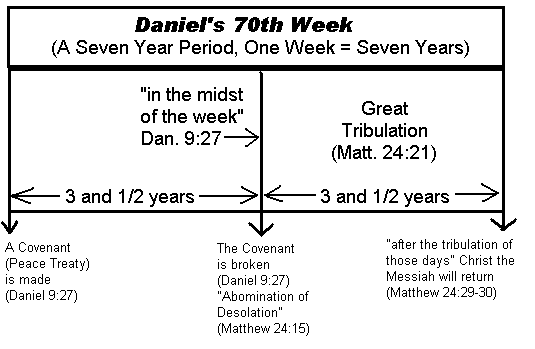
For the past couple of days we have been journeying our way through the Biblical teaching on the tribulation period.  We have noted the Old Testament's presentation as well as Jesus and the Apostle Paul. Through each successive book of the Bible the details and character of this time period become sharper and more detailed.  We have noted that both the Lord Jesus Christ and the Apostle Paul utilize Daniel's prophecy of the 70 weeks (Daniel 9:23-27) and other prophetic scriptures that speak of Divine judgment on the world. We will briefly survey the tribulation period in Revelation, concluding with a summary of the period in both testaments and a final chart visualizing the period.  To God be the glory!

John's teaching on the Tribulation
Revelation 6-19 is undoubtedly the fullest treatment we know of regarding the Tribulation period. As we have witnessed in the scripture, the whole period is future, representing God's prophetic clock for dealing with Israel, executing final judgment on this world and as seen in Paul's writings, destruction of Anti-Christ. Revelation 6-19 unfolds a repetition of this time period in four prophetic visions that together are like transparency slides on top of one another to complete a very detailed picture of the tribulation period:

a. The tribulation will be Christ's theater through which He will conquer the world. This particular depiction of the tribulation period is important because God in His Ultimate Will has ordained that time to prepare Israel to meet her Messiah and pour out judgment on the world.  Revelation 6-11

b. Revelation 12 is the introduction to John's next revelatory sequence of the events of the tribulation. The tribulation will be Christ's way of preparing Israel to meet Him. In Revelation 12-14 Satan and his man the anti-Christ will come into view during this period as the instrumental causes of the destruction and rebellion of unbelieving nations during the tribulation period. Like a set of transparency slides, Revelation 12-14 fits on top of the same time frame portrayed in Revelation 6-11.

c. The tribulation (especially the final 3 1/2 years or Great Tribulation) will be the time in which Christ brings an end to Anti-Christ. Revelation 13-14 and to the world system that he is permitted by God to control and wield in Revelation 15-19. Babylon the Great will function in the tribulation as the religious, economic and political web spun out by Satan, the Anti-Christ and the False Prophet of Revelation 12-14. After the half-way point of the tribulation period, the world system will begin to grow hostile toward the Anti-Christ and his regime and a war leading to the battle of Armegeddon will ensue. The only common point between the Anti-Christ and the nations will be their united stand-off against Christ at His return during the future epic battle of Armegeddon. Like a transparency slide once again, Revelation 15-19:10 fits over the previous visions of Revelation 6-11 & 12-14, completing for us the most detailed treatment of the tribulation period in the Bible.

d. The Great Tribulation will be a time in which the evils of man and the Anti-Christ's regime is brought to a close, with Christ's return marking the end of the tribulation -i.e "the day of the Lord".  The church will be with Jesus in the marriage supper of the Lamb, protected from wrath and return with her Lord who Himself will fight and defeat the armies of the world in the battle of Armegeddon.  All of these events, recorded in Revelation 19:11-21, and preparing the way for what will be Christ's thousand year reign in Revelation 20. 


Conclusion on the Old & New Testament's teaching of the Tribulation period
We have covered much ground in these past three blogs. We have seen the following main thoughts about the Tribulation period in our Biblical overview of the period:

Summary of the Old Testament's teaching on the tribulation

1. It will be an unprecedented time of human history, occurring at the end of this age. Being that the Old Testament predicts its uniqueness and unmistakable cosmic occurrences, the likelihood of it referring to a general pattern of tribulation that covers the church age or some other broad period of history is pretty slim.

2. The Tribulation period's purpose is two-fold - to judge the world and prepare Israel to meet her Messiah

3. The Tribulation periods' duration will be seven years. The first half is hardly mentioned, with the overwhelming focus on the events of the latter 3 1/2 years that Jesus calls later on "The Great Tribulation" in light of Daniel's prophecies.
4. A Tyrannical ruler will attempt to blaspheme God and lead the whole world astray in outright rebellion again God. 

Summary of the New Testament's teaching on the tribulation
As you can see, both Testaments teach essentially the same truths about this period, with the New Testament refining and sharpening the details:

1. It will be a future, seven year period that marks the completion of God's prophetic program for Israel.

2. It will be divided into two equal halves, with the latter half called the "Great Tribulation" and ending in a most intense way called "The day of the Lord", which will occur when Christ returns to earth. The Old Testament, Jesus, Paul and John were all surveyed and found consistent in their testimony about this period.

3. The period of the tribulation period will be a time where God judges the Gentile nations who rejected Him. Other scriptures testify of how Gentiles will be saved during this time as a result of the ministry of the 144,000 Jewish evangelists (Revelation 7:1-10; 11-19) In addition to the Lord's use of the tribulation period to prepare Israel and pour out wrath, a third purpose will be for Jesus to destroy Anti-Christ and his regime, casting him (and his compatriot "the false prophet") into the lake of fire.

4. God's people in the church ultimately do not have to worry about having to endure God's wrath. The tribulation functions to urge God;s people to live Godly lives right now. 


5. For those who evidence no concern about the impending coming tribulation, this truth can expose their false profession and be used of the Spirit of God to grant them repentance whereby they may believe and be saved. 

Endnotes & Chart
This chart is derived from the                                                                                          website: middletownbiblechurch.org

Wednesday, November 13, 2013

A Biblical Overview of the Tribulation period - Jesus and Paul


Matthew 24:21 "For then there will be a great tribulation, such as has not occurred since the beginning of the world until now, nor ever will. 22 Unless those days had been cut short, no life would have been saved; but for the sake of the elect those days will be cut short."

Introduction & Review

In yesterday's post we concluded the following regarding the Old Testament's teaching about the Tribulation period:
1. It will be an unprecedented time of human history, occurring at the end of this age. Being that the Old Testament predicts its uniqueness and unmistakable cosmic occurrences, the likelihood of it referring to a general pattern of tribulation that covers the church age or some other broad period of history is pretty slim.1  

2. The Tribulation period's purpose is two-fold - to judge the world and prepare Israel to meet her Messiah

3. The Tribulation period's duration will be seven years. The first half is not focused upon near as much as the latter half.  There is an overwhelming focus on the events of the latter 3 1/2 years that Jesus calls later on "The Great Tribulation" in light of Daniel's prophecies.

4. A tyrannical ruler will attempt to blaspheme God and lead the whole world astray in outright rebellion again God.


As we continue on in our Biblical overview of the Tribulation period, we enter now into the New Testament with the aim once again to understand what the Bible has to say about this subject.
 

1. Jesus' teaching on the Tribulation period
Matthew 24:1-31; Mark 13:1-27 & Luke 21:5-28 are the passages we look to to understand Jesus' teaching on the Tribulation period. Matthew and Mark's accounts appear to emphasize Jesus' predictions a near event future to them (destruction of Jerusalem in 70 A.D) and the Tribulation period at the end of this age. Luke's account does the same as Matthew and Mark, with the additional phrase of the "times of the Gentiles" referring to the Gentile occupancy in Jerusalem that began in the days of King Nebuchadnezzar and will cease at the end of the future Tribulation.

There is much more that could be said about Jesus' teaching, but we can note a few points about the Tribulation from these texts:


1. Jesus utilizes Daniel's prophecies throughout His sermon, meaning that He uses similar language to describe a future seven year period, divided into two equal 3 1/2 year periods, with the latter being the most severe.

2. Jesus refers to the whole period as "the tribulation period" (Matthew 24:29; Mark 13:24) and the latter half as "The Great Tribulation" (Matthew 24:21). Jesus uses phrases from Daniel 9:23-27 and Daniel 12 to describe this period as being unprecedented.

3. In all three passages there appears to be reference made to a fairly near event future to Jesus' time as well as the far future tribulation period. The near future event of the destruction of Jerusalem in 70 A.D acts as a template to preview what will be the final seven year tribulation period spoken of in Daniel. In Daniel's prophecies we see that same phenomena of "double-fulfillment" wherein he speaks of a fairly near set of events and of course the far future event of the tribulation period. Jesus (as God in human flesh) is showing Himself to both continue and further sharpen the vision of God's revelation of this period.

4. Jesus' continuity with Daniel's prophecies gives us a bridge between the Old and New Testament teachings on the Tribulation period. Every passage that follows throughout the New Testament on the Tribulation period does so from Jesus' sermon interpreting the extensive Old Testament treatment on the subject.


2. Paul's teaching on the Tribulation period in 1 Thessalonians 5
There are two main passages in Paul's writings the deal with the Tribulation Period. The first we encounter is found in 1 Thessalonians 5:1-11. This passage is worth outlining to see how it treats the Tribulation period:
I. The swiftness of God's wrath at the end of the tribulation will be avoided by believers 1 Thessalonians 5:1-3

The Apostle Paul undoubtedly is using this phrase "day of the Lord" as it is spoken of in Old Testament passages such as Isaiah 2:12; Isaiah 10:3; Isaiah 13:9; Isaiah 34:2; Isaiah 34:8; Isaiah 61:2; Ezekiel 30:3; Amos 5:18; Zephaniah 1:7. The Book of Zephaniah is perhaps the fullest treatment on this phrase in the Old Testament, being that the entire book is dedicated specifically to describing it.  Will this day encompass the entire Tribulation period? Or is this a phrase meant to describe the tail end of the Tribulation period? Zephaniah 1:1-3:11 describes how God will wage war against the nations who have assembled against Him, followed by the promised restoration of Israel and the redeemed in Zephaniah 3:12-20.

Jesus speaks of people not knowing the day when He comes in Matthew 24:42. From Matthew 24:42-25:46 we see Jesus unfolding further details about what He will do as He returns to earth.  Again the "day of the Lord" seems to speak of the grand finale of the Tribulation period's increasing frequency and intensity of judgment at the very end.


Therefore when we come to Paul's treatment of the Tribulation in general and the "day of the Lord" in particular, He is speaking of what seems to be the latter part of the seven year period.  The point being - the day of the Lord, the end of the Tribulation will come swiftly. No Christian in the church now or those tribulation martyrs saved in the tribulation will have to experience that most intense time of God's wrath at the end of the Tribulation (Revelation 6:9-11; 7:9-17). 


II. The severity of wrath of the Great Tribulation (final 3 1/2 years) will be avoided by Christians in the church right now. 1 Thessalonians 5:4-9

The Apostle Paul appears to be working backwards from the end of the seven-year tribulation period to its mid-point.  Whenever you compare Paul's presentation of the tribulation period to that of Jesus' in Matthew 24-25, you discover that this section of 1 Thessalonians 5:4-9 corresponds to Matthew 24:21-41. In terms of what we noted earlier, Jesus refers to the last 3 1/2 years of the Tribulation period as "The Great Tribulation". So the question is: would Paul's readers (and us) have to worry about the severity of wrath in that final half of the future tribulation? Paul's answer is no.  Now with that said, Paul uses the truth of the coming tribulation to tell his readers to be on the "alert" and "on their guard". For those people who think they are "o.k" with God and thus can live in ease, it is those people who need to be the most alarmed and who are the most likely to be in the time of the severe and swiftly coming wrath of the Great Tribulation and the day of the Lord. 

III. Solid encouragement to live for Jesus right now. 1 Thessalonians 5:11


3. Paul's teaching on The Tribulation in 2 Thessalonians 2

In 1 Thessalonians 5:1-11 we saw Paul begin with the end of the Tribulation (the day of the Lord) and work his way back through the second half of the Tribulation period (called by Jesus the Great Tribulation) to underscore the swiftness and severity of judgment. We have seen as well that Paul offers strong encouragement that believer's will not have to experience such wrath and that they are to strive all they can for Jesus now. 

But what about Paul's teaching in 2 Thessalonians 2:1-8? 2 Thessalonians speaks of the coming of Jesus Christ and our being gathered to Him. The doctrine of the rapture is being mentioned here in 2:1, however for now we will suspend discussion of that wonderful truth for a future post. Paul refers to that doctrine to comfort his readers in the face of rumors circulating that perhaps the Thessalonians had missed the rapture, or that the day of the Lord had come, or that they were somehow going to have to endure God's wrath after-all. From 2:2-12 we get an overview of the whole Tribulation period:

a. 2 Thessalonians 2:2-4 The increasing level of apostasy going on right now up until the Anti-Christ is first revealed at the beginning of the Tribulation.

b. 2 Thessalonians 2:5-11 The Spirit of God will remove His restraining influence and check on man's evil, and the Anti-Christ will have full liberty to increasingly and gradually exercise full dominion over this planet. Just as Daniel 9:26b-27 reveals and this passage confirms, the peace covenant will be broken, with the latter half unveiling the Anti-Christ's true character. One of main purposes of this period will be to judge unbelieving man's sin. a second main purpose for this period will be to prepare Israel for her coming Messiah at the end of this period. However we gain a clear third purpose: destruction of Satan's man - the Anti-Christ. 


With Jesus and the Apostle Paul's teaching on the tribulation summarized, we will conclude our Biblical overview of the tribulation period in the New Testament by considering how it appears in the Book of Revelation tomorrow... 

Endnotes:
1. To say there will be seasons of trial or tribulations throughout the history of Christ's church or the individual lives of God's people cannot be disputed.  In fact suffering and trials of all sorts is to be the norm for anyone wanting to be Godly in Christ Jesus. (Acts 14:22; 2 Timothy 3:12) However the testimony of scripture bears out the fact that the Tribulation period (the whole seven year period of time spoken of in Daniel and elsewhere) is unique in terms of its intensity and character and thus merits its own unique study and understanding. 


Tuesday, November 12, 2013

A Biblical overview of the Tribulation period - Old Testament


Deuteronomy 4:30-31 When you are in distress and all these things have come upon you, in the latter days you will return to the Lord your God and listen to His voice. 31 For the Lord your God is a compassionate God; He will not fail you nor destroy you nor forget the covenant with your fathers which He swore to them.

Introduction:
The above text stands as perhaps the first mention in the Bible of a period of time that Jesus calls "the tribulation" (Mark 13:19). Much ink of course has been spilled over the nature and purpose of the Tribulation period, and even as to whether or not it is currently happening right now or is yet to come. The aim today will not be to trace out those various viewpoints (that is for another post, another day). In today's post I simply want to list some texts of scripture that speak of this period to give you the reader an overview of what the Bible has to say about the Tribulation period.  We will begin in today's post by tracing this teaching through the Old Testament.

1. Deuteronomy 4:26-31 - First mention of the tribulation in the Bible
We began today's post with this text, being that it is the first mention of the tribulation period. God lays out the prophetic history of Israel through the Old Testament and human history (4:26-28) with reference to her going through a time of great difficulty and deliverance by her Lord in 4:29-31. At this early stage Israel's whole history and the tribulation period are treated as one, seamless history.


2. Isaiah 13:6-18 - The day of the Lord is associated with the Tribulation
The heart of this passage is expressed in Isaiah 13:9-11a "Behold, the day of the Lord is coming,Cruel, with fury and burning anger,
To make the land a desolation; And He will exterminate its sinners from it. 10 For the stars of heaven and their constellations will not flash forth their light; The sun will be dark when it rises and the moon will not shed its light.
11 Thus I will punish the world for its evil
And the wicked for their iniquity." Twice in this passage we find reference to what is called "the day of the Lord".  We are not told the duration of this "day" in the passage, only its character and purpose.  Later passages in the Bible will aid in answering the exact time frame of this "day".  The punishment of mankind on the earth is a revealed purpose of this period.  


3. Isaiah 17:4-11 Israel will be prepared to meet her Lord

Isaiah 17:7 notes "In that day man will have regard for his Maker and his eyes will look to the Holy One of Israel."

4. Jeremiah 30:4-11 The Tribulation is termed "The time of Jacob's distress or trouble"

It is in this passage that we gain further evidence of God turning His attention back to Israel. During the Tribulation period God will be preparing Israel to meet her Messiah through a process of chastening, purification, purging and protection. 

5. Ezekiel 20:33-38 The tribulation period will purify Israel to enter into the Lord's Kingdom

Ezekiel 20:38 states - "and I will purge from you the rebels and those who transgress against Me; I will bring them out of the land where they sojourn, but they will not enter the land of Israel. Thus you will know that I am the Lord." Thus far in our study of the Tribulation period, we have discovered that the judgment of the earth will occur and that the preparation of Israel for her Messiah will be the specific focus. The scriptures are teaching us the character and purposes of the Tribulation period.

6. Daniel 9:26b-27 The duration and details of the Tribulation period

Daniel 9:26b-27 "and the people of the prince who is to come will destroy the city and the sanctuary. And its end will come with a flood; even to the end there will be war; desolations are determined. 27 And he will make a firm covenant with the many for one week, but in the middle of the week he will put a stop to sacrifice and grain offering; and on the wing of abominations will come one who makes desolate, even until a complete destruction, one that is decreed, is poured out on the one who makes desolate.”It is in this passage that we first gain access to the time frame of this period - seven years.  Daniel's prophecy also unfolds another chronological feature: that this seven year period will be at the end of a 490 year period of time prescribed for Israel by God with regards to His program for her.  The final "seven" in the prophecy will be divided into two parts of 3 1/2 years each, featuring a tyrannical ruler called "the prince", who especially in the latter half of this period will unmask his true intentions.

7. Daniel 12 reveals details about the latter 3 1/2 years of the tribulation, called "The Great Tribulation"

Daniel 12:1 reads - “Now at that time Michael, the great prince who stands guard over the sons of your people, will arise. And there will be a time of distress such as never occurred since there was a nation until that time; and at that time your people, everyone who is found written in the book, will be rescued." As you read on down through the chapter, you discover the specific time frame of this vision to occur in the future and in the same latter 3 1/2 year period that Daniel spoke of in Daniel 9:23-27.  Daniel's prophecies in 9:23-27 and chapter 12 form the foundation of Jesus' teachings on the tribulation period in His Olivet discourses of Matthew 24, Mark 13 and Luke 21. 

8. Zechariah 14:1-4 The end of the Tribulation period witnesses the return of the Messiah to the earth. 
Zechariah 14:4 reads - "In that day His feet will stand on the Mount of Olives, which is in front of Jerusalem on the east; and the Mount of Olives will be split in its middle from east to west by a very large valley, so that half of the mountain will move toward the north and the other half toward the south."

Conclusions
In this fly-over of the Bible's teaching of the Tribulation period, we have attempted to look at the major Old Testament Prophecies that speak specifically about it. We have concluded the following:

1. It will be an unprecedented time of human history, occurring at the end of this age. Being that the Old Testament predicts its uniqueness, the likelihood of it referring to a general pattern of tribulation that covers the church age or some other broad period of history is pretty slim.

2. The Tribulation period's purpose is two-fold - to judge the world and prepare Israel to meet her Messiah

3. The Tribulation period's duration will be seven years. The first half is hardly mentioned, with the overwhelming focus on the events of the latter 3 1/2 years that Jesus calls later on "The Great Tribulation" in light of Daniel's prophecies.

4. A Tyrannical ruler will attempt to blaspheme God and lead the whole world astray in outright rebellion again God.

We could have looked at more scripture, but the ones above constitute the majority report of the Old Testament on the Tribulation period. In tomorrow's post we will consider what the New Testament has to say about this future period of time.

Monday, November 11, 2013

How Jesus will conquer the world - Revelation 6-11


Revelation 11:15-17 "Then the seventh angel sounded; and there were loud voices in heaven, saying, “The kingdom of the world has become the kingdom of our Lord and of His Christ; and He will reign forever and ever.” 16 And the twenty-four elders, who sit on their thrones before God, fell on their faces and worshiped God,17 saying, “We give You thanks, O Lord God, the Almighty, who are and who were, because You have taken Your great power and have begun to reign."

Introduction:
A couple of days ago I blogged concerning a seven-fold outline of Revelation that attempted to take into consideration key words and ideas (http://pastormahlon.blogspot.com/2013/11/a-seven-fold-outline-of-book-of.html ).  
The particular key words in the outline had to do with John seeing a sequence beginning with persons or activities "in heaven" followed by the outworking of Divine decrees here on earth. So for example we noticed the first visionary sequence of Revelation as being Revelation 1-3, with Jesus being the Lord over His church and thus exercising His reign over the church through her history and in every place. The first visionary sequence answers the question: What is Jesus doing and what is His relationship now to the church?
Today I want us to look specifically at the second sequence we proposed: namely Revelation 4-11. This second sequence begins with a dramatic vision of the Father (4) and the Lamb (5) on the throne, ready to unfurl the judgments contained within the title deed to planet earth. John's point is to demonstrate the Lamb is worthy to break open the seals and to retake what is rightfully His - namely the title deed to planet earth. In order to do this, Jesus Christ, the New Adam, the Lamb of God will need to conquer the Kingdoms of this world. And so in this second visionary sequence, we will be asking this question: how will Jesus conquer the world?

How Jesus will conquer the Kingdoms of man or the world
We know that this question is the main focus of Revelation 6-11 in particular because of what is said in Revelation 11:15 - "Then the seventh angel sounded; and there were loud voices in heaven, saying, “The kingdom of the world has become the kingdom of our Lord and of His Christ; and He will reign forever and ever.” The larger context of Revelation in 6-19 unfolds in a repetition of various events in the same general period of time - the final seven-year tribulation period. In this particular section of chapters 6-11, the groundwork is laid by John for the realization of this general time period, its character, the Lamb's activities from heaven to earth and the reactions of the people living on earth at that time. 1 

So in looking at Revelation 6-11, how will Jesus conquer man's kingdoms? Lets propose three general headings in answer to that question:

1. Period of the Tribulation 
As we saw in yesterday's post, Daniel's seventieth week will be a time of unprecedented fulfillment of prophetic events. 

Daniel 9:26-27 gives us the specific time frame of this period - seven years. This period, according to Daniel's prophecy and repeated by Jesus in His final sermon, the Olivet Discourse of Matthew 24, Mark 13 and Luke 21, will be subdivided into two parts. The first 3 1/2 years appears to be (relatively speaking) the less severe, with the second 3 1/2 years being termed by Jesus in Matthew 24:21 "The Great Tribulation".

Why this final seven year period prior to Christ's return? Revelation 6-11 ties together two main reasons that we find throughout other scriptures that also speak of the whole Tribulation period:

a. Pour out increasing judgment on the earth.
We see this in the seven seals of Revelation 6:1-8; 8:1-5 and the seven trumpets of 8:6-11:19.

b. Prepare Israel for her coming King.
The appearance of the 144,000 Jews from every tribe of Israel in this period is but a sampling of what the Lord intends to do in Israel.  The Bible says in Romans 11:25-26 that all Israel will be saved.  For now she has been set aside to give Gentiles, chosen and called from every nation to believe and be saved in this current age. (Romans 11) However the day is coming when Israel, having been prepared and purified will look upon the one whom they pierced and acknowledge Jesus Christ at His second coming as their Lord and Messiah. (Zechariah 12:10; John 19:37; Revelation 1:7)2

And so Jesus Christ will use the period of the Tribulation as His theater in which to bring about His conquering of man's kingdoms.  But note secondly...

Power of answered prayer. Revelation 8:1-5
I love Revelation 8:1-5 because it gives the reader a much needed pause in the midst of the havoc that will ensue during the Tribulation period. Every prayer, of every saint, prayed in every age will be used of God and the Lord Jesus Christ to bring to pass His purposes. God's Sovereign purposes are like a train traveling on the rails of His Spirit and prayer. Both run parallel and in sync with one another, with the Spirit being the believer's intercessor here on earth and prayer being shaped by the Spirit who initiates it. The railroad ties upon which God's Sovereign purposes and steel rails of the Spirit and prayer ride are the words of scripture. 

Whenever you read Revelation 8:1-5 in light of other scriptures, you see how Jesus includes prayer in the accomplishment of His victory over man's kingdoms. Luke 18:1-8, a marvelous passage on prayer, concludes with this statement in 18:8b "However, when the Son of Man comes,will He find faith on the earth?” Jesus instructs us to pray in Matthew 6:10 "Your kingdom come.Your will be done,
On earth as it is in heaven." Then of course the final prayer of the Bible that demonstrates Christ inclusion of prayer in His victorious return - Revelation 22:20 "He which testifieth these things saith, Surely I come quickly. Amen. Even so, come, Lord Jesus."

So Jesus Christ, in bringing about what will be His conquering of man's kingdoms, will utilize the period of the tribulation and prayer, but notice lastly:

Power of His Word. Revelation 10-11
Revelation 10-11 make references to the ways in which Jesus Christ will utilize the power of the Word of God to conquer the kingdoms of this world.  In Revelation 10 we see John describing Jesus in the Old Testament imagery of the Angel of the Lord, mirroring the imagery used by Ezekiel 1:22-3:3.  Clearly with Jesus Divine nature in view, John describes Jesus Christ speaking forth in peals of thunder in Revelation 10:3-4. Then in Revelation 10:10-11 we read - "I took the little book out of the angel’s hand and ate it, and in my mouth it was sweet as honey; and when I had eaten it, my stomach was made bitter.11 And they *said to me, “You must prophesy again concerning many peoples and nations and tongues and kings.”  In Revelation 11 we see two witnesses, presumed by many to be a re-appearance of Moses and Elijah in the latter half of the Tribulation period. For the final 3 1/2 years or Great Tribulation period, both men will preach for the Word of God. Despite the best efforts of unbelieving man at that time, God's resurrection power will enter both men and they will be taken up. 

2 Thessalonians 2:8 reminds us - "Then that lawless one will be revealed whom the Lord will slay with the breath of His mouth and bring to an end by the appearance of His coming." Revelation 19:15 records what will be the same time frame - "From His mouth comes a sharp sword, so that with it He may strike down the nations, and He will rule them with a rod of iron; and He treads the wine press of the fierce wrath of God, the Almighty." 

Conclusion:
We have witnessed today a summary of Revelation 6-11, aiming to answer the question: How will Jesus conquer man's kingdoms? We witnessed three answers given by the text: period of the tribulation, power of answered prayer and the power of His word. 

Endnotes:
1. Revelation 6-11 is critical because of the reminder that it is not ultimately Satan in Revelation 12, nor Anti-Christ in chapters 13-14 nor the evils of mankind that will determine the course of history's end - but rather Christ Himself.  Revelation 6-11 lays down the necessary substrata of what will be the later visions of Revelation 12-14 and 15-19. 

2.  A note on Revelation 6:9-11 & 7:9-17 is in order, since it is contended by this blogger that the 144,000 Jews are evangelists whom are used by God to take the Gospel forth throughout every nation.  Clearly John's vision here includes people getting saved during the Tribulation period in the first 3 1/2 years and perhaps into the second half.  Several opinions exist as to the identity of these people, with no decisive and fool-proof evidences given beyond what the text presents.  All we know is that they can cling to the promise of not having to endure the wrath of God that will be poured out in full measure as one goes further and further into the Tribulation.  Clearly after Revelation 7, we do not see any saints or believing Jews mentioned, telling us that the Lord's promise of no direct, unmingled wrath on the saints in that future time will stand as it is promised to Christians in the church at this present time. (compare 1 Thessalonians 1:10; 5:9) 

Sunday, November 10, 2013

Daniel's seventy weeks in summary


Daniel 9:23-24 "At the beginning of your supplications the command was issued, and I have come to tell you, for you are highly esteemed; so give heed to the message and gain understanding of the vision. 24 “Seventy weeks have been decreed for your people and your holy city, to finish the transgression, to make an end of sin, to make atonement for iniquity, to bring in everlasting righteousness, to seal up vision and prophecy and to anoint the most holy place."

Introduction
In today's post I want to give the reader a summary of one of, if not the most amazing prophecy in all the Bible - Daniel 9:23-27. I encourage the reader to use the chart above to help visualize what will be an unfolding of this significant passage of scripture.1

A quick fly over of Daniel's seventy weeks - 3 main divisions
The prophet Daniel, writing some 600 or so years before Jesus' coming, speaks of God's Divine time table for Israel, prophecy and this world.  The prophecy of Daniel 9:23-27, often termed "Daniel's seventy weeks", is regarded by many scholars to be the most amazing prophecy of God's Word.1  Daniel's prophecy reveals a 490 year period of time that constitutes God's Divine dealings with Israel in particular and the world in general.  In all three particular divisions can be briefly noted about this prophecy:

1. Division #1 49 years (seven sevens) in Daniel 9:25.  We know from secular history begins from Artaxerxes decree to rebuild Jerusalem on March 14, 445 b.c until its completion in 396 b.c.  That first leg of the prophecy also roughly marks the end of the Old Testament era of Divine revelation, especially in Malachi.

2. Division #2 434 years (sixty two sevens) in Daniel 9:25.  Again from a combination of predictive prophecy and secular historians we see Daniel speaking of the period of time extending between the testaments - the so-called "silent years". The "silent years" are called such because of God not revealing any new revelation nor inspiring any Bible books during that time.  When the books of Malachi and Esther were finished, the Old Testament Canon closed.  In this period of time (396 b.c to Jesus' days), four world empires arose and fell as predicted also by Daniel in his prophecies: Babylon-->Persia-->Greece-->Rome. 

Whenever you add the 49 years (from 445 b.c-396 b.c) and 434 years (396 b.c. - 32 A.D) together, you arrive at a total of 483 years. Remarkably, Daniel's prophecy begins at the decree to rebuild Jerusalem in March 14, 445 b.c to Jesus' riding into Jerusalem on April 6, 32 A.D. Daniel 9:26 then predicts what is most likely the crucifixion of Jesus Christ on that same week! - "Then after the sixty-two weeks the Messiah will be cut off and have nothing...."

3. Division #3 The final "week" or seven years, i.e Daniel's seventieth week in Daniel 9:26b-27. This third division of Daniel's prophecy, thought the shortest portion in God's prophetic time clock, yet receives the most focus in the prophecies of scripture.  

A more specific look at division #3 of the prophecy - Daniel's final 70th week or final seven years
As you look closer at the final "week" (seven years) of Daniel's prophecy, some details emerge.  First of all, Daniel 9:26b gives a general statement about the final seven years of history - "and the people of the prince who is to come will destroy the city and the sanctuary. And its end will come with a flood; even to the end there will be war; desolations are determined."  In this general statement of Daniel's seventieth week in 9:26b we see six elements:

1.  The people = The followers of the "prince"

2.  The prince = He is coming and is different from the Messiah who was cut off - namely Jesus Christ.

3.  The city = Jerusalem, the central city of the prophecy

4.  The sanctuary = A temple that will exist in Jerusalem in this final seven year period.  Most likely some sort of Jewish Temple built in the Tribulation period

5.  Its end = the prophecy has an end point in mind, corresponding to the conclusion of God's prophetic 490 year period set for Israel in relationship to His judgment of the world

6.  War = A final war will be waged with accompanying desolations or Divine judgments near the end of this seven year period of Daniel's seventieth week.   

A very detailed look at the last half of the seventieth week of Daniel
Daniel 9:27 states - 27 "And he will make a firm covenant with the many for one week, but in the middle of the week he will put a stop to sacrifice and grain offering; and on the wing of abominations will come one who makes desolate, even until a complete destruction, one that is decreed, is poured out on the one who makes desolate.” If we take the last three and one half years as the main focus of Daniel 9:27, we can note four elements of what is now a very detailed view of Daniel's seventieth week (seven years) and its latter half (3 1/2 years):

1. he - The Prince who comes and the same one spoken of in Daniel 9:26.

2. "firm covenant with the many for one week". The prince makes a peace covenant with the many, that is the Jews specifically and the world in general.  The covenant is promised by the prince to last the entirety of the seven years spoken of by Daniel, however....

3. "middle of the week he will put a stop to sacrifice". Evidently there will be sacrifices occurring at this temple during this seven year period, however this prince will suddenly interrupt the ceremonies and break covenant with the people at the 3 1/2 year mark.

4. "will come one who makes desolate, even until a complete destruction, one that is decreed". The true character of this prince, called elsewhere in scripture "false Christ" (Matthew 24:15, Mark 13:22); "the son of perdition" (2 Thessalonians 2); "anti-Christ" (1 John 2:18-19); "the beast" (Revelation 13-14), will blaspheme God and lead the whole world astray.  2 Thessalonians 2 summarizes the desolation spoken of here in Daniel, namely the true Christ, the Son of God, will destroy Anti-Christ, the prince, by the breath of His mouth. 

Conclusions and applications
We have aimed to summarize what is perhaps the most amazing prophecy in the Bible - Daniel 9:23-27.  First we noted its three main divisions which when added all together equal a 490 year period of time decreed by God for the Jewish people. Secondly, we noted how the prophecy focuses more closely on the third division, a final seven year period that has yet to occur and will include God's judgment on the world prior to the second coming of Jesus Christ. Thirdly we saw that the prophecy focuses even further on a figure called the Anti Christ who will make a covenant with the Jews for seven years, only to break that covenant mid-way and garner the wrath of God.  Fourthly, we saw a few of the New Testament passages that utilize Daniel 9:23-27 in identifying this future archenemy of God's people and the Lord Jesus Christ.  

The application of Daniel 9:23-27 is seen in two ways: first in how the passage describes the coming future judgment of God on this world, and how unbelievers need to believe and repent now. Secondly we see how accurate the scriptures are in their predictions and thirdly e see that God will keep His promises to His people the Jews, which of course means He will keep His promises to His people the church.   

Endnotes:
1. You can find the chart at http://www.middletownbiblechurch.org/oldtesta/oldtes10.htm

2. A most recent example of this continuing trend is the current sermon series being preached by Dr. Robert Jeffress of 1st Baptist Dallas entitled: "The Perfect Ending", wherein He comments on Daniel 9:23-27. 

Saturday, November 9, 2013

A seven-fold outline of the Book of Revelation


Revelation 1:1  "The Revelation of Jesus Christ, which God gave Him to show to His bond-servants, the things which must soon take place; and He sent and communicated it by His angel to His bond-servant John."

Introduction - ways in which to outline Revelation
In past blogs I have introduced the reader to ways in which we can outline of the Book of Revelation. The most common way of course is to take Revelation 1:19 as one's cue for understanding the Book in terms of it chronological unfolding - i.e a chronological outline:


1. "Therefore write the things which you have seen... (referring to Jesus' initial revelation of Himself in chapter 1)

2. "and the things which are".... (referring to the seven churches of chapters 2-3, as well as possibly 4-5)

3. "and the things which will take place after these things." (possibly chapters 4-5 and most definitely 6-22)

A second way to outline Revelation is through a thematic outline of the Book. Hence an example of a thematic outline that this blogger has used in times past would be as follows:

1. Jesus & His church. Rev 1-3
2. Jesus & His throne. Rev 4-5
3. Jesus & History. Rev 6-19
4. Jesus & His coming reign. Rev 19-20
5. Jesus & His Bride in eternity. Rev 21-22

In today's post I would like to introduce a third possible way - namely through key words and patterns in the text of Revelation itself.


A seven-fold pattern to outlining Revelation
Many commentators, pastors and scholars alike have looked at key words or patterns in the Book of Revelation as a key to understanding the book. In this post I would like to suggest two such patterns: the number "seven" and the idea of John seeing visions "in heaven" followed by an unfolding of events occurring here on earth as a result of something coming out of heaven.

Explaining a little further as to why these patterns are being used as guides for outlining Revelation
The number "seven" dominates the Book of Revelation, being found over fifty times in the Book. We won't take time today to look at where those are found, however the sheer number of the occurrences is what prompts this blogger to suggest utilizing that number in a proposed outline. The Holy Ghost's inspiration of the book included this number in both the contents and structure of the book.The second pattern, as already mentioned, deals with John first seeing something occur "in heaven", followed by a sequence of events occurring here on earth. Such switching back and forth between heaven and earth moves the book forward. As John wrote what he wrote, he would had repeated the particular set of events in order to add detail and depth, as well as to convey what will be the intensity of the events prior to Christ's second coming.


A seven-fold outline of the Book of Revelation
With those thoughts clearly in mind, I propose an outline of the Book featuring those two main patterns:

1. Vision sequence #1 Christ in Heaven, followed by His church here on earth. In this first sequence the question is answered: What is Jesus' doing now in relationship to His church?  Revelation 1:1-20; 2:1-3:22


2. Vision sequence #2 The Father and Son on the throne in heaven, followed by Christ's unfurling of the seals and trumpets here on earth. This second sequence helps us answer the question: How will Jesus defeat the kingdoms of man? Revelation 4-5; 6:1-11:19


3. Vision sequence #3 God's program for Israel set forth in Heaven, with its Old Testament History, Christ's incarnation and remaining history until Christ's return unfurled. This third sequence answers the question of how Jesus will defeat Satan and his man, the Anti-Christ. Revelation 12:1-18; 13:1-14:20


4. Vision sequence #4 God's relationship to creation & judgment on the nations articulated in heaven, followed by the final judgment of the world system Babylon the great.  This fourth sequence answer the question: How Jesus will defeat the evils of man (15:1-4; 15:5-18:24)

Thus far Revelation is presenting in sequences #2, #3 & #4 the same time frame in repeated fashion, with each vision superimposing details upon the previous vision. We can liken this characteristic of John's Revelation to what happens when multiple sets of transparency overheads are laid atop one another, producing a full and complete picture. 

5. Vision sequence #5 Christ bring to bear God's judgment on the nations as He makes His return (19:1-10).  Because of the prior seven year tribulation period and all the judgments, history and the earth are now ready for the King to come and set up His 1,000 year kingdom.


6. Vision sequence #6 Christ's second coming followed by His Millennial Reign and Great White Throne Judgment of unbelievers. Revelation 19:11-21; 20:1-15


7. Vision sequence #7 The Eternal State, with the New Heavens and New Earth joining together and God and the Lamb being at the center of redeemed believers in eternity. Revelation 21:1-22:21. 


Friday, November 8, 2013

P4 Guest Blogger Deborah Smith - Relational, Emotional and Spiritual Effects of Insecurities in Women


Genesis 1:27 "God created man in His own image, in the image of God He created him; male and female He created them."

Introduction: Guest Blogger Debi Smith
My wonderful wife Debi Smith has been featured in the past as a guest blogger on "Growing Christian Resources". Currently Debi is doing her Bachelors Degree in Christian Counseling at Liberty University. Recently I asked her if she would allow me to post her most recent paper that she did entitled: "Relational, Emotional, and Spiritual Effects of Insecurity in Women". I believe this topic is very important and that my wife's recent research and writing can provide an invaluable resource to the Body of Christ and readers of this blog. With that said we will be finishing today what Deb wrote, with the goal of concluding this very important series of posts on the issues surrounding women's insecurities. I now present to you once more, our guest blogger Deborah Smith:

Relational, Emotional, and Spiritual Effects of Insecurity in Women (continued)

Can an Insecure Woman Find Hope and Security in Jesus Christ?

The Bible is the answer book for all men and women who have a personal relationship with Jesus Christ. If a person has surrendered their life under Jesus Christ’s Lordship, then the answer is a resounding “Yes!” There is most definitely hope. It is not an easy path to overcome insecurities. Healing and changing an unhealthy mindset does not happen overnight, however, Philippians 4:13 says, “I can do all things through Him who gives me strength” (NIV). What are some steps to overcoming the faulty thinking of insecurity?

Develop God-esteem, Rather than Self Esteem
The Bible has much to say about what a man and a woman’s identity is in Christ. In Dr. Neil T. Anderson’s book, “The Bondage Breaker”, he addresses that after a person comes to a saving knowledge of Jesus Christ, meaning that they have recognized their need for a Savior and turned their hearts towards Him, every man and woman now can be secure in their “new identity”. In Christ all are accepted (John 1:12; John 15:15; Romans 5:1), all are secure (Romans 8), 2 Corinthians 1:21, 22), all are significant (Ephesians 2:10; Ephesians 3:12) (Anderson, 2000). 

Recognize That Only God Can Fill the Void
All people have the need to be accepted and loved. God created people to be this way on purpose. Everyone has a void that is like a vacuum that cannot be satisfied by any person or thing. Only God Himself can meet this need and fill that empty place within every heart. Only He can give the unfailing love people desperately crave and desire (Moore et al, 2003). Not only does God fill the “love and acceptance” void in the heart of every one of His followers, but He promises that He will never disappoint. “Kings will be your foster fathers, and their queens your nursing mothers. They will bow down before you with their faces to the ground; they will lick the dust at your feet. Then you will know that I am the Lord; those who hope in me will not be disappointed” (Isaiah 49:23, NIV). He invites everyone to “taste and see that the Lord is good; blessed is the one who takes refuge in him” (Psalm 34:8, NIV).

Allow God to Heal the Past 
In regards to the past traumas and hurts that women have experienced, God can help move a person past the pain and into a wonderfully healthy relationship with Him. “Listen, daughter, and pay careful attention: Forget your people and your father’s house. Let the king be enthralled by your beauty; honor him, for he is your Lord” (Psalm 45:10-11, NIV). Regarding one’s past, He also says, “See, I am doing a new thing! Now it springs up; do you not perceive it? I am making a way in the wilderness and streams in the wasteland” (Isaiah 43:19, NIV). 

Put God’s Approval above the Approval of Man
In the quest for acceptance, it is imperative that the approval that is sought out is God’s and not a mere human’s. Even the apostle Paul needed to remind himself of Whom He served and sought out to please. “Am I now trying to win the approval of human beings, or of God? Or am I trying to please people? If I were still trying to please people, I would not be a servant of Christ” (Galatians 1:10, NIV). 

In conclusion, insecurity can originate from the deepest, darkest places inside a woman. Past traumas and hurts can serve as chains to hold one down. An unhealthy self-image and pride can perpetuate insecurities as well. Insecurity destroys relationships and devalues the person who harbors it. Insecurity can keep a person in an endless cycle of relationships that harm. However, through a saving relationship with Jesus Christ, insecurity’s power over a woman’s mind and heart can be broken. Self-esteem can be replaced by God-esteem. He alone can heal the past and enable His daughters to move forward in a new identity. Through God, the insecure can indeed become secure once and for all.

References
Anderson, N. T. (2000). The Bondage Breaker. Eugene, Oregon: Harvest House Publishers.

Anderson, N. T. (2000). Victory Over the Darkness. Ventura, California: Regal books.

Berger-Stassen, K. (2011). The developing Person Through the Life Span 8th Edition. New York, New York: Worth Publishers.

Bleske-Rechek, A., & Lighthall, M. (2010). Attractiveness and Rivalry in Women's Friendships with Women. Hum Nat, 82-97.

Daly, R. (2010). Spotlight Shined on Hollywood's Unrealistic Portrayal of Women. Psychiatric News, 13,30.

Furman, R., Collins, K., Garner, M. D., Montanaro, K. L., & Weber, G. (2009). Using Social Work Theory for the Fascilitation of Friendships. Smith College Studies in Social Work, 17-33.

Holman, T. B., Galbraith, R. C., Timmons, N. M., Steed, A., & Tobler, S. B. (2009 30:413). Threats to Parental and Romantic Attachment Figures' Availability and Adult Attachment Insecurity. Journal of Family Issues, 413-429.

Moore, B. (2010). So Long Insecurity. Carol Stream, Illinois: Tyndale House Publishers, Inc.

Moore, B., Briscoe, J., Wilson, S. D., Hart, K., Hager, D., & Wells, T. L. (2003). A Woman and Her God. Brentwood: American Association of Christian Counselors.

Quigg, S. L., & Want, S. C. (2011). Highlighting Media Modifications: Can a Television Commercial Mitigate the Effects of Music Videos on Female Appearance Satisfaction? Elsevier, 135-142.

Smart, C., Davies, K., Heaphy, B., & Mason, J. (2012). Difficult Friendships and Ontological Insecurity. The Sociological Review, 91-109.

Walker, K. (1994). Men, Women, and Friendship: What They Say, What They Do. Gender and Society, 246-265.

Want, S. C. (2009). Meta-analytic Moderators of Experimental Exposure to Media Portrayals of Women on Female Appearance Satisfaction: Social Comparisons as Automatic Processes. Elsevier, 257-269.