2 Timothy 1:5-7 For I am mindful of the sincere faith within you, which first dwelt in your grandmother Lois and your mother Eunice, and I am sure that it is in you as well. 6 For this reason I remind you to kindle afresh the gift of God which is in you through the laying on of my hands. 7 For God has not given us a spirit of timidity, but of power and love and discipline.
Introduction
This particular text has been on my heart for more than a few weeks and I have been desiring to write on this subject of the urgency of preaching. Today's post is written as much to congregations as it is to fellow preachers of the Word. As a pastor of a wonderful, active church in the 21st century, I find it interesting how many churches and pastors are scaling back on the frequency of preaching throughout a given week. I understand that for some, the frequency of preaching may very well be considered a preference. Others may say that for the sake of increasing interest in church or for more effective outreach, perhaps preaching should be lessened to allow other programs to take its place.
There may very well be rare occasions where such sentiments are valid. However when I reflect on Paul's instructions to his young protégé Timothy, the urgency of the hour requires not less, but more emphasis on preaching of the Word. For me this text spells out why preaching more than once a week is not a preference, but a conviction. Please note the following thoughts:
1. Preachers who remain on fire must preach frequently. 2 Timothy 1:4-6
Whether the pastor is preaching more than once a week in their church, or whether the pastor has opportunity to preach in places such as nursing homes, hospitals or street corners - his preaching will only grow when it is done more frequently. Notice 2 Timothy 1:6 "For this reason I remind you to kindle afresh the gift of God which is in you through the laying on of my hands." That underlined phrase "kindle afresh" comes from a verbal form and root that speaks of a repeated stirring of glowing embers in a fire.
Preaching entails waging war against lack of faith, stirring saints to greater faith and sustaining interest in Christ, the author of faith. John Wesley often urged his preachers to "build a fire in the pulpit". A true preacher will say with Jeremiah 20:9 "But if I say, 'I will not remember Him Or speak anymore in His name,' Then in my heart it becomes like a burning fire Shut up in my bones; And I am weary of holding it in, And I cannot endure it."
2. Preaching that builds courageous listeners must be frequent. 2 Timothy 1:7-8
Paul writes in 2 Timothy 1:7-8 "For God has not given us a spirit of timidity, but of power and love and discipline. 8 Therefore do not be ashamed of the testimony of our Lord or of me His prisoner, but join with me in suffering for the gospel according to the power of God." We are living in a fearful age where out of timidity many churches and pulpits are backpedaling on the truth. As one preacher stated years ago about modern day pulpits: "Preaching now-a-days is a mild mannered man, speaking to a mild-mannered people a mild-mannered message about how to be more mild-mannered."
In a 21st century world where changes in laws on marriage, on- demand abortion and terrorism are realities, God's churches need to hear not less of God's Word, but more. Courageous churches are needed to minister to a wayward culture in both truth and love. Worry, doubt and fear crowd the hearts of so many people and what is needed is a Word from God. Paul's exhortation to young Timothy to not be ashamed of the testimony of the Lord was urgent, being that this young pastor was going to need to exhort His people weekly to face a paganized culture with the truth that Jesus reigns, Jesus saves and that without Him there is no hope in this world nor in the next. The church that is going to advance in the 21st century needs a courageous pulpit as its rudder to navigate the turbulent waters of this world. We need to be told repeatedly the words God told Joshua in Joshua 1:9 that in effect says be strong and very courageous, for the Lord your God is with you wherever you go.
3. Preaching the centers people on the cross must be frequent. 2 Timothy 1:9-12
If our churches are ever to remain strong and effective, they must be all about the cross in both its saving and sanctifying work. Paul speaks of the Sovereign foundations of the cross in 1:9, the saving power of the cross in 1:10, and the sound assurance of salvation the cross brings in 1:11-12. Unless the cross is both the center and circumference of everything we do or think, then our message will drift and our places of worship will become nothing more than monuments of a bygone era. As a preacher, I need to preach the Gospel to myself everyday, for I find if I don't, I rely more on my righteousness than Christ's and more on my power than the Spirit's power. If such a reality is true for the preacher, what about those who are in the pew?
4. Preaching frequently equips churches to be effective in love and holiness. 2 Timothy 1:13-14
Paul writes in 2 Timothy 1:13-14 "Retain the standard of sound words which you have heard from me, in the faith and love which are in Christ Jesus. 14 Guard, through the Holy Spirit who dwells in us, the treasure which has been entrusted to you." Notice the three words or phrases underlined in the text. First "retain". The word translated "retain" is from a verbal form and root that speaks of continuing to have or keeping hold of those things originally received. To retain God's words is no doubt rooted in faith and the second underlined word, "love". How is it that preaching can ever affect God's people to retain love for God's word, one another and people around them?
Jesus told His disciples originally that the world will know they are his disciples by their love for one another. (John 13:35). Then notice the final underlined phrase in addition to "retain" and "love", namely "The Holy Spirit". Why is He called the "Holy Spirit"? Because His task is to make God's people holy. Jesus Himself has ordained that through the washing of the water of the Word that He presents to Himself a glorious church without spot or wrinkle. (Ephesians 5:26-27) The Holy Spirit Who was sent by the Father in His name is preparing the church to meet her Lord by means of God-called preachers and teachers. (Ephesians 4:11-12). In a world that is unloving and unholy, the need of the hour is for preachers and a church that is loving and holy. If we are going to point the way to God - Jesus Christ, we must do it God's way. God would have it to be that in His church and among His preachers that they preach frequently, prayerfully, courageously and lovingly.
Conclusion:
Today I have shared my heart as to why preaching more than once a week is a conviction for me and why it must be a conviction for both preachers and churches. We noted four reasons from 2 Timothy 1:4-14 as to why this must be the case. Preaching that is done frequently will yield:
1. Preachers who are on fire 1:4-6
2. Courageous churches 1:7-8
3. Cross-centered churches 1:9-12
4. Loving and Holy churches 1:13-14
 Luke 11:14 "And He was casting out a demon, and it was mute; when the demon had gone out, the mute man spoke; and the crowds were amazed."
Acts 10:38 "You know of Jesus of Nazareth, how God anointed Him with the Holy Spirit and with power, and how He went about doing good and healing all who were oppressed by the devil, for God was with Him."
Introduction:
We find in the Gospel records many verses comprising nearly ten episodes of Jesus performing exorcisms on various people. Clearly such activity was a crucial part of Jesus' ministry. "Why?" Today's post will attempt to explore the texts in the Gospel records that record the instances of Jesus performing exorcisms and offer reasons behind why He did them:
1. Demonstration of His Authority
2. Deliverance from bondage
3. Declaration of the Gospel
So why are the exorcisms recorded in the Gospel records so vital to understanding the ministry of Jesus Christ? Notice first of all that they....
Demonstrated His authority. Luke 11:14-20
After being accused of casting out demons by the authority of Beelzebul (i.e satan), Jesus Himself states in Luke 11:19 "But if I cast out demons by the finger of God, then the kingdom of God has come upon you." That phrase "finger of God" is found throughout the Old Testament and refers to the authority or judgment of God, Yahweh Himself. In Exodus 8:19 the Egyptian magicians told Pharaoh that the severity of the plagues was due to the "finger of God". In Exodus 31:19 and Deuteronomy 9:10 we see Yahweh inscribing upon the tablets of stone with His own finger - i.e the "finger of God". Clearly Jesus' statement in Luke is Him making a reference to His Divine authority. Mind you Jesus is not merely saying He casts out demons with delegated authority as an emissary of Yahweh, rather He is asserting that He Himself does so as God in human flesh!
The reader must take note that until Jesus walked this earth, no recorded incident of exorcism had ever taken place in the Old Testament. Clearly the Son's incarnation into time and human flesh signified an alteration in both history and the cosmic realms. He evidenced Supreme authority in both the human and angelic realms - an authority that only God Himself can claim.
It is no wonder that in Matthew 4:24 that we see news spreading quickly about His authority over such beings. Matthew 8:16 tells us He cast out demons with just a word. In Matthew 8:29 and Mark 1:23-24 the demons thought it was the final judgment due to the fact that God in human flesh was taking authority over them as an act of judgment. We could cite several other scriptures but the point is made: Jesus cast out demons to demonstrate His authority. But notice secondly, Jesus cast out demons to affect deliverance from bondage.
Deliverance from bondage. Luke 11:21-26
It was quite obvious that Jesus' exorcisms served to deliver people from bondage and tyranny of affliction. According to the NIV harmony of the Gospels, Jesus' statements here in Luke about the process of exorcism are similar to the separate event that occurred a year earlier and is recorded in Matthew 12:22-37 and Mark 3:20-30.1 The fact that Jesus came to deliver people from bondage is uncontestable in the New Testament. Luke's rehearsal of Jesus' insight and experience of what takes place in an exorcism further substantiates Jesus' authority and comprehensive knowledge of how to defeat the kingdom of darkness in Luke 11:21-26. Other New Testament passages fill in the details regarding Jesus' mission in delivering people from bondage.
In Mark 9:17ff we see a lad afflicted with a spirit that needed casted out. Only Jesus' direct intervention could remedy the young man's plight. According to Mark 16:9 "Now after He had risen early on the first day of the week, He first appeared to Mary Magdalene, from whom He had cast out seven demons." According to Matthew 8:16, Jesus at times could drive out a demon by a simple word from His lips. Peter states in Acts 10:38 "You know of Jesus of Nazareth, how God anointed Him with the Holy Spirit and with power, and how He went about doing good and healing all who were oppressed by the devil, for God was with Him."
This point is important in understanding part of why the Son became incarnate. Hebrews 2:14 and 1 John 3:8 both remind us that He came to destroy the Devil's works and to set people free from bondage to fear. According to Colossians 2:14-15, such activity by Jesus in His earthly ministry set a pattern for what He would accomplish on the cross by triumphing over the demonic realm. Jesus victory over the cosmic powers was part of the multifaceted reasons behind the meaning of His atoning work. The work of delivering people from bondage was necessary, being that Satan and his forces are ever at work blinding people to the truth. Only Christ through the power of the Gospel can break people free of physical, chemical, relational and any other sort of bondage that is influenced by the Kingdom of darkness. (Acts 26:18) So Jesus' exercise of authority over the demonic realm was done to demonstrate His authority, deliver people from bondage and thirdly...
Declare the Gospel. Luke 11:27-36
When you read Luke 11:27-36, you discover that in expelling demons from people, Jesus was going to follow up with the preaching of the Gospel. In fact the power of Christ in the Gospel alone can overtake the Kingdom of darkness. As we look at Jesus' exorcisms in Matthew 12, we see him using the same illustration of Jonah and the Great fish typifying His soon coming death, burial and resurrection.
In the high profile exorcism of Mark 9:14-29, Jesus follows up with a prediction about His crucifixion. For Jesus, exorcisms were a means for preparing the demonized victim (and culture) to hear the scriptures. Exorcism, if ever having to be done, should never be done without sharing the Gospel. Demonized people represent the most extreme form of demonic opposition to the Kingdom of God. Yet in Acts 16:14-21 following Paul's expulsion of a demon from a servant girl, he ends up sharing the Gospel in prison, demonstrating the point that when opposition arises, whether human or otherwise, share the Gospel!
Conclusion:
Today we explored why Jesus did exorcisms. Such acts were a major part of His overall ministry. We identified three primary reasons: demonstration of His authority, deliverance of people from bondage and declaration of the Gospel.
Endnotes:
1. Robert L. Thomas and Stanley N. Gundry. The NIV Harmony of the Gospels. Page 83 and 141.
Evidently the incident recorded in Matthew and Mark occurred in Galilee and the episode in Luke took place in and around Jerusalem.
1 Thessalonians 4:16-17 For the Lord Himself will descend from heaven with a shout, with the voice of the archangel and with the trumpet of God, and the dead in Christ will rise first. 17 Then we who are alive and remain will be caught up together with them in the clouds to meet the Lord in the air, and so we shall always be with the Lord. 18 Therefore comfort one another with these words.
Note: The opening diagram for today's post is found at the following link: www.sunriseonline.ca/sermons/future_imperfect.html
Introduction and Review:
Yesterday we first considered five arguments for a posttribulational rapture. We then followed by proposing five pretribulational counter arguments and an additional five pretribulational arguments that demonstrate why the Bible favors the rapture of the church occurring prior to the tribulation period. In today's post we will follow a similar format in exploring the midtribulational viewpoint in comparison to the pretribulational viewpoint.
Briefly describing the midtribulational viewpoint
A conservative Bible believing scholar, Gleason L. Archer, describes his midtribulational viewpoint: "It simply regards the first three and a half years, during which the antiChrist will increase his power and mount his persecution against the church, as a lesser tribulation, not nearly as terrifying or destructive of life as those fearsome plagues that will dominate the last three and a half years. In other words, the interpretation makes a clear division between the first half as the period of the wrath of man, and the second half as the period of the wrath of God." 1 The chart below summarizes this view and derives from the site: christiankonnections.com
 With the viewpoint briefly defined, we will lay out three main arguments that one could propose for the position, followed by three pretribulational counterarguments and two additional pretribribulational arguments that demonstrate why the church will not experience the tribulation period at all.
Three arguments used by midtribulationalists to bolster their view
1. The tribulation period, referred to as Daniel's seventieth week in Daniel 9:26-27, is immediately further defined as being divisible into two periods of 3 1/2 years each. Daniel 12:11 states: "From the time that the regular sacrifice is abolished and the abomination of desolation is set up, there will be 1,290 days (i.e 3 1/2 years)." All viewpoints of the rapture agree that the AntiChrist's blasphemy against God will escalate and begin midway through the tribulation period. Thus it stands to reason that the church would be raptured shortly before that event occurs, as indicated in 2 Thessalonians 2:1-4.
2. Jesus makes the same distinction about the second half of the tribulation period, calling it "The Great Tribulation" as indicated in Matthew 24:21. According to midtribulationalists, Jesus speaks about the rapture in Matthew 24:31, closing out His particular discussion on the period of time leading up to His second coming.
3. When we read 1 Thessalonians 4:13-18 in light of Daniel 9:26-27; 12:11 and Matthew 24:21-31, it would seem then that the rapture will occur in the middle of the future seven year tribulation period. Furthermore, God's Divine Wrath does not officially begin until the second half of the seven year tribulation period, as seen in its sudden escalation and intensity in the judgment sequences of Revelation 6-19.
Three pretribulational counterarguments to the midtribulational rapture position
1. Though it is true that Daniel 12:11 and even Jesus Himself indicate the second half of the tribulation being worse than the first half, the rapture event itself is never presented as having any definitive signs that can pinpoint its occurrence. Furthermore, the prophecies of Daniel are referring to God's dealings with the nation of Israel in the tribulation, and nothing whatsoever is said about the church, since it would not be revealed until the New Testament.
2. The weakness of the Midtribulational argument is the same as the Postribulational position on Matthew 24 - namely assuming that the rapture is being referred to by Jesus. Again the elect being gathered from the four winds in Matthew 24:31 are being gathered by angels and fit the context of Jewish believers being raised at the time of Christ's second advent as marking the tail end of the sequence of events in the resurrection of the righteous. (see Daniel 12:1-2) Rapture passages such as John 14:1-3 and 1 Thessalonians 4:13-18 have Jesus himself gathering the church saints unto himself, marking an earlier stage in the overall sequence of events that is the resurrection of the righteous.
3. To distinguish between man's wrath and the Anti-Christ's wrath in the first half of the tribulation versus seeing Divine wrath only in the second half is saying too much. Paul Feinberg, a pretribulational scholar, has pointed out that when Christ began breaking the seals of the scroll in Revelation 6, that began the sequence of events of God's wrath covering the whole seven year tribulation period. Feinberg's point is what began convincing this blogger that a pretribulational scenario, rather than a postribulational ordering was the preferred interpretive method. Such an argument can likewise be used to critique the midtribulational point of view.2
Two additional pretribulational arguments in light of the above discussion
1. For midtribulationalism to be true, we have to contend with the fact that people are still getting saved even past the mid-way point of the tribulation period. Why would Christ take church saints but not those other saints? It appears then that the church being raptured out prior to the tribulation avoids such confusion.
2. Let the reader consider 2 Thessalonians 2:13-17 as well as the often discussed 2 Thessalonians 2:1-11. 2 Thessalonians 2:1-11 speaks of the tribulation period and the revealing of Anti-Christ. In 2:12-17 we see Paul switching gears to comfort his readers with the truth of their "gaining the glory of Jesus Christ" in 2:12. What does that tell you? That Paul is most likely referring back to his remarks in his prior letter of 1 Thessalonians 4:13-18, where he spoke to them in similar terms about the rapture. The rapture event is treated separately from the discussion of AntiChrist in 2 Thessalonians 2:1-12 because that actually is Paul's whole point: the Thessalonians had not missed it and furthermore would not have to be concerned about going through the tribulation.
Endnotes:
1. Stanley N. Gundry, Series Editor., Gleason L. Archer Jr., general editor. Three Views on the Rapture: Pre-, Mid-, or Post tribulation. Zondervan. 1996. Page 139.
2. To read Feinberg's complete argument for pretribulationalism, see his essay "The case for the pretribulation rapture position in the book:
Stanley N. Gundry, Series Editor., Gleason L. Archer Jr., general editor. Three Views on the Rapture: Pre-, Mid-, or Post tribulation. Zondervan. 1996. Pages 45-86.
Feinberg's remark to which I am referring to in the post is found on page 62 of his essay. Well worth the read!
 1 Thessalonians 4:16-17 For the Lord Himself will descend from heaven with a shout, with the voice of the archangel and with the trumpet of God, and the dead in Christ will rise first. 17 Then we who are alive and remain will be caught up together with them in the clouds to meet the Lord in the air, and so we shall always be with the Lord.
Introduction
In short order today I want to present the reader with 5 arguments given by post-tribulationalists for their position. The second part of this post will feature five counter-responses and five additional arguments given by pretribulationalists for their position.
5 arguments given by posttribulationalists for their position
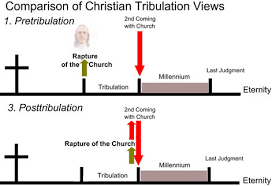
Before we begin, let me remind the reader what the posttribulational position is in comparison to other views by way of the following chart from the site: enWikipedia.org:
 For many years this writer held to a posttribulational viewpoint and so the following five arguments represent what was most commonly heard or read in print in support of this view:
1. Christ's second advent and the rapture are treated as one event in 2 Thessalonians 2:1-4
For many years this writer held to a posttribulational viewpoint and so the following five arguments represent what was most commonly heard or read in print in support of this view:
1. Christ's second advent and the rapture are treated as one event in 2 Thessalonians 2:1-4
2. Jesus will accompany his church through the end, which means the church will go through to the end of the tribulation. He will have His angels gather His elect from the four winds right before the final wrath of God at the end of the tribulation. (See Matthew 24:31; Matthew 28:18-20
3. There are believers in the tribulation period and so it is presumed that they are the church, even though they are not called "the church" in Revelation 7:13-14
4. Saints of God have had to endure suffering throughout all redemptive history. Thus it should not seem unusual to expect Christians to go through the tribulation period, exempt of course from God's wrath poured out at the end. (See Acts 14:22; 1 Peter 4:14)
5. The posttribulational position is claimed to be the oldest position on the rapture, being that it would had naturally fit with the oldest eschatological view on the Millennium - i.e Premillennialism.
Five counter-responses and five arguments for a pretribulational rapture position
Now that this writer is a pretribulationalist, the following five counter responses to the posttribulational rapture position and five additional affirmative arguments for the pretribulational viewpoint represent where this author stands on the issue. It must be stated of course that the proposed timing of the rapture is not an essential or 1st order concern of the Christian faith, but rather occupies an area whereby we exercise greater liberty and humility toward one another.
Counter responses to posttribulational arguments from a pretribulational perspective
1. When we compare 2 Thessalonians 2:1-4 to 1 Thessalonians 4:13-18 and 5:1-11, we discover that the 1 Thessalonians passages are speaking of two distinct events, not one event. Studies of the distinctions between the rapture and the 2nd advent yield their differences.
2. Matthew 24:31 is speaking of the gathering of the resurrected Jewish saints at the end of the tribulation at His second advent, not the rapture of the church. Furthermore, angels are doing the gathering of the Jewish believers, whereas in the rapture passages it is Christ Himself Who does the gathering. The church age will come to a close then when the rapture occurs prior to or right at the beginning of the tribulation period.
3. To try to advocate pre- or post- tribulationalism from the book of Revelation alone cannot be done, being that the book is focused entirely on the events surrounding Christ's second advent. With that said, the fact that the tribulation martyrs in Revelation 7 and 14 are not named should give pause to posttriublational interpreters. For this writer (a pretribulationalist), it is preferred to leave them as the scripture indicates - as people who got saved in the tribulation period and who will be part of the sequence of events of the resurrection of the righteous.
4. Undoubtedly Christians should expect to suffer if they want to be Godly in Christ Jesus. (2 Timothy 3:12). However there is a major difference between trials and tribulations and the specific prophetic event termed "The Tribulation" or "The Great Tribulation", wherein the wrath of God will be poured out in increasing measure. No church age saint will have to endure such wrath and even the tribulation martyrs will be exempt from the extremes forms at the end of the period.
5. This argument from church history is reaching in that the timing of the rapture was not as thoroughly discussed in the first four centuries as it is today. Yes Premillennialism was the majority report of the early Christians, however the reasons they held to the distinctives of their positions can often times be different from the more nuanced versions of today. History can be a great aid in measuring orthodoxy, however it is scripture alone that defines such.
Additional affirmative arguments for a pretribulational rapture
6. The pretribulationalist bases his or her view on the fact that God has promised His church that she will not have to endure future wrath. (1 Thessalonians 1:10; 5:9). The entire seven year period will consist of God's wrath. Therefore the rapture is the means by which Christ will keep His promises to His church. (1 Thessalonians 4:13-18; 5:1-11)
7. The Holy Spirit's restraining influence exercised currently through the church will be lifted in order to give the Anti-Christ opportunity to be revealed and to work forth his evil schemes. Having a Pre-tribulational rapture seems to best explain how this will occur. (2 Thessalonians 2:1-8)
8. Pretribulationalism ( and to a lesser extent mid-tribulationalism) best preserve the distinction made in the scripture between the rapture of the church and Christ's second advent.
9. The prophetic sequence laid out in Daniel 9:23-27 is particularly for the nation of Israel. For God to complete His purposes for her, He must needs remove the church from the scene, which now He is using to make Israel jealous. (read Romans 11)
10. Though there can be comfort found in all the rapture/tribulational viewpoints, yet the pretribulational rapture viewpoint achieves Paul's admonition with the least amount of effort in 1 Thessalonians 4:18 "comfort one another with these words".


