Translate

Tuesday, April 1, 2014

The War that is Already Won


Acts 10:38  "You know of Jesus of Nazareth, how God anointed Him with the Holy Spirit and with power, and how He went about doing good and healing all who were oppressed by the devil, for God was with Him."

Introduction
In today's post we aim to detail the war that has been waged, is waging and is already won by Jesus against the Devil.  In past studies we have looked at Jesus' battles against Satan in His incarnation and earthly ministry that led to Jesus' decisive victory over the Devil in the cross and resurrection. In today's study we want to discover what the Book of Acts, the Epistles and Revelation has to say about the fact that the War between Jesus and the Devil has already been won.  In today's post we will explore the Devil's demise and activities in light of Jesus decisive victory under the following three headings:

1. Devil defeated at Calvary by Jesus
2. Devil's devices can be disarmed by the grace from Jesus
3. Destiny of the Devil to be destroyed by Jesus

Devil defeated at Calvary by Jesus
The Acts, Epistles and Revelation serve to explain all that took place at the cross and empty tomb. In as much Jesus' central aim of coming to earth the first time was to die for sins and to pay the price of redemption to the Father, He also came to defeat the Devil.  Four key New Testament passages bear out this truth. Acts 10:38 states - "You know of Jesus of Nazareth, how God anointed Him with the Holy Spirit and with power, and how He went about doing good and healing all who were oppressed by the devil, for God was with Him."  Colossians 2:15 plainly says - "When He had disarmed the rulers and authorities, He made a public display of them, having triumphed over them through Him." The writer of Hebrews reminds us in Hebrews 2:14 - "Therefore, since the children share in flesh and blood, He Himself likewise also partook of the same, that through death He might render powerless him who had the power of death, that is, the devil". Then we see the Apostle John note in 1 John 3:8 -  "the one who practices sin is of the devil; for the devil has sinned from the beginning. The Son of Godappeared for this purpose, to destroy the works of the devil." It is no wonder the Devil is bent on attacking the people of God, for they represent the One Who soundly defeated him at Calvary.  Which leads us to the second idea associated with the fact that in Jesus Christ, the war is already won against the Devil, namely...

The Devil's devices can be disarmed by grace from Jesus
Sometimes a snake is never more dangerous than when he has been defeated, maimed and mortally wounded.  As children my sister and I loved playing outside in our yard.  One day as we were playing, a giant poisonous snake was coiled up in our yard.  We yelled at the top of our lungs for our dad to come out and rescue us from the dangerous serpent.  Our father came out and quickly grabbed a shovel.  For a couple of minutes my father and that old snake faced one another.  The hissing and quick movements of the snake were indeed intimidating.  Suddenly my father struck the snake with the shovel and then proceeded to take his boot and drive the shovel several times into the back of the snake.  The snake was no doubt dead - (or so we thought).  In a last ditch effort the snake lunged for my father's boot and buried its fangs into the hard, steel toe.  My dad then beheaded the creature, ending its tyranny of fear over my sister and me.  

The Devil, the Serpent of old, is now very dangerous and full of venom. Many wonder why Jesus did not do away with Satan at the cross.  Though the purposes of God may not always be easy to understand, one thing is clear - in order to be more than conquerors (Romans 8:37), we have to experience the same things Jesus did while on this earth.  His victory by fact is the basis for our ongoing experience of victory. The Devil certainly has his devices ready to unleash on God's people:  footholds (Eph 4:27); schemes (Eph 6:11); conceit (1 Tim 3:6); snares (1 Tim 3:7; 2 Tim 2:26); temptations (James 4:7; 1 Peter 5:8); persecution (Revelation 2:10) and of course deception (Rev 12:9). 

Despite all of these devices, thanks be to God that Jesus Christ, by His Spirit, sends forth graces whereby we as His people can battle and overcome just as He did.  We know that it is by the blood of the Lamb, the Word of God and the gifting of faith that we can overcome the evil one. (1 John 5:4-5; Rev 12:11). 

So in seeing how Jesus Christ defeated the Devil at Calvary and how in Jesus we can now obtain victory, let us consider the third heading that tells us that Jesus' war with the Devil is already won.

Destiny of the Devil to be destroyed by Jesus
The final book of the Bible spells out very clearly what the Devil's destiny will be.  As we scan God's final revealed book, we can note a three step downward spiral of Satan that describes his destiny.  First we can note that the Devil will experience a final demotion from the heavenly realms as the Prince of the power of the air to the earth.  Revelation 12:12 states - "For this reason, rejoice, O heavens and you who dwell in them. Woe to the earth and the sea, because the devil has come down to you, having great wrath, knowing that he has only a short time.” 

Following that demotion, which will occur in the midway point of the final seven year tribulation period, Jesus will return to earth at the end.  After destroying the Anti-Christ and his forces, Jesus will establish His throne in Jerusalem to rule over the earth for 1,000 years.  As that is taking place, the Devil's second downward spiral will take place - a dungeon.  Revelation 20:2 tells us - "And he laid hold of the dragon, the serpent of old, who is the devil and Satan, and bound him for a thousand years." 

After the 1,000 years comes to a near end, the Devil will be released from his dungeon, his pit, and be permitted to lead astray all the people born during Jesus' 1,000 year reign. (please compare Isaiah 65:20) It will be at that point that Jesus puts the proverbial nail in Satan's coffin and thus marking the third downward spiral in the Devil's destiny, namely his destruction.  Revelation 20:10 records - "And the devil who deceived them was thrown into the lake of fire and brimstone, where the beast and thefalse prophet are also; and they will be tormented day and night forever and ever."  Finally that old serpent, the dragon, will be writhing in eternal agony. Never again will he be able to dig his fangs into the hearts of people.  The defeat at Calvary and the graces of Jesus Christ plainly tell us that the destiny of the Devil is destruction.  Thus dear friend, these are the truths that tell us that in Jesus Christ, the war is already won!

Monday, March 31, 2014

P5 Intepreting Revelation 20:1-10 - A quick Outline of Revelation 19:11-20:15, with particular focus upon 20:1-10


Revelation 20:6 Blessed and holy is the one who has a part in the first resurrection; over these the second death has no power, but they will be priests of God and of Christ and will reign with Him for a thousand years.

Introduction:
For the past several days we have been exploring all of the major interpretive approaches to Revelation 20:1-10.  In this series we have covered the following:
1. Interpretive areas to consider when studying Revelation 20:1-10


2. Amillennialism and a Premillennialist Response


3. Postmillennialism and a Premillennialist response


4. Exploring different types of Premillennialism

In today's post I want to offer a brief outline of Revelation 20:1-10, with the previous posts operating as the background and preparation for the outline below.  If any reader is curious on where exactly I stand, they can look back at yesterday's post, where after some discussion I lay out four basic tenets of where I stand on the issue of Premillennialism.  

A Quick Outline of Rev. 19:11-20:15, with particular focus upon Revelation 20:1-10

I. Arrival of Jesus Christ to earth 19:11-21


II. Binding of Satan for 1,000 years 20:1-3


III. Continual 1,000 year Kingdom 20:4-6

   a. People of God with Christ 20:4
   b. Peaceful Kingdom 20:5
   c. Person of Christ the focus 20:6


IV. Devil released, rebels, destroyed 20:7-10

   a. Satan is released 20:7
   b. Sinful final rebellion crushed 20:8-9
   c. Satan is to be eternally destroyed the Lake of Fire 20:10

V. Ending of history 20:11


VI. Final Judgment of unbelievers 20:12-15

Sunday, March 30, 2014

P4 Interpreting Revelation 20:1-10 - Exploring the Premillennial Viewpoint


Revelation 20:6  "Blessed and holy is the one who has a part in the first resurrection; over these the second death has no power, but they will be priests of God and of Christ and will reign with Him for a thousand years."


Introduction:
For the past few days we have been exploring various interpretations of Revelation 20:1-10 and the particular points that aim to describe the Millennial Kingdom or 1,000 years in that same chapter. We have so far looked specifically at Amillennialism and Postmillennialism, noting their strengths and weaknesses and have offered Premillennial response to each. In today’s post we turn our attention to Premillennialism itself and must say up front that in the realm of Premillennial interpretation there exists two basic versions that in some ways could be considered almost two distinct viewpoints in their own right. 

So what are the two versions of Premillennialism?
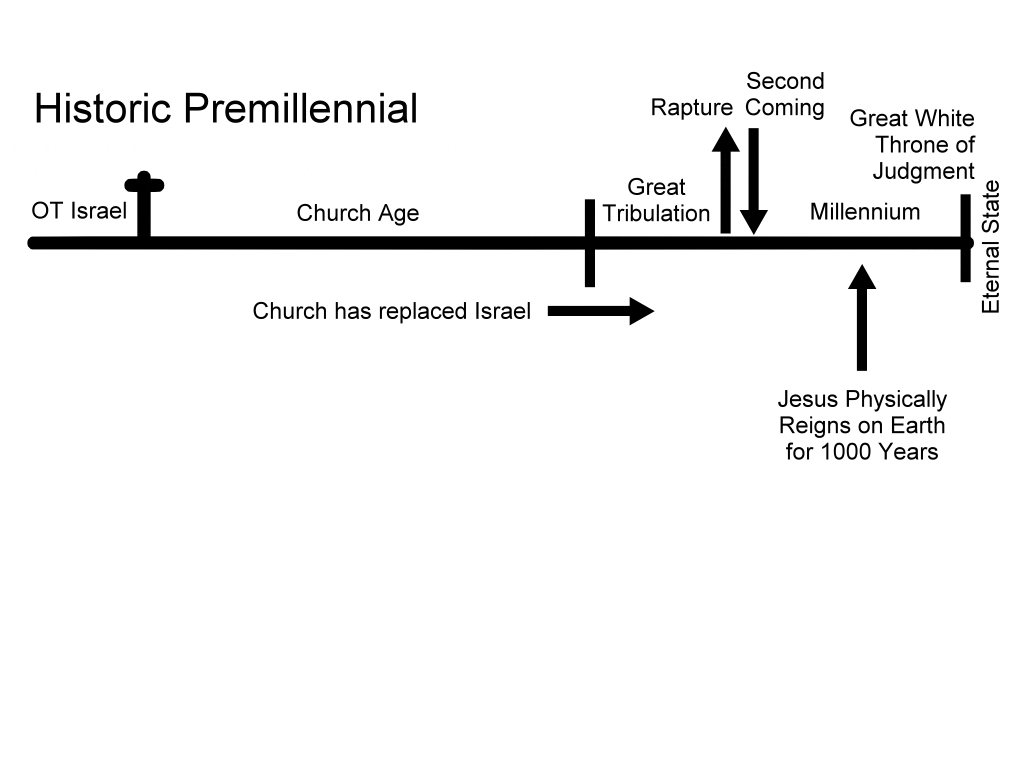
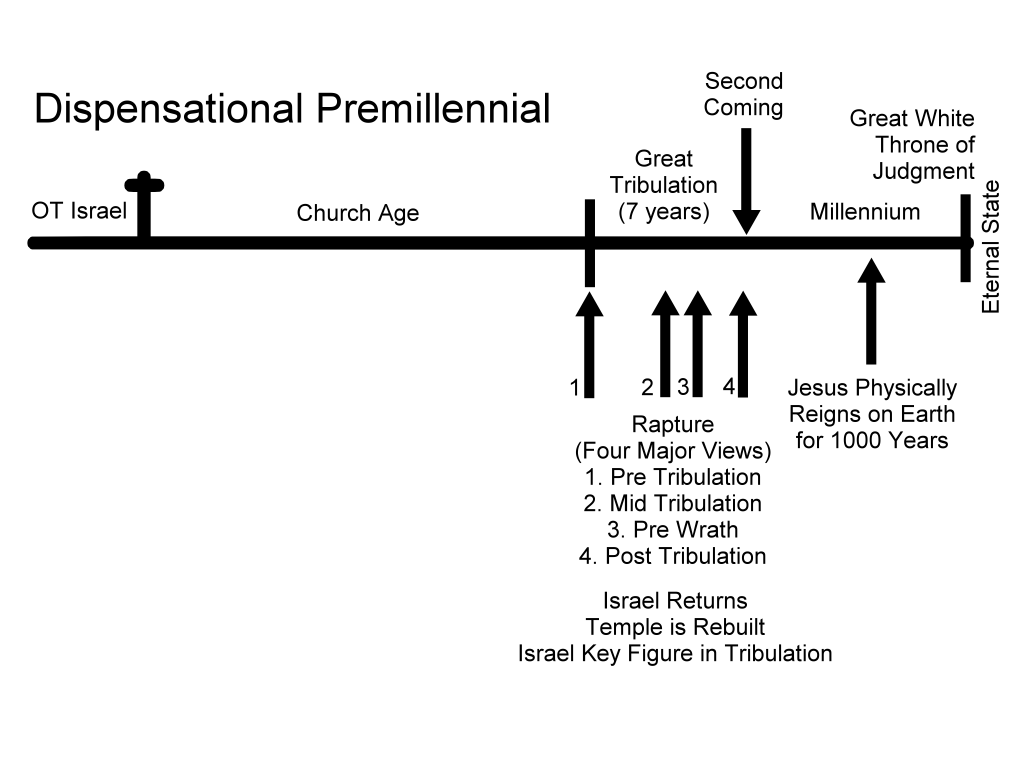
The older of the viewpoints is deemed “classical” or “historic” premillennialism because of it having existed since the early days of the church. The more recent of the two is called: “Dispensational Premillennialism”, due to its particular approach to dividing up history into epochs or dispensations and distinguishing between Israel and the church.1  To aid the reader in distinguishing between these two versions of Premillennial thought, the following comparative charts can be noted:


Historic Premillennialism Pictured2

Dispensation Premillennialism Pictured3


Similarities between Classical and Dispensational Premillennialism
Dr. Timothy Paul Jones nicely summarizes the similarities between historic/classical premillennialism and dispensational premillennialism:4

1. The Biblical writers expected a future physical kingdom

2. Jesus will reign personally over the whole earth, and no creature will ever be prey or predator ever again

3. Before Jesus returns, demonic deceptions will multiply, and spiritual conditions throughout the world will worsen (1 Timothy 4:1-5; 2 Timothy 3:1-9)

Two other similarities can be mentioned in addition to Dr. Jones' listing:

4. The term “1,000” is taken to refer to a literal earthly stage of Christ’s Kingdom. Historic Premillennialists will by and large focus more on the earthly kingdom aspect, without making the number necessarily literal (although most would say it is). Dispensational Premillennialists will assert both the literal earthly aspect of Jesus’ reign and that it will definitely be 1,000 years in duration. 

5. Revelation 20 in its entirety is speaking of a future earthly reign of Jesus Christ on this world. 

Differences between Historic and Dispensational Premillennialism
For a long time this author had held to what was a Historic Premillennial viewpoint. By and large there are a few tenets of that system this blogger still find appealing. However there are a couple of aspects of the Dispensational Premillennial viewpoint that this blogger believes to be in line with the scriptures. In having read books, listened to lectures and talked to various people over the years, the following differences can be noted.

1. Historic Premillennialism believes the church will go through the tribulation – i.e a posttribulational viewpoint. 


Dispensational Premillennialism would differ in saying that the church will be raptured before the tribulation – i.e a pretribulation viewpoint.  

2. Historic Premillennialists such as Charles Spurgeon believed the Gospel would continue to increase in study proclamation until Christ returns to set up His 1,000 year reign. 


Dispensational Premillennialism believes the Gospel will be proclaimed, but more in a start, stop, start fashion. With the church being rapture out before the tribulation, the 144,000 will pick up the task and multitudes of people (not the church) will get saved out of the tribulation, having died for their faith in the tribulation. (compare Revelation 7,14). 

3. Historic Premillennialists would say that the church has replaced Israel or is the new Israel.


Dispensational Premillennialists would make the distinction between the two.

4. Historic Premillennialists tend to read the Old Testament prophecies in light of the New Testament.


Dispensational Premillennialists tend to view the unfolding of Bible Prophecy as deriving from God’s promises to Abraham, David and the New Covenant. Both viewpoints of course make Jesus Christ and His act of fulfilling God’s promises and prophecies central to their understanding of end time events.

Where this author stands on the subject of Premillennialism
I'm certain by now for those readers who have been tracking this most recent series of posts that I am a Premillennialist in my approach to Revelation 20:1-10.  The question is, in light of the two positions above, where do I stand? Both positions represent endpoints in the interpretive camp of the Premillennial approach to scripture and Revelation 20.  There are in my mind at least two legitimate observations I find helpful from each version, totalling four points in all in where I stand on the Premillennial issue.

1. I find the Historic Premillennial idea of Jesus' Kingdom being an already/not yet Kingdom quite helpful in understanding Bible prophecy.  To say it is all future is ignoring the statements made by the Apostles regarding all that took place following Jesus' ascension.  Clearly He is ruling in some fashion in Heaven.  However there is an aspect to Jesus Kingdom that has yet to take place - which I would argue to be the 1,000 year reign spelled out in Revelation 20:1-10.

2. I agree with the Dispensational Premillennial view that we still need to make distinctions between the church and Israel.  Unlike my Historic Premillennial friends, I do not think the church has replaced Israel.  Two of the main purposes of the Millennium is for God's promises to Israel to be completed and for the church to physical rule with Jesus on His throne. (Romans 11:25-26; Ephesians 2:6-8; Revelation 20:1-6)

3. I agree with the Historic Premillennialists that the New Covenant spoken of in the Old Testament and the New Testament is the same and not two different New Covenants.  This is a key point in that the New Covenant promises of which the church is getting a foretaste are directly related to the full New Covenant promises which Israel will be enjoying in the Millennial Kingdom.  

4. I agree with the Dispensational Premillennialists that the rapture of the church will preceed the tribulation and thus the church-age saints resurrection will be a "part one" of a two-part resurrection of the righteous, with Israel's resurrection at Christ's second advent concluding that resurrection sequence. Revelation 20:6 notes "blessed  and holy is the one who has a part in the first resurrection".   

Endnotes:
1. To try to clear up the differences between the two positions, some scholars have deemed the older version of Premillennialism “post-tribulational Premillennialism” due to its view of seeing the church go through the tribulation and viewing the rapture and second coming as one event. The second version of Premillennialism is sometimes termed “pretribulational Premillennialism” and teaches that the church will be raptured before the tribulation and stresses the distinction between the church and Israel.  We will for our purposes stick to the titles “historic” and “dispensational” premillennialism. 

2. http://www.bibleistrue.com/qna/qna91.htm#historicpremill

3. http://www.bibleistrue.com/qna/qna91.htm#disppremillennial

4. Dr. Timothy Paul Jones. Rose Guide to Endtimes Prophecy. Page 329.

Saturday, March 29, 2014

P3 Interpreting Revelation 20:1-10 - The Postmillennial approach and a Premillennial response

Revelation 20:4 Then I saw thrones, and they sat on them, and judgment was given to them. And I saw the souls of those who had been beheaded because of their testimony of Jesus and because of the word of God, and those who had not worshiped the beast or his image, and had not received the mark on their forehead and on their hand; and they came to life and reigned with Christ for a thousand years.

Introduction and Review
In yesterday's post we did an overview of the Amillennial position, its treatment of Revelation 20:1-10, its seeming strengths and a Premillennial response to the position.  Today we want to continue in the same approach as we consider the Postmillennial position.

The Postmillennial position and its inerpretation of Revelation 20
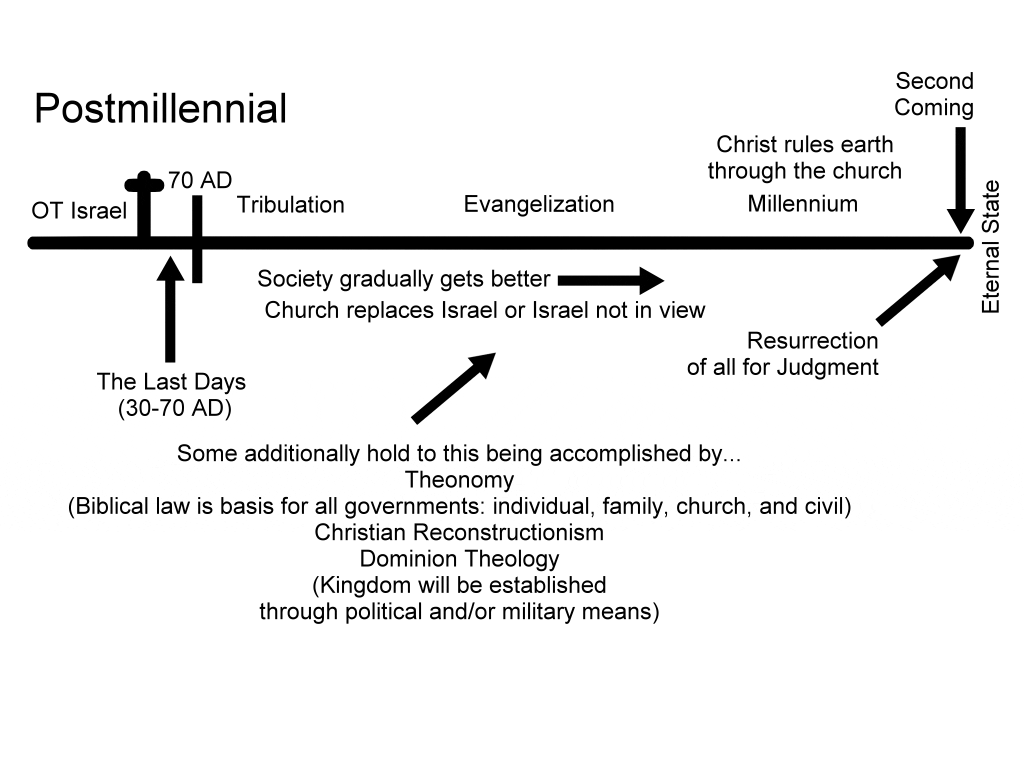
Out of all the major positions on the Millennium, the Postmillennial position is among the post positive.  Essentially in contrast to the Premillennial and Amillenial viewpoints, Postmillennialists believe history is gradually improving do to the continual preaching of the Gospel.  To illustrate the basic tenets of this position, I will direct the reader to the following chart:1


By quick comparison let the reader note the Amillennial timeline from yesterday:2


In somewhat familiar fashion to Amillennialism, Postmillennialists see Christ returning and immediately ushering in the eternal state.  As a matter of fact, up until over 100 years ago, no one made the distinction between the two viewpoints.  Remarkably in the past century, perhaps more than any other, we have seen a major increase in books, discussions and debates on the subject of last things or Bible prophecy.  So then how do Postmillennialists typically approach Revelation 20? In listening to lectures, watching videos and reading books over the years, the following typical approach can be outlined:

1. Revelation 20:1-3 refers to Christian conversion in this present age. Very similar to the Amillennial position.

2. Revelation 20:4-6 has the Gospel gradually overcoming and history becoming a golden age of sorts that may or may not be 1,000 years in duration. Some postmillennialists hold to the 1,000 years being literal but most would say it is symbolic, citing passages such as Psalm 90:4 and 2 Peter 3:18.

3. The New Covenant promises of Isaiah 40-66, Ezekiel 36 and Jeremiah 31-33 are read to refer to Israel being replaced by the church.  Passages such as Galatians 6:16 are often used to support the idea that the church is the New Israel.

4. Much like Amillennialism, the binding of Satan is treated as meaning His defeat at the cross.  Some Postmillennialists will also add that the Gospel itself is the main binding force, holding back an preventing Satan and the kingdom of darkness from having full freedom of expression.  

5. After the Gospel has converted all the nations (not every individual mind you, but a good portion of people on earth) and ushered in the "millenium" so to speak, Jesus will return and judge the nations as spelled out in Revelation 20:11-15. 

Seeming strengths of Postmillennialism
The Postmillennial position is admittedly appealing for a few reasons.  

1. For one thing, it has the most optimistic view regarding the accomplishment of the Great commission.  Many past missionaries such as Jonathan Edwards and William Carey were Godly, conservative Postmillennialists. 

2. Secondly, it ties in Christ's ascension and reign in heaven to the accomplishing of the Great commission on planet earth.  Some of my dearest friends, with great hearts for the lost are Postmillennialist and have a very exalted view of Christ.  

3. Thirdly, Postmillennialism tries to take seriously the Kingdom as not being only spiritual but eventully impacting every sgment of culture and society.  How much this impact will be differs among Postmillennialists, however it is quite intriguing to think about.  

A Premillenialist response to Postmillennialism
1. Much like the Amillenialist viewpoint, I see the weakness of trying to make Revelation 20:1-3 or 20:1-6 as referring to this present age as introducing an uncessary disruption in the flow of the book of Revelation.  John's main focus is on Christ's second coming and His reign that will follow.  The Premillennialist viewpoint holds to what appears to better fit the flow of Revelation as being primarily more future in the areas of Revelation 19-22.


2. The Postmillennialist's uncertainty of whether the number "1,000" is literal or symbolic stems from the similar inconsistency we see in Amillenialism. Postmillennialists try to read all of the Old Testament in light of the new, however they then read the number "1,000" in Revelation 20 in light of Psalm 90.  Yes, Peter also uses Psalm 90:4 in his main arguments in 2 Peter 3:18.  However, his subject has to do with the suddeness of events leading up to the quickness of Christ's return, whereas John in Revelation 20 is focusing more upon what will take place after Christ's return in Revelation 19.


3. Undoubtedly the church is getting a chance to foretaste in a spiritual way some of the blessings of the New Covenant spelled out in the Old Testament.  However to say that the church has replaced Israel is to ignore passages such as 1 Corinthians 10:32 where Jews, Gentiles and the church are distinguished.  Also too, if the church has replaced Israel completely in the realm of her blessings, then what of the curses pronounced upon Israel in the Old Testament?


4. The weakness on the point of Satan being bound now begs the question: what about passages that tell us that Satan is roaming to and fro on the earth, seeking whom he may devour? (1 Peter 5:8)  Also, if the Gospel is that main binding force, then why is Satan clearly blinding the eyes of people to the truth of the Gospel world wide?  Premillenialism recognizes the reality of things.  We would say with the Postmillennialist that only the Holy Spirit can convict and draw sinners to believe, represent and be saved.  However it is very evident that Satan is not bound now, but rather will be bound later. 


5. The idea of history getting gradually better and better is hard to measure and depending upon what part of the world your from will make such a measurement hard to do.  Postmillennialism in all its admirable optimism has fluctuated in popularity over the years.  Prior to the 20th century, Postmillennialism was at a near all-time high. However in the wake of two World Wars and many wars thereafter, Postmillennialism greatly waned.  Despite the fact of its recent increase in popularity, the position will ever remain at a disadvantage in its assertion that things will get better spiritually and historically leading up to Christ's return. The premillennialist recognizes that until Jesus returns, no such conditions will take place apart from His direct intervention.      

MORE TOMORROW.....

Endnotes:
1. http://www.bibleistrue.com/qna/endtimeschartpostmillennial.gif

2. http://www.bibleistrue.com/qna/endtimeschartamillennial.gif

Friday, March 28, 2014

P2 Interpreting Revelation 20:1-10 - The Amillennial approach and a Premillennial response

Revelation 20:4 Then I saw thrones, and they sat on them, and judgment was given to them. And I saw the souls of those who had been beheaded because of their testimony of Jesus and because of the word of God, and those who had not worshiped the beast or his image, and had not received the mark on their forehead and on their hand; and they came to life and reigned with Christ for a thousand years.

Introduction:
Yesterday we began looking at some of the interpretive issues the lie with the study of Revelation 20.  We explored the commonly held areas of agreement and discovered that there is far more agreement on the latter part (20:11-15) than there is on the first part (20:1-10).  In narrowing our focus to Revelation 20:1-10, we briefly listed and explain four prevailing interpretive positions on Revelation 20:1-10:
1. Classical Premillennialism
2. Dispensational Premillennialism
3. Amillennialism
4. Postmillennialism

Today we want to feature the Amillennial position and consider a Premillennial response in how Amillennialists typically outline and interpret revelation 20:1-10.

How Amillennialism handles Revelation 20:1-10
First of all let me place a chart depicting the Amillennialist position for the reader's reference:1


The reader will notice no reference to a literal millennium in the chart - hence the name "a" (meaning no) and "millennium" (meaning 1,000 years).  Amillennialists deny a literal, future 1,000 year earthly phase to Christ's kingdom and instead state that His Kingdom is totally spiritual and totally now.  Excellent Bible teachers and pastors, present and past, such as Baptists Dr. Sam Storms and Dr. Hershel Hobbs and Presbyterians like Dr. A.A Hodge and Dr. Sinclair Furgenson are articulate holders of the Amillennial position.  In comments such as their's on Revelation 20:1-10, we can note the following features of the Amillennial position on Revelation 20:1-10:

1. Revelation 20:1-6 refers to the conversion of believers and resurrection of the human spirit in this current age.  Many Amillennialist cite Jesus' statements in John 5:24-28 in His references to describing salvation in terms of a spiritual resurrection or regeneration from spiritual death, followed by what will indeed be a literal resurrection. 

2. Revelation 20:7-10 deals with Christ's spiritual reign in heaven, a reign that began upon His ascension into heaven and which will conclude upon His return to this earth to raise the dead, judge sinners and usher in the eternal state.

3. The number "1,000" is a symbolic number referring to a general period of time, as evidenced in passages such as Psalm 90:4 "a thousand years are as a day unto the Lord". 

4. Amillennialists typically treat Revelation 20:11-15 as referring to the final physical resurrection of both the righteous and unrighteous together, with the first resurrection referring to salvation and the second resurrection referring to physical resurrection. 

5. In Dr. Timothy Paul Jones overview of eschatology or endtime events, he notes the following strength of Amillennialism: "Satan is already bound, and the saints are already reigning! That's how amillennialists see what God accomplished through the work of Jesus on earth. Because Jesus has been "lifted up" on the cross, Satan has already been cast down" (John 12:31). The powers of darkness have been disarmed (Colossians 2:15). The Son of God has gained power over death (1 Corinthians 15:56-57; Revelation 1:18; 9:1; 20:1). 2

The seeming strengths of the Amillennial viewpoint
In light of the above outline of how Amillennialists would typically handle Revelation 20, we can note three seeming strengths that one will find being championed by holders of Amillennialism:

1. Simplicity.  The strengths of this position are first of all its utter simplicity.  Out of all the millennial positions, the Amillennial position is the least complicated, the most widely held viewpoint across all Christian communions (even some Baptists would assert their belief in Amillennialism). 

2. Taking serious the symbolism of the Book of Revelation. A second strength lies in the fact that it tries to take seriously the Book of Revelation being an apocalyptic book that can speak of events in symbolic terms. 

3. Reading Old and New Testaments in light of Jesus' statements on endtime events. Thirdly the Amillennial viewpoint on Revelation 20 attempts to read virtually all of prophetic scripture, Old and New Testament, and Revelation 20, in light of Jesus' statements in the Gospels and the unfolding of the Kingdom theme in the New Testament. 

A premillennial response to the Amillennial viewpoint
As a premillennialist, I first and foremost want to say I deeply respect my fellow brothers and sisters in Christ who espouse Amillennialism.  Many of my own favorite authors, preachers and friends hold to this position.  Furthermore, though a very important area, viewpoints on the millennium have never been used throughout church history as constituting the central "dogmas" or "1st order" heaven and hell beliefs necessary for Christianity to be Christianity. Thus there can be allowance for liberty in this area (even though I would say one needs to know where they stand on the issue). With that said, let me comment briefly on the Amillennialist position from a premillennial perspective:

1. To say Revelation 20:1-6 refers to salvation or regeneration in this age is to break the flow and continuity of subject that flows from Revelation 1-19. The key focus of Revelation is Christ's second coming. To suddenly throw Revelation 20 back to Christ's first coming is to introduce, in my estimation, an unecessary disruption.

2. As much as I do see Christ inaugurating some spiritual component of His Kingly reign in heaven over His church, to say that the Kingdom is entirely spiritual is going to far and not considering other passages that seem to refer to an earthly phase to Jesus' reign. (Zechariah 12-14; Matthew 25)

3. Amillennialist typically try to read Old Testament passage in light of new ones.  However, it seems they switch directions and assert the number "1,000" being symbolic because of what is read in Psalm 90. The number "1,000" is repeated no less than six times by John, which tells us that the number cannot be just a symbolic number.  Rather, the emphasis by John would lead to the plain and simple conclusion that this is a literal 1,000 years.

4. To combine the resurrection of the righteous and unrighteous together into one general resurrection is to ignore passages such as Daniel 12 and John 5:24-28 where there appears to be at least two resurrections in view.  If we read Revelation 20 in light of such passages, the only conclusion one can reach is that there is going to be a resurrection of the righteous, with an intervening 1,000 years, ending with the reusrrection of the wicked in Revelation 20:11-15. 

5. As much as this writer would assert our spiritual positions in the heavenly realms with Christ as being an "already" reality, nonetheless there are a lot more things that are "not yet".  For one thing, if Satan is bound, then what do we do with passages such as 1 Peter 5:8 that assert Satan roaming to and fro over the earth?  It would seem that the binding of Satan is yet future and that this would more naturally fit with the future contexts of Revelation 19 and 21-22. 

6. With regards to the seeming strengths, as everyone knows, majority opinion does not consistitute there being a necessarily all-right opinion.  Second, in as much Revelation is an apocalyptic book with symbols, we must not go to far into the ditch of saying that everything is necessarily that way.  Obviously John is using symbolic language, however he is also referring to literal realities.  Obviously the differences between the Amillennial and Premillenial arguments lie in just how much literal and how much symbolism is being communicated in the text.  Thirdly, usings Jesus' statements on endtime events is commendable for interpreting all of the prophetic scriptures.  However let the reader note that Jesus taught from a Jewish background and connection with God's promises to Israel and Abraham.  So many of those texts speak of a literal component to the future kingdom.  This particular observation is why why Premillennialism believes that Jesus' reign will include a future 1,000 year period on earth.  

MORE TOMORROW..

Endnotes:
1. http://www.bibleistrue.com/qna/endtimeschartamillennial.gif

2. Timothy  Paul Jones. Rose Guide to End Times Prophecy. Page 283

Thursday, March 27, 2014

P1 Interpreting Revelation 20:1-10 - Interpretive issues and the various positions on the millennium


1

Revelation 20:1-3 "Then I saw an angel coming down from heaven, holding the key of the abyss and a great chain in his hand. 2 And he laid hold of the dragon, the serpent of old, who is the devil and Satan, and bound him for a thousand years; 3 and he threw him into the abyss, and shut it and sealed it over him, so that he would not deceive the nations any longer, until the thousand years were completed; after these things he must be released for a short time."

Introduction:
There are certain chapters in the Bible that legitimate and Godly Christian people differ upon in terms of interpretation.  Revelation 20 stands among one of the most discussed and at times hotly debated chapters among the 1189 chapters of God's Word. Today we want to begin noting some key positions that one finds when studying this amazing chapter of the Book of Revelation. 

Points upon which all Bible believing Christians agree in interpreting Revelation 20
Before getting to the differing interpretations, let us first consider what all Christians agree upon with regards to Christ's second coming generally and Revelation 20 in particular.

1. Clearly all are in agreement that Christ will have a literal, bodily, visible return.  According to Bible Teacher John MacArthur, 1 out of every 25 New Testament passages speak on His return. In all the major positions held about what we read in Revelation 19-20, virtually all interpreters are united in affirming that Revelation 19:11-21 is speaking about Christ's literal, bodily return to earth.

2. In my consideration of the major viewpoints on Revelation 20 from listening to lectures, sermons and readings of nearly all the major creeds and confessions of church history, it has been observed that the latter half of Revelation 20 (vss 11-15) finds near unanimous agreement.  Throughout church history the major areas of emphasis on this particular section of Revelation have been the resurrection of the dead and final judgment. 

3. Southern Baptists fall within the mane of the historic Christian church on the subject of Christ's return.  The Baptist Faith & Message 2000 reads in its article on "Doctrine of Last Things: "God, in His own time and in His own way, will bring the world to its appropriate end. According to His promise, Jesus Christ will return personally and visibly in glory to the earth; the dead will be raised; and Christ will judge all men in righteousness. The unrighteous will be consigned to Hell, the place of everlasting punishment. The righteous in their resurrected and glorified bodies will receive their reward and will dwell forever in Heaven with the Lord." 

In considering the above three points, there is general uniformity on Revelation 20:11-15 speaking of the final judgment that will occur as the final and ultimate event that closes out history and proceeds the Eternal State of Revelation 21-22.  What this means then that our area of focus can be narrowed down to Revelation 20:1-10.         

Why there are differences of interpretation on Revelation 20:1-10
   The real areas of difference of interpretation on Revelation 20 chiefly arise from how the first ten verses are handled and read. I am sure readers could add five more differences to the list I have below.  Yet in order to avoid making this post to cumbersome, we will stick to the five major areas one finds consistently in the literature on this subject.  The areas of difference arise from the following considerations:

1. Is Revelation 20:1-10 recapping current history from Christ's resurrection to 2nd coming or is it following from His 2nd coming in Revelation 19:11-21?

2. Is the reference to "First Resurrection" speaking of salvation or of a future resurrection of the righteous at Christ's return?

3. Is Revelation 20:1-10 detailing more than one resurrection or is there only one general resurrection of both righteous and the wicked at the end of history? Many will include discussion of 20:11-15 in answering this question.

4. Is the Kingdom of Jesus Christ only spiritual and present, spiritual and earthly with an already/not yet component or entirely earthly in the future?

5. Is the number "1,000" a literal reference to a future 1,000 year reign of Jesus or is it a symbolic round number referring to His current reign in Heaven over the earth or a little bit of both?

Listing out the four major interpretations of Revelation 20:1-10
Three major positions, with one having two variations (and thus a total of four views in all), exist in determining the answers to various interpretive issues and questions outlined above.  Though many details could be cited, for sake of simplicity, we will for now just list each viewpoint, their names and the broadest definitions. The reader is also encouraged to consult the chart included at the beginning of today's post.

 1. Premillennialism - Those who hold to this teach that, when Christ returns, He will set up a literal earthly kingdom for 1,000 years, followed by a brief loosing of Satan to deceive the nations, the Great white throne judgment and then the bringing in of the "New Heavens and New Earth".  The reason for the name "premillenialism" is due to the prefix "pre" referring to "before" and "millennium" being "1,000 years". As stated earlier, two variations exist within the Pre-millennial interpretation which for now we will just list their names: 

a. Classical Premillennialism 
Sometimes called "Post-Tribulational Premillennialism".

b. Dispensational Premillennialism.
Sometimes called "Pre-tribulational Premillennialism

2. Amillennialism.
This position teaches that Christ began His reign at His ascension into Heaven and is ruling and reigning over a spiritual kingdom right now.  Being that it denies a literal 1,000 year reign of Christ, the term "A-millenialism" is used (a=no and millennium = 1,000 years).  History (according to this view) will continue in its downward spiral and at the end Christ will return, judging the world and Satan, and bring about the new heavens and new earth. 

3. Post Millennialism 
This position teaches that Christianity will continue to increase until the whole world is taken over by the gospel.  Though not every individual will be saved, yet post-millennialists contend that every nation will eventually see many of their people saved.  It generally teaches that the church will continue to evangelize until so many people are converted that Christ will then return at the end of the future golden age or "millennium" )post = "end" millennium= 1,000 years).  Post-millennialists take passages such as Psalm 2 and missionary passages such as Matthew 28:18-20 to refer to the triumph of the gospel over unbelief.  

MORE TOMORROW.....


Endnotes:
1. The above image comes from the following link: http://bereanbiblestudygroup.com/2010/08/rev-69-17-seals-5-and-6/

Wednesday, March 26, 2014

God strengthens and grows His church through preaching


Acts 5:42 And every day, in the temple and from house to house, they kept right on teaching and preaching Jesus as the Christ.


Introduction and Review:
Yesterday we considered the ways in which God strenghtens and grows His church.  We suggested that one of the chief ways is through corporate prayer.  We noted through the book of Acts that every time the church prayed in Acts 3-8, some area of ministry was strengthened.  In the Gospels we saw how Jesus had ordained the pattern to continue from what was set for the temple and synogogue of His day.  Prayer was to be priority! Then finally we looked at the New Testament epistles to see how much prayer continued on into the later part of the Apostolic era and saw the without question - corporate times of prayer and prayerfulness among God's people in the church was one of the ways used by God to strengthen and grow His church. 

As we turn our attention yet again to Acts 3-8 and other passages, we ask the question: "how is it that God grows and strenghtens His church?" We saw the first method to be that of prayer.  However there is a second important method: preaching.  Once more we will consider mainly Acts 3-8, followed by a few reflections on Jesus' pattern of ministry, with some final observations in the Epsitles to discern whether or not preaching is yet another way God has prescribed to strengthen and grow His church.

God strengthens and grows His church through preaching as seen in Acts 3-8
It is truly amazing how many sermons and instances of preaching we find throughout the Book of Acts.  Whenever we count up the sermons, addresses and exhortations given by the Apostles and their associates, we end up with roughly 20 such examples.  Just as we saw with the pattern of prayer in yesterday's post, we see that when the Word of God was preached, strengthening and growth occurred. For example in Acts 3:11-26 we see Peter preaching his second sermon, expounding further on the miracle of the healing of the lame man at the Gate called Beautiful in 3:1-10. Peter ties the miracle to the activity and person of the resurrected and Ascended Christ in heaven.  Thereupon his conclusion of that sermon, we read the outcome in Acts 4:4 
"But many of those who had heard the message believed; and the number of the men came to be about five thousand."


Then we read later on in Acts 4:5-12 and in Acts 5:29-32 of Peter preaching twice more, and with God strengthening the church in some area and conversions being the result.  In Acts 7:1-60 we see one of the fullest and complete sermons recorded in Acts.  Stephen is the keynote speaker and before it is all said and done, he will be recorded as the church's first martyr. 


Stephen's preaching undoubtedly led to persecution but also to advancement in the cause of Christ. God indeed strengthens His cause and grows His people spiritually or numerically (or both) through preaching.  

Jesus' pattern of preaching in His ministry
Mark 1:38 records for us the early conviction Jesus had about preaching: He said to them, “Let us go somewhere else to the towns nearby, so that I may preach there also; for that is what I came for.” In Luke's Gospel we see Jesus reading and expounding from the scroll of Isaiah, describing how He had fulfilled the contents of Isaiah 61:1-2a.  In Matthew we see recorded a number of sermons - from his inaugural Sermon on the Mount in Matthew 5-7 to his final Sermon "The Olivet Discourse" of Matthew 24-25.  It is not hard to see Jesus' priority on preaching and how He used it to advance the cause for which He came - to go to the cross and to unfurl to the people the Kingdom of God. 

How we see God using preaching in the Epistles
We could say in all fairness that the Epistles represent the outcomes of and in some cases, the preaching of the Apostles.  The Book of Hebrews for instance may very well had been a sermon and extended exposition of Psalm 110 and Genesis 14 as the author aimed to explain to His readers why Christ is superior to the Old Covenant Judaism.  The Epistle to the Romans has Paul detailing the place of preaching in the conversion of sinners in Romans 10:11-17 and the strengthening of saints.  Galatians 1 begins addressing what consistutes solid gospel preaching from counterfiet versions.  Then of course the epistles of 1 and 2 Timothy and Titus have instructions given to Timothy and Titus as to how they ought to preach in the church and how preaching equips the church to live and do the will of God.  1 Timothy 4:13-16 plainly states:  "Until I come, give attention to the public reading of Scripture, to exhortation and teaching. 14 Do not neglect the spiritual gift within you, which was bestowed on you through prophetic utterance with the laying on of hands by the presbytery. 15 Take pains with these things; be absorbed in them, so that your progress will be evident to all. 16 Pay close attention to yourself and to your teaching; persevere in these things, for as you do this you will ensure salvation both for yourself and for those who hear you."

Conclusion:
Today we have looked at how God uses preaching to strengthen and grow His church. We saw in Acts 3-8 how God used the sermons of the Apostles to motivate the church in its forward movement and how God brought about the conversion of many souls. In the Gospels we saw how Jesus had made preaching on of the chief priorities in His earthly ministry.  Then in the Epistles we saw how preaching is the very fabric of the life of the church, without which the church cannot be strengthened nor ever hope to grow.