Translate

Saturday, April 5, 2014

Angels in the Book of Revelation


Revelation 1:1 The Revelation of Jesus Christ, which God gave Him to show to His bond-servants, the things which must soon take place; and He sent and communicated it by His angel to His bond-servant John

Today's post features the angels we find throughout the book of Revelation.  In past posts we have looked at angels and have looked at the Book of Revelation.  In other posts we have occasionally focused on a subject where angels were part of the discussion.  In today's post we want to specifically consider the main reasons why God included angels in the Apocalypse of John.  In the nearly 300 places we find angels in God's Word, nearly 25% of those appearances occur in the final book of the Bible.  To discern the significance of angels in the Book of Revelation, we will note by their function such purposes by considering the three following activities which we see them performing:
1. Royal Court of Heaven
2. Render Judgment
3. Reinforce God's People

Royal Court of Heaven
There is no doubt how often the Bible ascribes to God the title of Kingship. (Isaiah 6; Psalm 99)  As the Son shares in the same nature as the Father, He too is deemed King of Kings and Lord of Lords. (Revelation 19:11-21)  Then of course with the Father and Son we see the Holy Spirit proceeding forth from the throne in thunders and lightenings in Revelation 4:5.  With such royal imagery used to describe the Triune God, it is only fitting for Him to have a royal court.  The angels function in this capacity in the Book of Revelation.  In Revelation 3:5 we read of Jesus confessing the names of His people before His Father and the angels. In Revelation 5:11 we see multiplied millions upon millions of angels singing and exalting God and the Lamb around the throne.  The Royal court of heaven idea is found elsewhere in Revelation in places such as Revelation 7:11; 12:9-10 and 14:10.  Far from being a static group of beings, we see Michael the Archangel and his hosts expelling Satan and his hosts permanently from heaven during the Great Triublation period in Revelation 12:9-10.  So undoubtedly we find the angels in Revelation functioning as a Royal Court, but notice also...

Render Judgment
In Revelation 7:2 we read "And I saw another angel ascending from the rising of the sun, having the seal of the living God; and he cried out with a loud voice to the four angels to whom it was granted to harm the earth and the sea."  It is in the context of executing God's judgment here on earth in the future tribulation period where we see the power of the angelic realm.  Some will have the ability to harm large portions of the earth and sea. (Revelation 8:8) Four angels alone will have the capability of wiping out 1/3 of mankind in Revelation 9:15. Another particular type of angel will be so bright as to illuminate the entire earth in Revelation 10.  Still another angel will have so much power that at the beginning of Christ's Millennial reign Satan himself will be bound and cast into the abyss by such a being. (Revelation 20:1-2) God's angels represent his holy and righteous character and stand to oppose any and all who cross purposes with God's Divine Will. As one proceeds further and further into Revelation, the boundary separating the realms of men and angels becomes blurred, and before it is all said and done, angels will become more evident than human beings in the final days before the Lord's return.  

And so angels function in the Book of Revelation as the royal court of heaven and render judgment but notice their third and final capacity...

Reinforce God's People
I can recall as a child growing up how my father worked as a carpenter.  He was all the time working on framing up various walls or pieces of furniture.  One of the areas my dad was especially good at was reinforcing whatever he made.  I always would ask him why he spent so much time in the detail work of reinforcement, being that no one would see the reinforcements he put in place.  He told me he believed in quality work both inside and out, and that the finished product needed to include excellent reinforcement.

When I think of the ministry of angels to believers, one of those ministries has to do with reinforcement.  The focus is not on the reinforcement in as much as the finished product.  In the latter part of God's book we find angels guiding the Apostle John and aiding him in understanding the visions he is both seeing and recording by Divine inspiration.  Revelation 21:9 states - "Then one of the seven angels who had the seven bowls full of the seven last plagues came and spoke with me, saying, “Come here, I will show you the bride, the wife of the Lamb.” Think of John the Revelator, in his mid-90's, already having written what he did.  The Holy Spirit was guiding the entire process as he wrote.  God knew that John's frame of mind required an attendant from on high to ensure that John would be able to peer into the vision.  Hebrews 1:14 tells us explicitly that angels are ministering spirits sent to those who are about to inherit eternal life.  In other passages in Revelation 21:12,17 and 22:6,8 and 16 we see angels aiding, assisting, supplementing and encouraging John and us the reader in apprehending the truth of what is being depicted.  The Spirit superintends over how His Word is produced and includes the necessary means in ensuring its composition and accuracy.  No doubt about it, the angelic realm in Revelation serves to reinforce God's people by pointing them to Jesus and the scriptures. 

Friday, April 4, 2014

The Bible's teaching on Hell (Sheol, Hades) & the Lake of Fire


Revelation 20:14 Then death and Hades were thrown into the lake of fire. This is the second death, the lake of fire.

Introduction: Hell and the Lake of Fire
Today's subject is emotionally and theologically difficult, however it is nonetheless true.  To think of multiplied millions or even billions of unbelieving souls dying in their sins and going to Hell to be in reserved judgment for the Eternal Lake of Fire is very hard to think about, let alone write. Nonetheless whenever you survey the scriptures, the Bible is very plain on this subject.  As theologian Michael Horton notes: "The only decisive question is whether scripture teaches it"...."The critical point to be made from Scripture with regard to eternal punishment is not to its degree or duration, but its horrifying reality as God's personal judgment that is final and forever."1 

My aim today it to see what scripture teaches on Hell and the Lake of Fire, how both are discussed and some applications for understanding why this teaching is so crucial to Biblical Christianity. 

Describing both "Hell" and "The Lake of Fire"
When one studies the Biblical teaching on hell and eternal punishment, the following descriptions are discovered about the two main places where unbelievers go now (Hell, Sheol or Hades) as well as the final eternal destination of unbelievers called in Revelation 20:14 "The Lake of Fire".

1. The holding place called Sheol, Hades or Hell, where unbelievers go now in reserve for final judgment: 

a. It is a place of unquenchable fire Mk 9:13; Ps 106:17-18

b. It is a place that has gates or influence Mt 16:18; Ps 9:13; Is 38:10

c. It is a place where unbelievers are conscious of their suffering. Luke 16:19-31

2. The final destination of unbelievers following the Great White Throne Judgment - The Lake of Fire 

a. It is a place of everlasting fire Mt 18:18

b. It is a place of outer darkness Mt 25:47; Jude 11


c. It is a place were unbelievers are conscious 2 Thessalonians 2:8; Revelation 19:20; 20:14-16; 21:8

3. Evidently there are some similar characteristics shared by both, with the Lake of Fire being far worse
a. Both are places of wailing & gnashing of teeth Mt 8:12; 13:42, 50; 22:13; 24:51; 25:30; Lk 13:28; Lk 16:19-31

b. Both are places of  burning and stench Mt 5:22, 29-30, 10:28, 18:9, 23:15, 33, Mk 9:43; Lk 12:5; Luke 16:19-31

How "Hell" and the "Lake of Fire" are developed throughout God's revelation in the Bible
These are most of the references we find in the New Testament regarding the current destination of unbelievers.  In the Old Testament the word translated "hell" or "grave" is the Hebrew "Sheol" which points primarily to the realm of the dead.  In the New Testament the Greek word "hades" is used and we see a more nuanced understanding - lending itself to the progressive nature of God's revelation of topics in the Bible.  The word "hades", in addition to referring to the realm of the unbelieving dead, also carries with it the idea of being a "holding place" until judgment day. 

1. Sheol, Hades, "Hell" - The Holding Cell until judgment day
In most of the places of the Old Testament and New Testament, we come to understand that unbelievers go to a place that the scripture commonly translates as "Hell".  However there is another place that though often lumped in with the current holding place until judgment, is actually a worse place. 

Think of the difference between a county jail and a state penitentury.  The county or local jail is often used to hold offenders until the final details of their sentence is handed down by the judge.  Once the legal system has sentenced the offender, they are taken to a high security facility that will house them for years, decades or life to serve out their sentence.    County jail is no doubt a horrible place, however the "State Pen" is even worse. Both Jesus and scripture reveal a far worse reality - the Lake of Fire.

2. The Lake of Fire - Worse than hell
The first mention of the Lake of Fire in the Bible is found in Daniel 7:9-11 where we read: “I kept looking until thrones were set up, and the Ancient of Days took His seat; His vesture was like white snow and the hair of His head like pure wool. His throne was ablaze with flames, Its wheels were a burning fire. 10“A river of fire was flowing and coming out from before Him;  Thousands upon thousands were attending Him, and myriads upon myriads were standing before Him;  The court sat, and the books were opened. 11“Then I kept looking because of the sound of the boastful words which the horn was speaking; I kept looking until the beast was slain, and its body was destroyed and given to the burning fire."

In Matthew 25:41 we get a hint of this far worse place, wherein Jesus speak of the final judgment having unbelievers going into a place of unquenchable fire.  In Matthew 25 we see Jesus presiding over the final judgment, separating the "Sheep and the Goats".  It is here that we really get the sense of the awful truth of an even worse place.

In the Book of Revelation, the Apostle John describes the Lake of Fire as a separate reality.  In the opening verse we quoted today at the beginning of this blog, "death and hades" are cast into the lake of fire. (Revelation 20:14).

The Book of Revelation describes this Lake of fire in the following ways:

1. Revelation 19:20 And the beast was taken, and with him the false prophet that worked miracles before him, with which he deceived them that had received the mark of the beast, and them that worshipped his image. These both were cast alive into a lake of fire burning with brimstone.

2. Revelation 20:10 And the devil that deceived them was cast into the lake of fire and brimstone, where the beast and the false prophet are, and shall be tormented day and night for ever and ever.

3. Revelation 20:14 And death and hell were cast into the lake of fire. This is the second death.

4. Revelation 20:15 And whoever was not found written in the book of life was cast into the lake of fire.

5.Revelation 21:8 But the fearful, and unbelieving, and the abominable, and murderers, and fornicators, and sorcerers, and idolaters, and all liars, shall have their part in the lake which burns with fire and brimstone: which is the second death.

Why there are times the Bible makes Hell and the Lake of Fire sound the same
As we saw earlier in this post, Jesus will sometimes use the same descriptions in his references to both the current holding place and final place of judgment for unbelievers.  One of those images is that of a stinking place where the fire burns and the worm dies not.  This intense imagery utilized a well-known trash dump outside the city limits of First century Jerusalem known as "Gehenna".  It was a constantly burning place where people would dump trash, dead bodies and sanitation waste.  Worms and maggots would crawl through the flame scorched, smoke intoxicating trash heaps, lending further to the real-life imagery.  In fact this place had been around for centuries and had been also the site of human sacrifices in the Old Testament times.  Jesus of course alludes to this in passages such as Mark 9:44.  Quite frankly these references by Jesus could be used to describe the current holding place and the future final place of the condemned, being that the former will be cast into the latter.  (Revelation 20:14)


Points of Application: This worst of all places reveals ever more the urgency and greatness of the Gospel
Whenever we look at the most well-known passage of John 3:16, we should see even more how marvelous of a passage it is.  Not only is the promise of "not perishing" referring to faith in Jesus Christ as providing immunity from the wrath of God suffered in the current holding place of Hell, but also from the worse place of judgment - the Lake of Fire. 

We should as Christians have a greater burden to see our loved ones, neighbors and co-workers won to saving faith in Christ.  As Christians, we should also be humbled and ever more thankful to the fact that God in His love and mercy decided to extend saving grace to us, to send His Son and to Sovereignly have His Spirit convict sinners such as us to freely believe on Jesus Christ.    May we go and tell others about Jesus Christ, so that they may believe and escape the wrath of God that is already on them, and that is coming. (John 3:36; 1 Thessalonians 1:10)

Endnotes:
1. Michael Horton. The Christian Faith - A Systematic Theology for Pilgrims on the Way. Zondervan. 2011. Page 984.

Thursday, April 3, 2014

Revelation 20:11-12 Some thoughts on God's books in heaven


Revelation 20:11-12 Then I saw a great white throne and Him who sat upon it, from whose presence earth and heaven fled away, and no place was found for them. 12 And I saw the dead, the great and the small, standing before the throne, and books were opened; and another book was opened, which is the book of life; and the dead were judged from the things which were written in the books, according to their deeds.

Introduction:
I can recall several years ago when my wife and I ordered an extra copy of our marriage license.  We were living in a different state at the time and sent a written request to the court house in the county wherein we were wed. The courthouse promptly sent us our extra copy, notarized and concealed in an official envelope.  How was it that we were able to obtain that document? The courthouse had us on record in their files where our names were recorded.  Such public registers or records illustrate the idea of how often we deal with matters of public record.  

In the scripture above we see depicted what will be the final judgment. God keeps His own set of records or what the Bible refers to as "Books". An interesting detail is recorded that I would like us to consider today, namely the phrase: "And I saw the dead, the great and the small, standing before the throne, and books were opened...".  What kind of books are there in heaven that have the record of every person ever born or to ever be born? Are these people believers, unbelievers or both? Such questions we aim to answer in a post I'm entitling: "God's books in Heaven."

Noting what the Bible says about God's books in Heaven 
Revelation 20;11-12 is not the first place we find reference to various books of Heavenly Divine Record.  Throughout the scripture we see God progressively reveal through the pens of His appointed prophets and apostles various sorts of books that function in different ways. Evidently there are several books that are defined by their contents in over 25 places in the Bible.1 Bible Scholar Tim Lahaye notes: "Evidently God owns a complete set of books that record every person's deeds, waiting to be recalled on judgment day. These are the books of man's works."2 In surveying all the passages that deal on this subject, we can layout two sets of books or "Heavenly registers" whereby God will use in His dealings with all unbelievers who die in their sins and with all believers who die in Jesus.

1. A Book of life for all men born into this world 

This first book is called most often in the scripture by the simply title "The Book of Life" or "The Book of the Living".  Such a book could also be termed God's "Biological Book of Physical Life",  recording the names of all people who were ever born and died.  Moses in Exodus 32:32 gives us the first reference in God's word to the existence of such a book: "But now, if You will, forgive their sin—and if not, please blot me out from Your book which You have written!”  Tim Lahaye notes concerning this book: "The Book of life is referred to as the Father's book in Exodus 32:33; it records all those whom the Father has made. It is then the book of the Living, much like the local records book at the local county Government office." 3

The Bible traces out the fact that every person ever to be born was ordained by God to be born and to die on a certain day.  Passages such as Psalm 90 and 139 bear out these ideas. We know the day of a person's birth is ordained by God to begin their natural life (Job 3:1; Ecclesiastes 7:1) and the end of their natural life. (Hebrews 9:27) All men born into this world are lost due to inheriting the sin of their representive natural head - Adam.  It is by Adam that sin entered into the world and resulted in the Divine curse on us all. (Romans 5:11-21; Ephesians 2:1-4, 12). 

Unless there is the New Birth and reception of salvation by faith, and unless that person's name is written in the Lamb's book of Life, there can be no possibility of salvation.  To be saved, a person must needs be born again and thus be in the New Adam Jesus Christ, since their natural birth and association in Old Adam is rejected. (John 3:1-6) Thus in Revelation 20:11-15, the basis for judgment is the absence of a person's name in the Lamb's Book of Life. All believers have there names recorded eternally in The Lamb's Book of Life and the Biological Book of Life. However the sad truth is that unbeliever's names are recorded only in the Biological Book of Life. Now with this Book of life is an accompanying volume....

2. A book recording the deeds of unbelievers
Unbelievers have a book wherein is recorded every deed and word they have uttered.  Revelation 21:5 states "and the dead were judged from the things which were written in the books, according to their deeds." Such books are kept to determine the levels of judgment and punishment unbelievers will experience for eternity.  Why is this important to note? Because to whatever degree of light of God's truth a person as been exposed, and subsequently rejected, will determine what degree of suffering they endure when they die in their sins.  Thus for those who die never having heard the name of Jesus, their degree of judgment will be less than those who died in their sins having heard the Gospel numerous times over the course of their lives. Yes all unbelievers will have their place in the Lake of Fire, however the degrees of suffering meted out to each will be dependant upon the deeds they did in this life. Jesus notes in Matthew 25:28-29 “For to everyone who has, more shall be given, and he will have an abundance; but from the one who does not have, even what he does have shall be taken away. 30 Throw out the worthless slave into the outer darkness; in that place there will be weeping and gnashing of teeth." 

Such truths demonstrate that God is a fair and just God, and that in the end, all people who die and enter into eternal judgment do so as a result of their own choices and repeated rejection of God's revelation of Himself in creation and His Son Jesus Christ in the Bible.  According to Dr. John MacArthur, the phrases "weeping and gnashing of teeth" refer to anger and hatred being expressed by sinners against God and all things in general. Such truths, though frightening are nonetheless revealed in scripture to warn sinners to believe, repent and be saved.  
So we have looked at the first set of books for unbelievers - The book of life and a book recording their deeds.  Such books will be used in the final judgment recorded in Revelation 20:11-15.  But now lets look at a second set of books revealed in the Bible for believers who stand at a different judgment - the judgment seat of Christ. 

3. "The Lamb's Book of Life" 
Those who have been born again unto faith and repentance in Christ (Old Testament Saints would had believed on Him as the Promised Savior, New Testament believers believe on Him as Personal Savior) are described as having had their names written in the Lamb's Book of Life. Passages such as Psalm 69:28 refer to this particular book as the "Book of Life" and Psalm 87 refers to God's record keeping of every believer throughout every nation as being recorded by the words: "This one lives here".  Clearly the recording of names by God of all His saints are personal and detailed.  Daniel 12:1 simply uses the term "The Book" to specify much the same references we have looked at in the verse above.  The names of the saints of God are kept by God in a record called in the Old Testament: "The Book of Life". 

Although this title is very similar to the "Book of Life" described up above, both context of the scripture and the contents of the book itself reveal it to be different.  Numerous other texts could be cited, however it is clear there is a book that records the names of the redeemed, that is kept in Heaven (Luke 10:20; Hebrews 12:23; Revelation 3:5); contain the names of every child of God (Philippians 4:3) which were recorded before the foundation of the world (Revelation 13:8; 17:8) and is deemed the Son or Lamb's Book of Life. (Revelation 13:8) 

4. A Book that records the "deeds" of the saints
In the Old Testament we see examples of a certain collection of Books that record the deeds of believers. (Nehemiah 13:14)  In the New Testament we know following the rapture of the Church that every Christian will stand before what Romans 14:10 will call "The Judgment Seat of Christ".  1 Corinthians 3:8-11 and 2 Corinthians 5:10 describes the purpose of this specific judgment in examining all the deeds or works performed post-conversion here on earth.  As every Christian is examined by the Lord in Heaven during the tribulation here on earth, the issue will not be about salvation, but rather reward. The Christian's place in heaven is already set due to Christ's cross and God's purpose of Grace in choosing them in Christ which they received by faith. The "Lamb's Book of Life" will not be opened during this judgment.  However there will be books opened wherein God has recorded every deed and word spoken by Christians. Such truths ought to motivate us onto love and good deeds. (Romans 14:10)

We see then two books that God has for believers: one which has recorded His choice and their faith in Him - the Book of Life and another book that records all their deeds done post-conversion.  


Conclusion:
We have surveyed today the Bible's teaching on God's Books in Heaven that are referenced to in Revelation 20:11-15 and in other places.  We noted that there are two sets of books: a set consisting of the names and deeds of believers and a book consisting of the deeds done by unbelievers.  There is another book that records the names of all people born and their appointed days of death - a Book of Life. Then there is a book that has recorded already the names of every person who believes on Jesus - the Lamb's Book of Life.  All these books together point to how God will deal justly and fairly with believers in the Judgment Seat of Christ in Heaven during the Tribulation Period and with unbelievers in the Great White Throne of Judgment at the End of the Millennium.

Endnotes:
1. The one online article that features every verse in the Bible on this subject of "God's Books" is found at:


http://www.bbc.edu/journal/volume1_2/books_of_judgment-jelinek.pdf
, includes the following scripture references to the various Heavenly books: Exodus 32:32-33; Psalm 40:8; 56:9; 69:28; 87:6; 139:16; Isaiah 4:3; 34:16-17; 65:6; Jeremiah 17:3; 22:30; Ezekiel 13:9; Daniel 7:10; 10:21; 12:1;Malachi 3:16-17; Luke 10:20; Philippians 4:3; Hebrews 12:23; Jude 4; Revelation 3:5; 13:8; 17:8; 20:15,15; 21:27; 22:19

2. Tim Lahaye. Charting the Endtimes. Harvest House Publishers. Page 74

3. Tim Lahaye. Charting the Endtimes. Harvest House Publishers. Page 74

Wednesday, April 2, 2014

How God uses trials to strengthen His church

Acts 5:41 So they went on their way from the presence of the Council, rejoicing that they had been considered worthy to suffer shame for His name.


Introduction:
We turn our attention today to Acts 3-8 to consider a subject that many readers may not want to hear but nonetheless is necessary to understand: that God strengthens His church through trials. In past posts we have explored these chapters in noting how God uses two other methods for strengthening His church:
1. Prayer
http://pastormahlon.blogspot.com/2014/03/god-strengthens-and-grows-his-church.html


2. Preaching
http://pastormahlon.blogspot.com/2014/03/god-strengthens-and-grows-his-church.html

This third method of trials will be our focus today.


Understanding what the Bible teaches about the place and purposes of trials and testing in God's plan
There are over 250 passages in the scriptures that touch upon this theme of trial and suffering. Oftentimes when we are experiencing testing, we ascribe it to God punishing us for unconfessed sin or for something we have unknowingly done wrong.  Certainly such forms of "correction" are taught in nearly 80 places throughout the scriptures. However what is interesting to note is that overwhelmingly, trials and storms are Sovereignly permitted in our lives to purify us in an area.  In studying the passages that speak on this subject, the author found 145 places that demonstrate God's purifying purposes.  Additionally, another 30 spots indicate that God uses trials and testings to advance His kingdom purposes, which mean that we may very well be experiencing a storm of life that has more to do with God's overall plan, rather than just us alone.


Now why are such statistics encouraging? Because we know that in every trial, there is always a Divine purpose, with a Divine process, with a Divine end in mind.  2 Timothy 3:12 reminds us - "Indeed, all who desire to live godly in Christ Jesus will be persecuted." Peter writes in 1 Peter 1:6-7 "In this you greatly rejoice, even though now for a little while, if necessary, you have been distressed by various trials, 7 so that the proof of your faith, being more precious than gold which is perishable, even though tested by fire, may be found to result in praise and glory and honor at the revelation of Jesus Christ." Believe it or not, God's use of trials in your life is for your advantage according to James 1:3-4 "knowing that the testing of your faith produces endurance. 4 And let endurance have its perfect result, so that you may be perfect and complete, lacking in nothing."
So then do we have proof that these truths actually work? The Book of Acts supplies the answer by showing us how the early church advanced under the various trials and testings that she had to endure in her first year of life. In short order we will aim for the rest of this post to answer this question: How does God use trials to strengthen His church?


1. Testing yields a testimony. Acts 4:3, 4:13
It has often been said that in every mess God can bring forth a message, and in every testing God brings forth a testimony. The more the church was tested, the more testimony she had. Adrian Rogers once said you can tell what is important to a man by what makes him laugh, cry and get angry.  When these early Christians were pressed and tried, what came out? Jesus! But notice secondly....


2. Warfare leads to worship. Acts 4:23-31, 41-42
Perhaps the reader never thought of worship as warfare - but it truly is.  Undoubtedly these early Christians were being attacked not only by the kingdoms of this world but the kingdom of darkness. Right after their release from prison, the apostles went back to the Christians gathered in a worship service.  The result? These people cried out to God and sought the face of God and ultimately the heart of God! They quoted scripture and before it was all said and done, the Spirit of God fell and the place was shaken.  This early church was a broken people who were ready to be used mightily by God.  Their worship ascended to the clouds and beyond because of the Divinely appointed cleansing agent of trial and testing. So testings are used by God to create a testimony and strengthen worship but notice thirdly...


3. Persecution leads to proclamation. Acts 5:25-26,29; 6:15 and 7:1-60; 8:4
In the wake of all the persecutions we find in Acts 3-8, we discover an increased effort and ability to communicate God's Word. It may sound so odd to think about that, especially when in our day and age we would like to be the majority voice in our media driven world.  Nonetheless notice the following statements:


1. Acts 5:26-29 Then the captain went along with the officers and proceeded to bring them back without violence (for they were afraid of the people, that they might be stoned). 27 When they had brought them, they stood them before the Council. The high priest questioned them, 28 saying, “We gave you strict orders not to continue teaching in this name, and yet, you have filled Jerusalem with your teaching and intend to bring this man’s blood upon us.” 29 But Peter and the apostles answered, “We must obey God rather than men.


2.  Acts 6:15 "And fixing their gaze on him, all who were sitting in the Council saw his face like the face of an angel." When the Sanhedrin were putting the pressure on Stephen, the scriptures say his face shone like an angel.  The sermon in Acts 7 is among the greatest sermons recorded in Holy Writ.


3. Acts 8:4 "Therefore, those who had been scattered went about preaching the word." This statement was made on the heels of Stephen's martyrdom.  Notice the unexpected outcome - persecution led to bolder preaching and a much larger effort on the part of the Apostles and early church.   


Conclusion:
We have considered today how God uses trials and testings in the life of His church.  We noted the following three ways from Acts 3-8:
1. Testing yields a testimony
2. Warfare leads to worship
3. Persecution leads to proclamation

Tuesday, April 1, 2014

The War that is Already Won


Acts 10:38  "You know of Jesus of Nazareth, how God anointed Him with the Holy Spirit and with power, and how He went about doing good and healing all who were oppressed by the devil, for God was with Him."

Introduction
In today's post we aim to detail the war that has been waged, is waging and is already won by Jesus against the Devil.  In past studies we have looked at Jesus' battles against Satan in His incarnation and earthly ministry that led to Jesus' decisive victory over the Devil in the cross and resurrection. In today's study we want to discover what the Book of Acts, the Epistles and Revelation has to say about the fact that the War between Jesus and the Devil has already been won.  In today's post we will explore the Devil's demise and activities in light of Jesus decisive victory under the following three headings:

1. Devil defeated at Calvary by Jesus
2. Devil's devices can be disarmed by the grace from Jesus
3. Destiny of the Devil to be destroyed by Jesus

Devil defeated at Calvary by Jesus
The Acts, Epistles and Revelation serve to explain all that took place at the cross and empty tomb. In as much Jesus' central aim of coming to earth the first time was to die for sins and to pay the price of redemption to the Father, He also came to defeat the Devil.  Four key New Testament passages bear out this truth. Acts 10:38 states - "You know of Jesus of Nazareth, how God anointed Him with the Holy Spirit and with power, and how He went about doing good and healing all who were oppressed by the devil, for God was with Him."  Colossians 2:15 plainly says - "When He had disarmed the rulers and authorities, He made a public display of them, having triumphed over them through Him." The writer of Hebrews reminds us in Hebrews 2:14 - "Therefore, since the children share in flesh and blood, He Himself likewise also partook of the same, that through death He might render powerless him who had the power of death, that is, the devil". Then we see the Apostle John note in 1 John 3:8 -  "the one who practices sin is of the devil; for the devil has sinned from the beginning. The Son of Godappeared for this purpose, to destroy the works of the devil." It is no wonder the Devil is bent on attacking the people of God, for they represent the One Who soundly defeated him at Calvary.  Which leads us to the second idea associated with the fact that in Jesus Christ, the war is already won against the Devil, namely...

The Devil's devices can be disarmed by grace from Jesus
Sometimes a snake is never more dangerous than when he has been defeated, maimed and mortally wounded.  As children my sister and I loved playing outside in our yard.  One day as we were playing, a giant poisonous snake was coiled up in our yard.  We yelled at the top of our lungs for our dad to come out and rescue us from the dangerous serpent.  Our father came out and quickly grabbed a shovel.  For a couple of minutes my father and that old snake faced one another.  The hissing and quick movements of the snake were indeed intimidating.  Suddenly my father struck the snake with the shovel and then proceeded to take his boot and drive the shovel several times into the back of the snake.  The snake was no doubt dead - (or so we thought).  In a last ditch effort the snake lunged for my father's boot and buried its fangs into the hard, steel toe.  My dad then beheaded the creature, ending its tyranny of fear over my sister and me.  

The Devil, the Serpent of old, is now very dangerous and full of venom. Many wonder why Jesus did not do away with Satan at the cross.  Though the purposes of God may not always be easy to understand, one thing is clear - in order to be more than conquerors (Romans 8:37), we have to experience the same things Jesus did while on this earth.  His victory by fact is the basis for our ongoing experience of victory. The Devil certainly has his devices ready to unleash on God's people:  footholds (Eph 4:27); schemes (Eph 6:11); conceit (1 Tim 3:6); snares (1 Tim 3:7; 2 Tim 2:26); temptations (James 4:7; 1 Peter 5:8); persecution (Revelation 2:10) and of course deception (Rev 12:9). 

Despite all of these devices, thanks be to God that Jesus Christ, by His Spirit, sends forth graces whereby we as His people can battle and overcome just as He did.  We know that it is by the blood of the Lamb, the Word of God and the gifting of faith that we can overcome the evil one. (1 John 5:4-5; Rev 12:11). 

So in seeing how Jesus Christ defeated the Devil at Calvary and how in Jesus we can now obtain victory, let us consider the third heading that tells us that Jesus' war with the Devil is already won.

Destiny of the Devil to be destroyed by Jesus
The final book of the Bible spells out very clearly what the Devil's destiny will be.  As we scan God's final revealed book, we can note a three step downward spiral of Satan that describes his destiny.  First we can note that the Devil will experience a final demotion from the heavenly realms as the Prince of the power of the air to the earth.  Revelation 12:12 states - "For this reason, rejoice, O heavens and you who dwell in them. Woe to the earth and the sea, because the devil has come down to you, having great wrath, knowing that he has only a short time.” 

Following that demotion, which will occur in the midway point of the final seven year tribulation period, Jesus will return to earth at the end.  After destroying the Anti-Christ and his forces, Jesus will establish His throne in Jerusalem to rule over the earth for 1,000 years.  As that is taking place, the Devil's second downward spiral will take place - a dungeon.  Revelation 20:2 tells us - "And he laid hold of the dragon, the serpent of old, who is the devil and Satan, and bound him for a thousand years." 

After the 1,000 years comes to a near end, the Devil will be released from his dungeon, his pit, and be permitted to lead astray all the people born during Jesus' 1,000 year reign. (please compare Isaiah 65:20) It will be at that point that Jesus puts the proverbial nail in Satan's coffin and thus marking the third downward spiral in the Devil's destiny, namely his destruction.  Revelation 20:10 records - "And the devil who deceived them was thrown into the lake of fire and brimstone, where the beast and thefalse prophet are also; and they will be tormented day and night forever and ever."  Finally that old serpent, the dragon, will be writhing in eternal agony. Never again will he be able to dig his fangs into the hearts of people.  The defeat at Calvary and the graces of Jesus Christ plainly tell us that the destiny of the Devil is destruction.  Thus dear friend, these are the truths that tell us that in Jesus Christ, the war is already won!

Monday, March 31, 2014

P5 Intepreting Revelation 20:1-10 - A quick Outline of Revelation 19:11-20:15, with particular focus upon 20:1-10


Revelation 20:6 Blessed and holy is the one who has a part in the first resurrection; over these the second death has no power, but they will be priests of God and of Christ and will reign with Him for a thousand years.

Introduction:
For the past several days we have been exploring all of the major interpretive approaches to Revelation 20:1-10.  In this series we have covered the following:
1. Interpretive areas to consider when studying Revelation 20:1-10


2. Amillennialism and a Premillennialist Response


3. Postmillennialism and a Premillennialist response


4. Exploring different types of Premillennialism

In today's post I want to offer a brief outline of Revelation 20:1-10, with the previous posts operating as the background and preparation for the outline below.  If any reader is curious on where exactly I stand, they can look back at yesterday's post, where after some discussion I lay out four basic tenets of where I stand on the issue of Premillennialism.  

A Quick Outline of Rev. 19:11-20:15, with particular focus upon Revelation 20:1-10

I. Arrival of Jesus Christ to earth 19:11-21


II. Binding of Satan for 1,000 years 20:1-3


III. Continual 1,000 year Kingdom 20:4-6

   a. People of God with Christ 20:4
   b. Peaceful Kingdom 20:5
   c. Person of Christ the focus 20:6


IV. Devil released, rebels, destroyed 20:7-10

   a. Satan is released 20:7
   b. Sinful final rebellion crushed 20:8-9
   c. Satan is to be eternally destroyed the Lake of Fire 20:10

V. Ending of history 20:11


VI. Final Judgment of unbelievers 20:12-15

Sunday, March 30, 2014

P4 Interpreting Revelation 20:1-10 - Exploring the Premillennial Viewpoint


Revelation 20:6  "Blessed and holy is the one who has a part in the first resurrection; over these the second death has no power, but they will be priests of God and of Christ and will reign with Him for a thousand years."


Introduction:
For the past few days we have been exploring various interpretations of Revelation 20:1-10 and the particular points that aim to describe the Millennial Kingdom or 1,000 years in that same chapter. We have so far looked specifically at Amillennialism and Postmillennialism, noting their strengths and weaknesses and have offered Premillennial response to each. In today’s post we turn our attention to Premillennialism itself and must say up front that in the realm of Premillennial interpretation there exists two basic versions that in some ways could be considered almost two distinct viewpoints in their own right. 

So what are the two versions of Premillennialism?
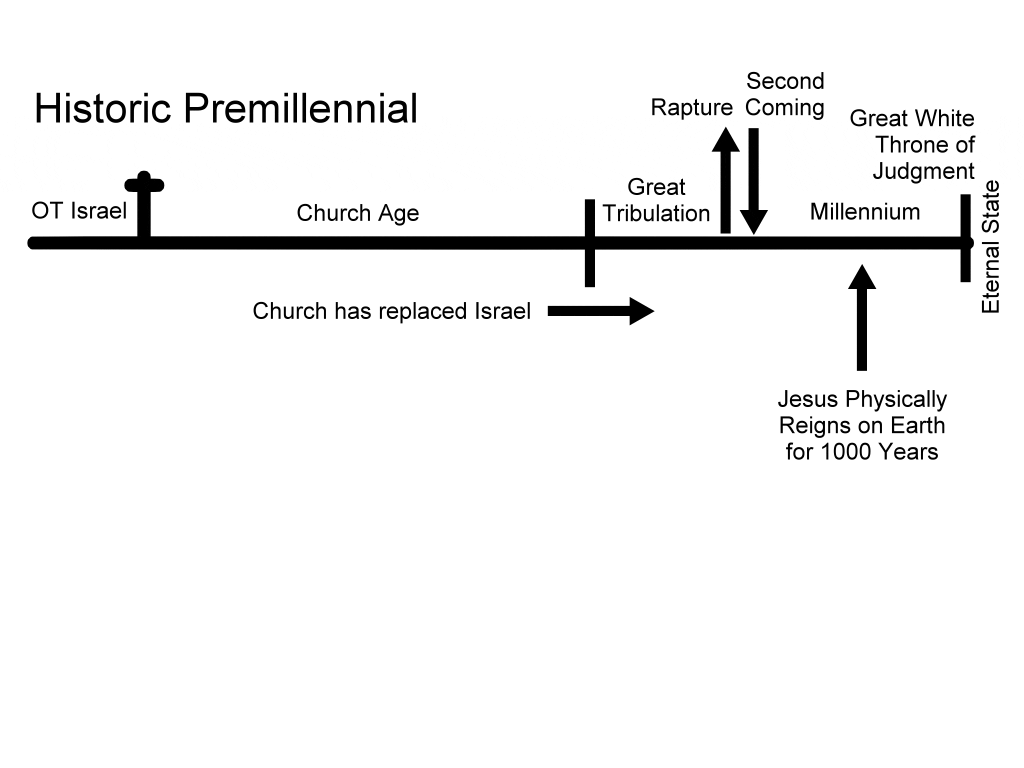
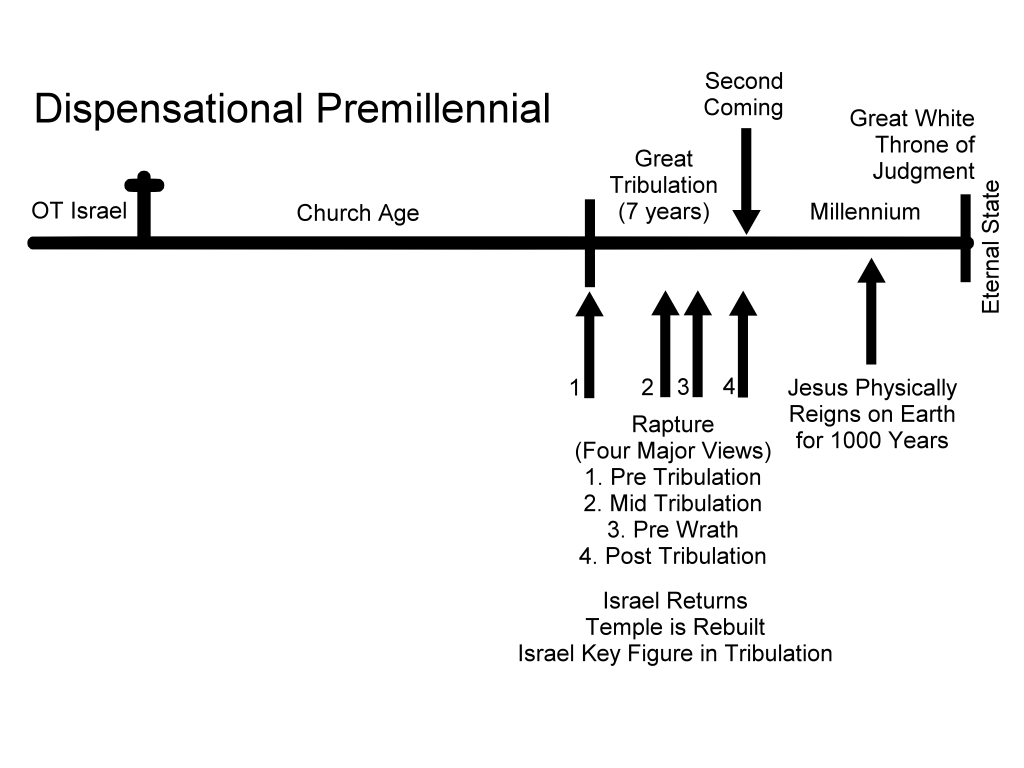
The older of the viewpoints is deemed “classical” or “historic” premillennialism because of it having existed since the early days of the church. The more recent of the two is called: “Dispensational Premillennialism”, due to its particular approach to dividing up history into epochs or dispensations and distinguishing between Israel and the church.1  To aid the reader in distinguishing between these two versions of Premillennial thought, the following comparative charts can be noted:


Historic Premillennialism Pictured2

Dispensation Premillennialism Pictured3


Similarities between Classical and Dispensational Premillennialism
Dr. Timothy Paul Jones nicely summarizes the similarities between historic/classical premillennialism and dispensational premillennialism:4

1. The Biblical writers expected a future physical kingdom

2. Jesus will reign personally over the whole earth, and no creature will ever be prey or predator ever again

3. Before Jesus returns, demonic deceptions will multiply, and spiritual conditions throughout the world will worsen (1 Timothy 4:1-5; 2 Timothy 3:1-9)

Two other similarities can be mentioned in addition to Dr. Jones' listing:

4. The term “1,000” is taken to refer to a literal earthly stage of Christ’s Kingdom. Historic Premillennialists will by and large focus more on the earthly kingdom aspect, without making the number necessarily literal (although most would say it is). Dispensational Premillennialists will assert both the literal earthly aspect of Jesus’ reign and that it will definitely be 1,000 years in duration. 

5. Revelation 20 in its entirety is speaking of a future earthly reign of Jesus Christ on this world. 

Differences between Historic and Dispensational Premillennialism
For a long time this author had held to what was a Historic Premillennial viewpoint. By and large there are a few tenets of that system this blogger still find appealing. However there are a couple of aspects of the Dispensational Premillennial viewpoint that this blogger believes to be in line with the scriptures. In having read books, listened to lectures and talked to various people over the years, the following differences can be noted.

1. Historic Premillennialism believes the church will go through the tribulation – i.e a posttribulational viewpoint. 


Dispensational Premillennialism would differ in saying that the church will be raptured before the tribulation – i.e a pretribulation viewpoint.  

2. Historic Premillennialists such as Charles Spurgeon believed the Gospel would continue to increase in study proclamation until Christ returns to set up His 1,000 year reign. 


Dispensational Premillennialism believes the Gospel will be proclaimed, but more in a start, stop, start fashion. With the church being rapture out before the tribulation, the 144,000 will pick up the task and multitudes of people (not the church) will get saved out of the tribulation, having died for their faith in the tribulation. (compare Revelation 7,14). 

3. Historic Premillennialists would say that the church has replaced Israel or is the new Israel.


Dispensational Premillennialists would make the distinction between the two.

4. Historic Premillennialists tend to read the Old Testament prophecies in light of the New Testament.


Dispensational Premillennialists tend to view the unfolding of Bible Prophecy as deriving from God’s promises to Abraham, David and the New Covenant. Both viewpoints of course make Jesus Christ and His act of fulfilling God’s promises and prophecies central to their understanding of end time events.

Where this author stands on the subject of Premillennialism
I'm certain by now for those readers who have been tracking this most recent series of posts that I am a Premillennialist in my approach to Revelation 20:1-10.  The question is, in light of the two positions above, where do I stand? Both positions represent endpoints in the interpretive camp of the Premillennial approach to scripture and Revelation 20.  There are in my mind at least two legitimate observations I find helpful from each version, totalling four points in all in where I stand on the Premillennial issue.

1. I find the Historic Premillennial idea of Jesus' Kingdom being an already/not yet Kingdom quite helpful in understanding Bible prophecy.  To say it is all future is ignoring the statements made by the Apostles regarding all that took place following Jesus' ascension.  Clearly He is ruling in some fashion in Heaven.  However there is an aspect to Jesus Kingdom that has yet to take place - which I would argue to be the 1,000 year reign spelled out in Revelation 20:1-10.

2. I agree with the Dispensational Premillennial view that we still need to make distinctions between the church and Israel.  Unlike my Historic Premillennial friends, I do not think the church has replaced Israel.  Two of the main purposes of the Millennium is for God's promises to Israel to be completed and for the church to physical rule with Jesus on His throne. (Romans 11:25-26; Ephesians 2:6-8; Revelation 20:1-6)

3. I agree with the Historic Premillennialists that the New Covenant spoken of in the Old Testament and the New Testament is the same and not two different New Covenants.  This is a key point in that the New Covenant promises of which the church is getting a foretaste are directly related to the full New Covenant promises which Israel will be enjoying in the Millennial Kingdom.  

4. I agree with the Dispensational Premillennialists that the rapture of the church will preceed the tribulation and thus the church-age saints resurrection will be a "part one" of a two-part resurrection of the righteous, with Israel's resurrection at Christ's second advent concluding that resurrection sequence. Revelation 20:6 notes "blessed  and holy is the one who has a part in the first resurrection".   

Endnotes:
1. To try to clear up the differences between the two positions, some scholars have deemed the older version of Premillennialism “post-tribulational Premillennialism” due to its view of seeing the church go through the tribulation and viewing the rapture and second coming as one event. The second version of Premillennialism is sometimes termed “pretribulational Premillennialism” and teaches that the church will be raptured before the tribulation and stresses the distinction between the church and Israel.  We will for our purposes stick to the titles “historic” and “dispensational” premillennialism. 

2. http://www.bibleistrue.com/qna/qna91.htm#historicpremill

3. http://www.bibleistrue.com/qna/qna91.htm#disppremillennial

4. Dr. Timothy Paul Jones. Rose Guide to Endtimes Prophecy. Page 329.