Translate

Monday, November 17, 2014

Saturday 11/15 Give thanks to the Lord


1 Timothy 1:12 "I thank Christ Jesus our Lord, who has strengthened me, because He considered me faithful, putting me into service."

Introduction
I like how Paul begins this section of 1 Timothy with the simple words: "I thank Christ Jesus". Too often we as God's people don't take the time to thank the Lord. Today's post aims to see how major figures in the Bible thanked the Lord. 

1. Jacob gave thanks the Lord. 
Genesis 32:10 "I am unworthy of all the lovingkindness and of all thef aithfulness which You have shown to Your servant; for with my staff only I crossed this Jordan, and now I have become two companies."

Jacob had to flee for his life from his brother Esau for stealing his blessing. Twenty years had passed and Jacob was on the eve of meeting up with his brother again. God had been certainly good to Jacob in a way far more than he deserved. But in reality, cannot the same be said of us as Christians living in the 21st century. It is not until we are forced to slow down and reflect that we can look back and see all the good things God has done, even when circumstances were less than desirable.

2. King Solomon gave thanks the Lord.
1 Kings 8:56 “Blessed be the Lord, who has given rest to His people Israel,according to all that He promised; not one word has failed of all His good promise, which He promised through Moses His servant."


King Solomon is recognizing God's faithfulness to his people, stretching all the way back to 480 years during the days of Moses. God's character and faithfulness are the lenses that enable us to see numerous reasons to thank the Lord. Solomon's statement of "not one Word of the Lord has failed" is one of the strongest affirmations in the Bible about the infallibility of scripture. To know that no one word of the Lord can ever fail is great cause for giving thanks to Him.

3. The Psalms gave thanks to the Lord
Psalm 136:1 "Give thanks to the Lord, for He is good,For His lovingkindness is everlasting."

This Psalm has to be among the most saturated Psalms that deals with the subject of giving thanks to the Lord. The entirety of redemptive history is rehearsed, with near continuous cries of thanksgiving to God for His provision, power and protection of His people. Should you and I not give thanks to the Lord for all those times he has demonstrated his power, protected us and provided?

4. Jesus gave thanks to the Lord. 
Luke 10:21 "At that very time He rejoiced greatly in the Holy Spirit, and said, “I praise You, O Father, Lord of heaven and earth, that You have hidden these things from the wise and intelligent and have revealed them to infants. Yes, Father, for this way was well-pleasing in Your sight."

None give us a finer example of being thankful to the Lord than the Lord Himself - Jesus Christ. Jesus thanked the Lord for the illumination that was being experienced by His audience. We ought to give thanks to the Lord for those moments where clarity is obtained and where we see growth in our lives or in the lives of others. Certainly without the grace of God at work in the human heart, no one could believe nor understand the things of God. We have so much to be thankful for in this day and age. 

5. Paul gave thanks to the Lord
As we saw in the opening verse above in today's post, Paul was thanking the Lord Jesus Christ for calling him to the ministry and for the blessings bestowed upon him in salvation. As Paul wrote to Timothy and the church at Ephesus in this epistle, he was reminding them that our Christian lives and church lives ought to be constantly attended with thanksgiving to God.

Will you and I give thanks to the Lord?
So what about you and me? Are we giving thanks to the Lord? We ought. God has so blessed us in far more ways than we can think or imagine. Thank the Lord for the small things as well as the big things. Thank Him for the people in your lives - including those who rub you the wrong way. Why? They are heavenly sandpaper ordained by God to rid you and me of anything that is not likened unto Jesus Christ. Thank the Lord for His Word, prayer and even the fact we live in a free country. Most of all - thank the Lord for Himself. Give thanks to the Lord!


Sunday 11/16 Be thankful for God's calling


1 Timothy 1:12-14 "I thank Christ Jesus our Lord, who has strengthened me, because He considered me faithful, putting me into service, 13 even though I was formerly a blasphemer and apersecutor and a violent aggressor. Yet I was shown mercy because I acted ignorantly in unbelief; 14 and the grace of our Lord was more than abundant, with thefaith and love which are found in Christ Jesus."

Yesterday we considered the importance of giving thanks to the Lord. We considered key individuals in the Biblical record, and how they gave thanks to the Lord. Today we consider Paul's statements in 1 Timothy 1:12-14. As he wrote this epistle to the young Pastor at Ephesus, Timothy, Paul wanted to express to Timothy what it would take to excercise oneself properly in the church of God. A key trait of both pastor and church member alike is giving thanks to the Lord. Certainly the theme of God's calling is evident in these verses, being that without God's calling in ministry or even in salvation, no one could serve and no one could experience salvation.

Thank the Lord for the call to ministry
Paul begins by expressing to Timothy how awesome it was that Jesus Christ Himself had called Him to minister as an apostle. One of the motivations for sharing this trip down memory lane is to remind Timothy of the fact that he had been with the Lord from the beginnings of the Christian movement. Some of the false teachers who were confusing the Law and Gospel were "Johnny-Come-Latelys" who only wanted fame and noteriety among men. Paul's Divine encounter with the post-resurrected, post-ascended Jesus on the Damscus road can be reasonably dated to within less than two years of Jesus' ascension. In Acts 9:22 we read of what took place following Paul's dramatic encounter: "But Saul kept increasing in strength and confounding the Jews who lived at Damascus by proving that this Jesus is the Christ."

Paul had been known as "Saul" in those early days, and Acts 9 explicitly states that he was "increasing in strength". The same word used by Luke in Acts 9:22 is the same word used by Paul here in 1 Timothy 1:12. It was Jesus Himself who enabled Paul with the gifts and talent to begin serving him in the ministry. Such an endument or "anointing" from on-high remained with Paul even to the writing of 1 Timothy. God's calling is remarkable in the fact that God's choosing and calling of people stems not from what they do but completely from God's own personal desire to use them. 

Thank the Lord for the call to salvation
It is in 1 Timothy 1:13-14 that Paul expands upon the significant circumstances surrounding His calling to ministry. Paul's call to salvation came first. The point of these verses is to underscore the fact that out of all the people in the world who were least likely to be the greatest spokeman for Jesus Christ the world-over, certainly that person could not had been Saul of Tarsus. As Paul relays in 1 Timothy 1:13a "even though I was formerly a blasphemer and a persecutor and a violent aggressor." I love the phrase "even though". Why? Because whatever will come after that "even though" phrase will totally overule whatever Paul had once done prior to his conversion.

You and I dear friend have done a lot of "even though's" in our lifetimes. We were not worthy to be called by Jesus Christ unto His salvation. We were in the same predicament as all lost sinners. Paul was literally arch-enemy number one to both the early church and to Jesus Christ. 

With that said, the most powerful word in 1 Timothy 1:13 erases Paul's former identity: "yet". "Yets" are awesome words in the scriptures. When I see the word "yet", that is usually a God word. God alone can take a no body and make them a somebody who can tell everybody about The Somebody who can save anybody. This is Paul's whole point in his fountain of thanksgiving in these verses. We read in 1 Timothy 1:14 "and the grace of our Lord was more than abundant, with the faith and love which are found in Christ Jesus."

Think about this: if Jesus had not called Paul in salvation, he would had continued on the road of destruction. Furthermore, if Jesus had not called Paul in salvation and then into ministry, we may not have had 2/3 of our New Testaments or at least we would not have the same Bibles that have survived for two millennia. The call of God makes nothing into something. 

May you and I today be thankful for God's calling. I thank the Lord who called me unto Himself in 1984 and who called me into His service in 1991. Whatever station of life you are serving, whatever you are doing, give thanks to the Lord. To think that the God of Eternity can be this Personal to call us by name to Himself and into His service is indeed cause of much thanksgiving!

5 Statements you can trust from 1 & 2 Timothy and Titus


1 Timothy 1:15 "It is a trustworthy statement, deserving full acceptance, that Christ Jesus came into the world to save sinners, among whom I am foremost of all."

Today's post is about the five "trustworthy" statements we find throughout 1 Timothy, 2 Timothy and Titus. As Paul wrote these letters to Timothy, Titus and their congregations, he wrapped his arms around key truths of scripture and the early apostolic preaching based upon the scriptures and summarized it all in five statements. Being that the Holy Spirit of God was superintending these words, we could say that these 5 statements illustrate for us the truth of the Bible's infallibility - that is to say, the Bible's ability to lead us into all truth and to never fail (hence the term "trustworthy statements). Below I will list the sayings with headings to highlight these 5 statements you can trust, and why it is you can trust them.

1. Gospel to save the sheep. 
1 Timothy 1:15 states - "It is a trustworthy statement, deserving full acceptance, that Christ Jesus came into the world to save sinners, among whom I am foremost of all." This first "trustworthy statement" deals with the mission of Jesus Christ as spelled out clearly in the Gospel. When I speak of "sheep", I'm referring to believers in Jesus Christ, as called by Jesus for example in John 10. The term "gospel" is found over 100 times in the New Testament. Paul told Timothy to deal with the false teachers that were infiltrating the church at Ephesus, and to be sure to preach the Gospel which can save both he and his hearers. (1 Timothy 4:13-16). Thus the Gospel itself is the first statement we can trust, because it saves the sheep. But notice the second trustworthy statement...

2. Pastors to guard the sheep
1 Timothy 3:1 "It is a trustworthy statement: if any man aspires to the office of overseer, it is a fine work he desires to do." We as believers in Jesus Christ need pastors. Even as a pastor writing this post today, I myself look to other fellow pastors and listen to pastors in their preaching to get fed, to attain wisdom and to better understand the scriptures. This statement is trustworthy for the simple fact that it gives us the qualifications for pastors and it reminds us of our need to be under God's Word. Jesus prescribes the pastoral ministry to His church to build up the church to the goal of attaining the unity He prayed for and aims to achieve before His second coming. (John 17; Ephesians 4:11-12). Now lets consider a third statement you can trust regarding doctrine.

3. Doctrine to feed the sheep
1 Timothy 4:9-10 tells us these words - "It is a trustworthy statement deserving full acceptance. 10 For it is for this we labor and strive, because we have fixed our hope on the living God, who is the Savior of all men, especially of believers." What is doctrine? Doctrine is the fine pearl necklace that adorns the church and tells us who God is, who we are, how to think Biblically and what to tell others about the Gospel. Doctrine gives us vocabulary with which to describe our glorious Savior. Doctrine is the handmaiden of Biblical preaching and the assistant to the Christian in the practical affairs of everyday life. The reason why I ascribe the value of doctrine to this third trustworthy statement is because it answers for us in the clearest way possible: for whom did Christ die? The accomplishment of Jesus Christ on the cross requires doctrine to explain it and apply it to both believers and non-believers alike. This statement is one that summarizes virtually every scripture that touches upon Jesus' atoning death. He died for all men in a historic sense (Savior of all men) and for His church in the eternal sense (especially of believers). (1 John 2:2; Acts 20:28) 

Jesus died for all men in the sense to give time and room in history for everyone to believe and repent. God's general revelation in creation renders all people without excuse and no one can say they did not know about God and His nature, power and wrath. (Romans 1:18-20; Acts 14:17). If a person so humbles them selves to such general revelation, God by His Spirit will send a Christian with the Gospel of the special revelation of the Bible, drawing that person then to saving faith in Jesus Christ. Unless the Son's work on the cross had been directed toward the whole world, the whole world would had been destroyed due to the fact that the Holy God of eternity cannot tolerate sin in His sight. (Isaiah 6; Habakkuk 1:13). 

In dying for all men, those whom the Father sends His Spirit to Divinely affect by His convicting work, whom He lovingly set His affection upon, who willingly and freely respond to the call of Gospel are those for whom Jesus died for in the ultimate sense. Those truly regenerate persons are those who compose the true church of Jesus Christ, which is what Jesus gave His life for as planned out between He, the Father and The Spirit in eternity. (Acts 20:28) 1 Timothy 4:9-10 is a trustworthy statement that wraps its long arms around the massive doctrine of the atoning achievement of Jesus Christ and thus is a statement we can trust as doctrine that feeds the soul of the sheep. 

4. Truth to liberate the captive sheep and those pretending to be sheep
2 Timothy 2:9-11 tells us - "It is a trustworthy statement: For if we died with Him, we will also live with Him;
12 If we endure, we will also reign with Him; If we deny Him, He also will deny us; 13 If we are faithless, He remains faithful, for He cannot deny Himself."  I find in this fourth trustworthy statement a word of warning and a word of encouragement. The liberating truth comes in freeing believers from the fear of wondering whether or not they are saved. Likewise, for some who are playing church or make-believers, the jarring truth of 1 Timothy 2:12 awakens them from their little game to believe, repent and be saved. We need this statement to set us free from fear and carelessness. Truly then this statement can liberate people. 

5. Holiness to purify the sheep
Titus 3:8 notes - "This is a trustworthy statement; and concerning these things I want you to speak confidently, so that those who have believed God will be careful to engage in good deeds. These things are good and profitable for men." We have considered four statements thus far that you can trust in essential matters of the Christian life. This final statement is important due to the call to live a holy life for the glory of God. Without the scriptures and the power of the Holy Spirit, our efforts to live holy lives will be exercises in futility. Paul reminds Titus that the scriptures (including what he is writing) are designed to urge readers to pursue a holy and devout life with God and before men. 

Closing thoughts
Today we have considered the five "trustworthy statements" found in Paul's three letters of 1 Timothy, 2 Timothy and Titus. These are summaries of large and important teachings of scripture that are inspired statements themselves that we can trust. As was mention, such statements highlight the infallibility of scripture or the ability of the Bible to lead us into all truth without fail. In considering these five statements you can trust, we saw...
1. The Gospel that saves the sheep
2. Pastor to guard the sheep
3. Doctrine to feed the sheep
4. Liberation of captive sheep
5. Holiness to purifiy the sheep

Thursday, November 13, 2014

Friday 11/14 This Means War! What it means to put on the full armor of God: Fight for your faith


Ephesians 6:10-12 "Finally, be strong in the Lord and in the strength of His might. 11 Put on the full armor of God, so that you will be able to stand firm against the schemes of the devil. 12 For our struggle is not against flesh and blood, but against the rulers, against the powers, against the world forces of this darkness, against the spiritual forces of wickedness in the heavenly places."

Introduction and Review
We have been spending the past couple of days exploring what is meant by the command to "put on the full armor of God." So far in our consideration of the wider context of Ephesians 4-6, we have suggested that putting on the full armor of God means: Filled with the Holy Spirit and living out the fully-obedient Christian life. Today we offer a third and final suggestion as to what it means to put on the full armor of God: Fight for your faith.

Putting on the full-armor of God means fighting the fight of faith
I want to direct the reader's attention to the following statements in Ephesians 6:11-12 that suggest this third meaning of "putting on the full armor of God".

"so that you will be able to stand firm" vs 11

"our struggle" vs 12

"but against rulers, against powers, against the world forces of this darkness, against the spiritual forces of wickedness in heavenly places" vs 12

Think about this: Why would the Apostle Paul be commanding us to put on the full armor of God unless we were not to fight? Now this may seem obvious from the context of Ephesians 6 - however by the way we so often live the Christian life, it seems we are more ready to give up ground to our enemy in the eternal matters of the Christian faith.

All of the spiritual armor has to do with various areas of the Christian life. If we fail to put on the full armor and fight the fight of faith - then we give up much ground. Consider how often we are told to "fight for our faith":

Romans 13:12 "The night is almost gone, and the day is near. Therefore let us lay aside the deeds of darkness and put on the armor of light."

1 Timothy 1:18-19 "This command I entrust to you, Timothy, my son, in accordance with the prophecies previously made concerning you, that by them you fight the good fight, 19 keeping faith and a good conscience, which some have rejected and suffered shipwreck in regard to their faith."

2 Timothy 4:7  "I have fought the good fight, I have finished the course, I have kept the faith."

1 Thessalonians 5:8 "But since we are of the day, let us be sober, having put on the breastplate of faith and love, and as a helmet, the hope of salvation."

Jesus Himself waged cosmic battle against Satan and the kingdom of darkness, winning the war of redemption in Colossians 2:11-15. We are as it were the church militant, sailing through the turbulent waters of the history and proclaiming this victory. Jude writes these words in Jude 3  "Beloved, while I was making every effort to write you about our common salvation, I felt the necessity to write to you appealing that you contend earnestly for the faith which was once for all handed down to the saints."

Closing thoughts:
We have considered these past several days the meaning of "putting on the whole armor of God." In our studies we have concluded three meanings for this instruction:

1. Filled with the Holy Spirit
2. Fully obedient to the Lord
3. Fight for your faith

This means war! What it means to put on the full armor of God: Fully Obedient


Ephesians 6:10-12 "Finally, be strong in the Lord and in the strength of His might. 11 Put on the full armor of God, so that you will be able to stand firm against the schemes of the devil. 12 For our struggle is not against flesh and blood, but against the rulers, against the powers, against the world forces of this darkness, against the spiritual forces of wickedness in the heavenly places."

Introduction and Review
Yesterday we suggested that Paul's command to put on the full armor of God has to do with being filled with the Holy Spirit. The Spirit-filled life entails us surrendering under the Holy Spirit's leadership so as to be more effective in the daily battle of faith. We noted how the Spirit-filled life can be likened unto chain-mail that protects the body from the weaponry of the enemy. Being that the idea of "putting on the full-armor of God" is a command, we suggest that the second meaning of putting on the full-armor of God has to do with the obedient Christian life.

Putting on the full armor of God means living the obedient Christian life
Obedience to God and the Spirit-filled life goes hand in hand. The filling of the Spirit is the power source or motivation for obedience and obedience is the fruit and effect stemming from being Spirit-filled. It is a manifest impossibility to claim to be Spirit-filled and yet not be obedient. Whenever we disobey God in an area, we have just betrayed such a claim. 

Anytime we see God commanding things in scripture, two things are implied: exercise of the will and the need of God's grace to carry out the command. The ancient Christian writer Augustine had a short little prayer that went something like this: "command what thou wilt and will what thou commandest." In other words, God has the right and authority to issue forth commands from His Word for the carrying out by His people. The human will is the primary vehicle of the heeding in such circumstances. Think of a snow-shovel used to shovel a drive-way. How can I go outside in the winter and shovel snow unless I have the proper tool to carry out the task.

However the involvement of the human will in obedience does not complete the explanation. There must necessarily be some kind of power, influence and Person at work with the human will. Just as a shovel by itself would never be able to shovel snow, and thus needs an external person yielding it, so it is with God in the carrying out of His commands.

Whenever we see Paul's instructions on putting on the full-armor of God, certainly the power source in this instance is the filling of the Holy Spirit. The Holy Spirit is the Person Who shapes and molds the Christian to do the will the Lord. However, the Christian in turn must yield in obedience to demonstrate that they are ready to fight the good fight of faith. Notice the commands Paul issues in Ephesians 6:10-18:

"be strong in the Lord" vs 10

"Put on the full armor of God" vs 11

"take up the full armor of God" vs 13

"Stand firm" vs 14

"and having shod your feet..." vs 15

"taking up the shield of faith.." vs 16

"And take the helmet of salvation" vs 17

"pray at all times...." vs 18

These commands indicate that at the heart of putting on the full armor of God is obeying the Lord's will. Even the idea of being Spirit-filled is a command! Our General - Jesus Christ - issues these commands by His Spirit through the Word. We require the Spirit-power to carry them out and the willing obedience to heed the commands. Thus putting on the full-armor of God means being Spirit-filled and living out the obedient Christian life. 

Wednesday, November 12, 2014

This means war - What it means to put on the full armor of God: Be Spirit filled


Ephesians 6:10-12 "Finally, be strong in the Lord and in the strength of His might. 11 Put on the full armor of God, so that you will be able to stand firm against the schemes of the devil. 12 For our struggle is not against flesh and blood, but against the rulers, against the powers, against the world forces of this darkness, against the spiritual forces of wickedness in the heavenly places."

Introduction
Last week I began a periodic blog series that featured the topic of spiritual warfare. I am entitling this periodic series: "This means War!" In the post last week we considered the significance of spiritual warfare and looked at 1 Samuel 17 and the account of David and Goliath. In considering principles about spiritual warfare from that epic battle, we saw the following points:
1. The methods of the enemy are pride and fear. 1 Samuel 17:1-11

2. Mission of enemy is to destroy you. 1 Samuel 17:12-30

3. Might of God defeats the enemy. 1 Samuel 17:31-58.

In that opening study we considered our main point of application to be: We must grasp that we are in a spiritual war if we are to fight the fight of faith. 

In today's post we now turn our attention exclusively to Ephesians 6, with the goal this week to discover what putting on the full armor of God actually means. Such a command can sound so abstract until we consider the wider context of Ephesians 6:10-18. Today's focus will be on exploring the first meaning behind this command: Be Filled with the Holy Spirit.

Putting on the Whole Armor of God means being Spirit filled. 
Notice what Paul writes in Ephesians 6:10 "Finally, be strong in the Lord and in the strength of His might." Whenever you see that underlined word: "finally", the indication is that Paul is bring to a close a series of points. In tracing back through the letter of Ephesians, we arrive at the beginning point of his line of argumentation, Ephesians 4:1 "Therefore I, the prisoner of the Lord, implore you to walk in a manner worthy of the calling with which you have been called."

The whole idea of "walking with God" is a huge point in this second part of Ephesians. Like connecting the dots throughout the remainder of Ephesians 4,5 and 6, we can trace the chain of commands:

Ephesians 4:17 "So this I say, and affirm together with the Lord, that you walk no longer just as the Gentiles also walk, in the futility of their mind."

Ephesians 5:1-2  "Therefore be imitators of God, as beloved children; 2 and walk in love, just as Christ also loved you and gave Himself up for us, an offering and a sacrifice to God as a fragrant aroma."

Ephesians 5:15,18 15 "Therefore be careful how you walk, not as unwise men but as wise." 18 "And do not get drunk with wine, for that is dissipation, but be filled with the Spirit."

To walk with God requires the believer to be "filled" or "under the influence" of the Holy Spirit. The filling of the Holy is commanded not only here in Ephesians, but elsewhere in the scriptures and stated in differing ways. For example, Galatians 5:16 "But I say, walk by the Spirit, and you will not carry out the desire of the flesh." Colossians 3:16 "Let the word of Christ richly dwell within you, with all wisdom teaching and admonishing one another with psalms and hymns and spiritual songs, singing with thankfulness in your hearts to God." To have the scriptures memorized or to have spent time in them to the point of having them in me is practically equivalent to submitting oneself under the Spirit's influence. 1 Thessalonians 5:19 "Do not quench the Spirit."

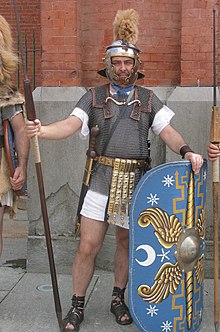
When I think of the "Spirit-filled" life, such a condition can be likened unto the "chain-mail" a soldier would had worn in the Roman army of the 1st century. 

wikipedia picture

Putting on the Whole Armor of God not only has to do with putting on behaviors and habits but must first begin with the inside.  According to the Zondervan Pictorial Encyclopedia of the Bible, such "chain-mail" (called by the Roman Soldiers lorica) would had protected the heart and vital organs behind the rib cage. 

Why labor this point about chain-mail? Because the filling of the Holy Spirit means we are guarding the organ of thought and passion for God - the heart. Certainly the Holy Spirit's indwelling presence is a must, being that this is after all "the whole armor of God". One must be a Christian to wear the spiritual armor. However, to ensure effectiveness in spiritual warfare and defending Kingdom ground in our marriages (Ephesians 5:22-33); child-rearing (Ephesians 6:1-4) and workplaces (Ephesians 6:5-9), we as Christians must daily be Spirit-filled. This is why Paul's command to put on the full armor of God in Ephesians 6:10-18 comes at the tail end of a string of commands that are about making sure we are walking with God as Spirit-filled believers.  As is always the case in the Spirit-filled life: the issue is not about you getting more of the Spirit but rather Him getting more of you. Thus putting on the full armor of God means being filled with the Holy Spirit.

Tuesday, November 11, 2014

4 Great tires 4 life


Galatians 1:1-5 "Paul, an apostle (not sent from men nor through the agency of man, but through Jesus Christ and God the Father, who raised Him from the dead), and all the brethren who are with me, To the churches of Galatia: Grace to you and peace from God our Father and the Lord Jesus Christ, who gave Himself for our sins so that He might rescue us from this present evil age, according to the will of our God and Father,to whom be the glory forevermore. Amen."

Introduction:
Anytime you get fresh tires on your car, the performance and the ability of the vehicle to stay on the road dramatically improves. The road of life needs 4 great tires if we are to navigate the perilous pot holes and obstacles we encounter as believers in Jesus Christ. Paul's letter to the Galatians is all about presenting in the clearest way possible the implications of the Gospel of Jesus Christ. Facing a crisis that entailed a near wholesale compromise of the Gospel by the Galatians, Paul sets forth his most aggressive letter in urging the Galatian Christians to stay true to the Gospel of Jesus Christ. 

Today's post is aimed at setting out in short order the 4 great tires of life. As we take a quick drive through the Book of Galatians, our main point of application will be: You and I need 4 great tires to stay on the road of life into eternity to the right destination. What are the tires of which I speak? Let's discover. First of all....

God is in control. Galatians 1:1-5
As we saw in the opening text of today's post, Paul was acknowledging that God through Jesus Christ had called Him to be an apostle. In Galatians 1:4 he states that all of this was made possible by "the will of God". Do you believe God is in control? Such a belief affirms what we call "God's Sovereignty". God's Sovereignty refers to His comprehensive control over all people, places and times. God uses other secondary methods in accomplishing His will such as the choices of human beings, events and history. Whenever you and I are facing uncertainty or dealing with incredible difficulties like what Paul was facing here in Galatians, affirming the Sovereignty of God can be a great comfort. Passages such as Romans 11:36 reminds us: "For from Him and through Him and to Him are all things, to Him be the glory forever and ever, amen." So the first great tire for keeping life on the road for God is understanding that God is Sovereign or in control. Let's consider the second great tire for life, namely....

Jesus. Galatians 2:20; 3:13-14; 6:14
As Paul was urging his readers to stay focused on the Lord, he repeatedly affirmed the Person and work of Jesus Christ. In Galatians 2:20 he writes: "I have been crucified with Christ; and it is no longer I who live, but Christ lives in me; and the life which I now live in the flesh I live by faith in the Son of God, wholoved me and gave Himself up for me." Without Jesus Christ, life as we know it could not exist. There would be no hope. No salvation. Nothing. Galatians 3:13-14 gives us one of the clearest summaries of what Jesus achieved: "Christ redeemed us from the curse of the Law, having become a curse for us—for it is written, “Cursed is everyone who hangs on tree”— 14 in order that in Christ Jesus the blessing of Abraham might come to the Gentiles, so that we would receive the promise of the Spirit through faith." When Paul closed out his letter, he ended with the focus clearly on Jesus Christ in Galatians 6:14 "But may it never be that I would boast,except in the cross of our Lord Jesus Christ, through which the world has been crucified to me, and I to the world." So far we have two incredible tires for keeping life on the road of life into the right destination to eternity: God is in control and Jesus Christ. Now let's consider the third Great tire for life...

The Bible. Galatians 3:8, 22-23
Paul writes in Galatians 3:8 "The Scripture, foreseeing that God would justify the Gentiles by faith, preached the gospel beforehand to Abraham, saying, “All the nations will be blessed in you.” Think about this: where we would be without the Bible? God is the talking God who reveals His Power and Presence in creation, His Person in Jesus Christ and His Personal will in the scriptures. Without the Bible, we have no light for the path (Psalm 119:105); no understanding of how to follow the Lord (Proverbs 3:5-6) and no ability to know God's will for our lives. Without the scriptures, no one could experience salvation. (Romans 10:17). Scripture is so necessary for living a life for the glory of God. We read these words in Galatians 3:22-23 "But the Scripture has shut up everyone under sin, so that the promise by faith in Jesus Christ might be given to those who believe. 23 But before faith came, we were kept in custody under the law, being shut up to the faith which was later to be revealed." 
So far we have seen that we need four great tires to stay on the road of life into eternity: God is in control, Jesus and the Bible. Now lets consider one more of the these "four great tires"...

The Gospel. Galatians 1:9; 2:16-19; 3:6
My question to you dear reader is this: have you by grace through faith received Christ Jesus as Savior and Lord? Paul's central concern about the Gospel touches upon how a person is reconciled to God. Galatians 1:9 states:  "As we have said before, so I say again now, if any man is preaching to you a gospel contrary to what you received, he is to be accursed!" If we don't get the Gospel right, we won't get anything right. The Gospel is clearly presented in the Bible, about Jesus Christ and made possible by the Sovereignty of God. We must not merely assert these truths as intellectual facts, but as articles of faith embraced by faith in our hearts. The Gospel not only reminds us of Jesus' achievement - but Jesus' achievement for you and me. Consider Galatians 2:16 "nevertheless knowing that a man is not justified by the works of the Law but through faith in Christ Jesus, even we have believed in Christ Jesus, so that we may be justified by faith in Christ and not by the works of the Law; since by the works of the Law no flesh will be justified." The central truth of the Gospel is that by means saving faith, Jesus Christ's righteousness is credited to the sinner by God. Galatians 3:6 states: "Even so Abraham believed God, and it was reckoned to him as righteousness." This truth, called "justification by faith", is in the words of the Great Reformer Martin Luther: "The one article upon which the church stands or falls". If we get the gospel wrong, we get it all wrong, and thus we will be headed down the wrong road.

Closing thoughts:
Today's post was all about presenting four great tires for life. Our main point of application was: You and I need 4 great tires to stay on the road of life into the right eternal destination. The four great tires for life we considered were:
1. God is in control
2. Jesus
3. The Bible
4. The Gospel.