Translate

Saturday, May 30, 2015

Sat 5/30An Outline of the Book of Galatians - The Gospel of Freedom


Galatians 5:1 "It was for freedom that Christ set us free; thereforekeep standing firm and do not be subject again to ayoke of slavery."

Introduction:
Yesterday we introduced the reader to the book of Galatians, stating that it's main theme is: "The Gospel of Freedom". After making some introductory remarks and tracing through the epistle this overall theme, the aim of today's post is to offer an outline of Paul's letter. The hope is that the outline with give the reader a sense of how much the Gospel liberates those who by grace through faith trust in Jesus and who continue to go forth in their process of sanctification, preserved by God to the end. 

Outline of Galatians - The Gospel of Freedom
I. The Gospel that "freed" those who believed on Jesus. 
Galatians 1-4

A. Freed believers from this age. ch1

B. Freed believers from self-righteousness. ch 2

C. Freed believers from religious performance. ch 3

D. Freed believers from their past. ch 4

II. The Gospel that is "freeing" believers in Jesus. Galatians 5-6

A. Freeing believers in the Spirit-filled life. ch 5

B. Freeing believers to do good works. ch 6:1-10

C. Freeing believers to say "yes" to righteousness and "no" to the world.
ch 6:11-18 


Friday, May 29, 2015

Introducing Galatians: The Gospel of Freedom

Galatians 1:3-5 "Grace to you and peace from God our Father and the Lord Jesus Christ,4 who gave Himself for our sins so that He might rescue us from this present evil age, according to the will of our God and Father,5 to whom be the glory forevermore. Amen."

Introduction:
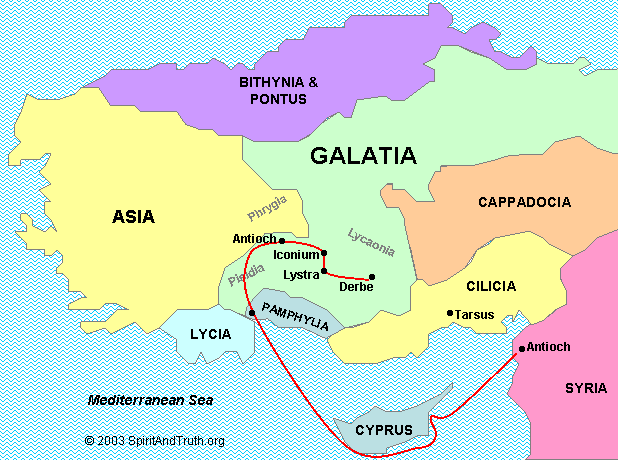
The Apostle Paul is author to nearly 2/3 of the New Testament books. As a former persecutor of the church of Jesus Christ (Acts 9); Saul of Tarsus had a dramatic conversion experience as a result of being encountered by the post-resurrected Jesus on the road to Damascus. Acts 9-13 recounts Saul's conversion, call and commissioning as the Apostle to the Gentiles. As he began to minister, Saul's name was changed to Paul. He would eventually travel in circuits throughout the Mediterranean world, beginning in Jerusalem and eventually ending up in Rome by the end of the Book of Acts. Three of these circuits or "missionary journeys" are recorded in Acts, with the first being the focus in Acts 13-14. As a matter of first importance, Paul took the Gospel into the regions of Galatia in Acts 14:1-23. While some debate whether the churches in Province of Galatia to the North were intended, or whether the three principle cities of Lystra, Derbe and Iconium - all agree that Paul's letter was among his earliest or perhaps even the first one written. (See map below)
We won't concern ourselves today with which theory (North Galatian, making the letter of later composition; South Galatia, making the letter Paul's earliest), pro or con, is the best one. The point is that Galatians represents the main thrust of the preaching of the Gospel as it spread from the region of Judea and Israel to the outer regions of Syria, Cicilia and Galatia. 

The theme of Galatians: The Gospel of Freedom
The Bible Knowledge Commentary notes the purpose of Paul's letter to the Galatians: "The Judaizers in Galatia both discredited Paul and proclaimed a false gospel. It was necessary that Paul vindicate his apostleship and message, a task he undertook in the first two chapters. In this autobiographical section Paul demonstrated convincingly that his apostleship and his message came by revelation from the risen Christ. In chapters 3 and 4 Paul contended for the true doctrine of grace, that is, for justification by faith alone. Finally, to show that Christian liberty does not mean license the apostle, in chapters 5 and 6, taught that a Christian should live by the power of the Holy Spirit and that when he does he manifests in his life not the works of the flesh but the fruit of the Spirit."

There were those operating within the churches of Galatia who attempted to persuade the Galatians that circumcision and adherence to the Mosaic law were needed additions to Christ to complete their salvation. These opponents of the Gospel, the Judiaizers, receive the most blistering rebuke from Paul. Their influence led to the Galatians near renouncement of everything Paul had preached to them. Galatians is the only letter Paul wrote that does not commend the churches for any exemplarary advances in their faith. Paul cuts to the chase and tells them that the Judiaizers are attempting to steal their freedom in Christ that was broughout about by the Gospel. As one writer has noted, any attempt to "add" to Christ only subtracts from Christ. 

In reading through Paul's letter to the Galatians, this blogger submits Galatians 5:1 as the key verse to the whole epistle, since it contains the main theme. Galatians 5:1 states - "It was for freedom that Christ set us free; therefore keep standing firm and do not be subject again to a yoke of slavery." Galatians 5:1 summarizes the Gospel that "freed" believer's from things of their past (Galatians 1-4) and prepares the reader for explaining how the Gospel continues "freeing" believers in their progressive growth in sanctification (Galatians 5-6). 

How the theme of "freedom" is developed throughout the Epistle to the Galatians
As we saw in the opening verses of today's post, the Gospel is described by Paul as Christ's rescue operation of sinners from bondage and sin. Paul warns his readers that the Judaizers are attempting to bring them back into bondage as they spy out their freedom in Christ. (Galatians 2:4) Galatians 5:13 reiterates this main theme of freedom - "For you were called to freedom, brethren; only do not turn your freedom into an opportunity for the flesh, but through love serve one another." 

Other key words throughout letter suggest this key motif of "freedom" in it's expression of the Gospel. For example, Galatians 3:10 reminds the reader that for anyone trying to please God by works of the law, a curse is upon them due to the fact that anyone failing to perform the law's commands are condemned. To contrast this tendency of mankind to choose "performance-based" methods of attempted salvation, Paul states Christ came to "redeem" us from the curse of the law in Galatians 3:13. On several occassions Paul makes reference to God's promise to Abraham, the proto-typical illustration of the believer who has been justified by faith. The theme of God's promise in setting free those who trust in Christ by faith is repeated through the remainder of Galatians 3:22 and 3:29. In chapter 4 of Galatians the reader is introduced to the concept of "adoption", indicating that as adopted sons and daughters of God through saving faith, we are no longer "slaves" but "sons". (Galatians 4:7) Finally, Galatians 5-6 switches the tone from how Christ sets the believer free at the beginning of their salvation to the on-going process of freedom that is available throughout the Christian life. This process of setting Christians free is experienced as a result of the Person and work of the Holy Spirit mentioned in Galatians 5:5,16,18,22-23 & 25 and alluded to in Galatians 6. 

Closing thoughts
The goal of today's post was to introduce the reader to Paul's letter to the Galatians. The theme of "The Gospel of Freedom" is the point and purpose of the letter. When we study Galatians, we are shown how the Gospel sets us free from the things of the past and is setting us free in the here and now. The persistent presence of sin in the believer finds the extremes of legalism or license to sin very enticing. Religion without the cross or godlessness without Christ will always characterize sinful man untouched by saving grace. This is why we need the Gospel and the Christ of the Gospel, who sets us free. 

Thursday, May 28, 2015

God's tender mercies that lead us to worship Christ - Romans 9-11

Romans 12:1 "Therefore I urge you, brethren, by the mercies of God, to present your bodies a living and holy sacrifice,acceptable to God, which is your spiritual service of worship."

Introduction:
Today's post wraps-up what has turned into a series on the tender mercies of God in Romans 12:1. I pray in our journeying through Romans you have found out how great our God is in the display of His tender mercies. Is it any wonder why Paul would use such mercies as the basis for being able to present one's body as a living sacrifice? The mercies we have explored here in Romans represent the much larger expressions of God's tender mercies we find throughout the Bible. We will only have the desire to live the life of worship to God insofar as we recognize how much mercy He has expressed to us. 

We have discovered how Romans is the perfect book to explore the theme of God's mercies.  Amazingly enough there are roughly 70 such mercies listed throughout the first 11 chapters of Romans. We've considered 55 of them thus far in Romans 1-8 and in today's post we will finish up the remainder of God's tender mercies in Romans 9-11. The tender mercies of God we have looked at deal with those mercies which draw us to Christ (Romans 1-3) and which keep us desiring Christ (Romans 3-5) and keep us in Christ (Romans 6-8). Today's post will consider one final heading - namely those mercies which lead to worship of Christ in Romans 9-11.

God's tender mercies which lead to worship of Christ - Romans 9-11

1. Mercy 9:14
2. Identity
3. Israel 11:1
4. Answered Prayer 10:13
5. No shame 10:11
6. Missionary 10:15
7. God's plan 11:12

Romans 9 as a whole deals with the too often neglected doctrine of election, which as we saw in yesterday's post is among the many tender mercies of God. God was under no obligation to choose anyone. The fact that He chooses whosover He wants is described by Paul as an act of mercy. His choosing of Jacob over Esau and Israel over the other nations is His expression of love. He does what He does because of His loving purposes of grace towards those whom He wants. God is God and has the right to be such. By nature God is merciful. Hence His plan of salvation includes gentiles from every tribe and nation whom He has loving chose to display mercy. Missionaries, the proclamation of the Gospel and the call for sinners to believe and repent are God's mission in demonstrating His mercy upon those who otherwise do not deserve it. 

8. Christ's return 11:26
9. God's wisdom 11:33
10. God's knowledge 11:33
11. God's judgments 11:33
12. God's mind 11:34
13. God's providence 11:36

These last remaining mercies remind us of how great our God is. God has been revealed in the incarnation of the Son and thus such mercies drive us to worship Him. When we think of the nearly 70 mercies that we have considered over the last few days, is it any wonder that Paul would end Romans 1-11 with the great doxology of Romans 11:33-36. May we be those who worship Christ and give Him thanks for His tender mercies. 

Wednesday, May 27, 2015

God's tender mercies that guarantee our salvation in Christ - Romans 6-8

Romans 12:1 "Therefore I urge you, brethren, by the mercies of God, to present your bodies a living and holy sacrifice,acceptable to God, which is your spiritual service of worship."

Introduction:
I pray in our journeying through Romans you have found out how great our God is in the display of His tender mercies. Is it any wonder why Paul would use such mercies as the basis for being able to present one's body as a living sacrifice? We will only have the desire to live the life of worship to God insofar as we recognize how much mercy He has expressed to us. Jesus proves this point in Luke 7:47 "For this reason I say to you, her sins, which are many, have been forgiven, for she loved much; but he who is forgiven little, loves little.” 

We need exposure to a fresh unfolding of God's greatness in His tender mercies. Romans is the perfect book to explore the theme of God's mercies, since Paul basis the remainder of His practical instructions in Romans 12-16 upon such tender mercies revealed in Romans 1-11. Amazingly enough there are roughly 70 such mercies listed throughout the first 11 chapters of Romans. We've considered 43 of them thus far in Romans 1-5 and in today's post we will explore more of these wonderful mercies in Romans 6-8. The tender mercies of God we have looked at deal with those mercies which draw us to Christ (Romans 1-3) and which keep us desiring Christ (Romans 3-5). Today's post will look at those tender mercies of God in Romans 6-8 that guarantee our salvation in Christ.

God's tender mercies that guarantee our salvation in Christ - Romans 6-8

1. Crucified life 6:1-4
2. Freedom 6:4
3. Eternal life 6:23
4. Christ our spouse 7:1-5
5. No condemnation 8:1
6. Spirit-control 8:5
7. Resurrection 8:11
8. God's calling 8:28
9. Election 8:29
10. Foreknown 8:29
11. Secure 8:39
12. Glorified 8:30

When we look at these 12 tender mercies, they all are used by the Holy Spirit to minister gurantees of assurance. When the Christian is aware of who they are and whose they are, they walk in victory. It has been said that the principle of the victorious Christian life is laid down in Romans 6. In Romans 7, we see depicted the struggle that comes in experiencing what it means to be an overcomer. Romans 8 spells out the reality of such a life and thus God's guarantee that we will not only persevere, but flourish under trial. God has so guaranteed our victory that such mercies empower us to run, not crawl, across the finish line of faith! (2 Timothy 4:7-8) These are the tender mercies that guarantee our salvation in Christ.

More tomorrow...

Tuesday, May 26, 2015

God's tender mercies that keep Christians desiring Christ in Romans 3-5

Romans 12:1 "Therefore I urge you, brethren, by the mercies of God, to present your bodies a living and holy sacrifice,acceptable to God, which is your spiritual service of worship."

Introduction:
Today's post is continuing to explore more of the tender mercies of God revealed to us in Romans. It seems like this phrase in Romans 12:1 "by the mercies of God" has captured my attention. I pray in our journeying through Romans you have found out how great our God is in the display of His tender mercies. Is it any wonder why Paul would use such mercies as the basis for being able to present one's body as a living sacrifice? We will only have the desire to live the life of worship to God insofar as we recognize how much mercy He has expressed to us. Jesus proves this point in Luke 7:47 "For this reason I say to you, her sins, which are many, have been forgiven, for she loved much; but he who is forgiven little, loves little.” 

We need exposure to a fresh unfolding of God's greatness in His tender mercies. Romans is the perfect book to explore the theme of God's mercies, since Paul basis the remainder of His practical instructions in Romans 12-16 upon such tender mercies revealed in Romans 1-11. Amazingly enough there are roughly 70 such mercies listed throughout the first 11 chapters of Romans. We've considered 26 of them thus far in Romans 1-3 and in today's post we will explore 17 more of these wonderful mercies in Romans 3-5. When we think of how merciful God is to an otherwise undeserving people such as us, it truly staggers the mind! We looked at those mercies two days ago which draw sinners to Christ. Today and tomorrow we will explore those mercies which keep Christian's desiring Christ. 

God's tender mercies that keep Christian's desiring Christ - Romans 3-5
1. His glory 3:10
2. His honor 3:10
3. His peace 3:10
4. Imputed righteousness 3:24

The four tender mercies in the above list has to do with God crediting to the sinner the righteousness of Jesus Christ which Christ earned in both His life and death. Such righteousness is place over the sinner like a robe at saving faith. Any good works the Christian does from salvation onward is called "sanctification" or "practical righteousness". Our practical works of righteousness, imperfect and incomplete as they are, are deemed acceptable to God due to the source from whence they draw - namely Christ's imputed or credited righteousness. God's glory, honor and peace are the benefits enjoyed by believers, further testifying to His tender mercies in their lives as a result of Jesus' achieved work on their behalf.

5. Covenant signs 4:11
6. Covenant of grace 4:12
7. Christ our inheritance 4:13
8. Peace with God 5:1
9. Access to God 5:1
10. Hope in God 5:2
11. Perserverance 5:3
12. Character 5:3
13. God's love 5:4
14. Reconciliation 5:10
15. God's gift 5:16
16. Christ's active obedience 5:19
17. Christ's Lordship 5:21

These last remaining tender mercies are those mercies that keep us energized, growing, progressing, desiring, thirsting and loving God. God has walled us in more than we realized. His tender mercies are a might fortress. It would require a years worth of blogposts to unfold all of these mercies. Indeed the mercy and love of God is lavishly poured out on the Christian, testifying to the fact that they are indeed children of God. (1 John 3:1-2)

More tomorrow.... 

Monday, May 25, 2015

God's tender mercies that draw you to Christ in Romans 2-3


Romans 12:1 "Therefore I urge you, brethren, by the mercies of God, to present your bodies a living and holy sacrifice,acceptable to God, which is your spiritual service of worship."

Introduction:
Today's post continues on to explore more of the tender mercies of God revealed to us in Romans. Two days ago we considered God's tender mercies from Romans 1 (http://www.growingchristianresources.com/2015/05/exploring-all-of-gods-tender-mercies-in.html). Romans is the perfect book to explore the theme of God's mercies, since Paul basis the remainder of His practical instructions in Romans 12-16 upon such tender mercies revealed in Romans 1-11. Amazingly enough there are roughly 70 such mercies listed throughout the first 11 chapters of Romans. We've considered 11 of them thus far in Romans 1 and in today's post we will explore 15 more such mercies revealed throughout Romans 2-3. When we think of how merciful God is to an otherwise undeserving people such as us, it truly staggers the mind! To aid us in our exploration, I will deem these mercies as the ways in which God draws us to Jesus Christ.

God's tender mercies that draw you to Jesus Christ - Romans 2-3
1. Riches of His kindness 2:4
2. Riches of His tolerance 2:4
3. Riches of His patience 2:4

These first three mercies of God are described as "riches". God lavishly makes known to sinners His tender mercy by way of the richness of kindness, tolerance and patience. God's endurance, giving space for repentance and kindness is so undeserving. No sinner will be able to say that God was ever unfair. Quite honestly, if God dealt with any of us according to fairness, all of us would be in hell. Let it be remembered that mercy is God choosing to withhold from sinners what they rightly deserve.

4. Justice 3:10
5. The law 2:17, 3:20
6. God's name 2:24
7. The conscience 3:15
8. The Spirit 3:29

These mercies may at first glance appear contradictory. How can God's wrath or justice and the law be viewed as merciful. Like we saw two days ago, God's revelation of anything about Himself or word of warning is an act of mercy. To be shown how dark and sinful we really are is merciful. Such information prompts us to want to find the remedy. Moreover, the same wrath of God revealed from heaven is the same wrath that the Father poured out on the Son. By bearing the wrath of God on His cross, we discover that in our confrontation with the wrath of God we flee to the only place of refuge - the cross. This is where God's name and His Spirit enter into the picture. No other name (the name of Jesus) is given under heaven among men whereby we must be saved (Acts 4:12). Only the blood of Jesus can cleanse the guilty conscience upon which God's law is written. (Romans 2:15; Hebrews 9:13-15) The Holy Spirit is the One Who convicts the world of sin, righteousness and judgment and convinces sinners of their need for Jesus as Savior and Lord. (John 16:8-12) Lest the Spirit of God makes known to sinners the implication and saving power of Jesus, no sinner will willingly turn to God. Once the Spirit of God has acted on the sinner's behalf, we see more tender mercies turning us to Jesus, namely....

9. Regeneration 3:29
10. Righteousness apart from the law 3:21
11. Christ's redemption 3:21 
12. His atonement applied 3:25
13. His blood 3:25
14. God's forebearance
15. Justification 3:26

As we close out today's post, we consider these last seven tender mercies. Regeneration is the act of the Holy Spirit moving in and affecting the human heart to freely and willingly respond to the call of God in the Gospel. All the other mercies are applied at saving faith, with God's judicial pronouncement of the sinner's innocence in justification. Regeneration logically begins the miracle work of salvation, with justification pronouncing that salvation has truly occurred following sinner's trust of Christ in saving faith. So many mercies for a people who are ladened down by so many sins. Thankfully, mercy triumphs over judgment at the cross. Thank you Lord for your greatness revealed in your tender mercies!

More tomorrow

Sunday, May 24, 2015

Happy Pentecost Sunday 2015 - 9 reasons for Pentecost

Leviticus 23:15-16 "And you shall count for yourselves from the day after the Sabbath, from the day that you brought the sheaf of the wave offering: seven Sabbaths shall be completed. 16 Count fifty days to the day after the seventh Sabbath; then you shall offer a new grain offering to the Lord

Acts 2:1-2 "When the Day of Pentecost had fully come, they were all with one accord in one place. 2 And suddenly there came a sound from heaven, as of a rushing mighty wind, and it filled the whole house where they were sitting."


Introduction:
Happy Pentecost Sunday! Christians the world over celebrate today in commemoration of the event of the coming of the Holy Spirit in Acts 2. The New Testament records in Acts 2 that the Holy Spirit came in power and presence, birthing forth the early church some 50 days after Jesus Christ's resurrection.  Pentecost Sunday occurs 50 days after Easter (hence the reason for the name "pentecost", "penta" = "50"), and is the focus of today's blog.  Let the reader note that Pentecost, though pointing primarily to the day in which the Holy Spirit came in power and glory to empower Christ's church, was not originally a New Testament holiday.  Back in the Old Testament, during the days of Moses, God revealed to the Jews seven festivals or "feasts".  The middle one on the Jewish Calendar was referred to by various names: "Shavu'ot", "Feast of Weeks",  and of course "Pentecost".  As you will see in a moment, Pentecost has great significance for the Christian in understand the wider scope of redemption revealed in the Bible.  Below I am going to list reasons why Pentecost is so important for you as a Christian as we see in both the Old and New Testament Scriptures.

1. Pentecost's Purpose: Harvest

It was to occur 50 days after the bringing forth of the first fruit of the barley harvest, the day which would become Jesus' resurrection of the dead.  The Jews had two harvest seasons: spring harvest for Barley and Summer Harvest for the Wheat crop.  Among other images, wheat symbolizes the harvest of souls in salvation.  (Matthew 3, 12 and 13)  We know from Acts 2 that 3,000 souls were saved on the day the Holy Spirit came - a mighty harvest indeed! (Acts 2:41)

2. Priority of God's Word

The very first festival revealed to the Jews was that of Passover, commemorating God's deliverance of them out of Egypt. (Exodus 12-15)  Fifty days after their crossing the Red Sea, God delivered the Law or Torah on Mount Sinai in Exodus 19-20.  Through the centuries the Jews came to connect their celebration of that fiftieth day not only for the purpose of God's revealed festival of Pentecost, but also the revelation of His Law or Torah to them.  This commemoration came to be called "Shavu'ot" or the bringing forth of the Law.   A significant parallel connects the very first Pentecost with the one in Acts: namely at the time of the Law's revelation, 3,000 souls died (compare Exodus 32:28).  However in the New Testament Pentecost in Acts 2, 3,000 souls were saved!

3. Prophecy is fulfilled
Peter preached on the day of Pentecost the explanation behind the Spirit's arrival.  In Acts 2:17-21 Peter quotes verbatim Joel 2:28-31, a prophecy written almost 800 years before the events in Acts.

4. Promise fulfilled
Jesus had promised His disciples in John 14 and 16 that He would not leave them comfortless once He ascended in to Heaven, but that the Father and He would send the Holy Spirit in His name.  Jesus kept His promise to both His disciples and us, thus another significant truth about Pentecost.

5. Person of the Holy Spirit
Lets not forget of course the chief purpose and goal of Pentecost: The coming of the Holy Spirit as a Permanent and Abiding Person in Christ's church Who is at work in this world.  He is God the Holy Spirit, the Third Person of the Trinity.  In the Old Testament the Holy Spirit worked on the outside and would come upon people at periodic times.  In this New Covenant age, the Holy Spirit works from the inside out in Christians and is the Permanent Resident of the church and individual saints. (1 Corinthians 2:12; 3:6)  In the Old Testament, the Holy Spirit pointed saints forward to God's Promise of salvation yet to come.  In this present age the Holy Spirit since Pentecost points people back to the Person of salvation - Jesus Christ, and by the scriptures explains and applies Christ's finished work to all who convicted by Him believes.

6. Proof that Jesus raised from the dead and is Ascended
Pentecost, as John Piper notes, is the reason we know anything about Easter.  The fact that the Holy Spirit came is proof that Jesus did indeed raise from the dead and that He made it to heaven to be at the Father's right hand. Pentecost and it's outcome is proof positive that Christ is ascended and that the Gospel is undoubtedly true.

7. Preview of things to come
The seventh significant purpose or reason for Pentecost in the scripture lies in the fact that the Spirit came to give His people a preview.  Throughout the 224 prophecies that pertain to Christ's return and the coming Kingdom, we are told about a New Heavens and new Earth where there will be no curse.  In Acts 2, we see evidence of God reversing, on a local level, the curse of the languages He pronounced originally in Genesis 11:1-10 at Babel.  Throughout Acts 10 and 19, this miracle would be repeated.  Pentecost tongues was a miracle insofar as 17 different language groups got to hear the Gospel all at once from men who had never been trained in them.1

For a brief span of hours, the Spirit so gifted the Apostles to share Christ with nationalities gathered at Jerusalem for the Feast of Pentecost.  Another curse that was reversed and gave a foretaste of things to come is the fact that the Spirit returned to the Lord's temple.  Ezekiel the Prophet saw the Spirit of God leave the temple in Ezekiel 9-10.  However the Spirit came back to inhabit a new temple of flesh and blood, the church.  We know that when Christ comes back, Israel will be restored and she will be indwelt by the Spirit of God. (Zechariah 12-14; Romans 11:25-26) Previews such as these are granted to us as a result of Pentecost.

8. Person of Christ
Jesus Christ in His pre-Pentecost state concerning His humanity was limited to being in one place and at one time.  Whenever the Spirit came, though Christ was in Heaven, still retaining a glorified humanity, yet by His Divine nature shared together with the Spirit, we can on an experiential level be ministered to by Jesus through the Holy Spirit.  To illustrate, I can watch and experience events half-way around the world by way of television.  Though those events and people are localized from the origin of the signal, yet by way of the signal beamed to my satellite dish, I can experience them.  Likewise the Holy Spirit, sharing in the same Divine nature with the Divine Son of God, brings the Person of Christ to us, Who touching His humanity is localized in Heaven at the Father's right hand.  This post-Pentecost Jesus is thus able to minister globally and universally to each of his people by the Holy Spirit's ministry.

9. Partition between Old and New Testaments
When did the Old Testament or Covenant come to an end, and when did the New Testament era or Covenant begin?  Acts 2 is the international dateline of the Bible.  Though from a literary standpoint our New Testaments begin at Matthew, yet from a Chronological standpoint, Pentecost in Acts 2 is the official beginning of the church age.  Now mind you, it would take 30 years on either side of Pentecost before the transition from Old to New Covenant was complete.  Jesus' entry into time by His virgin birth 30 years before Pentecost signaled the beginning of the end of the Old Testament economy.  Likewise by the end of Acts 2, some 30 years after Pentecost, the New Testament church age was well underway and in full swing.

May you dear friend have a wonderful Lord's day and remember: fifty days after Easter is Pentecost Sunday.  My hope is that through these thoughts from scripture, we can gain an ever richer view of all the Lord has done for us by the sending of His Holy Spirit, Who points us to Jesus.  

Endnotes________________________

1. I don't believe the gift of tongues spoken of in the Bible has anything to do with a private prayer language or ecstatic utterance.  Rather the gift of tongues was given at Pentecost for the purpose of evangelizing people groups whose language had not been previously learned, rather than for private edification.  I have some dear friends who will advocate the prayer language position from passages such as 1 Corinthians 12 and 14.  However the context of those two chapters actually undercuts the private prayer language position, since the Apostle Paul is urging his readers to seek the greater gifts that will "edify the body".  Oftentimes, modern tongue speakers will claim that their abilities bring personal edification, an outcome that is opposite of what Paul was teaching in the Corinthian letters.  Whatever may be claimed about the modern day phenomenon called tongues, I don't personally think the phenomena called "tongues" matches the gift of tongues recorded here in the New Testament.