Translate

Monday, June 1, 2015

5 practical reasons why you should study the angelic realm in the Bible


Hebrews 13:2 Do not neglect to show hospitality to strangers, for by this some have entertained angels without knowing it.

Introduction

Over the course of the next several days we will be diving into understanding how angels function to point people to God's greatness. I thought before beginning with that series, it would behoove this blogger to present practical reasons for undertaking the study of angels in the firstplace. A quote from one of the ablest theological minds, Charles Hodge, will set the tone for why this subject is of utmost practical importance:
"So much is said in the Scriptures of good and evil angels, and such important functions are ascribed to them both in the providence of God over the world, and especially in the experience of his people and of his Church, that the doctrine of the Bible concerning them should not be overlooked."1

Anytime we engage in the study of the angelic realm, three branches are generally recognized in the subject (some may list more or less): angelology (study of angels, their nature, function and ranks); demonology (study of demons, their nature, function and ranks) and Satanology (Satan's nature, function and efforts against mankind and God).  To get us off the runway and into the air on this subject, I want us to consider why studying the angelic realm is important.


1. Massiveness of the subject in the Bible

A great tool to have when studying any topic of scripture is a Bible Concordance.  A concordance functions much like a telephone book, in that you can find the verses where any word or any subject is listed.  The added bonus is that many Bible Concordances today will print out a portion of the passages and give you all the Bible books and number of times each word appears.2  The magnitude of times the angelic realm appears in the scripture is extraordinary and thus warrants its study.  Consider the following statistics (I found these just searching through the Strongest Strong's NIV exhaustive concordance):

a. Angels and their various ranks and descriptions are found roughly 400 times in the scriptures. Angels of all sorts are mentioned in 17 of the 39 Old Testament books and 19 out of 27 of the New Testament books.


b. Demons and their various ranks are found in 6 of the 39 Old Testament books and 12 of the 27 New Testament books.  In the concordance I consulted I discovered nearly 75 places in the scriptures on the subject of demons.


c. Satan, who is also called the Devil, Serpent, Dragon and other names appears in 6 of the 39 Old Testament books and in 19 of the 27 New Testament books, reeking havoc in at least 115 places throughout scripture. 


d. When you add up all of the places in the Bible where angels, demons and Satan appear, you come up with close to 600 places.  


e. Whether good angels, fallen angels or Satan himself, the nature of angelic beings is that of spirit - that is, they are rational, intelligent beings without a physical body. (Psalm 104:3-4; Daniel 7:10; Hebrews 1:14) Occassionally (good angels) can assume for a temporary period of time a physical form of sorts (Genesis 18:2; Mark 16:5; Hebrews 13:2) By and large though, angels are spirit beings whose numbers far exceed those of us humans. Such a large number of mentions and the extraordinary facts of the angelic realm in the Bible reveal the importance of such a study. But notice a second reason why this subject is important...

2. Major scale of spiritual warfare

Ephesians 6:11-12 issues this command - "Finally, be strong in the Lord and in the strength of His might. 11 Put on the full armor of God, so that you will be able to stand firm against the schemes of the devil."  Should not Christians of all people be more aware of the nature of the spiritual battle that they are involved? As a practical example, lets say you were to take a trip to a foreign country that is experience increasing pockets of violent outbreaks.  Would you not read up on the current conditions of the government, intelligence information on where attacks have taken place, as well as updates on where the most safe places would be? Would you not want to know whom you could trust as well as who to avoid? If that is the case in the incidence of travel, how much the more in the daily Christian walk.  Knowing the proverbial "lay of the land" in the spiritual Christian walk will make for a more Biblically informed and wise people who are effective witnesses for Jesus Christ.

3. Maintain a proper balance on the angelic realm

Having been involved with or having interacted with various Christians from many denominational and theological persuasions, there are two ditches people fall into when it comes to the angelic realm:

a. Ignorance.  Some denominations and some theological traditions don't talk about angels, demons or Satan.  The danger of this ditch is viewing life and reality in only physical terms. The urgency for Godly living and fighting the good fight of faith presuppose the existence of Two Kingdoms: the far greater and ultimate kingdom of God and the lesser and dangerous kingdom of darkness. To be ignorant of the angelic realm means ignorance of the supernatural realm, a Christianity that operates with one arm tied behind its back if you will.


b. Obsession. Other groups go to the other extreme and see demons behind every bush. They blame everything bad on the Devil. When the ditch of obsession over the angelic realm occurs, Christianity can skirt close to paganism by giving angels too much prominence.  


To see these two general attitudes, walk into the average Christian bookstore or listen to the topics being preached in more well-known pulpits.  It seems to me (at least in the circles I operate), that the tendency would be more in the ignorant direction.  Our culture is unusually pre-occupied by mostly the demonic side (and a skewed view at that) or operating in a paganized view of angels and demons.  We as believers need to be aware of what the Bible teaches in order to moderate our priority of the angelic realm.  


4. Mandate of scripture: The study of the angels is indeed practical

In the opening verse of today's blog I mentioned Hebrews 13:2 which commands Christians to exercise hospitality. Why? Because among other things, we may be entertaining angels unawares.  Reference to angels is listed among the very practical topics of Hebrews 13:1-4 such as loving the brethren (13:1); hospitality (13:2); visiting prisoners (13:3) and marriage (13:4). 

Certainly in other passages such as 2 Corinthians 13:4-5 and Ephesians 6:10-18, knowledge of the angelic realm can be useful in practical everyday Christian life. In 2 Peter 2:4, mention is made of the cosmic rebellion of the angels who followed after Lucifer in his bid to attempt a coup against God as recorded elsewhere in scripture (isaiah 14; Ezekiel 28; Revelation 12:4). Now why does Peter bring to the reader's minds the angelic realm along with other examples of rescuing Noah out of the flood and Lot from the destruction of Sodom and Gomorrah? The inclusion of the angelic realm is to demonstrate the universality of the principle laid out in 2 Peter 2:9 "then the Lord knows how to rescue the godly from temptation, and to keep the unrighteous under punishment for the day of judgment." In ways not fully explained, God preserved the holy angels from further corruption by casting out Satan and the fallen angels. Likewise God also preserved Noah, and Lot and thus preserves Christians today living in this godless world. (Philippians 2:15-16) Peter sees the practicality of including knowledge of the angelic realm in the exercising of ourselves in Godly living. So studying the angelic realm is important because of its massiveness in the scripture, major scale of spiritual warfare, maintain a proper balance in our view of the supernatural and the mandate from scripture to be more aware of the the invisible realm. But now lets consider one more practical reason for studying the angelic realm...

5. Majesty of God is reinforced in our hearts and minds by the study of angels

Perhaps the most important reason to study angelology, demonology and satanology is due to how each subject in one way or another points to God's glory.  Satan for sure is the chief adversary of God and His people, however knowing that He was defeated at the cross shows the glory of Jesus Christ (Hebrews 2:14-15; 1 John 3:8).  For sure the demonic realm can certainly discourage and afflict God's people, however knowing that nothing, not even they, can separate us from the love of God actually points the way to the majesty of God's love. (Romans 8:37-39) Satan's far lesser kingdom functions as a black cloth to highlight the far greater Kingdom of God.  In God's Sovereignty He permits Satan to carry out his diabolic schemes so that in the end, His glory is shown in even greater proportion. (Philippians 2) Angels (the good ones) function in relationship to God like rays of light do for the sun.  The rays of the sun lead the viewer back to their point of origin - the sun.  Likewise the good angels continually point believers back to the glory and majesty of God.  In fact the angels of heaven are termed "fellow servants" with the saints of God (Revelation 19:10)

Closing thoughts:

We have taken the time to briefly sketch out what the Bible has to tell the reader about the angelic realm - good, bad and ugly. The aim was to express practically why anyone would study angels. The last reason especially will be the motive for the next upcoming posts on how angels function in pointing the way to the greatness of God. I hope and pray the reader will return tomorrow as we launch this new series. 
Endnotes:

1. Charles Hodge. Systematic Theology - Volume 1. WM. B Eerdmans. 1965 edition. Page 637 

Dr. Charles Hodge was a professor of theology at Princeton Seminary in the late nineteenth century.  Before Princeton went liberal in the late 1920's, it had been known for years as a bastion of Bible believing orthodoxy.  At Princeton, three theologians were noteworthy for their contributions to conservative bible believing Christianity from the 1880's-1920's: Charles Hodge, B.B Warfield and J. Greshem Machen. Dr. Hodge wrote a three volume work on Systematic Theology that to this day is a standard reference work for any and every subject in the field. 

2. Any Bible concordance will aid you greatly and there are number available to purchase at either a Christian Bookstore, Lifeway.com, Amazon.com or CBD (Christian Book Distributors).  Some of the ones I have found helpful are: Strong's Exhaustive Concordance of the Bible (based of KJV) and NASB Exhaustive Concordance of the Bible (based of NASB text).  Most of the major English versions have their own concordances as well, such as the ESV (English Standard Version); NLT (New Living Translation); NKJV (New King James Version) and NRSV (New Revised Standard Version). Most of these resources are produced by Zondervan.

Sunday, May 31, 2015

Happy Trinity Sunday 2015!

Deuteronomy 6:4-5 “Hear, O Israel! The Lord is our God, the Lord is one!5 You shall love the Lord your God with all your heart and with all your soul and with all your might."

Isaiah 6:3 "And one called out to another and said, “Holy, Holy, Holy, is the Lord of hosts, The whole earth is full of His glory.”

2 Corinthians 13:11,14 "Finally, brethren, rejoice, be made complete, be comforted, be like-minded, live in peace; and the God of love and peace will be with you. 14 The grace of the Lord Jesus Christ, and the love of God, and the fellowship of the Holy Spirit, be with you all."

Introduction:
Today Christians the world-over are celebrating what is called on the Christian calendar year: "Trinity Sunday". Fred Craddock, John Hayes, Carl Holladay and Gene Tucker explain the purpose of Trinity Sunday on page 300 - their book: "Preaching through the Christian Year - Volume A""Trinity Sunday was introduced into the liturgical cycle of the church as the celebration of a doctrine. The texts for the day enable the church at worship to reflect upon doctrine, but, more than that, they direct attention to the reality that called forth the doctrine in the first place."

Inasmuch as Baptist people are right to assert the unique authority of the Bible over any creed or confessional statement (including our own Baptist Faith & Message), to ignore the rich Christian heritage of the past 2,000 years hinders more than helps. Furthermore, any opportunity we can take in focusing more on the God of the Bible ought to be done. Finally, as a pastor of a church called "Trinity Baptist Church", it just seems to make sense to have a post today of all days that celebrates the Trinity! With those thoughts in mind, the point of today's post is to simply express what Southern Baptists believe about the Trinity, with the hope of showing how awesome God is and how much we, along with all other Trinitarian Christian bodies, affirm this most precious of truths. Below is the Baptist Faith and Message 2000 article on the Trinity, with army-loads of scripture for those desiring to dig further into exploration of the Trinity. The entire Baptist Faith & Message can be found at http://www.sbc.net/bfm2000/bfm2000.asp To God be the glory and happy Trinity Sunday!

The Southern Baptist belief in the Triune God, as taken from Article 2 of the Baptist Faith & Message 2000

1. One God
There is one and only one living and true God. He is an intelligent, spiritual, and personal Being, the Creator, Redeemer, Preserver, and Ruler of the universe. God is infinite in holiness and all other perfections. God is all powerful and all knowing; and His perfect knowledge extends to all things, past, present, and future, including the future decisions of His free creatures. To Him we owe the highest love, reverence, and obedience. The eternal triune God reveals Himself to us as Father, Son, and Holy Spirit, with distinct personal attributes, but without division of nature, essence, or being.

A. God the Father
God as Father reigns with providential care over His universe, His creatures, and the flow of the stream of human history according to the purposes of His grace. He is all powerful, all knowing, all loving, and all wise. God is Father in truth to those who become children of God through faith in Jesus Christ. He is fatherly in His attitude toward all men.

B. God the Son
"Christ is the eternal Son of God. In His incarnation as Jesus Christ He was conceived of the Holy Spirit and born of the virgin Mary. Jesus perfectly revealed and did the will of God, taking upon Himself human nature with its demands and necessities and identifying Himself completely with mankind yet without sin. He honored the divine law by His personal obedience, and in His substitutionary death on the cross He made provision for the redemption of men from sin. He was raised from the dead with a glorified body and appeared to His disciples as the person who was with them before His crucifixion. He ascended into heaven and is now exalted at the right hand of God where He is the One Mediator, fully God, fully man, in whose Person is effected the reconciliation between God and man. He will return in power and glory to judge the world and to consummate His redemptive mission. He now dwells in all believers as the living and ever present Lord."
Genesis 18:1ff.; Psalms 2:7ff.; 110:1ff.; Isaiah 7:1453Matthew 1:18-233:178:2911:2714:33;16:16,2717:52728:1-6,19Mark 1:13:11Luke 1:354:4122:7024:46John 1:1-18,2910:30,38;11:25-2712:44-5014:7-1116:15-16,2817:1-521-2220:1-20,28Acts 1:92:22-247:55-569:4-5,20Romans 1:3-43:23-265:6-218:1-3,3410:41 Corinthians 1:302:28:615:1-8,24-282 Corinthians 5:19-218:9Galatians 4:4-5Ephesians 1:203:114:7-10Philippians 2:5-11;Colossians 1:13-222:91 Thessalonians 4:14-181 Timothy 2:5-63:16Titus 2:13-14Hebrews 1:1-34:14-157:14-289:12-15,24-2812:213:81 Peter 2:21-253:221 John 1:7-93:24:14-15;5:92 John 7-9Revelation 1:13-165:9-1412:10-1113:819:16.

C. God the Holy Spirit
The Holy Spirit is the Spirit of God, fully divine. He inspired holy men of old to write the Scriptures. Through illumination He enables men to understand truth. He exalts Christ. He convicts men of sin, of righteousness, and of judgment. He calls men to the Saviour, and effects regeneration. At the moment of regeneration He baptizes every believer into the Body of Christ. He cultivates Christian character, comforts believers, and bestows the spiritual gifts by which they serve God through His church. He seals the believer unto the day of final redemption. His presence in the Christian is the guarantee that God will bring the believer into the fullness of the stature of Christ. He enlightens and empowers the believer and the church in worship, evangelism, and service.

Saturday, May 30, 2015

Sat 5/30An Outline of the Book of Galatians - The Gospel of Freedom


Galatians 5:1 "It was for freedom that Christ set us free; thereforekeep standing firm and do not be subject again to ayoke of slavery."

Introduction:
Yesterday we introduced the reader to the book of Galatians, stating that it's main theme is: "The Gospel of Freedom". After making some introductory remarks and tracing through the epistle this overall theme, the aim of today's post is to offer an outline of Paul's letter. The hope is that the outline with give the reader a sense of how much the Gospel liberates those who by grace through faith trust in Jesus and who continue to go forth in their process of sanctification, preserved by God to the end. 

Outline of Galatians - The Gospel of Freedom
I. The Gospel that "freed" those who believed on Jesus. 
Galatians 1-4

A. Freed believers from this age. ch1

B. Freed believers from self-righteousness. ch 2

C. Freed believers from religious performance. ch 3

D. Freed believers from their past. ch 4

II. The Gospel that is "freeing" believers in Jesus. Galatians 5-6

A. Freeing believers in the Spirit-filled life. ch 5

B. Freeing believers to do good works. ch 6:1-10

C. Freeing believers to say "yes" to righteousness and "no" to the world.
ch 6:11-18 


Friday, May 29, 2015

Introducing Galatians: The Gospel of Freedom

Galatians 1:3-5 "Grace to you and peace from God our Father and the Lord Jesus Christ,4 who gave Himself for our sins so that He might rescue us from this present evil age, according to the will of our God and Father,5 to whom be the glory forevermore. Amen."

Introduction:
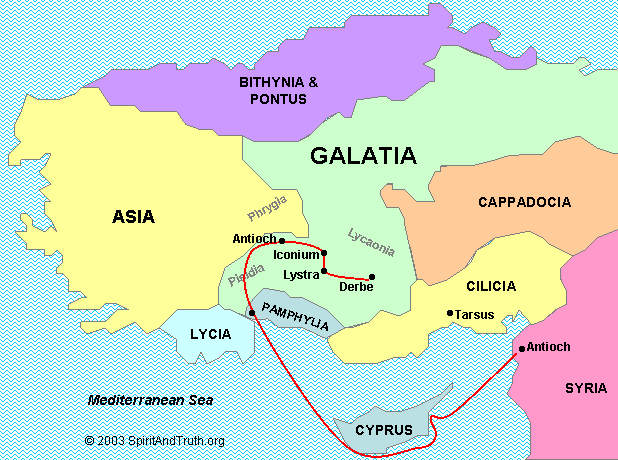
The Apostle Paul is author to nearly 2/3 of the New Testament books. As a former persecutor of the church of Jesus Christ (Acts 9); Saul of Tarsus had a dramatic conversion experience as a result of being encountered by the post-resurrected Jesus on the road to Damascus. Acts 9-13 recounts Saul's conversion, call and commissioning as the Apostle to the Gentiles. As he began to minister, Saul's name was changed to Paul. He would eventually travel in circuits throughout the Mediterranean world, beginning in Jerusalem and eventually ending up in Rome by the end of the Book of Acts. Three of these circuits or "missionary journeys" are recorded in Acts, with the first being the focus in Acts 13-14. As a matter of first importance, Paul took the Gospel into the regions of Galatia in Acts 14:1-23. While some debate whether the churches in Province of Galatia to the North were intended, or whether the three principle cities of Lystra, Derbe and Iconium - all agree that Paul's letter was among his earliest or perhaps even the first one written. (See map below)
We won't concern ourselves today with which theory (North Galatian, making the letter of later composition; South Galatia, making the letter Paul's earliest), pro or con, is the best one. The point is that Galatians represents the main thrust of the preaching of the Gospel as it spread from the region of Judea and Israel to the outer regions of Syria, Cicilia and Galatia. 

The theme of Galatians: The Gospel of Freedom
The Bible Knowledge Commentary notes the purpose of Paul's letter to the Galatians: "The Judaizers in Galatia both discredited Paul and proclaimed a false gospel. It was necessary that Paul vindicate his apostleship and message, a task he undertook in the first two chapters. In this autobiographical section Paul demonstrated convincingly that his apostleship and his message came by revelation from the risen Christ. In chapters 3 and 4 Paul contended for the true doctrine of grace, that is, for justification by faith alone. Finally, to show that Christian liberty does not mean license the apostle, in chapters 5 and 6, taught that a Christian should live by the power of the Holy Spirit and that when he does he manifests in his life not the works of the flesh but the fruit of the Spirit."

There were those operating within the churches of Galatia who attempted to persuade the Galatians that circumcision and adherence to the Mosaic law were needed additions to Christ to complete their salvation. These opponents of the Gospel, the Judiaizers, receive the most blistering rebuke from Paul. Their influence led to the Galatians near renouncement of everything Paul had preached to them. Galatians is the only letter Paul wrote that does not commend the churches for any exemplarary advances in their faith. Paul cuts to the chase and tells them that the Judiaizers are attempting to steal their freedom in Christ that was broughout about by the Gospel. As one writer has noted, any attempt to "add" to Christ only subtracts from Christ. 

In reading through Paul's letter to the Galatians, this blogger submits Galatians 5:1 as the key verse to the whole epistle, since it contains the main theme. Galatians 5:1 states - "It was for freedom that Christ set us free; therefore keep standing firm and do not be subject again to a yoke of slavery." Galatians 5:1 summarizes the Gospel that "freed" believer's from things of their past (Galatians 1-4) and prepares the reader for explaining how the Gospel continues "freeing" believers in their progressive growth in sanctification (Galatians 5-6). 

How the theme of "freedom" is developed throughout the Epistle to the Galatians
As we saw in the opening verses of today's post, the Gospel is described by Paul as Christ's rescue operation of sinners from bondage and sin. Paul warns his readers that the Judaizers are attempting to bring them back into bondage as they spy out their freedom in Christ. (Galatians 2:4) Galatians 5:13 reiterates this main theme of freedom - "For you were called to freedom, brethren; only do not turn your freedom into an opportunity for the flesh, but through love serve one another." 

Other key words throughout letter suggest this key motif of "freedom" in it's expression of the Gospel. For example, Galatians 3:10 reminds the reader that for anyone trying to please God by works of the law, a curse is upon them due to the fact that anyone failing to perform the law's commands are condemned. To contrast this tendency of mankind to choose "performance-based" methods of attempted salvation, Paul states Christ came to "redeem" us from the curse of the law in Galatians 3:13. On several occassions Paul makes reference to God's promise to Abraham, the proto-typical illustration of the believer who has been justified by faith. The theme of God's promise in setting free those who trust in Christ by faith is repeated through the remainder of Galatians 3:22 and 3:29. In chapter 4 of Galatians the reader is introduced to the concept of "adoption", indicating that as adopted sons and daughters of God through saving faith, we are no longer "slaves" but "sons". (Galatians 4:7) Finally, Galatians 5-6 switches the tone from how Christ sets the believer free at the beginning of their salvation to the on-going process of freedom that is available throughout the Christian life. This process of setting Christians free is experienced as a result of the Person and work of the Holy Spirit mentioned in Galatians 5:5,16,18,22-23 & 25 and alluded to in Galatians 6. 

Closing thoughts
The goal of today's post was to introduce the reader to Paul's letter to the Galatians. The theme of "The Gospel of Freedom" is the point and purpose of the letter. When we study Galatians, we are shown how the Gospel sets us free from the things of the past and is setting us free in the here and now. The persistent presence of sin in the believer finds the extremes of legalism or license to sin very enticing. Religion without the cross or godlessness without Christ will always characterize sinful man untouched by saving grace. This is why we need the Gospel and the Christ of the Gospel, who sets us free. 

Thursday, May 28, 2015

God's tender mercies that lead us to worship Christ - Romans 9-11

Romans 12:1 "Therefore I urge you, brethren, by the mercies of God, to present your bodies a living and holy sacrifice,acceptable to God, which is your spiritual service of worship."

Introduction:
Today's post wraps-up what has turned into a series on the tender mercies of God in Romans 12:1. I pray in our journeying through Romans you have found out how great our God is in the display of His tender mercies. Is it any wonder why Paul would use such mercies as the basis for being able to present one's body as a living sacrifice? The mercies we have explored here in Romans represent the much larger expressions of God's tender mercies we find throughout the Bible. We will only have the desire to live the life of worship to God insofar as we recognize how much mercy He has expressed to us. 

We have discovered how Romans is the perfect book to explore the theme of God's mercies.  Amazingly enough there are roughly 70 such mercies listed throughout the first 11 chapters of Romans. We've considered 55 of them thus far in Romans 1-8 and in today's post we will finish up the remainder of God's tender mercies in Romans 9-11. The tender mercies of God we have looked at deal with those mercies which draw us to Christ (Romans 1-3) and which keep us desiring Christ (Romans 3-5) and keep us in Christ (Romans 6-8). Today's post will consider one final heading - namely those mercies which lead to worship of Christ in Romans 9-11.

God's tender mercies which lead to worship of Christ - Romans 9-11

1. Mercy 9:14
2. Identity
3. Israel 11:1
4. Answered Prayer 10:13
5. No shame 10:11
6. Missionary 10:15
7. God's plan 11:12

Romans 9 as a whole deals with the too often neglected doctrine of election, which as we saw in yesterday's post is among the many tender mercies of God. God was under no obligation to choose anyone. The fact that He chooses whosover He wants is described by Paul as an act of mercy. His choosing of Jacob over Esau and Israel over the other nations is His expression of love. He does what He does because of His loving purposes of grace towards those whom He wants. God is God and has the right to be such. By nature God is merciful. Hence His plan of salvation includes gentiles from every tribe and nation whom He has loving chose to display mercy. Missionaries, the proclamation of the Gospel and the call for sinners to believe and repent are God's mission in demonstrating His mercy upon those who otherwise do not deserve it. 

8. Christ's return 11:26
9. God's wisdom 11:33
10. God's knowledge 11:33
11. God's judgments 11:33
12. God's mind 11:34
13. God's providence 11:36

These last remaining mercies remind us of how great our God is. God has been revealed in the incarnation of the Son and thus such mercies drive us to worship Him. When we think of the nearly 70 mercies that we have considered over the last few days, is it any wonder that Paul would end Romans 1-11 with the great doxology of Romans 11:33-36. May we be those who worship Christ and give Him thanks for His tender mercies. 

Wednesday, May 27, 2015

God's tender mercies that guarantee our salvation in Christ - Romans 6-8

Romans 12:1 "Therefore I urge you, brethren, by the mercies of God, to present your bodies a living and holy sacrifice,acceptable to God, which is your spiritual service of worship."

Introduction:
I pray in our journeying through Romans you have found out how great our God is in the display of His tender mercies. Is it any wonder why Paul would use such mercies as the basis for being able to present one's body as a living sacrifice? We will only have the desire to live the life of worship to God insofar as we recognize how much mercy He has expressed to us. Jesus proves this point in Luke 7:47 "For this reason I say to you, her sins, which are many, have been forgiven, for she loved much; but he who is forgiven little, loves little.” 

We need exposure to a fresh unfolding of God's greatness in His tender mercies. Romans is the perfect book to explore the theme of God's mercies, since Paul basis the remainder of His practical instructions in Romans 12-16 upon such tender mercies revealed in Romans 1-11. Amazingly enough there are roughly 70 such mercies listed throughout the first 11 chapters of Romans. We've considered 43 of them thus far in Romans 1-5 and in today's post we will explore more of these wonderful mercies in Romans 6-8. The tender mercies of God we have looked at deal with those mercies which draw us to Christ (Romans 1-3) and which keep us desiring Christ (Romans 3-5). Today's post will look at those tender mercies of God in Romans 6-8 that guarantee our salvation in Christ.

God's tender mercies that guarantee our salvation in Christ - Romans 6-8

1. Crucified life 6:1-4
2. Freedom 6:4
3. Eternal life 6:23
4. Christ our spouse 7:1-5
5. No condemnation 8:1
6. Spirit-control 8:5
7. Resurrection 8:11
8. God's calling 8:28
9. Election 8:29
10. Foreknown 8:29
11. Secure 8:39
12. Glorified 8:30

When we look at these 12 tender mercies, they all are used by the Holy Spirit to minister gurantees of assurance. When the Christian is aware of who they are and whose they are, they walk in victory. It has been said that the principle of the victorious Christian life is laid down in Romans 6. In Romans 7, we see depicted the struggle that comes in experiencing what it means to be an overcomer. Romans 8 spells out the reality of such a life and thus God's guarantee that we will not only persevere, but flourish under trial. God has so guaranteed our victory that such mercies empower us to run, not crawl, across the finish line of faith! (2 Timothy 4:7-8) These are the tender mercies that guarantee our salvation in Christ.

More tomorrow...

Tuesday, May 26, 2015

God's tender mercies that keep Christians desiring Christ in Romans 3-5

Romans 12:1 "Therefore I urge you, brethren, by the mercies of God, to present your bodies a living and holy sacrifice,acceptable to God, which is your spiritual service of worship."

Introduction:
Today's post is continuing to explore more of the tender mercies of God revealed to us in Romans. It seems like this phrase in Romans 12:1 "by the mercies of God" has captured my attention. I pray in our journeying through Romans you have found out how great our God is in the display of His tender mercies. Is it any wonder why Paul would use such mercies as the basis for being able to present one's body as a living sacrifice? We will only have the desire to live the life of worship to God insofar as we recognize how much mercy He has expressed to us. Jesus proves this point in Luke 7:47 "For this reason I say to you, her sins, which are many, have been forgiven, for she loved much; but he who is forgiven little, loves little.” 

We need exposure to a fresh unfolding of God's greatness in His tender mercies. Romans is the perfect book to explore the theme of God's mercies, since Paul basis the remainder of His practical instructions in Romans 12-16 upon such tender mercies revealed in Romans 1-11. Amazingly enough there are roughly 70 such mercies listed throughout the first 11 chapters of Romans. We've considered 26 of them thus far in Romans 1-3 and in today's post we will explore 17 more of these wonderful mercies in Romans 3-5. When we think of how merciful God is to an otherwise undeserving people such as us, it truly staggers the mind! We looked at those mercies two days ago which draw sinners to Christ. Today and tomorrow we will explore those mercies which keep Christian's desiring Christ. 

God's tender mercies that keep Christian's desiring Christ - Romans 3-5
1. His glory 3:10
2. His honor 3:10
3. His peace 3:10
4. Imputed righteousness 3:24

The four tender mercies in the above list has to do with God crediting to the sinner the righteousness of Jesus Christ which Christ earned in both His life and death. Such righteousness is place over the sinner like a robe at saving faith. Any good works the Christian does from salvation onward is called "sanctification" or "practical righteousness". Our practical works of righteousness, imperfect and incomplete as they are, are deemed acceptable to God due to the source from whence they draw - namely Christ's imputed or credited righteousness. God's glory, honor and peace are the benefits enjoyed by believers, further testifying to His tender mercies in their lives as a result of Jesus' achieved work on their behalf.

5. Covenant signs 4:11
6. Covenant of grace 4:12
7. Christ our inheritance 4:13
8. Peace with God 5:1
9. Access to God 5:1
10. Hope in God 5:2
11. Perserverance 5:3
12. Character 5:3
13. God's love 5:4
14. Reconciliation 5:10
15. God's gift 5:16
16. Christ's active obedience 5:19
17. Christ's Lordship 5:21

These last remaining tender mercies are those mercies that keep us energized, growing, progressing, desiring, thirsting and loving God. God has walled us in more than we realized. His tender mercies are a might fortress. It would require a years worth of blogposts to unfold all of these mercies. Indeed the mercy and love of God is lavishly poured out on the Christian, testifying to the fact that they are indeed children of God. (1 John 3:1-2)

More tomorrow....