Translate

Tuesday, July 21, 2015

The importance of unity in the church

John 17:20-21 “I do not ask on behalf of these alone, but for those also who believe in Me through their word; 21 that they may all be one; even as You, Father, are in Me and I in You, that they also may be in Us, so that the world may believe that You sent Me."

Introduction
When Jesus prayed His High Priestly prayer in John 17, the setting was on the eve of His crucifixion. Jesus prayed not only for His disciples but for every generation of believers chosen and loved by Him. The prayer of Jesus on this occassion had to do with unity in the church. Almost no one would say that Jesus' prayer was an exercise in futility. Whatever Jesus prayed was in perfect unity with the will of the Father in Heaven. He declared His will for the church in every age and locale. The importance of unity in the church cannot be over-stressed. 

At times people have imagined such unity as relating to "uniformity" - meaning everyone acting the same and there being no distinctions. God so designed the church to be composed of different people - of differing gifts centered around one common faith, doctrine, Bible and Jesus. Jesus' single prayer here in John 17 begins as a small ripple in the pond of God's redemptive purposes. That ripple spreads throughout the pages of the New Testament and the remainder of church history. Below I want to alert readers to some of the major texts that reveal the importance of unity in the church today.

1. Unity practiced. 
Acts 2:42-47 They were continually devoting themselves to the apostles’ teaching and to fellowship, to the breaking of bread and to prayer. 43 Everyone kept feeling a sense of awe; and many wonders and signs were taking place through the apostles. 44 And all those who had believed were together and had all things in common; 45 and they beganselling their property and possessions and were sharing them with all, as anyone might have need. 46 Day by day continuing with one mind in the temple, and breaking bread from house to house, they were taking their meals together with gladness and sincerity of heart, 47 praising God andhaving favor with all the people. And the Lord was adding to their number day by day those who were being saved."

2. Unity commanded.
Ephesians 4:1-6 Therefore I, the prisoner of the Lord,implore you to walk in a manner worthy of the calling with which you have beencalled, 2 with all humility and gentleness, with patience, showing tolerance for one another in love, 3 being diligent to preserve the unity of the Spirit in the bond of peace.4 There is one body and one Spirit, just as also you were called in one hope of your calling; 5 one Lord, one faith, one baptism,6 one God and Father of all who is over all and through all and in all.

3. Unity's provisions
Ephesians 4:11-13 "And He gave some as apostles, and some as prophets, and some as evangelists, and some as pastors and teachers, 12 for the equipping of the saints for the work of service, to the building up of the body of Christ; 13 until we all attain to the unity of the faith, and of the knowledge of the Son of God, to a mature man, to the measure of the stature which belongs to the fullness of Christ."

4. Unity's forgiveness
Colossians 3:12-16 "So, as those who have been chosen of God, holy and beloved, put on a heart of compassion, kindness, humility, gentleness and patience; 13 bearing with one another, and forgiving each other, whoever has a complaint against anyone; just as the Lord forgave you, so also should you. 14 Beyond all these things put on love, which is the perfect bond of unity. 15 Let the peace of Christ rule in your hearts, to which indeed you were called in one body; and be thankful. 16 Let the word of Christ richly dwell within you, with all wisdom teaching and admonishing one another with psalmsand hymns and spiritual songs, singingwith thankfulness in your hearts to God."

5. Unity's call
1 Corinthians 1:10 "Now I exhort you, brethren, by the name of our Lord Jesus Christ, that you all agree and that there be no divisions among you, but that you be made complete in the same mind and in the same judgment."

6. Unity's aim
1 Peter 2:9 "But you are a chosen race, a royalpriesthood, a holy nation, a people for God’sown possession, so that you may proclaim the excellencies of Him who has called youout of darkness into His marvelous light."

Monday, July 20, 2015

Daniel - Faith at work in a foreign land


Daniel 1:8-9 "But Daniel made up his mind that he would not defile himself with the king’s choice food or with the wine which he drank; so he sought permission from the commander of the officials that he might not defile himself. 9 Now God granted Daniel favor and compassion in the sight of the commander of the officials."

Introduction:
I wanted to begin today's post with a quotation from 1 Peter 2:9-12 "But you are a chosen race, a royal priesthood, a holy nation, a people for God’s own possession, so that you may proclaim the excellencies of Him who has called you out of darkness into His marvelous light;10 for you once were not a people, but now you are the people of God; you had not received mercy, but now you have received mercy. 11 Beloved, I urge you as aliens and strangers to abstain from fleshly lusts which wage war against the soul. 12 Keep your behavior excellent among the Gentiles, so that in the thing in which they slander you as evildoers, they may because of your good deeds, as they observe them,glorify God in the day of visitation." 

Peter's point is to remind the Christian of the fact that they are "strangers" and "pilgrims" passing through this world. Such a theme is not unique to Peter, since his statements - under Divine inspiration of the Holy Spirit - are taken directly from what Moses wrote in Exodus 19 and other Old Testament passages. Hebrews 11 takes this theme of "strangers and pilgrims" and shows how patriarchs such as Abraham, men such as Joseph and then prophets such as Daniel exhibited this mindset as they journeyed by faith to "the city whose builder and maker is God" (John 14:1-3; Hebrews 11:10-16). Today's post features one of these figures, Daniel, and how he demonstrated faith at work in a foreign land. 

The longer I walk with Jesus, the more estranged I feel from this world's system and the more I pine to get to that Heavenly home. Daniel illustrates in real life what Peter and other Biblical writers wrote frequently about - namely faith at work in the foreign land of this age.

Daniel - Faith at work in a foreign land
As you begin to read the Book of Daniel, you read a book that is partly historical, partly prophetic and also devotional. These three themes weave their way through Daniel's book 
like a three braided rope. In Daniel 1:1-2:18 we see Daniel as a 15 year-old lad, along with his friends, taken away into exile in Babylon, some 800 miles from their Jewish homeland. We could say that is these verses, we see the devotional theme of Daniel exercising faith in a foreign land (along with his three friends) modeled under the following headings in Daniel 1-2: 

1. True faith rejects worldliness. Daniel 1:1-21
As Daniel and his friends were brought into Babylon, they were already endowed by God with character, blamelessness, wisdom and insight from God (Daniel 1:4). Although these young men were in their teens, they operated in a level of faith beyond their years. Unless we have been captured by the glory of God and the endless beauty of the Lord Jesus Christ, we won't begin the fight to reject the world nor persist in such an endeavor. Daniel and his friends were given opportunities to live at ease in the royal courts of Babylon, imbibing in feasting and drinking and changing their language from their native Hebrew to Babylonian Aramaic. 

Despite the pressure placed upon them to conform, Daniel 1:8 is perhaps the tipping point in the chapter: "But Daniel made up his mind". Following that resolve, we see God injecting Daniel and his friends with further favor and compassion from the Babylonians (1:9) and knowledge (1:17).  Daniel was already walking in grace. He had held position and went through process in his current level of grace. The level of faith he had was his measure of light to go by - all provided by God. By having passed the test of Nebuchadnezzars' offers of the easy life, God granted Daniel and his friends the greater measure of faith and grace they would need to handle the tests of success as well as the trials of the furnace (Daniel 3) and the much later lion's den (Daniel 6). 

2. True faith relies upon the word of God (2:1-20). 
Intermingled in this devotional theme is the prophetic dream of Nebuchadnezzar. God gives Daniel wisdom as he and his friends seek God in prayer over the dream's interpretation. We see in Daniel 2:19-23 the following comforts of God's Sovereignty: 

a. God reigns (2:19-21)
b. God reveals (2:22) 
c. God relates (2:23).

As Daniel then stands before the King to give the interpretation of the grand colossus or statue of Nebuchadnezzar's dream. We discover the prophetic history and destiny of history from Daniel's day to the end: 

a. The enormous Kingdom of Babylon is the head of gold(2:36-38)

b. Empire kingdoms of Persia, Greece and Rome, represented by the colossus' chest, belly and legs (2:39-40)

c. An evil kingdom, the kingdom of the future anti-Christ, represented by the feet and toes (2:41-43) 

d. The Eternal Kingdom of Jesus Christ represented as a stone smashing the statue. Daniel 2:44-45.

Nebuchadnezzar's statue or colossus represents the system of unbelief and Satanically inspired, man-made rebellion called "the world". Daniel's faith thrives in a foreign land because of his reliance upon the Word of God. Those prophetic visions gave Daniel the needed perspective on the fleeting duration of this world and the enduring Sovereignty of God. 

3. True faith revolves around Jesus Christ.
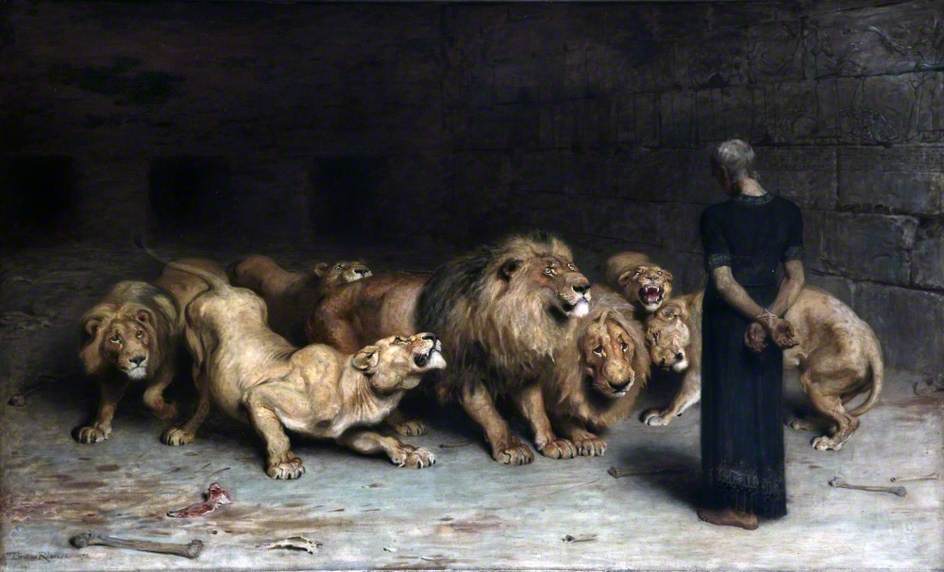
Daniel 1:21 has this note - "And Daniel continued until the first year of Cyrus the king." This short statement refers to the total time Daniel would be in Babylon - at least 70 years. So did Daniel's faith hold out for the 70 years that elapsed from his arrival in Daniel 1-2 until we come to the scene of the Lion's Den in Daniel 6? In Daniel 6, a new King, a new Empire and many of Daniel's enemies had died off. New opponents had arisen who hated Daniel just as much, if not moreso than the old enemies. These new villains tricked King Darius into signing an edict that would result in the Lion's Den for anyone refusing to worship the king. Though Daniel knew of the edict, his faith did not waver. In Daniel 6:10 we read - "Now when Daniel knew that the document was signed, he entered his house (now in his roof chamber he had windows open toward Jerusalem); and he continued kneeling on his knees three times a day, praying and giving thanks before his God, as he had been doing previously."

How many of us would continue persevering in faith, knowing full-well that "documents had been signed" that could end our lives? Daniel's faith was not looking at the situation around him brought about by a king in Persia but rather towards the city of the Great King. Daniel orientated his life around God's precious promises which pointed Him towards the Lord Jesus Christ. Now some may wonder how we get to Jesus from Daniel 6? Consider the logic of Hebrews 11:33 for just a moment - "who by faith conquered kingdoms, performed acts ofrighteousness, obtained promises, shut the mouths of lions." Within that same sequence of verses in Hebrews 11, we note how Moses had chosen the reproaches of Christ over the comforts of sin for a season (Hebrews 11:25-26). Much like Moses, Daniel feared not the wrath of a king, but rather chose to set his eyes of faith upon Him who is unseen (compare Hebrews 11:27 to Hebrews 11:33). The unseen One whom Daniel looked to was none other than the Lord Jesus Christ. The logic of Hebrews 11 is at work in Daniel 6. Although Daniel may not had possessed the 20/20 perspective afforded to us by Hebrews 11, the resolve and direction of His faith is as accurate in terms of what His trust is anchored to (Hebrews 6:18-20). As 21st century Christians we are reminded in Hebrews 12:1-3 "Therefore, since we have so great a cloud of witnesses surrounding us, let us also lay aside every encumbrance and the sin which so easily entangles us, and let usrun with endurance the race that is set before us, 2 fixing our eyes on Jesus, the author and perfecter of faith, who for the joy set before Him endured the cross,despising the shame, and has sat down at the right hand of the throne of God. 3 For consider Him who has endured such hostility by sinners against Himself, so that you will not grow weary and lose heart."

Closing thoughts
Today we considered how Christian faith can work and flourish in the foreign land of this present age. The prophet Daniel was our example. We discovered three necessary truths regarding faith at work in a foreign land:

1. True faith rejects worldliness. 
Daniel 1

2. True faith relies upon the Bible. Daniel 2

3. True faith revolves around Jesus Christ. Daniel 6

Sunday, July 19, 2015

Why Jesus Christ is the only way

Isaiah 30:21 "Your ears will hear a word behind you, 'This is the way, walk in it,” whenever you turn to the right or to the left.'

John 14:6 "Jesus said to him, 'I am the way, and the truth, and the life; no one comes to the Father but through Me.'"

This upcoming week will be dedicated to vacation Bible school at our church. In addition to the many wonderful lessons and activities planned for the children, we will also be having a class for the adults. The VBS theme verse is found in one of the verses quoted above - Isaiah 30:21. The VBS will aim to show kids and adults alike why Jesus alone is the only unique guide in matters pertaining to life, eternal life and the after life. As I was looking over the first night in which I will be teaching, this precious truth of Jesus Christ being the only way or the only guide was pressed deep into my heart. Today's post is all about helping readers to see why Jesus is the only way, and that there is no other Biblical alternative to understanding His Person, work and mission. 

Why Jesus is the only way
Sadly today a growing majority of Christians are denying this cardinal truth of Jesus Christ being the only way, truth and life. In Isaiah's time, Jerusalem and the surrounding environs of the Southern Kingdom of Judah had abandoned their faith in Yahweh. Much like their Northern counterparts in the Northern Kingdom of Israel, the Southern kingdom had fallen prey to worshipping other deities of the surrounding nations. The kings of Judah were making alliances with Egypt to try to stave off a threat from the Assyrian Empire who had already defeated the Northern Kingdom of Israel. In short, Isaiah's nation and people had turned to other "ways" and "deliverances" for their hope. The outcome of their decision was doomed, and yet Yahweh promises at the end of Isaiah 30 that He will restore the very people who had turned their backs on Him for the sake of His covenant promises to Abraham, Isaac and Jacob. Hence the reason for the central affirmation of Isaiah 30:21 "Your ears will hear a word behind you, 'This is theway, walk in it,” whenever you turn to the right or to the left.'

In today's world, not just one voice, but many are competing for the attention of many Christians who perhaps waver on the exclusivity of Jesus Christ. A 2011 Barna research survey of those claiming to be born-again Christians in America discovered that 43% believe that other religions beside Christianity teach similar truths, just from different perspectives (https://www.barna.org/barna-update/faith-spirituality/484-what-americans-believe-about-universalism-and-pluralism#.VaUjsflViko) A similar percentage in that same poll indicated a more "inclusive view" of salvation, meaning that someone could be reconciled to God in salvation through other religions besides Christianity. 
Those respondants have been undoubtedly affected moreso by cultural pluralism - the belief that there is no one "Truth" and that all religions teach the same thing in different ways and promote many ways to God - than the Bible. 

The Bible leaves no space for marshalling the belief that salvation is found outside of faith alone in Jesus Christ alone. The same One who spoke those words through Isaiah in His day of being "The Voice" who said "this is the way, walk in it" is the Same One who stated in John 14:6 "Jesus said to him, 'I am the way, and the truth, and the life; no one comes to the Father but through Me.'" To believe that Jesus Christ is the Only, Unique Way of salvation is at the heart of Biblical revelation. Denial of this cardinal doctrine affects other important doctrinal tenets pertaining to the Person and work of Jesus Christ. To quickly note the key New Testament verses that speaks about major points in describing the Person and work of Jesus Christ and our salvation will demonstrate why Christians must assert that Jesus is the only way.

1. He is the Unique revelation of God in human flesh
John 1:1 begins with these words - "In the beginning was the Word, and the Word was with God, and the Word was God." As "The Word", the Son of God pre-existed eternally with the Father and the Spirit as the One Triune God of the Bible. When the Son came into this world to assume full humanity, He is described as "The Word made flesh" in John 1:14; "God" or "He who was manifested in the flesh" in 1 Timothy 3:16 and "the fulness of the Godhead bodily" in Colossians 2:9. To deny the exclusivity of Jesus Christ is to deny that He alone fully reveals God. If other religions have as much saving value as Christianity, then their various deities and manifestations would reveal a deity far different from the Bible, and thus point completely away from Jesus. The very identity and revelation of the God of the Bible is set aside when we deny Jesus being the only way.

2. Jesus Christ is unique in His birth
Luke 2:10-11 "But the angel said to them, “Do not be afraid; for behold, I bring you good news of great joy which will be for all the people; 11 for today in the city of David there has been born for you a Savior, who is Christ the Lord." When coupled with the other scriptures that speaks of Christ's virgin birth (Luke 1:35) and fulfillment of prophecy concerning the unique beginning of His humanity (Matthew 1:20-23; Isaiah 7:14), the uniqueness of Jesus' birth makes Him the only way to God. By remaining very God, Jesus' existence as a man began with the virgin birth conception (Luke 1:35; Philippians 2:5-11). Both truths are foundational to understanding the Person and work of Jesus Christ. No other religious figure or religious ideology teaches anything close to what is seen in the incarnation of Jesus Christ as Eternal Deity. If anything, the virgin birth and incarnation of Jesus Christ underscores why He is the only way.

3. Jesus Christ's unique life and ministry
Matthew 4:23-25 "Jesus was going throughout all Galilee, teaching in their synagogues and proclaiming the gospel of the kingdom, and healing every kind of disease and every kind of sickness among the people. 24 The news about Him spread throughout all Syria; and they brought to Him all who were ill, those suffering with various diseases and pains, demoniacs, epileptics,paralytics; and He healed them. 25 Large crowds followed Him from Galilee and the Decapolis and Jerusalem and Judea and from beyond the Jordan." By asserting the uniqueness of Jesus Christ as the only way to God and salvation, further proof is found in the life and ministry He led. No other figure in all of history did as much, nor did it as perfectly as Jesus Christ. His 50 or so parables, 35 miracles and fulfillment of over 100 prophecies testify to His uniqueness as God in human flesh and as the perfect man who ever remained God. Jesus was not just a teacher, nor just a spiritual leader or just an example. Jesus didn't come to proclaim a way to God, He came claiming to be that one, unique way. People who believe on Him are saved by His life of perfect righteousness, since in His active obedience He provided the life of righteousness needed to be credited to sinners who are saved by grace alone through faith alone in Christ alone.

4. Jesus Christ's unique death and resurrection. 
1 Corinthians 15:1-6 states - "Now I make known to you, brethren, the gospel which I preached to you, which also you received, in which also you stand, 2 by which also you are saved, if you hold fast the word which I preached to you, unless you believed in vain. 3 For I delivered to you as of first importance what I also received, that Christ died for our sins according to the Scriptures, and that He was buried, and that He was raised on the third day according to the Scriptures, 5 and that He appeared to Cephas, then to the twelve." As the case for Jesus Christ being the only way builds, without doubt His death and resurrection stand out as premier proof. Galatians 3:13 and 4:4-5 both testify to how Christ alone could bear the curse of sin. As already noted in 1 Corinthians 15:1-5, this same Jesus who died as the lone, ultimate sacrifice for sin also physically raised from the dead. No other person in human history has ever physically resurrected. Jesus' resurrection demonstrated the reality of the cross. His unique death and resurrection, as well as His unique pre-existence, birth and life demonstrate why Jesus is the only way. 


Saturday, July 18, 2015

Glimpses of God's Kingdom work in the midst of hopeless despair - Isaiah 24-35

Isaiah 24:21-23 "So it will happen in that day,That the Lord will punish the host of heaven on high, And the kings of the earth on earth. 22 They will be gathered together like prisoners in the dungeon, And will be confined in prison;
And after many days they will be punished. 23 Then the moon will be abashed and the sun ashamed, For the Lord of hosts will reign on Mount Zion and in Jerusalem, And His glory will be before His elders."


Introduction:
One of things I so appreciate about the prophetic books is how much they speak to today's world. Whenever I plunge myself into the world of the  prophets, I'm equipped with the concepts and spiritual tools needed to address my world. These last couple of days have been dedicated to looking closer at the prophet Isaiah. His world was a world where he literally saw his nation and people go from the highest points under the reign of Uzziah to dwindling spiritual ruins by the days of Kings Jotham and Hezekiah. Despite reforms and revival, the nagging reality was that the efforts seemed to be a day late and a dollar short. The ultimate renewal that would abide and last was not going to occur in Hezekiah's day. Isaiah saw the True King and Savior through prophetic vision that would bring in everlasting salvation. 

One of the truths we discover in Isaiah's book is how often he made recourse to Christ's future earthly reign in the midst of judgment and woe on the nation or the people of God. Though the thunder and lightening of judgment was pealing all around Isaiah, the radiant beams of the hope of God's Kingdom always found a way to shine through. To see a sample of this, I thought we would peer into Isaiah 24-35 to grasp this pattern of glimpsing God's kingdom work in the midst of hopeless despair.

1. Despair (24:1-20) and Kingdom hope (24:21-23)

2. Praise for God's Sovereignty in Isaiah 25-26 as a result of what is spoken in Isaiah 24.

3. Isaiah 27 Promised restoration of Judah

4. Isaiah 28:1-13 judgment upon the Northern Kingdom. 28:14-29 Judgment against Judah's leadership

5. Isaiah 29:1-17 Judgment upon Judah's hypocrisy. Yet, promise of Judah's restoration in Isaiah 29:18-24

6. Judgment upon Judah's rebellion in Isaiah 30:1-7. Yet, promises of restoration for Judah in the future and protection in its immediate circumstances from a power enemy in Isaiah 30:8-33.

7. Isaiah 31 details God's Judgment on Egypt for Judah's confidence in her. At the time, Jerusalem and Judah had made an alliance with Egypt.

8. Isaiah 32:1-8 gives us a glimpse of Christ's earthly millennial reign followed by a prediction of Assyria conquering the Northern Kingdom of Israel.

9. Isaiah 33. A cry for for mercy and promise of forgiveness

10. Isaiah 34. Judgment on the nation of Edom.

11. Isaiah 35 details another picture of a restored Jerusalem during Christ's earthly reign. 

As you can see, God has sprinkled the hope of His kingdom promises in the midst of hopeless despair. Perhaps the reader today is dealing with very difficult circumstance. Sometimes we bring them on ourselves but oftentimes difficulties come when we least expect it. Acts 14:22 tells us that in the process of entering the Kingdom, difficulties will come. Jesus told His disciples in John 16:33 that many trials would come upon them, and yet not to fear, since He has overcome the world. James 1:3-4 and 1 Peter 1:6-7 remind us that trials are normal for the Christian, and that God is working with us in the trial to purify our faith and trust in Him. Matthew 6:33 states that we are to seek first the Kingdom of God and His righteousness, and everything else will be added unto us. Would it be that we would glimpse God's Kingdom work in our midst. Would it be that we would trust in God and His promises, rather than relying on present circumstances to give us hope that will endure. 

Friday, July 17, 2015

An outline and brief exposition of the book of Isaiah

Isaiah 6:1 "In the year of King Uzziah’s death I saw the Lord sitting on a throne, lofty and exalted, with the train of His robe filling the temple."

Introduction:
Yesterday we considered Isaiah 1:1. Today's post aims to dig further into the Book of Isaiah. Isaiah has been called by preachers and teachers the "Prince of the Prophets". Among the writing prophets, other than Moses, no other prophet enjoys the influence that Isaiah has on the minds and thoughts of the New Testament authors. Jesus Himself read from Isaiah 61 at the beginning of His public ministry and fulfilled Isaiah 53 to the letter in his crucifixion. Following Jesus' resurrection and ascension, the sending of the Holy Spirit is in some fashion connected to the prophecies of the pending Messianic age in Isaiah 12. Today's post is aimed at presenting to the reader a working outline of Isaiah that can be used in teaching or preaching situations. 

1. Chapters 1-5 First set of oracles against Judah

2. Chapters 6-12 Judgment upon Ephraim and the first glimpses of Christ reign here on earth 

To pause here for just a moment, the outline of Isaiah reveals what will be an ever increasing focus of God from Judah and its surrounding regions to ultimately the nations of the world. Isaiah's prophecy is international in its scope. Here is a map for the reader's reference:

3. Chapters 13-23 God's judgment on the nations and glimpses of hope for Israel

4. Chapters 24-35 Glimpses of Christ's earthly kingdom to show Judah how she will be restored

As one reads on in Isaiah, the pattern of judgment/hope/kingdom is repeated. God will pronounce judgment either on His people or a particular set of nations, and then end that given section with a glimpse of Christ's millennial kingdom. This at least characterizes the pattern in Isaiah 1-35. The threat of the Assyrian Kingdom destroying Jerusalem was very near and real, since in Isaiah's day (722 b.c) Assyria had taken the Northern Kingdom of Israel, particularly Samaria, into exile. God used Isaiah to first chide Judah for her sinfulness and then give her the hope of being restored in Him. The fact that Isaiah 24-35 is bookended with views of Christ's earthly reign and ultimate Kingdom reminds us that all the kingdoms of this world will bow the knee to the Lord Jesus Christ (compare Philippians 2:5-11; Revelation 11:15; 19:1-21)

5. Chapters 36-39 God uses King Hezekiah as the tool for revival in Jerusalem

It is at this point that the first part of Isaiah, dedicated mostly to pronouncing judgment, switches to the second great theme - comfort. Isaiah 40:1 starts out - "Comfort, O comfort my people, says your God." 

6. Chapters 40-53 Yahweh is Judah's Sovereign God and Savior

7. Chapters 54-66 Judah is given the hope of restoration through a glimpse of the Messiah and His earthly reign

These final two sections of Isaiah's prophecy deliver home the theme of comfort or hope. Is it no wonder why Isaiah is among the top prophets referenced in the New Testament? For years scholars have noted how often Isaiah is quoted for instance in the four Gospels:

Matthew 3:3 quotes Isaiah 40:3
Matt 8:17 quotes Isaiah 53:4
Matt 12:17 quotes Isaiah 42:1
Matt 13:14 quotes Isaiah 6:9,10
Matt 15:7 quotes Isaiah 29:13
Mark 1:2 quotes Isaiah 40:3
Mark 7:6 quotes Isaiah 29:13
Luke 3:4 quotes Isaiah 40:3-5
Luke 4:17 quotes Isaiah 61:1,2
John 1:23 quotes Isaiah 40:3
John 12:38 quotes Isaiah 53:1
John 12:39 quotes Isaiah 6:9,10
John 12:41 quotes Isaiah 6:9-10 & 53:1

Conclusion:
Today's post was all about delivering a basic outline of the Book of Isaiah with some brief exposition. It is hoped this proved encouraging and can be used by others to proclaim God's Word. To God be the glory!

Thursday, July 16, 2015

The value of the opening verse of Isaiah 1:1


Isaiah 1:1  "The vision of Isaiah the son of Amoz concerning Judah and Jerusalem, which he saw during the reigns of Uzziah, Jotham, Ahaz and Hezekiah, kings of Judah."

Introduction:
Today's post is a quick overview of the opening verse of the book of Isaiah. It is amazing what you can learn of a Bible book by just considering the first verse. 

1. The nature of Isaiah's ministry as a prophet
When you read the above verse, what is it that is being communicated about the prophecy of Isaiah? Isaiah was going to write out what he saw by way of vision from God. As a prophet, he was able to see things from God's point of view. The idea of "vision" literally refers to someone given the God-given ability to see things supernaturally. Throughout scripture, though not everyone who saw a vision per se was a prophet in the strictest sense, yet the prophetic office included the idea of seeing, hearing and experiencing God's Word first-hand. The prophet was charged with communicating God's will to the people (see Amos 3:7). The older title for prophet, "Seer", expressed the perspective of the prophet as being one who could look at things the way God did (see Numbers 12:6; 1 Samuel 9:9)

2. Isaiah's audience
The audience to which Isaiah wrote were the Jews occupying Judah and Jerusalem. During the time of Isaiah's ministry, the land of Israel was divided into "two kingdoms", namely "Israel" to the North and "Judah" to the South. Roughly 250 years prior to Isaiah's time and during the end of King Solomon's reign, Solomon's heir Rehoboam had not heeded God's voice and as a result, ten of the twelve tribes of Israel followed after his then army general Jeroboam, with the two remaining tribes - Benjamin and Judah - staying in and around the city of Judah. Throughout the remainder of time, Judah to the South came to be the object of God's loving covenant purposes. Though Israel to the North was given promises of restoration with Judah in the future (Ezekiel 47), Judah to the South would have the favor of God as being the redemptive cradle of Jesus' humanity (Genesis 49:10; Matthew 1:1-17). For convenience sake I have included a map to illustrate the particular geographical locations just discussed (from biblecity.org).

3. Isaiah's time and circumstance - seeing everything go from prosperity to ruin
Isaiah loved his people and within his long, four-decade plus ministry (740-698b.c), saw his nation go from near the height of its glory under Uzziah 783-742b.c) and Jotham (742-735b.c) to near destruction under Ahaz (735-715b.c) to revival and compromise under Hezekiah (715-687). Adam Clarke's commentary relays the situation in which Isaiah wrote. Though the quote is long, it is worth the time to read. If the reader is pressed for time, the quote can be skipped and the conclusion of today's post will then be given. Here is the quote: "The kingdom of Judah seems to have been in a more flourishing condition during the reigns of Uzziah and Jotham, than at any other time after the revolt of the ten tribes. The former recovered the port of Elath on the Red Sea, which the Edomites had taken in the reign of Joram. He was successful in his wars with the Philistines, and took from them several cities, Gath, Jabneh, Ashdod; as likewise against some people of Arabia Deserta, and against the Ammonites, whom he compelled to pay him tribute. He repaired and improved the fortifications of Jerusalem; and had a great army, well appointed and disciplined. He was no less attentive to the arts of peace; and very much encouraged agriculture, and the breeding of cattle. 

Jotham maintained the establishments and improvements made by his father; added to what Uzziah had done in strengthening the frontier places; conquered the Ammonites, who had revolted, and exacted from them a more stated and probably a larger tribute. However, at the latter end of his time, the league between Pekah, king of Israel, and Retsin, king of Syria, was formed against Judah; and they began to carry their designs into execution.

But in the reign of Ahaz his son not only all these advantages were lost, but the kingdom of Judah was brought to the brink of destruction. Pekah king of Israel overthrew the army of Ahaz, who lost in battle one hundred and twenty thousand men; and the Israelites carried away captives two hundred thousand women and children, who however were released and sent home again upon the remonstrance of the prophet Oded. After this, as it should seem, (see Vitrinpa on Isaiah 7:2;), the two kings of Israel and Syria, joining their forces, laid siege to Jerusalem; but in this attempt they failed of success. 

In this distress Ahaz called in the assistance of Tiglath-pileser, king of Assyria, who invaded the kingdoms of Israel and Syria, and slew Rezin; but he was more in danger than ever from his too powerful ally; to purchase whose forbearance, as he had before bought his assistance, he was forced to strip himself and his people of all the wealth he could possibly raise from his own treasury, from the temple, and from the country. About the time of the siege of Jerusalem the Syrians took Elath, which was never after recovered. 

The Edomites likewise, taking advantage of the distress of Ahaz, ravaged Judea, and carried away many captives. The Philistines recovered what they had before lost; and took many places in Judea, and maintained themselves there. Idolatry was established by the command of the king in Jerusalem, and throughout Judea; and the service of the temple was either intermitted, or converted into an idolatrous worship.

Hezekiah, his son, on his accession to the throne, immediately set about the restoration of the legal worship of God, both in Jerusalem and through Judea. He cleansed and repaired the temple, and held a solemn passover. He improved the city, repaired the fortification, erected magazines of all sorts, and built a new aqueduct. In the fourth year of his reign Shalmaneser, king of Assyria, invaded the kingdom of Israel, took Samaria, and carried away the Israelites into captivity, and replaced them by different people sent from his own country; and this was the final destruction of that kingdom, in the sixth year of the reign of Hezekiah."

Closing thoughts
The point of today's post was to unpack the opening verse of the Book of Isaiah to gain insight into the prophecy. The hope was that the reader could see what an opening verse of scripture contains and how one verse can give insight into what a particular Biblical author is going to write under Divine inspiration. As a matter of practical application, to know that Isaiah's day and age mirrors our own encourages us to seek God's will as we read, meditate and apply Bible books like Isaiah to our lives. 

Wednesday, July 15, 2015

We need to get back to God-centered church life

Some Things I Believe about the Church (at this point)
Acts 2:46-47 "Day by day continuing with one mind in the temple, and breaking bread from house to house, they were taking their meals together with gladness and sincerity of heart, 47 praising God andhaving favor with all the people. And the Lord was adding to their number day by day those who were being saved."

Introduction: 
As a pastor who has ministered in both the 20th and 21st centuries, I have begun reaching the point in my life where I can see certain trends. Years ago I was in a conversation with someone who posed the following question: "is church ministry to be designed around the needs of believers or unbelievers?" I'll admit at the time that question was posed, I had no answer. Certainly one could argue in either direction. Whenever you look at the past 75 years of American church life, it appears that many have tried to embody one or the other option.

So who is the church for? What should our church ministries be catering to?
Many churches of by-gone days opted to do everything they did to meet the needs of the church membership. To one degree there is nothing wrong with meeting the needs of people. Yet in many cases, if we were to ask the question: who is the church for? The answer from some would be mainly to serve the needs of church members. 

In trying to correct an over-emphasis towards focusing only on the needs of members, some churches have opted to go in the other direction. Typically the aim is to create worship spaces that are more "user-friendly" and cater to those who are called "seekers". Seeker-sensitive approaches to church-life aim to create an environment for an unbeliever who walks into our fellowship and worship services doesn't feel threatened, guilted or uncomfortable. The architecture and ministry scheduling purposefully appeal to unbelievers and seekers moreso than believers. The faulty logic in this approach begins with the category of "seeker". 

The Bible teaches that the only person who truly seeks God is the person who has been born-again by faith in Jesus Christ (John 1:12-13). People can prior to conversion express curiosity about Christianity, however the perceived benefits to them, rather than Jesus Himself, is the fuel for their curiosity. Unless the Holy Spirit is actively at work in the person's soul, showing them Jesus and their need to trust in him, no person will seek God, despite the right lighting, ease of worship services and lessening of the demands of Christianity (Romans 3:10-13). 

I can recall growing up in the late 70's and 80's and having Sunday nights dedicated to singing Gospel groups, church bake sales and the like. Then in the 90's and New Millennium, attending services where there was drama productions, light shows and high-powered music. Both approaches appealed respectively to believers and moreso unbelievers. The key word in all of these approaches is "attractional ministry", whereby we are doing all we can to get as many people to come and be involved. The sincerity behind both of these approaches is unquestionable. To a certain level, churches ought to be the most inviting places to come and certainly ought to be doing all they can to reach the unconverted. 

Whenever we consider the early church in the book of Acts, the audience to which the early church attempted to make a fitting envornment for was not believers, nor unbelievers, but God. Now before readers write me off, let me explain. Peter and the Apostles and the early church majored on five key areas: preaching/ministering of the Word, fellowship, evangelism, small-group ministry and songs of praise and worship. Why? To appeal to God. 

Here's the point - when we aim to make God our audience, believers will be attracted and unbelievers will begin asking questions. Jesus said in John 12:32 that if He be lived high above the earth He would draw all men unto Himself. He also said in Matthew 6:33 if we seek first the Kingdom of God (which was another way of saying "seek first God") and His righteousness (the righteousness found by faith in Jesus), then everything else will be added. 

Picturing the God-centered church as portrayed in the Bible
The American church needs to return to God-centered church life if it aims to reach people. The Risen Christ and His word has been and always will be the "main-draw". Why do we forget that? I don't think we forget. Rather, we think we have a better idea on how to do church. Paul reminds us in 1 Corinthians 1:17-21 that it is through the foolishness of preaching that God confounds the wisdom of this world, convicts the sinner and comforts the saint. Passages such as Acts 2:42-47 and Acts 4:32-37 and 5:17-21 teach the early patterns of both corporate worship settings around the Word and small-group ministries dedicated to building relationships with each other while discussing the Word and living life together. Included in the corporate worship of the church are such essentials as the preaching of the scriptures (1 Timothy 4:13-16); celebration of the Lord's Table (1 Corinthians 11) and what would hopefully be the baptism of new converts who had made prior professions of faith as a result of the efforts of the membership, prayer and evangelism (Romans 6:4-11). Scriptures such as Ephesians 5:19-21 and Colossians 3:16 command Christians to incorporate the Word into their expressions of singing of Psalms, Hymns and spiritual songs. Other verses in the Bible command the church, both as a corporate body and as individual believers to share Jesus in evangelism and build up one another in discipleship and Christian growth (Matthew 28:18-20; 2 Corinthians 5:15-21; Hebrews 3:12-13; Hebrews 10:24-25). This is God-centered church life performing the Word, fellowship, songs of praise and worship, small-group ministry and evangelism. 

Closing thoughts:
My prayer is that readers of this post have understood the intent: to encourage and offer a correction to what can often-times be excesses in church ministry life. I myself am just as guilty of being enticed by fads. This post stands as a word to both myself and all who love the church, love Jesus and more and want to see people reached with the Gospel. The flesh always operates in excess. If anything, we need to construct our methods and motives for doing what we do around God. If we start with God, we will know His heart and then will know the people we need to reach. God in His Word has given us the right focus - Himself. If we begin with God, we will affect people along the way and thus have God as our destination. Let every church and every Christian be about the Word, singing songs of praise and worship, evangelism, getting together in small groups and thus fellowship. What America needs is a church world that is serious about getting focused once again on the Living God and His Word.