Translate

Saturday, July 25, 2015

A strategy for addressing debilitating problems in American churches - Prescriptions for the problems

1 Corinthians 1:10 "Now I exhort you, brethren, by the name of our Lord Jesus Christ, that you all agree and that there be no divisions among you, but that you be made complete in the same mind and in the same judgment."

Introduction:
Over the past two posts we have been offering a strategy for addressing debilitating problems in the American church from 1 Corinthians 1. We saw that the first step had to do with focusing on the positive working of God (1 Corinthians 1:1-9). Yesterday we looked at the second major step - namely the problems needing to be addressed (1 Corinthians 1:10-17). Whenever we read the epistle of 1 Corinthians, we are reading as-it-were Jesus' prescription pad for his people. With the diagnosis in hand, what prescriptions can be offered. Paul's strategy as it was composed under the inspiration of the Holy Spirit is amazing in that it begins with the positives of God's work and ends with some prescriptions stemming from Christ's finished work. Let's briefly consider the three main prescriptions.

1. Go to the cross. 1 Corinthians 1:18; 2:1-2
We read in 1 Corinthians 1:18 "For the word of the cross is foolishness to those who are perishing, but to us who are being saved it is the power of God." Then again in 1 Corinthians 2:1-2 "And when I came to you, brethren, I did not come with superiority of speech or of wisdom, proclaiming to you the testimony of God. 2 For I determined to know nothing among you except Jesus Christ, and Him crucified." The cross is the ground-zero of the Christian life. Not only is the cross the place the Spirit of God directs us to at salvation, but it is to be the center-of-orbit in the post-conversion Christian life or sanctification. At the cross, division, disagreements and any other unholy activities have no place. The flesh will dress itself up, nod-the-head and act spiritual before ever going to the cross. Only at the cross can the works of the flesh and the carnal tendencies towards self-centeredness be crucified (Galatians 2:20; 6:14). 

2. Emphasize the Word of God. 1 Corinthians 1:19-25
Word ministry. Plain and simple. Unless the Word of God is regularly communicated in teaching settings, preaching services or devotional times, there will be no power. Faith comes by hearing and hearing by the Word of God (Romans 10:17). In the Word I hear the Savior's voice. 

3. Get involved in evangelism. 1 Corinthians 1:26-31
We read in 1 Corinthians 1:30-31 "But by His doing you are in Christ Jesus, who became to us wisdom from God, and righteousness and sanctification, and redemption, 31 so that, just as it is written, “Let him who boasts, boast in the Lord.” To "boast in God" is the biblical way of saying "testifying about what God has done". When we share the Gospel - we are boasting in what the incarnate God, Jesus Christ, has achieved. I have found that when I or God's people are regularly involved in praying for and engaging in the regular evangelization of lost people, much of what passes for divisions in the church dwindles. 

Paul reminds the Corinthians that God's elective purpose of grace (1 Corinthians 1:27-29) and effectual calling of sinners unto salvation (1 Corinthians 1:26) are the basis for our evangelism. Whoever wants to get saved will get saved - plain and simple. Whenever God's choice and calling in the Gospel are wedded to a willing response to trust in Jesus - salvation occurs (John 1:12-13). As we read in Acts 18:10 "for I am with you, and no man will attack you in order to harm you, for I have many people inthis city.” Churches need to realize that there is no telling which ones God has been working in to prepare them for the moment of salvation - which is why we must go to all people. 

Closing thoughts:
As we close out today's post, we consider once more a strategy for addressing debilitating problems that occur in so many churches from 1 Corinthians 1. We first of all must begin with the positive work of God. He is working and wants to do more work in our churches. The question is: are we willing to work with Him?

Secondly, problems have to be addressed and not ignored. Then thirdly, God has prescribed the cross, the Word and evangelism for both mitigating problems that threaten to arise and forging ahead to go from God-given potential to God-ordained actuality in the Kingdom. May we all heed this strategy as given in God's Word. 

Friday, July 24, 2015

A strategy for addressing debilitating problems in American churches - Addressing problems and getting back on track with God

1 Corinthians 1:10 "Now I exhort you, brethren, by the name of our Lord Jesus Christ, that you all agree and that there be no divisions among you, but that you be made complete in the same mind and in the same judgment."

Introduction
Yesterday we began considering a strategy for addressing debilitating problems in American churches. I'll admit that in some ways I am painting with a very broad-brush. Perhaps readers of this post are dealing with context specific issues in their own church. If any readers out there are pastors, perhaps the principles being unpacked in this short series will prove helpful. Eitherway, we noted yesterday that when addressing debiliating problems in American churches (or any church in any country for that matter); we must begin with the positive work of God. God is still working in churches - even troubled ones. Unless the church and its leadership have uniformly turned away the Spirit's calling for them to conform to the will of the Father, there is always hope. We must recognize that the Lord Jesus Christ is King over His church. The Corinthian churches had many positive things still occuring in its midst. Despite the liabilities - Paul wanted to first highlight the positive workings of God in 1 Corinthians 1:1-9. With those positives outlined, we now move to the second part: the problems needing to be addressed. 

Problems needing to be addressed - 1 Corinthians 1:11-17
Paul writes in 1 Corinthians 1:11-13 "For I have been informed concerning you, my brethren, by Chloe’s people, that there are quarrels among you. 12 Now I mean this, that each one of you is saying, “I am of Paul,” and “I of Apollos,” and “I of Cephas,” and “I of Christ.” 13 Has Christ been divided? Paul was not crucified for you, was he? Or were you baptized in the name of Paul?" Each of the people had been influence by one gifted teacher or another. Undoubtedly we certainly must respect those who bring to us God's word (1 Thessalonians 5:12-13; Hebrews 13:7,17). The problem that the Corinthians had was they focused on the messengers, rather than the Master who sent the messengers. The attitude of competitiveness had entered into the fray. Some felt themselves superior because they had been baptized or sat under Peter's ministry (i.e Cephas). Others had been influenced by the mighty Bible teacher Apollos and still others held their allegiance to Paul. The fellowship was fractured at Corinth, debilitating its effectiveness and causing it to squander its God-given potential. 

Paul was very specific in his addressing of problems. In our American churches, we too often sweep problems under the rug. Leadership oftentimes lacks the courage needed to lead people through a time of working through issues that come about through the collective sin of people. Despite ample scriptures that detail how Christ's church ought to address its problems, churches today tend to rely on their own methods.

Jesus gave the first command to the church in Matthew 18 by reminding God's people of the need to care for one another, keep each other accountable and rescue one another from the perils of sin (Matthew 18:1-14). Jesus then lays out a simple step by step strategy: one-on-one (18:15); followed by a group helping the person to see their issue (18:16) and if refused, telling it to the church (18:17). Many churches shy away from such instructions, failing to see how such a process could benefit fellow believers. However, such a process is designed not to destroy Christians and thrust them out of the fold, but to beg them to be restored so as to reconnect them to the fold. 

Churches today preach about the Great Command in Matthew 22:37-39 about the need to love one another and the Great Commission of Matthew 28:18-20 concerning the need to evangelize the nations. However, lest we heed Jesus' Great concern in Matthew 18 - namely unity and holiness with the church walls - we will never be effective in our love nor evangelism. In Matthew 18:18-20 Jesus details the results that occur when Christians are unified. The agenda of Heaven and the activities here on earth are brought into allignment. Prayer is powerful. 

When we are made alert to our weaknesses, short-comings and problems, it can be unsettling. Yet such a process is needful if the church in America is to move forward and go from God-given potentiality to God-ordained actuality. Corinth was immersed in a pagan culture that was saturated with moral and spiritual darkness. God was calling the church to heed the call to unity and to address its problems. Likewise the American church of the 21st century is in a culture that is more pagan and no-longer Christian. Everyone in every church is responsible to one degree or another for the overall spiritual atmosphere at any given church. It truly takes pastors, leaders and people in the pew all working together in humble submission to Jesus Christ to accomplish the mission of the local church. Unless the Spirit of God is empowering every Christian and every church - all will be in vain. Once problems are addressed, repentance must occur. As 2 Chronicles 7:14 reminds us: "if my people who are called by my name will humble themselves, and pray, and seek my face, and turn from their wicked ways, then will I hear from Heaven, then will I forgive their sins and then will I heal their land." God has given us an abundant and robust method for addressing problems in our churches. When we heed what He says in His word - we will then get back on track with God.

More tommorrow.....


Thursday, July 23, 2015

A strategy for addressing debilitating problems in American churches - Begin with the positives of what God is still doing

1 Corinthians 1:10 "Now I exhort you, brethren, by the name of our Lord Jesus Christ, that you all agree and that there be no divisions among you, but that you be made complete in the same mind and in the same judgment."

Introduction:
In yesterday's post we spend time considering how the American church and Christians can avoid squandering their God-given potential. We concluded that what it will take is heeding God's call to unity. Why heed such a call? By heeding God's call to unity in the local church, Christians can go from God-given potentiality to God-ordained actuality. That is to say, we can go from what could-had-been Christianity to the real Christianity demonstrated in the Bible. Today I want to explore further into 1 Corinthians 1. Undoubtedly 1 Corinthians 1:10 not only occupies the center-point of the first chapter, but really the main point of Paul's entire first Epistle to the church at Corinth. Noting what he writes in this opening section can aid us in diagnosing and addressing the all-too-common issues that plague our American churches today. 

Positives of God's ongoing work
Paul begins in 1 Corinthians 1:1-9 by noting what God has already been doing in the church at Corinth. As a pastor here in America, I hear all the time how much trouble churches are experiencing in our cities, towns and country-sides. In the particular area where I serve for example, I know of 2 churches that have closed their doors already this year. Such news can be depressing and we can almost be convinced that God is no longer working. 

However, even in churches where there are abounding problems such as discontent, leadership disagreements, declines of various sorts and the like, we must remember that God is still at work! Paul issues forth positives about the church at Corinth. She was a church that was rich in grace (1:1-3); rich in gifts (1:4-8) and rich in God (1:9). Despite all the church's issues, the Corinthians were termed by Paul as "saints" in 1:2. God had a word for this church - and that's a good thing! As long as God has a word for the church to hear, that means there is a blessing He is desiring to bestow. We musn't focus only on the ruinous outcomes and consequences caused by our collective sinfulness or poor decisions or careless words. Indeed addressing such issues are the chief point of this Epistle, but not the only point. Beginning with the positives of God's still-ongoing work must be done to give hope to people in our churches that God still desires to do even more work in their midst. 

To illustrate this point, I can recall years ago working with a team of people in a Baptist Association that was trying to help a church in a given area. Over the years the church had changed many pastors and had even shut its doors at least once and started up again. The situation was so dire that the congregation of a once thriving church of 100 people had dwindled down to 15. Once the Association had gathered various people from other churches, the process of revitalization had begun. Sadly, three months into the work, a few people in the congregation pushed back and told the team of helpers and leaders to leave.

Two friends of whom I knew personally on the team were convinced that God was not yet done. The leader over the Baptist Association, other pastors and myself all concluded that the church was going to close its doors for good. Thankfully, my two friends and four other people exercise "sanctified stubbornness" and convinced a few key people in the church to work with them. To the shock of everyone in the Baptist Association, that small congregation turned around in six-months! What man could not do - God did! God was still working - even though many people had quit working! God determines which churches remain - not man. Jesus said in Matthew 16:18 that the gates of Hell will not prevail against the church - so who are we to argue against Jesus?

Whenever you read Paul's letter to the Corinthian church, you may wonder how in the world such a church was able to still operate. There is only one answer: God had more work He wanted to do in and through that church. Paul began with the positives of what God was still doing - and I think that is what every pastor and church member and denominational leader of any stripe must do. God is Sovereign. God is Good. His will achieve the outcomes, and He expects our effort and faith to work alongside with Him in promoting His mission in every local church. Its not easy - but it is sure worth it!

More tomorrow!

Wednesday, July 22, 2015

How the American church can quit squandering its God-given potential

1 Corinthians 1:10 "Now I exhort you, brethren, by the name of our Lord Jesus Christ, that you all agree and that there be no divisions among you, but that you be made complete in the same mind and in the same judgment."

Introduction
Paul's first epistle to the church at Corinth might as well had been a letter written to many American churches. Why? Corinth was a troubled church that function well-below its God-given potential. The American church has been vested by God with more literature, resources, people and pulpit presence than any other church in any other country. The startling reality of both Corinth and the church in America is spelled out accurately in another passage of scripture concerning another church in Revelation 3:1-3 “To the angel of the church in Sardis write:
He who has the seven Spirits of God andthe seven stars, says this: ‘I know your deeds, that you have a name that you are alive, but you are dead. 2 Wake up, and strengthen the things that remain, which were about to die; for I have not found your deeds completed in the sight of My God. 3 So remember what you have received and heard; and keep it, and repent. Therefore if you do not wake up, I will come like a thief, and you will not know at what hour I will come to you."

The path to revival or ruin in the average local church balances on a knife's edge. In my years of ministry I have witnessed first-hand what happens when a church comes so-close to reaching forward towards what God is showing through the scriptures - only to take back it's collective hand and wave God's blessings on down the road. Nothing is more heart-breaking to any pastor than to see the people He loves choose the good over the better and God's prime rib over man's table scraps. Success is the sought-after goal of many churches. Yet, how often do churches and pastors alike crave after God?

The potential of many good churches is squandered
Whenever you consider Paul's opening statements to the Corinthians in 1 Corinthians 1:1-9, there is no doubt how much potential the church had for God. In 1 Corinthians 1:1-3 the richness of God's grace had been given to the Corinthians in saving faith. Whenever you think about the potential each church and believer in Jesus Christ has - that potential is not natural, but supernatural. Unless God's very presence by His Spirit moves upon and in a person in regenerative saving grace, there will be no potential nor actual living for God. The Corinthians needed to be reminded of that - and so do churches. How Christians need to recapture the child-like wonder of faith that they had in those beginning days of their salvation. 

As Paul takes the Corinthians down memory lane to recall the richness of God's grace in 1:1-3, he next reminds them of the richness of their giftings in 1:4-8. If there is one thing the Epistle of 1 Corinthians is known for, it is that it possess the most exhaustive treatment of the spiritual gifts anywhere in the scriptures in 1 Corinthians 12-14. The people of God at the Corinthian church was a happening church. They had people who could speak eloquently for God (1:5); possessed insight into spiritual realities (1:5) and as a collective body were living and breathing the very testimony of Christ Himself (1:6). 

At Corinth, revival had went atmospheric. Every conceivable gift was in operation (1:7) and their reputation was to such a degree as to warrant as potential "honorable mention" at Christ's return (1:8). Among the starry firmament of Christ's local churches, Corinth stood out like a supernova. The American church has in many ways enjoyed a similar reality. A church enriched in grace and giftings was the church at Corinth and the church in America.

It is at this point that Paul reminds his readers of the most important richness of all - rich in God. 1 Corinthians 1:9 states - "God is faithful, through whom you were called into fellowship with His Son, Jesus Christ our Lord." Why is it that God enriched Corinth in saving grace and giftings? To bring them one by one unto Himself. The American church has, like King David in his younger years, enjoyed sweet times and blessing when she made Him her priority. Trials certainly come on God's people. However, when Jesus Christ is everything to a people, nothing can extinguish the Gospel light. 

Whenever a local church is rich in God - there is no amount of conjoling or bribing needed to convince people to show up and to go out and invite others to do the same. John Wesley, the founder of the Methodist church in the late 18th century, quipped how if a fire is built in the pulpit, people will come to see what the smoke is all about. Paul wrote these reminders to the Corinthian church to compel them that their condition of division does not need to remain. 

Much like Corinth, so many good churches in America are squandering their God-given potential. I'm reminded of the time I had the opportunity to get behind the wheel of a fairly-new high-powered Corvette owned by one of my good friends. We were on a straight-stretch of road, and I was not prepared for the power under the hood. As we pulled out, I committed the near-unpardonable sin among car-enthusiasts of easing into the gas-pedal. My friend urged me to "let go, and put it down"! I couldn't do it. Thoughts went through my mind of not wanting to wreck. My friend told me that he felt I could do it, and that he was there right beside me. I was behind the wheel of just about the best man had to offer. When we got back to his house and we changed seats, my friend showed me what the car could really do! Man-given potential had been squandered! 

In a far-greater way, God has invested every church with the capability to do more than its collective natural talents, wisdom, programs and ideas. Every Christian has been individually enriched by God in His grace, gifts and presence. Yet how often do we squander God-given potential?  

Churches need to heed the call to unity if they are to ever get beyond God-given potential to God-ordained actual
Corinth's tragedy lies in what it could have been. In simlitude, so many churches in America exist only in potentiality and never in God-ordained actuality. When I speak of God-ordained actuality, I'm talking about real churches to real things for God that exceed the boundaries of men. Paul raises the trumpet and issues this clarion call in 1 Corinthians 1:10 "Now I exhort you, brethren, by the name of our Lord Jesus Christ, that you all agree and that there be no divisions among you, but that you be made complete in the same mind and in the same judgment." The "sameness" that Paul is exhorting his readers to is the type of unity we see lived out in the original church of Acts 2:42-47. Such unity represents the heart of what a church body ought to be. Is such unity a possibility?

Whenever you read of the reports of Christianity in South America or moreso in Africa, the testimonies of those churches are far different. I recall reading the book "Radical" by Dr. David Platt, wherein he retells of his missions trip to Christians serving overseas. Despite having so little by way of facilities, resources and numbers, the Christians he encountered were so unified in their love for Jesus, His Word and one another, that he had no resistance when it came to preaching or enjoying fellowship. If for anything, those Christians begged him to give them all the Bible!

When I hear of such reports, is it any wonder why the center of world-wide Christianity is no longer in North America or Europe, but rather in Africa and South America! By-and-large, the Christians in these so-called "less-developed" countries exhibit a state of Christianity that is far more developed and other-worldly. Those saints of God have heeded the call to unity. They got it! So can you and I dear friend! Let us heed the call to unify in our churches around Jesus, His cross, His empty tomb and His Word. Heeding such a call will enable us to quit squandering our God given potentials. When we do so, we will go from God-given potential to God-ordained actuality!


Tuesday, July 21, 2015

The importance of unity in the church

John 17:20-21 “I do not ask on behalf of these alone, but for those also who believe in Me through their word; 21 that they may all be one; even as You, Father, are in Me and I in You, that they also may be in Us, so that the world may believe that You sent Me."

Introduction
When Jesus prayed His High Priestly prayer in John 17, the setting was on the eve of His crucifixion. Jesus prayed not only for His disciples but for every generation of believers chosen and loved by Him. The prayer of Jesus on this occassion had to do with unity in the church. Almost no one would say that Jesus' prayer was an exercise in futility. Whatever Jesus prayed was in perfect unity with the will of the Father in Heaven. He declared His will for the church in every age and locale. The importance of unity in the church cannot be over-stressed. 

At times people have imagined such unity as relating to "uniformity" - meaning everyone acting the same and there being no distinctions. God so designed the church to be composed of different people - of differing gifts centered around one common faith, doctrine, Bible and Jesus. Jesus' single prayer here in John 17 begins as a small ripple in the pond of God's redemptive purposes. That ripple spreads throughout the pages of the New Testament and the remainder of church history. Below I want to alert readers to some of the major texts that reveal the importance of unity in the church today.

1. Unity practiced. 
Acts 2:42-47 They were continually devoting themselves to the apostles’ teaching and to fellowship, to the breaking of bread and to prayer. 43 Everyone kept feeling a sense of awe; and many wonders and signs were taking place through the apostles. 44 And all those who had believed were together and had all things in common; 45 and they beganselling their property and possessions and were sharing them with all, as anyone might have need. 46 Day by day continuing with one mind in the temple, and breaking bread from house to house, they were taking their meals together with gladness and sincerity of heart, 47 praising God andhaving favor with all the people. And the Lord was adding to their number day by day those who were being saved."

2. Unity commanded.
Ephesians 4:1-6 Therefore I, the prisoner of the Lord,implore you to walk in a manner worthy of the calling with which you have beencalled, 2 with all humility and gentleness, with patience, showing tolerance for one another in love, 3 being diligent to preserve the unity of the Spirit in the bond of peace.4 There is one body and one Spirit, just as also you were called in one hope of your calling; 5 one Lord, one faith, one baptism,6 one God and Father of all who is over all and through all and in all.

3. Unity's provisions
Ephesians 4:11-13 "And He gave some as apostles, and some as prophets, and some as evangelists, and some as pastors and teachers, 12 for the equipping of the saints for the work of service, to the building up of the body of Christ; 13 until we all attain to the unity of the faith, and of the knowledge of the Son of God, to a mature man, to the measure of the stature which belongs to the fullness of Christ."

4. Unity's forgiveness
Colossians 3:12-16 "So, as those who have been chosen of God, holy and beloved, put on a heart of compassion, kindness, humility, gentleness and patience; 13 bearing with one another, and forgiving each other, whoever has a complaint against anyone; just as the Lord forgave you, so also should you. 14 Beyond all these things put on love, which is the perfect bond of unity. 15 Let the peace of Christ rule in your hearts, to which indeed you were called in one body; and be thankful. 16 Let the word of Christ richly dwell within you, with all wisdom teaching and admonishing one another with psalmsand hymns and spiritual songs, singingwith thankfulness in your hearts to God."

5. Unity's call
1 Corinthians 1:10 "Now I exhort you, brethren, by the name of our Lord Jesus Christ, that you all agree and that there be no divisions among you, but that you be made complete in the same mind and in the same judgment."

6. Unity's aim
1 Peter 2:9 "But you are a chosen race, a royalpriesthood, a holy nation, a people for God’sown possession, so that you may proclaim the excellencies of Him who has called youout of darkness into His marvelous light."

Monday, July 20, 2015

Daniel - Faith at work in a foreign land


Daniel 1:8-9 "But Daniel made up his mind that he would not defile himself with the king’s choice food or with the wine which he drank; so he sought permission from the commander of the officials that he might not defile himself. 9 Now God granted Daniel favor and compassion in the sight of the commander of the officials."

Introduction:
I wanted to begin today's post with a quotation from 1 Peter 2:9-12 "But you are a chosen race, a royal priesthood, a holy nation, a people for God’s own possession, so that you may proclaim the excellencies of Him who has called you out of darkness into His marvelous light;10 for you once were not a people, but now you are the people of God; you had not received mercy, but now you have received mercy. 11 Beloved, I urge you as aliens and strangers to abstain from fleshly lusts which wage war against the soul. 12 Keep your behavior excellent among the Gentiles, so that in the thing in which they slander you as evildoers, they may because of your good deeds, as they observe them,glorify God in the day of visitation." 

Peter's point is to remind the Christian of the fact that they are "strangers" and "pilgrims" passing through this world. Such a theme is not unique to Peter, since his statements - under Divine inspiration of the Holy Spirit - are taken directly from what Moses wrote in Exodus 19 and other Old Testament passages. Hebrews 11 takes this theme of "strangers and pilgrims" and shows how patriarchs such as Abraham, men such as Joseph and then prophets such as Daniel exhibited this mindset as they journeyed by faith to "the city whose builder and maker is God" (John 14:1-3; Hebrews 11:10-16). Today's post features one of these figures, Daniel, and how he demonstrated faith at work in a foreign land. 

The longer I walk with Jesus, the more estranged I feel from this world's system and the more I pine to get to that Heavenly home. Daniel illustrates in real life what Peter and other Biblical writers wrote frequently about - namely faith at work in the foreign land of this age.

Daniel - Faith at work in a foreign land
As you begin to read the Book of Daniel, you read a book that is partly historical, partly prophetic and also devotional. These three themes weave their way through Daniel's book 
like a three braided rope. In Daniel 1:1-2:18 we see Daniel as a 15 year-old lad, along with his friends, taken away into exile in Babylon, some 800 miles from their Jewish homeland. We could say that is these verses, we see the devotional theme of Daniel exercising faith in a foreign land (along with his three friends) modeled under the following headings in Daniel 1-2: 

1. True faith rejects worldliness. Daniel 1:1-21
As Daniel and his friends were brought into Babylon, they were already endowed by God with character, blamelessness, wisdom and insight from God (Daniel 1:4). Although these young men were in their teens, they operated in a level of faith beyond their years. Unless we have been captured by the glory of God and the endless beauty of the Lord Jesus Christ, we won't begin the fight to reject the world nor persist in such an endeavor. Daniel and his friends were given opportunities to live at ease in the royal courts of Babylon, imbibing in feasting and drinking and changing their language from their native Hebrew to Babylonian Aramaic. 

Despite the pressure placed upon them to conform, Daniel 1:8 is perhaps the tipping point in the chapter: "But Daniel made up his mind". Following that resolve, we see God injecting Daniel and his friends with further favor and compassion from the Babylonians (1:9) and knowledge (1:17).  Daniel was already walking in grace. He had held position and went through process in his current level of grace. The level of faith he had was his measure of light to go by - all provided by God. By having passed the test of Nebuchadnezzars' offers of the easy life, God granted Daniel and his friends the greater measure of faith and grace they would need to handle the tests of success as well as the trials of the furnace (Daniel 3) and the much later lion's den (Daniel 6). 

2. True faith relies upon the word of God (2:1-20). 
Intermingled in this devotional theme is the prophetic dream of Nebuchadnezzar. God gives Daniel wisdom as he and his friends seek God in prayer over the dream's interpretation. We see in Daniel 2:19-23 the following comforts of God's Sovereignty: 

a. God reigns (2:19-21)
b. God reveals (2:22) 
c. God relates (2:23).

As Daniel then stands before the King to give the interpretation of the grand colossus or statue of Nebuchadnezzar's dream. We discover the prophetic history and destiny of history from Daniel's day to the end: 

a. The enormous Kingdom of Babylon is the head of gold(2:36-38)

b. Empire kingdoms of Persia, Greece and Rome, represented by the colossus' chest, belly and legs (2:39-40)

c. An evil kingdom, the kingdom of the future anti-Christ, represented by the feet and toes (2:41-43) 

d. The Eternal Kingdom of Jesus Christ represented as a stone smashing the statue. Daniel 2:44-45.

Nebuchadnezzar's statue or colossus represents the system of unbelief and Satanically inspired, man-made rebellion called "the world". Daniel's faith thrives in a foreign land because of his reliance upon the Word of God. Those prophetic visions gave Daniel the needed perspective on the fleeting duration of this world and the enduring Sovereignty of God. 

3. True faith revolves around Jesus Christ.
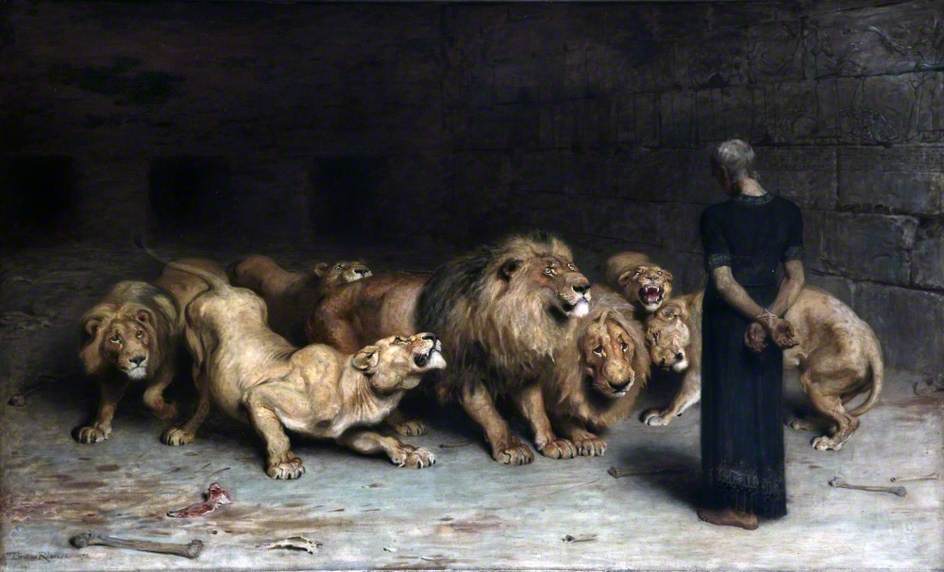
Daniel 1:21 has this note - "And Daniel continued until the first year of Cyrus the king." This short statement refers to the total time Daniel would be in Babylon - at least 70 years. So did Daniel's faith hold out for the 70 years that elapsed from his arrival in Daniel 1-2 until we come to the scene of the Lion's Den in Daniel 6? In Daniel 6, a new King, a new Empire and many of Daniel's enemies had died off. New opponents had arisen who hated Daniel just as much, if not moreso than the old enemies. These new villains tricked King Darius into signing an edict that would result in the Lion's Den for anyone refusing to worship the king. Though Daniel knew of the edict, his faith did not waver. In Daniel 6:10 we read - "Now when Daniel knew that the document was signed, he entered his house (now in his roof chamber he had windows open toward Jerusalem); and he continued kneeling on his knees three times a day, praying and giving thanks before his God, as he had been doing previously."

How many of us would continue persevering in faith, knowing full-well that "documents had been signed" that could end our lives? Daniel's faith was not looking at the situation around him brought about by a king in Persia but rather towards the city of the Great King. Daniel orientated his life around God's precious promises which pointed Him towards the Lord Jesus Christ. Now some may wonder how we get to Jesus from Daniel 6? Consider the logic of Hebrews 11:33 for just a moment - "who by faith conquered kingdoms, performed acts ofrighteousness, obtained promises, shut the mouths of lions." Within that same sequence of verses in Hebrews 11, we note how Moses had chosen the reproaches of Christ over the comforts of sin for a season (Hebrews 11:25-26). Much like Moses, Daniel feared not the wrath of a king, but rather chose to set his eyes of faith upon Him who is unseen (compare Hebrews 11:27 to Hebrews 11:33). The unseen One whom Daniel looked to was none other than the Lord Jesus Christ. The logic of Hebrews 11 is at work in Daniel 6. Although Daniel may not had possessed the 20/20 perspective afforded to us by Hebrews 11, the resolve and direction of His faith is as accurate in terms of what His trust is anchored to (Hebrews 6:18-20). As 21st century Christians we are reminded in Hebrews 12:1-3 "Therefore, since we have so great a cloud of witnesses surrounding us, let us also lay aside every encumbrance and the sin which so easily entangles us, and let usrun with endurance the race that is set before us, 2 fixing our eyes on Jesus, the author and perfecter of faith, who for the joy set before Him endured the cross,despising the shame, and has sat down at the right hand of the throne of God. 3 For consider Him who has endured such hostility by sinners against Himself, so that you will not grow weary and lose heart."

Closing thoughts
Today we considered how Christian faith can work and flourish in the foreign land of this present age. The prophet Daniel was our example. We discovered three necessary truths regarding faith at work in a foreign land:

1. True faith rejects worldliness. 
Daniel 1

2. True faith relies upon the Bible. Daniel 2

3. True faith revolves around Jesus Christ. Daniel 6

Sunday, July 19, 2015

Why Jesus Christ is the only way

Isaiah 30:21 "Your ears will hear a word behind you, 'This is the way, walk in it,” whenever you turn to the right or to the left.'

John 14:6 "Jesus said to him, 'I am the way, and the truth, and the life; no one comes to the Father but through Me.'"

This upcoming week will be dedicated to vacation Bible school at our church. In addition to the many wonderful lessons and activities planned for the children, we will also be having a class for the adults. The VBS theme verse is found in one of the verses quoted above - Isaiah 30:21. The VBS will aim to show kids and adults alike why Jesus alone is the only unique guide in matters pertaining to life, eternal life and the after life. As I was looking over the first night in which I will be teaching, this precious truth of Jesus Christ being the only way or the only guide was pressed deep into my heart. Today's post is all about helping readers to see why Jesus is the only way, and that there is no other Biblical alternative to understanding His Person, work and mission. 

Why Jesus is the only way
Sadly today a growing majority of Christians are denying this cardinal truth of Jesus Christ being the only way, truth and life. In Isaiah's time, Jerusalem and the surrounding environs of the Southern Kingdom of Judah had abandoned their faith in Yahweh. Much like their Northern counterparts in the Northern Kingdom of Israel, the Southern kingdom had fallen prey to worshipping other deities of the surrounding nations. The kings of Judah were making alliances with Egypt to try to stave off a threat from the Assyrian Empire who had already defeated the Northern Kingdom of Israel. In short, Isaiah's nation and people had turned to other "ways" and "deliverances" for their hope. The outcome of their decision was doomed, and yet Yahweh promises at the end of Isaiah 30 that He will restore the very people who had turned their backs on Him for the sake of His covenant promises to Abraham, Isaac and Jacob. Hence the reason for the central affirmation of Isaiah 30:21 "Your ears will hear a word behind you, 'This is theway, walk in it,” whenever you turn to the right or to the left.'

In today's world, not just one voice, but many are competing for the attention of many Christians who perhaps waver on the exclusivity of Jesus Christ. A 2011 Barna research survey of those claiming to be born-again Christians in America discovered that 43% believe that other religions beside Christianity teach similar truths, just from different perspectives (https://www.barna.org/barna-update/faith-spirituality/484-what-americans-believe-about-universalism-and-pluralism#.VaUjsflViko) A similar percentage in that same poll indicated a more "inclusive view" of salvation, meaning that someone could be reconciled to God in salvation through other religions besides Christianity. 
Those respondants have been undoubtedly affected moreso by cultural pluralism - the belief that there is no one "Truth" and that all religions teach the same thing in different ways and promote many ways to God - than the Bible. 

The Bible leaves no space for marshalling the belief that salvation is found outside of faith alone in Jesus Christ alone. The same One who spoke those words through Isaiah in His day of being "The Voice" who said "this is the way, walk in it" is the Same One who stated in John 14:6 "Jesus said to him, 'I am the way, and the truth, and the life; no one comes to the Father but through Me.'" To believe that Jesus Christ is the Only, Unique Way of salvation is at the heart of Biblical revelation. Denial of this cardinal doctrine affects other important doctrinal tenets pertaining to the Person and work of Jesus Christ. To quickly note the key New Testament verses that speaks about major points in describing the Person and work of Jesus Christ and our salvation will demonstrate why Christians must assert that Jesus is the only way.

1. He is the Unique revelation of God in human flesh
John 1:1 begins with these words - "In the beginning was the Word, and the Word was with God, and the Word was God." As "The Word", the Son of God pre-existed eternally with the Father and the Spirit as the One Triune God of the Bible. When the Son came into this world to assume full humanity, He is described as "The Word made flesh" in John 1:14; "God" or "He who was manifested in the flesh" in 1 Timothy 3:16 and "the fulness of the Godhead bodily" in Colossians 2:9. To deny the exclusivity of Jesus Christ is to deny that He alone fully reveals God. If other religions have as much saving value as Christianity, then their various deities and manifestations would reveal a deity far different from the Bible, and thus point completely away from Jesus. The very identity and revelation of the God of the Bible is set aside when we deny Jesus being the only way.

2. Jesus Christ is unique in His birth
Luke 2:10-11 "But the angel said to them, “Do not be afraid; for behold, I bring you good news of great joy which will be for all the people; 11 for today in the city of David there has been born for you a Savior, who is Christ the Lord." When coupled with the other scriptures that speaks of Christ's virgin birth (Luke 1:35) and fulfillment of prophecy concerning the unique beginning of His humanity (Matthew 1:20-23; Isaiah 7:14), the uniqueness of Jesus' birth makes Him the only way to God. By remaining very God, Jesus' existence as a man began with the virgin birth conception (Luke 1:35; Philippians 2:5-11). Both truths are foundational to understanding the Person and work of Jesus Christ. No other religious figure or religious ideology teaches anything close to what is seen in the incarnation of Jesus Christ as Eternal Deity. If anything, the virgin birth and incarnation of Jesus Christ underscores why He is the only way.

3. Jesus Christ's unique life and ministry
Matthew 4:23-25 "Jesus was going throughout all Galilee, teaching in their synagogues and proclaiming the gospel of the kingdom, and healing every kind of disease and every kind of sickness among the people. 24 The news about Him spread throughout all Syria; and they brought to Him all who were ill, those suffering with various diseases and pains, demoniacs, epileptics,paralytics; and He healed them. 25 Large crowds followed Him from Galilee and the Decapolis and Jerusalem and Judea and from beyond the Jordan." By asserting the uniqueness of Jesus Christ as the only way to God and salvation, further proof is found in the life and ministry He led. No other figure in all of history did as much, nor did it as perfectly as Jesus Christ. His 50 or so parables, 35 miracles and fulfillment of over 100 prophecies testify to His uniqueness as God in human flesh and as the perfect man who ever remained God. Jesus was not just a teacher, nor just a spiritual leader or just an example. Jesus didn't come to proclaim a way to God, He came claiming to be that one, unique way. People who believe on Him are saved by His life of perfect righteousness, since in His active obedience He provided the life of righteousness needed to be credited to sinners who are saved by grace alone through faith alone in Christ alone.

4. Jesus Christ's unique death and resurrection. 
1 Corinthians 15:1-6 states - "Now I make known to you, brethren, the gospel which I preached to you, which also you received, in which also you stand, 2 by which also you are saved, if you hold fast the word which I preached to you, unless you believed in vain. 3 For I delivered to you as of first importance what I also received, that Christ died for our sins according to the Scriptures, and that He was buried, and that He was raised on the third day according to the Scriptures, 5 and that He appeared to Cephas, then to the twelve." As the case for Jesus Christ being the only way builds, without doubt His death and resurrection stand out as premier proof. Galatians 3:13 and 4:4-5 both testify to how Christ alone could bear the curse of sin. As already noted in 1 Corinthians 15:1-5, this same Jesus who died as the lone, ultimate sacrifice for sin also physically raised from the dead. No other person in human history has ever physically resurrected. Jesus' resurrection demonstrated the reality of the cross. His unique death and resurrection, as well as His unique pre-existence, birth and life demonstrate why Jesus is the only way.