Translate

Wednesday, September 30, 2015

Spiritual Warfare A,B,C - Approaching Spiritual Warfare


Ephesians 6:10 "Finally, be strong in the Lord and in the strength of His might."

Introduction:
The subject of spiritual warfare is of perennial interest among Christians. Understanding Christian spiritual warfare is vital in breaking Christian people out of a civilian mindset and into the clear reality of needing to be soldiers of the cross. Spiritual warfare also eases somewhat the disillusionment the we feel between living for God in this world and the opposition from the world.  We realize it is not abnormal to experience opposition for being a Christian. I would like to attempt a brief summary of this vast subject of spiritual warfare from the standpoint of Ephesians 6:10-13 for the purpose of spelling out what I call the "A,B,C's of spiritual warfare". Today's post will deal with the first of these, namely the approach to spiritual warfare.

The approach to spiritual warfare - Spirit and the Word
Ephesians 6:10 gives us two and only two ways in which one can approach spiritual warfare in the Christian life. The first is what we looked at in detail yesterday, namely the Spirit-filled life. The second approach is closely related to being filled with the Holy Spirit, namely being filled with the scriptures or maintaining one's exposure to the Word of God.

Ephesians 6:10a states - "Finally, be strong in the Lord...". The underlined words indicate an imperative command that is coined in the passive sense of dependency upon someone. To "be strong in the Lord" refers to depending upon the Person and work of the Holy Spirit. With the Person and work of the Holy Spirit, we cannot understand and discern, which are marks of the strength needed when fighting the good fight of faith. (Ephesians 1:17) Ephesians 3:16 proves that the source of such strength comes from the Spirit: "that He would grant you, according to the riches of His glory, to be strengthened with power through His Spirit in the inner man." 

This strengthening of the Spirit comes to the degree we are filled with or influenced by the Holy Spirit (Ephesians 5:18). Moreover, the Spirit's strength is enjoyed and experienced as we position ourselves in a posture of prayer (Ephesians 6:18). 

But now we notice the second phrase of Ephesians 6:10 - namely: "and in the strength of His might." This second phrase identifies the second  closely related approach to spiritual warfare, the Word of God. 

So how do we know that "the strength of his might" is most likely referencing the scriptures? First, the word of God itself is the offensive weapon of the otherwise defensive armaments in the spiritual armor of Ephesians 6:14-18. Second, Hebrews 4:12 ties together this concept of God's might and spiritual warfare - "For the word of God is living and active and sharper than any two-edged sword, and piercing as far as the division of soul and spirit, of both joints and marrow, and able to judge the thoughts and intentions of the heart." Then thirdly, 2 Corinthians 6:7 alludes to carrying forth spiritual weaponry in the right hand and the left, which in context includes the word of God.  

This then is the two-fold approach to spiritual warfare: namely being filled with the Holy Spirit and being in His Word. 

More tomorrow....

Tuesday, September 29, 2015

Relating the Spirit-filled life to spiritual warfare


Ephesians 6:10-12 "Finally, be strong in the Lord and in the strength of His might. 11 Put on the full armor of God, so that you will be able to stand firm against the schemes of the devil. 12 For our struggle is not against flesh and blood, but against the rulers, against the powers, against the world forces of this darkness, against the spiritual forces of wickedness in the heavenly places."

Introduction
In today's post we now turn our attention exclusively to Ephesians 6, with the goal this week to discover what putting on the full armor of God actually means. Such a command can sound so abstract until we consider the wider context of Ephesians 6:10-18. Today's focus will be on exploring the necessary condition for putting on the whole armor of God: being filled with the Holy Spirit. We will consider this thought under two main headings:

1. Putting on the whole armor of God means being Spirit-filled

2. The Spirit-filled life is pre-requisite to putting on the full-armor of God

Putting on the Whole Armor of God means being Spirit filled. 
Notice what Paul writes in Ephesians 6:10 "Finally, be strong in the Lord and in the strength of His might." Whenever you see that underlined word: "finally", the indication is that Paul is bring to a close a series of points. Notice....

1. Ephesians 4:1 "Therefore I, the prisoner of the Lord, implore you to walk in a manner worthy of the calling with which you have been called."

The whole idea of "walking with God" is a huge point in this second part of Ephesians. Like connecting the dots throughout the remainder of Ephesians 4,5 and 6, we can trace the remaining chain of commands:

2. Ephesians 4:17 "So this I say, and affirm together with the Lord, that you walk no longer just as the Gentiles also walk, in the futility of their mind."

3. Ephesians 5:1-2  "Therefore be imitators of God, as beloved children; 2 and walk in love, just as Christ also loved you and gave Himself up for us, an offering and a sacrifice to God as a fragrant aroma."

4. Ephesians 5:15,18 15 "Therefore be careful how you walk, not as unwise men but as wise." 18 "And do not get drunk with wine, for that is dissipation, but be filled with the Spirit."

To walk with God requires the believer to be "filled" or "under the influence" of the Holy Spirit. The filling of the Holy is commanded not only here in Ephesians, but elsewhere in the scriptures and stated in differing ways. For example, Galatians 5:16 "But I say, walk by the Spirit, and you will not carry out the desire of the flesh." Colossians 3:16 "Let the word of Christ richly dwell within you, with all wisdom teaching and admonishing one another with psalms and hymns and spiritual songs, singing with thankfulness in your hearts to God." To have the scriptures memorized or to have spent time in them to the point of having them in me is practically equivalent to submitting oneself under the Spirit's influence. 1 Thessalonians 5:19 "Do not quench the Spirit." Thus when Paul commands believers to "put on the full armor of God", he is is effect commanding them to be "Spirit-filled people" on a regular basis.   

The Spirit-filled life is pre-requisite to putting on the full-armor of God
As is always the case in the Spirit-filled life: the issue is not about you getting more of the Spirit but rather Him getting more of you. Thus putting on the full armor of God means being filled with the Holy Spirit. As we have already witnessed in Paul's flow of argument through Ephesians 4,5,6; life requires the Spirit-filled life. Undoubtedly, whether in our churches, marriages, parenting or workplaces, relating and responding to people in a Christ-like manner can only occur when we have given ourselves daily to the Spirit's filling ministry. 

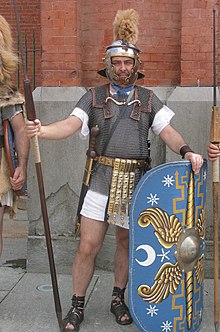
When I think of the "Spirit-filled" life, such a condition can be likened unto the "chain-mail" a soldier would had worn in the Roman army of the 1st century. According to the Zondervan Pictorial Encyclopedia of the Bible, such "chain-mail" (called by the Roman Soldiers lorica) would had protected the heart and vital organs behind the rib cage. 

wikipedia picture

Putting on the Whole Armor of God must begin from the inside to the outside - from the heart and mind to to attitudes then actions. 

The filling of the Holy Spirit means we are guarding the organ of thought and passion for God - the heart. The heart (which again, is the seat of the emotions and in all reality, the causal center of human life itself) must be guarded at all costs. The heart in scripture is described as the well-spring of life (Proverbs 4:23); the source of either the overflow of evils in a man (Matt 15:19) or goodness (Matt 12:34-35). The passions in the heart follow after whatever the mind deems to be the best course of action, whether good or evil (see James 1:13-15). 

Certainly the Holy Spirit's indwelling presence is a must, being that this is after all "the whole armor of God". One must be a Christian to wear the spiritual armor. However, to ensure effectiveness in spiritual warfare and defending Kingdom ground in our marriages (Ephesians 5:22-33); child-rearing (Ephesians 6:1-4) and workplaces (Ephesians 6:5-9), we as Christians must daily be Spirit-filled. This is why Paul's command to put on the full armor of God in Ephesians 6:10-18 comes at the tail end of a string of commands that are about making sure we are walking with God as Spirit-filled believers.

Monday, September 28, 2015

Learning how to pray like Jesus - Cultivating a life around prayer


Mark 1:35 "In the early morning, while it was still dark, Jesus got up, left the house, and went away to a secluded place, and was praying there." 

Do you and I truly enjoy God when we are praying? Jesus did.
When the disciples were following Jesus in the days of His earthly ministry, they were surrounded by numerous examples of "praying people". The Pharisees and teachers of the law had either written or publically demonstrated the so-called "right ways" to pray. The entire Temple System of 1st Century Jerusalem rang out with priests publically offering up prayers. With all the discussion and teaching on prayer, it would seem that the disciples would had been well-versed in how to pray. Yet, once they began to follow Jesus and observe His prayer-life, they knew they were witnessing a prayer-life that was unique and Holy Spirit-empowered. 

When we learn to pray like Jesus, we note how often He enjoyed spending time alone with His heavenly Father.   Almost from the onset of Jesus' ministry we find Him setting the pattern for His busy three and one half year ministry. At times Jesus would be in the seeming height of business and suddenly drop everything to go and pray. Luke 4:42 notes: "When day came, Jesus left and went to a secluded place; and the crowds were searching for Him, and came to Him and tried to keep Him from going away from them." 

Success and popularity followed Jesus wherever he went in those early stages of His work. Many people would look for such opportunities to grab the spotlight and sway the masses - but not our Lord. Luke notes in Luke 5:15-16 "But the news about Him was spreading even farther, and large crowds were gathering to hear Him and to be healed of their sicknesses. 16 But Jesus Himself would often slip away to the wilderness and pray."

The source of Jesus' life and prayer-life while He was ministering on this earth
The true source of Jesus' strength was not the crowds, but the time He had with the Father.  Though Jesus ever remained fully God, yet He chose not to utilize the benefits that come with being fully Divine, but rather chose in His humanity to rely upon the One who had sent Him. Luke 9:18 reveals: "And it happened that while He was praying alone, the disciples were with Him, and He questioned them, saying, “Who do the people say that I am?”  Jesus ever retained the understanding of Who He was and Whose He was.  His prayer life was so powerful and persistent that his disciples requested a lesson from Him on prayer. Luke 11:1-4 records for us the incident: "It happened that while Jesus was praying in a certain place, after He had finished, one of His disciples said to Him, “Lord, teach us to pray just as John also taught his disciples.” And He said to them, “When you pray, say: ‘Father, hallowed be Your name. Your kingdom come. ‘Give us each day our daily bread.  ‘And forgive us our sins, For we ourselves also forgive everyone who is indebted to us. And lead us not into temptation.’ " Jesus enjoyed time with the Father. When we enjoy time with the Father, we will find ourselves wanting to cultivate a life around prayer.

Two Points of Application when it comes to cultivating a life around prayer like Jesus
As we draw today's post on praying like Jesus to a close - we can glean two points of application from Jesus prayer-life. 

1. First, Jesus prioritized the tasks of life around His prayer-life and by His prayer-life.  

Too often we reverse the order and say to ourselves: "I'll pray later" or "I'll pray when my schedule gets better". Jesus shows us that life's busyness never recedes - and that time with the Father regulates all we do.  

2. Secondly, Jesus public ministry was regulated by His prayer-life. 
A man's ability to influence men for God will never exceed how much the man is influenced by God in prayer. Jesus' prayer-life was saturated by the Father's presence - which is why He wielded such power to shape and mold the world around Him. Jesus demonstrates both the priority of prayer by how eager He was to spend time with the Father.  May you and I dear friend take to heart these lessons from the Master.

Sunday, September 27, 2015

Some observations about prayer and why we need Jesus Christ and the Holy Spirit for effective prayer


Hebrews 4:14-16 "Therefore, since we have a great high priest who haspassed through the heavens, Jesus the Son of God, let us hold fast our confession. 15 For we do not have a high priest who cannot sympathize with our weaknesses, but One who has been tempted in all things as we are, yetwithout sin. 16 Therefore let us draw near withconfidence to the throne of grace, so that we may receive mercy and find grace to help in time of need."

Introduction: What unbelievers outside of Jesus Christ understand about prayer
Did you know that non-Christian people pray? Multitudes of devotees from all sorts of religions have prayers and rituals woven into their activities. Such a general observation of mankind's religious bent can be explained by humanity still bearing the image of God and the response to God's general revelation of Himself in the consciences of men and creation (see Genesis 1:26-28; Psalm 8:1-4; Psalm 19:1-6; Romans 1:18-20) 

People outside the Christian faith generally pray only for two reasons: out of fear or out of need. When an unbeliever calls out to God in repentance, God will hear such prayers due to the fact that the Spirit of God has already been at work (see for instance the sailors in the Book of Jonah and 2 Timothy 2:24-25). In other occassions where God responds to unbelievers, it is out of God's choice to respond, being that He is not obligated to unbelievers' prayers. 

At best, this is what natural unbelieving man is able to understand about prayer, namely fear and need. The thought of enjoying God never crosses the non-Christian's mind, due to the fact that outside of Jesus, people can only know about God but not know Him (Acts 17:24-25; 1 Corinthians 2:9,14). Such general observations underscore why we need to look to Jesus in understanding how to pray and why we pray. Jesus alone connects human beings by faith to God. Jesus Christ is the fulness of God's revelation in human flesh. When by the Spirit's working through the specific revelation (i.e the Gospel in the Bible) people respond in saving faith and thus are reconciled to God. Since Jesus Himself, being God, came as a man and retains such humanity to connect God to the Christian, the Christian can now know God and experience Him on a personal level.

What makes prayer unique in Christianity and the Gospel: Personal connection to God through Jesus Christ
What makes the Gospel and Christianity unique is that prayers offered up in Jesus name connect directly to God. As we noted earlier, unbelievers who pray may only pray out of fear or out of need. Whenever a person is born again in saving faith, a new impulse is gained - namely the desire to desire God. 

In the faithwalk with Jesus Christ, the need for God is sought first in order to better understand how to pray for other needs. Additionally, in one's faithwalk with Jesus Christ, fearing God means hating sin and seeking Him at all costs, thus transforming the basis for prayer from fear to faith (see Hebrews 11:1,6). 

To know God and to enjoy Him can only occur when a person by grace through faith has trusted in Jesus Christ (Jeremiah 9:23-24; 2 Corinthians 5:15-21; 1 Timothy 2:5; Jude 1:20-25).  In other words, only within a relationship with Jesus Christ by faith are prayers accepted by God, meaning that He commits Himself in covenant relationship to the Christian who prays in the name of Jesus (see John 9:31; Hebrews 4:13-16). 

Moreover, unlike other religions, the Gospel and Biblical Christianity alone teach that Christians are able to pray in expectation of an answer due to the personal inner working of the Holy Spirit in their lives (Jude 20-23).

The cycle of how God works in the prayer-life of the Christian
If we were to summarize what makes prayer unique in relationship with Jesus Christ, it would be this: God commits Himself to pray in and through the Christian. In other words, the Holy Spirit initiates the promptings of prayer in the Christian's heart, resulting in a prayer offered up to the Father through the Son (Ephesians 2:18; Romans 8:26-27). The Son in turn takes every prayer received and intercedes on behalf of the Christian to the Father (1 John 2:1-2). Then thirdly, the Father responds by excercising His will through the continuing work of the Holy Spirit (Jude 1:20-23). If we can think of this "prayer-cycle" as the Triune God's involvement in the Christian's prayer life, no other religion comes even close to this supernatural, empowered reality of prayer. 

Closing thoughts
In short, every other religion has people trying to reach up to God that they cannot know personally by religion or reason. Only by grace through faith alone in Jesus Christ does God reach down to make Himself known and commits Himself to the continual activity of doing so in the life of the believer. This is why we need Jesus Christ and the Holy Spirit for effective prayer. 

Saturday, September 26, 2015

Ingredients for a powerful and effective prayer life

Romans 8:26-27 "In the same way the Spirit also helps our weakness; for we do not know how to pray as we should, but the Spirit Himself intercedes for us with groanings too deep for words; 27 and He who searches the hearts knows what the mind of the Spirit is, because He intercedes for the saints according to the will of God."

Introduction:
The photograph above features the moments following the explosion of a star in a far-away nebula that astronomers deemed "Super Nova 1987A". Prior to the star going supernova, it looked like any other star to the untrained eye. In what has been perhaps the most documented Supernova event in modern times, scientists got a cosmic front row seat to witness an otherwise ordinary looking star suddenly explode and outshine its host nebula. Needless to say, the event proved to be powerful and effective in capturing the scientific world.

How can you and I as Christians go from having a less-than-stellar prayer-life to one that will shine through the often-times darkness of this life? How can we have a powerful and effective prayer life? Romans 8:21-28 gives the list of ingredients necessary for having such a life of prayer. As one writer once put it: "a man (and for that matter a woman) of God can never exceed in their public life the level to which they are with God in their private life." If we can take note of the principles Paul lays out here for praying with power, then we will have the Christian lives and churches that are also marked with the Spirit's power and enduement.

1. Pray with expectation. Romans 8:21-25 
Romans 8:21-25 states: "that the creation itself also will be set free from its slavery to corruption into the freedom of the glory of the children of God.22 For we know that the whole creationgroans and suffers the pains of childbirth together until now. 23 And not only this, but also we ourselves, having the first fruits of the Spirit, even we ourselves groan within ourselves, waiting eagerly for our adoption as sons, the redemption of our body. 24 Forin hope we have been saved, but hope that is seen is not hope; for who hopes for what he already sees? 25 But if we hope for what we do not see, with perseverance we wait eagerly for it." Notice the underlined words in the text: "waiting eagerly" and "hope". Do we expect God to genuinely work when we pray? Are we expecting Him to act on our behalf. The tone of the Christian world and personal Christian living is often powerless due to the fact we don't believe God is powerful. We have tamed God and domesticated Him to operating on the same plane as we do. If God is powerful enough (and He is) to bring to a resolution the sin and decay of this creation through the redemptive efforts of His Son, surely he can act effectively on your behalf and mine. So to pray with power, we must pray with expectation, meaning we know God is able to do whatsoever His will in His Word says he can and will do. But notice a second necessary element...

Pray with weakness. Romans 8:26 
Romans 8:26 states - "In the same way the Spirit also helps our weakness; for we do not know how to pray as we should, but the Spirit Himself intercedes for us with groanings too deep for words." If there is one thing missing in our church world and Christianity as a whole in America it is the sense of dependency on God. We like to come off like we have it all together. Showing of strength, human ingenuity, professionalism, cleverness, no problems, personality and the like make for appealing to the crowds and attracting more people. However, does such an envoronment foster the type of atmosphere wherein the Spirit of God will show up in supernatural power? 

Consider again what we learn in prayer, and apply it in your Christian life or the church world: "His power is made perfect in weakness". Admitting that I don't have the answers. Acknowledging to God we need help with this or that. Coming to our heavenly father as a little wee child comes to their daddy with upheld arms, moistened eyes and quicvering voice saying: Daddy, please help me! Would any decent father reject such a plea? Hardly! How much more our Heavenly Father will grant the co-equal, co-eternal Spirit in powerful aid to those crying out in prayer. Our strength lies in our weakness, a message so alien to our culture. Nonetheless this is what is called for in praying with power, namely praying in our weakness and dependance upon God. We need also to pray with expectation. But notice the last ingredient for praying with power...

Praying with faith in God. Romans 8:27-28
Romans 8:27-28 "and He who searches the hearts knows what the mind of the Spirit is, because He intercedes for the saints according to the will of God. 28 And we know that God causes all things to work together for good to those who love God, to those who are called according to His purpose." In prayer the mind and the human spirit are linked together. The mind that has taken in the words of God from the Bible knows the will of God. The human spirit that is home to the Holy Spirit of God knows the will of God intuitively. Faith by its very defintion in Hebrews 11:1 is the substance of things hoped for and the certainty of things not yet seen. 

Fear says: "Maybe". Faith says: "He can". Fear says: "I'm not sure". Faith says: "I know He will". Prayer crosses over that invisible boundary between human half-hearted prayers vs Spirit-wrought powerful intercession by what we can call "certainty" and "knowing that we know that we know". Romans 8:28 is an everest in the Christian's prayer life. You can take that one verse and pull it over every area of your Christian life and whatever is lacking in our local churches. Praying with power will lead to living with power, worshipping with power and preaching with power. 

We need the power and Person of God in our lives. May we pray with expectation, weakness and faith. Those are the ingredients for praying in power. 

Friday, September 25, 2015

How to enter into the enjoyment of the Abundant Christian life

Matthew 6:25-27 “For this reason I say to you, do not be worried about your life, as to what you will eat or what you will drink; nor for your body, as to what you will put on. Is not life more than food, and the body more than clothing?26 Look at the birds of the air, that they do not sow, nor reap nor gather into barns, and yet your heavenly Father feeds them. Are you not worth much more than they? 27 And who of you by being worried can add a single hour to his life?"

Matthew 6:33 "But seek first His kingdom and His righteousness, andall these things will be added to you."

Introduction:
There is a coffee shop in the town where I live that serves an incredible cup of coffee. Whenever I enter into that shop, the owner knows what I will order. He proceeds over to the expresso machine and puts in a "shot" of what I call "new life" (that is, expresso). Now that small amount of super-concentrated expresso sits in the cup. The owner then hands me the cup and I proceed over to some assorted coffee pots and choose which beverage I will put in to fill the cup to the brim. The full experience and enjoyment of that cup of "new life" will be accompanied by undertones of rich, nutty, earthy, smoky flavor. To not have that cup filled to the brim would be missing out on the enjoyment that accompanies the energy guaranteed by the coffee. We could say that my alertness and quality of pgysical energy before the coffee contrasts with the change of energy that occurs when I begin sipping that good cup of "life-infused" coffee.

Two types of life are contrasted by Jesus in the opening verses of today's post. The first set of verses we could classify as "life" or "natural life". Self-centeredness enthrones itself in the natural life. Getting all the one can get and canning all that one can get is the pursuit of natural life. Worry. Doubt. Fear. Those three emotions are outcomes of the natural life. Whenever you look at mankind's attempts to live life without God, you will find worry, doubt and fear interlaced in every plan, pursuit and purpose. The natural, unbelieving soul considers God's Word a foolish book (1 Corinthians 2:14). Many will outwardly pay their respects to the scriptures. However, the court of human opinion means more and carries more weight for the natural human mindset than any book claiming to be the Word of God. 

The second type of life that Jesus speaks of we could classify as "Kingdom life" or "The abundant life". This life is entered upon through the New birth in saving faith (John 3:1-6). Matthew 6:33 gives the Christian the antidote they need to combat the temptation to think only in natural terms. The New nature received in saving faith runs contrary to the assumptions of natural, everyday life. Afterall, the "Kingdom life" or "Abundant life" is supernatural. Jesus speaks a similar thought to Matthew 6:33 in John 10:10 "The thief comes only to steal and kill and destroy; I came that they may have life, and have it abundantly." The Apostle Paul wrote of the abundant life in Ephesians 3:20-21 "Now to Him who is able to do far more abundantly beyond all that we ask or think,according to the power that works within us, 21 to Him be the glory in the church and in Christ Jesus to all generations forever and ever. Amen." The abundant life of walking in Jesus and He in us is the calling of every Christian. 

How is the abundant life, life, consistently enjoyed?
Jesus began the opening of His first sermon with these words in Matthew 5:6 “Blessed are those who hunger and thirst for righteousness, for they shall be satisfied." The entry point of the abundant Christian life is the new birth. The entry point of continual enjoyment of the abundant life is by being filled with the Holy Spirit. Jesus didn't come merely to give life, but abundant life. 
This is why Jesus sent His promised Holy Spirit to His church (John 16:12-15). We as Christian people are heirs to an abundant Christian life. Only when we daily heed to the Spirit's influencing or filling ministry will we persist in life not upon the basis of natural life, but the supernatural life of the Son of God afforded to us by the Spirit's filling ministry. Ephesians 5:18 states - "And do not get drunk with wine, for that is dissipation, but be filled with the Spirit."
We propose today this main idea: The Spirit-filled life enables enjoyment of the abundant experience of Jesus in this life.
What abundant life looks like in action - Ephesians 5:19-6:9
1. Abundant church-life. Ephesians 5:19-21
Here we see commands given to the entire church body to "speak to one another" and "submit to one another". The songs of praise and worship result in the overflow of the individual Spirit-filled Christians coming together in either a corporate worship setting or smaller groups. Like live coals in a BBQ, as one Spirit-filled Christian fellowships with another Spirit-filled Christian, the worship quickly escalates to that level of worship that can only be described as "other-worldly". A sweetness fills the air and the focus becomes absolutely Christ-centered. Churches benefit from church members who regularly make the Spirit-filled life their priority. It is important to note that nothing can kill church-life quicker than whenever any of us emphasizes self and the flesh over and above the leading of the Lord. Ephesians 4:29-30, which is logically connected to Ephesians 5-6, warns readers of what can occur when self, rather than the Spirit, is trying to run the show in our church-life. When the Lord is in charge, church life goes from "trying to get the work to move forward" to "the Lord at work". Truly t
he Spirit-filled life enables enjoyment of the abundant experience of Jesus in this life.

2. Abundant Family life. Ephesians 5:22-6:4
In the flesh, the idea of "submission" is viewed negatively. Moreover, the possibility of loving one's wife as Christ loved the church - i.e putting her needs ahead of my own, willing to die if need be, being the spiritual leader - is too-tall of an order in the flesh. The self-life groans in the sight and hearing of such instructions. Natural life cannot imagine abundance.

Only the Spirit-filled wife and husband can achieve what is expected here in Ephesians 5:22-33. Harmony and unity result when both spouses are regularly led by the Holy Spirit. Just as we saw in the example of the Spirit-filled church, the Spirit-filled marriage will focus on Jesus Christ. Turning once again back to Ephesians 4, we find why it is necessary not to end the day on an angry note in Ephesians 4:26-27. Husbands, did you know if you mistreat your wife, your prayer life will come to a standstill? Let’s not give the devil a foothold in our marriages. Let’s be filled with the Holy Spirit again and again for Jesus’ sake and each other’s sake.

I find it interesting that the entire argument for the Spirit-filled life is not only for adult believers, but young Christians too. Parenting in the way God has prescribed can often be an exhausting chore. However when I yield myself to the Spirit's leading by way of daily time in the scripture, praying for my child and denying self - parenting in the name of Jesus becomes a delight. Conversely, whenever a little Christian child is taught to submit themselves to the Lord by practicing daily time in the Word, asking the Lord to lead them and most-importantly of all, mom and dad having Spirit-filled lives, the growing pains of childhood can be greatly dampened.

This is why the Spirit-filled life is a repeated experience post-conversion. Just as your car needs repeated fill-ups, so does the Christian walk. Perhaps this observation is no more realized than in the context of parenting. The abundant life of Jesus Christ is enjoyed by being Spirit-filled. The results that can flow from the abundant life are abundant church life and family life. As we have already noted, 
the Spirit-filled life enables enjoyment of the abundant experience of Jesus in this life. In church, in the family and then one more area....

3. Abundant life in the work place. Ephesians 6:5-9
Working on the job tests the patience of employees and employers alike. How can either make Godly decisions or treat each other in such a way that honors Christ? In the context of the work-a-day world, where there is often more unbelievers and believers, the Spirit-filled life is an utmost necessity. If an employee finds themselves as the only Christian among dozens (I've been there) or working for a boss who regularly pressures them to attempt things that are contrary to biblical convictions (I've been there as well), then the only way in which successful navigation can occur is the Spirit-filled life. To walk away from temptations, or opportunities to be lazy when the boss is not looking requires a Christian to be daily yielded to the Spirit of God. Abundant life in the midst of life will pray for co-workers and supervisors and labor to be a part of the change being prayed for by the Christian. 
The Spirit-filled life enables enjoyment of the abundant experience of Jesus that is needed in the workplace.

Closing thoughts
Today we considered how to enter into enjoyment of the abundant Christian life. We saw that such a life is what Jesus came to provide and that is entered upon in the New birth. We also considered this main thought: The Spirit-filled life enables enjoyment of the abundant experience of Jesus in this life. Whether we are talking about church life, family life or work-life, our experience and enjoyment of Jesus Christ is directly related to how much we are placing ourselves under the Holy Spirit's filling ministry. God desires for us to live abundantly for Him. The question is: how much do we want to have a richer experience and walk with Jesus Christ?

Thursday, September 24, 2015

Biblically understanding Spirit-filled, Spirit-anointed employees and employers


Ephesians 6:5-9 "Slaves, be obedient to those who are your masters according to the flesh, with fear and trembling, in the sincerity of your heart, as to Christ; 6 not by way of eyeservice, as men-pleasers, but as slaves of Christ, doing the will of God from the heart. 7 With good will render service, as to the Lord, and not to men, 8 knowing thatwhatever good thing each one does, this he will receive back from the Lord, whether slave or free. 9 And masters, do the same things to them, and give up threatening, knowing that both their Master and yours is in heaven, and there is no partiality with Him."

Introduction
These last couple of days we have considered how the Spirit-filled life produces necessary consequences for daily living. We've explored Spirit-filled church life and Spirit-filled families. Today's post considers the Spirit-filled workplace. One of the reasons Paul is writing these words is to help readers to apply the central truth of Christ's all-sufficiency and Lordship to matters pertaining to family, to child-rearing and then of course the work place. How one functions as a Christian in the everyday workplace is covered under the discussion of "vocation". The Spirit-filled life is key to being a Spirit-filled employee or boss. One related area that is important to include in such a discussion is the matter of "the anointing of the Holy Spirit".

The anointing of the Holy Spirit 
When we talk about the anointing of the Holy Spirit, we are referring to the overflow of His power and presence in our lives. One cannot expect to walk in the overflow of the Spirit unless they are filled or influenced by Him. 

Operating as an employee who is a Christian is as spiritual of a consideration as thinking upon heeding the call to pastoring or missionary work. The types of work may be different and the callings God gives for each might be distinct, yet the value each has in contributing to the overall accomplishment of God's purposes can be used equally by God. God certainly has used preachers and pastors in times past to initiate mighty movements of God, but so has He used business men to do the same work. The gifting and calling of God is certainly greater than any man, however God is greater than them all and will use each as he sees fit to accomplish His purpose. 

Such ability to not only model but be the presence of God in the work place derives from the spiritual authority delegated by God to the Christian.  The Bible uses the language of "anointing" to communicate this idea of spiritual authority. The anointing of the Holy Spirit is that ministry He does while indwelling the Christian that results in them having empowerment and insight to function and serve the Lord. The filling of the Holy Spirit links together the Spirit's indwelling ministry on the inside to the anointing He does in taking what is on the inside and blessing others on the outside. At least two types of anointing are spelled out in scripture. 

The first is what I call an "outward" anointing. This has to do primarily with offices of every sort, whether family, govermental or within the church. God grants grace and ability to achieve that particular office. Clearly unbelievers or believers occupy positions or stations in families (parents) and in the culture (politics, doctors, police officers, teachers, etc). Thus for example in the Old Testament, we see godly King David and a Pagan King named Cyrus both referred to as "God's anointed" (Psalm 2 and Isaiah 45). Only Christian men are specifically assigned by God to occupy the Pastoral/Elder and Deacon offices of Christ's church. (1 Timothy 3:1-14 and Titus 1) and believers in general are called by God with graces that accompany other areas such as teaching, administrating. All authority comes from God. Period. 

The second type of anointing, what we will deem "inner anointing", refers to that spiritual authority that only comes through saving faith in Jesus Christ. 1 John 2:20 and 2:27 describes the indwelling Holy Spirit as being the Christian's "anointing", meaning the source of delegated authority from God to discern and live out the Christian life. 2 Corinthians 1:21-22 also describes this second type of anointing: "
Now He who establishes us with you in Christ and anointed us is God, 22 who also sealed us and gave us the Spirit in our hearts as a pledge."  Every Christian has the indwelling Spirit, and thus possess this inner anointing. Though all Christians have the inner anointing, each Christian will operate in different measure based upon how much they have taken in the scripture and have obediently yielded themselves to the Spirit's filling or influence. (Ephesians 5:18; Galatians 5:1,16). The anointing of the Holy Spirit is simply the empowerment and insight the Christian has from the indwelling Holy Spirit at work in and through their lives.

How so-called Christians are anointed by God to do extraordinary things
How can a Christian, working in an otherwise non-Christian environment, affect change? Certainly whatever station one is at in life, whether a parent, a doctor, a teacher, a laborer, a pastor or whatever the case may be, God has created the boundaries and abilities that come with each one. God has so-called and placed every believer where He wants them so they can be used by Him to impact others. 

In understanding the nature of one's vocation to do a certain task (again we will tie this to the term "outward anointing"), the Christian uniquely has that second anointing, that "inner anointing" or indwelling Holy Spirit. The Holy Spirit indwells the child of God to compell them work hard and love their neighbor as themselves. When we regularly are filled with the Spirit, as commanded in Ephesians 5:18, we will be equipped to delight in doing for God and for others. So how do these two anointings work together?

Over time, a Christian who has regularly given themselves to the scriptures and prayer will to the unsuspecting co-worker gain respect. As the Christian learns their place and accepts what they are doing as a call from God, their ability to be used of God can only increase. 

Closing Thoughts
Just knowing that where you are is ordained by God (outward anointing) and that all that you need to do your job is supplied by the Holy Spirit of God indwelling you (i.e inward anointing) supplies the basis for Christian spiritual authority. Such authority must  not be viewed as imposing one's will on someone else but rather serving the Lord by loving one's neighbor for Jesus sake and doing one's job for God's glory. The working of the Spirit's anointing is directly connected to the Spirit's filling ministry. We could say on a practical level - one cannot truly operate in the anointing and not be Spirit-filled, since both ministries are intertwined with one another. If we were to assign a theme verse to Spirit-filled, Spirit-anointed employees and employers, it would be Romans 14:7-8. Notice what Paul writes in Romans 14:7-8 "For not one of us lives for himself, and not one dies for himself;for if we live, we live for the Lord, or if we die, we die for the Lord; therefore whether we live or die, we are the Lord’s."