Translate

Saturday, October 3, 2015

P1 - The Final Authority of all faith, practice and life


2 Timothy 3:16-17 "All Scripture is inspired by God and profitable for teaching, for reproof, for correction, for training in righteousness; 17 so that the man of God may be adequate, equipped for every good work."

Introduction:
Who is in charge? To whom or to what standard do people answer? No one considers the importance of authority until there is either a decision to be made, a crisis or a major transition in life. Final, ultimate authority is possessed by God and God alone. Psalm 47:7-8 reminds us - "For God is the King of all the earth;Sing praises with a skillful psalm. 8 God reigns over the nations, God sits on His holy throne." Such authority is called by scripture and Bible teachers "God's Sovereignty". Psalm 103:19 for example states - "The Lord has established His throne in the heavens, And His sovereignty rules over all." In the New Testament we find this same truth echoed in 1 Timothy 6:15 - "which He will bring about at the proper time—He who is the blessed and only Sovereign, the King of kings and Lord of lords." The Sovereignty of God is uncontested in the Bible. Most people pay lip service to the idea of God's Sovereign, ultimate authority. People have no problem with a God running the affairs of the world as long as they still retain their own, personal, self-perceived autonomy. The moment God's authority is brought to bear on a personal level - people begin to shift in their seats. Famous general George Patton once quipped: "All human beings have an innate resistence to obedience." 

The final authority of all faith, practice and life is the Bible
When we speak of God's Sovereign final authority, how is it that such authority is brought to personally bear directly on a person? Certainly God delegates His authority to civil governments to exercise justice and maintain order in societies (Romans 13). A city government can enact laws to tell a man to not spit on the sidewalk, however civil government cannot convince the man that this is the preferrable course of action. At best, government can curb evil behavior and keep crime to a tolerable minimum.

When we come to the church - who is in charge? What holds sway over the conscience of a man - the one place where right and wrong are inscribed? Such authority can be deemed final authority when it wields the same type of authority as God Himself. Pastors are delegated the authority by Christ to lead the church - however they are not the final authority. Pastors are accountable to the churches they shepherd. 

The congregation of God's people function as God's delegated governing authority - however churches need to be led by competent, Biblical shepherds.  Both types of leadership and authority co-exist in a local church as delegated authorities with different roles - and yet neither one can be deemed "final authority". 

What about the Bible? What kind of authority is it? First and foremost, the Bible is deemed "The Word of God". The title "Word of God" means that the Bible's 66 books are God's voice in written form. 

Secondly, throughout the Bible on hundreds of occassions we find the phrase: "thus says the Lord" closely attached to the words of the prophets. 

Thirdly, no other book or written document in the world functions in the unique capacity of final authority like the Bible. The Baptist Faith & Message 2000 defines in more precise terms what is meant by the Bible being called "the final authority of all faith, practice and life: "Therefore, all Scripture is totally true and trustworthy. It reveals the principles by which God judges us, and therefore is, and will remain to the end of the world, the true center of Christian union, and the supreme standard by which all human conduct, creeds, and religious opinions should be tried. All Scripture is a testimony to Christ, who is Himself the focus of divine revelation." The Bible is thus the only authority that is final. The question is: how is this the case? Does the Bible claim for itself such a designation?

How the Bible declares itself to be the final authority and thus the written voice of God
Theologian Charles Hodge in Volume 1 of His Systematic Theology, page 159, summarizes beautifully how the Bible functions as the written form of God's authoritative voice: "Prophecy, i.e., what a prophet said, was not human, but divine. It was not the prophet’s own interpretation of the mind and will of God. He spoke as the organ of the Holy Ghost."

Hodge then later writes: What the Prophets said God said....it is another decisive proof that the sacred writers were the organs of God in the sense above stated, that whatever they said the Spirit is declared to have said. Christ himself said that David by the Spirit called the Messiah Lord. (Matt. 22:43.) 

David in the 95th Psalm said, “To-day if ye will hear his voice, harden not your heart;” but the Apostle (Heb. 3:7), says that these were the words of the Holy Ghost. 

Again, in (Hebrews) ch. 10:15, the same Apostle says, “Whereof the Holy Ghost also is a witness to us: for after that he had said before, This is the covenant that I will make with them after those days, saith the Lord.” Thus quoting the language of Jeremiah 31:33, as the language of the Holy Ghost."

Hodge then concludes his argument demonstrating how the Bible is the final authority of all faith, practice and life, insofar as it functions as God's verbalized authority to men in general and the church in particular: In Acts 4:25, the assembled Apostles said, “with one accord,” “Lord thou art God Who by the mouth of thy servant David hast said, Why did the heathen rage?” In Acts 28:25, Paul said to the Jews, “Well spake the Holy Ghost by Esaias the prophet unto our fathers.” It is in this way that Christ and his Apostles constantly refer to the Scriptures, showing beyond doubt that they believed and taught, that what the sacred writers said the Holy Ghost said."

Tomorrow's post will deal with the life-practical ramifications of the truth that the Bible is the final authority of all faith, practice and life.

More tomorrow.....


Friday, October 2, 2015

Spiritual Warfare A,B,C - Confidence to win in spiritual warfare


Ephesians 6:13 "Therefore, take up the full armor of God, so that you will be able to resist in the evil day, and having done everything, to stand firm."

Introduction and review
The last couple of days have served to unpack the A,B,C's of spiritual warfare. In this short series we have noted that when approaching spiritual warfare, we need to be Spirit filled and word filled, per what we looked at in Ephesians 6:11. Carnal weapons of the flesh have no place in spiritual warfare (2 Corinthians 10:3-5).  God's supplied Word and He in the Person of the Holy Spirit are the only ways we can approach our daily warfare as Christians. 

Then we noted yesterday the "B" of the A,B,C's - "Believer's three common enemies". In considering 1 John 2:14-17 and Ephesians 6:12, we saw that the Devil (via his demonic network), the world and the flesh are the three main enemies we deal with in spiritual conflict. Today's post aims to show the confidence we have in spiritual warfare.

The Confidence in Spiritual Warfare
Ephesians 6:13 states - "Therefore, take up the full armor of God, so that you will be able to resist in the evil day, and having done everything, to stand firm." A brief unfolding of this verse, one phrase at a time, will show why it is we as Christians can have confidence in spiritual warfare.

1. Divine provision of spiritual armor

Paul writes first of all: "Therefore take up the full armor of God...". In the days that Paul wrote this letter, he was chained to a Roman soldier who was likely a member of the elite Roman unite called the "Italian band". When a Roman soldier went into battle, they had behind them the entire Roman Senate and authority of the Emperor. Furthermore, they possessed what was then the finest armor of any army in the world. 

The word translated "full armor" could just as easily be translated "full array". The Roman soldier had everything he needed, and then some, to defeat his enemy. Christians have at their disposal the entirety of God's provision of the spiritual armor. Moreover, the Holy Spirit Himself indwells the Christian. 

No demon, no desire of the flesh and no influence in the world is greater than the Spirit of God (1 John 4:4). We also have the authority of the King of Kings, Jesus Christ Himself, behind and in us (Colossians 1:27). We have the Father's favor watching over us (James 1:17). The Christian as the provision of God when it comes to fighting the good fight of faith. So there is the Divine provision, but notice secondly....

2. Divine power to fight
Ephesians 6:13 says next - ..."so that you will be able to resist in the evil day...". To know that we as Christians have God's very power available to resist temptations, overcome fear and resist the Devil ought to increase our confidence. 1 Corinthians 10:13 reminds us - "No temptation has overtaken you but such as is common to man; and God is faithful, who will not allow you to be tempted beyond what you are able, but with the temptation will provide the way of escape also, so that you will be able to endure it." 

Oftentimes I will hear Christians worry about whether or not they would be able to take a stand for Jesus if the situation demanded it. My answer to them is a resounding "yes"! These texts, and many others (Hebrews 12:3; James 1:3-4; 1 Peter 1:5-7; 1 Peter 4:10-11) speak to how we have the Divine power to win spiritual battles and Divine provision, but notice lastly...

3. Divine guarantee of victory
Ephesians 6:13 says once more - ..."and having done everything, to stand firm." The verb translated "having done everything" is the same exact verb found in Philippians 2:12 - "So then, my beloved, just as you have always obeyed, not as in my presence only, but now much more in my absence, work out your salvation with fear and trembling." 

Will the fight of faith be immune from troubles and pain? No. We must literally "work it out" in the exercise of our faith in prayer (Jude 1:20); the scriptures (2 Timothy 2:15) and church attendance (Hebrews 10:24-25). We must "work it out" by ways of loving our enemies (Matthew 22:39); watching our speech (James 1:26-27) and enduring hardship (2 Timothy 3:12). Yet, we know that God is the One working forth in us His perfect and pleasing will and a glory that cannot compare (2 Corinthians 4:18; Philippians 2:13). The victory has already been won by Jesus. We are  running our victory lap for the King of Kings (Hebrews 12:1-3). 

Thus Divine provision, power and guarantee comprises the confidence Christians have in spiritual warfare.

Closing thoughts
We have explored the A,B,C's of spiritual warfare these last few posts. We have discovered the following:

1. Our approach must be as Spirit-filled and word-filled people. 

2. Believers have three enemies: the world, the flesh and the Devil. 

3. Then the confidence we have in spiritual warfare is the Divine provision of the spiritual armor, Divine power to fight and Divine guarantee to win. 

Thursday, October 1, 2015

Spiritual Warfare A,B,C - Believer's 3 Common Enemies


Ephesians 6:10-11 "Finally, be strong in the Lord and in the strength of His might.11 Put on the full armor of God, so that you will be able to stand firm against the schemes of the devil."

John 2:16-17 "Do not love the world nor the things in the world. If anyone loves the world, the love of the Father is not in him. 16 For all that is in the world, the lust of the flesh and the lust of the eyes and the boastful pride of life, is not from the Father, but is from the world."

Introduction:
We saw in yesterday's post the two-pronged method for approaching spiritual warfare: Spirit-filled and word-filled living. Both the Spirit's leading and the authority of God's word go hand-in-hand in the Christian's daily warfare. Consider the following observation from Dr. Charles Stanley in his book: "The Wonderful Spirit-Filled Life", page 210: "Peace or no peace. Guilty conscience or no guilty conscience. The Word of God stands. It is the final authority for the Spirit-filled believer. The Spirit-filled life is a life lived in accordance with the teachings of Scripture - whether one feels like it or not and whether it bears witness to one's spirit or not." Dr. Stanley later on notes in page 213 of the same book: "That is why the Spirit-filled life begins with surrender to the Lordship of Christ. Surrendered Christians approach the text with humble hearts, not hidden agendas. Spirit-filled believers come to the scriptures with teachable spirits. They don't view Bible study as simply a fact-finding mission. They see it as an opportunity to peer into the mind and heart of God."

With thse thoughts in mind, today's post is all about identifying the three common enemies faced by every Christian. In the opening passage above we see them underlined: the Devil, the world and the flesh. The contexts of both scriptures indicate the following:

1. Common Enemy in spiritual warfare is The Devil.

2. Cravings that contribute to our spiritual warfare is the flesh.

3. Context in which our warfare occurs is the world. 

Enemy #1: The Devil
Ephesians 6:11 warns the reader of the "schemes" or "methodologies" of the Devil. Who is the Devil? A brief sketch of his personage and career reveals the following:

1. He was originally a powerful angel named Lucifer (Ezekiel 28; Isaiah 14), perhaps an archangel, who got his eyes off of God and instead focused on his own beauty. Shortly after the creation week scripture records Lucifer, now Satan or the Devil, leading 1/3 of the angelic hosts astray, who in their fall became the myriads of demons occupying the various orders of the kingdom of darkness. (Revelation 12) 

2. The Devil or Satan is a creature who is a liar (John 8:44), a deceiver and prince of the power of the air who blinds the hearts of unbelievers (2 Corinthians 4:1-4). As a creature, the Devil communicates his malevolent intentions through the vast network of demonic hosts we see mentioned in Ephesians 6:12.

3. We know the Devil tempted Jesus on three occasions in Matthew 4, and the Devil's aim is to do all he can to discourage and divide the church. (Matthew 16:18)

4. According to 1 Peter 5:8, The Devil is a roaring lion prowling about seeking whom he may devour. 

This sketch lays out for us why it is the Devil is the believer's common enemy in spiritual warfare. Now notice the second enemy...

Enemy #2 - The World
1 John 2:16 warns us about not loving "the world". The Greek word behind this word (kosmos) is the word from whence we get our terms "cosmetics" and "cosmology" and "cosmopolitan".  A "kosmos" or "world" refers to a certain orderly arrangement or system, hence for example, cosmetics are products designed to help someone arrange the colors and appearance of their face. I someone were to take up the study of "cosmology", they would be concerned about studying the arrangement of things in our universe. When reference is made to a "cosmopolitan person", that person is typically a traveler, a "person of the world" who dresses in the finest clothes and keeps up with the trends of things worldwide. 

Whenever the Apostle John refers to the term "world", he is talking about the organized system of thought that is under the authority of Satan. The Devil is the common enemy of the believer. Other than Adam, Job, King David and Jesus, no other person has ever had to deal with Satan directly, but moreso indirectly. Satan wields his influence through his vast network of demonic hosts (Ephesians 6:12) and through the network system known as the world.

The physical body gathers its understanding of reality through the five senses, and this is how the influence of the world makes its way through if unchecked by the vigilant Christ follower. This is why John warns his readers to "not love the world". Elsewhere in the New Testament we read about the influence of the world and the need to be cautious of it. Romans 12:2 states -  "And do not be conformed to this world, but be transformed by the renewing of your mind, so that you may prove what the will of God is, that which is good and acceptable and perfect." James 1:27 gives this insight: "Pure and undefiled religion in the sight of our God and Father is this: to visit orphans and widows in their distress, and to keep oneself unstained by the world." Jesus gave this simultaneous warning and encouragement in John 16:33 - "These things I have spoken to you, so that in Me you may have peace. In the world you have tribulation, but take courage; I have overcome the world.” Now notice the third enemy...

Enemy #3 - The flesh
Notice what the Apostle John writes in 1 John 2:16 "For all that is in the world, the lust of the flesh and the lust of the eyes and the boastful pride of life, is not from the Father, but is from the world." What is meant by the term "flesh"? The term "flesh" can have one of two meanings in the New Testament. 

The first meaning of "flesh" refers to the physical body of a person, whereas the second meaning describes the expression of our soul's drives in cooperation with the remnants of sin in the soul. Galatians 5:19-21 gives the fullest definition of the flesh in the New Testament: "Now the deeds of the flesh are evident, which are: immorality, impurity, sensuality, 20 idolatry, sorcery, enmities, strife, jealousy, outbursts of anger, disputes, dissensions, factions,21 envying, drunkenness, carousing, and things like these, of which I forewarn you, just as I have forewarned you, that those who practice such things will not inherit the kingdom of God."

The flesh is an "expression", a "reaction" to certain conditions whereby the inborn drives of a person are set aflame and decisions are made to feed the hunger. The indwelling Holy Spirit aims to teach the child of God to "put on Jesus Christ, make no provision for the flesh to fulfill its lusts." (Romans 13:14) 

Therefore when we are dealing with spiritual warfare, the flesh and the inward desires that go unchecked are among the most damaging of the three enemies. Unlike the Devil and the World, which attacks from the outside, the flesh works inward to outward. 

Closing thoughts for today
We considered in yesterday's post the approach one needs to spiritual warfare: namely the filling of the Holy Spirit and being filled with the word. Today's post served to unfold the believer's three common enemies: the world, the flesh and the Devil. Tomorrow we will consider the confidence the Christ has in spiritual warfare as we conclude this study on the A,B,C's of spiritual warfare.

Wednesday, September 30, 2015

Spiritual Warfare A,B,C - Approaching Spiritual Warfare


Ephesians 6:10 "Finally, be strong in the Lord and in the strength of His might."

Introduction:
The subject of spiritual warfare is of perennial interest among Christians. Understanding Christian spiritual warfare is vital in breaking Christian people out of a civilian mindset and into the clear reality of needing to be soldiers of the cross. Spiritual warfare also eases somewhat the disillusionment the we feel between living for God in this world and the opposition from the world.  We realize it is not abnormal to experience opposition for being a Christian. I would like to attempt a brief summary of this vast subject of spiritual warfare from the standpoint of Ephesians 6:10-13 for the purpose of spelling out what I call the "A,B,C's of spiritual warfare". Today's post will deal with the first of these, namely the approach to spiritual warfare.

The approach to spiritual warfare - Spirit and the Word
Ephesians 6:10 gives us two and only two ways in which one can approach spiritual warfare in the Christian life. The first is what we looked at in detail yesterday, namely the Spirit-filled life. The second approach is closely related to being filled with the Holy Spirit, namely being filled with the scriptures or maintaining one's exposure to the Word of God.

Ephesians 6:10a states - "Finally, be strong in the Lord...". The underlined words indicate an imperative command that is coined in the passive sense of dependency upon someone. To "be strong in the Lord" refers to depending upon the Person and work of the Holy Spirit. With the Person and work of the Holy Spirit, we cannot understand and discern, which are marks of the strength needed when fighting the good fight of faith. (Ephesians 1:17) Ephesians 3:16 proves that the source of such strength comes from the Spirit: "that He would grant you, according to the riches of His glory, to be strengthened with power through His Spirit in the inner man." 

This strengthening of the Spirit comes to the degree we are filled with or influenced by the Holy Spirit (Ephesians 5:18). Moreover, the Spirit's strength is enjoyed and experienced as we position ourselves in a posture of prayer (Ephesians 6:18). 

But now we notice the second phrase of Ephesians 6:10 - namely: "and in the strength of His might." This second phrase identifies the second  closely related approach to spiritual warfare, the Word of God. 

So how do we know that "the strength of his might" is most likely referencing the scriptures? First, the word of God itself is the offensive weapon of the otherwise defensive armaments in the spiritual armor of Ephesians 6:14-18. Second, Hebrews 4:12 ties together this concept of God's might and spiritual warfare - "For the word of God is living and active and sharper than any two-edged sword, and piercing as far as the division of soul and spirit, of both joints and marrow, and able to judge the thoughts and intentions of the heart." Then thirdly, 2 Corinthians 6:7 alludes to carrying forth spiritual weaponry in the right hand and the left, which in context includes the word of God.  

This then is the two-fold approach to spiritual warfare: namely being filled with the Holy Spirit and being in His Word. 

More tomorrow....

Tuesday, September 29, 2015

Relating the Spirit-filled life to spiritual warfare


Ephesians 6:10-12 "Finally, be strong in the Lord and in the strength of His might. 11 Put on the full armor of God, so that you will be able to stand firm against the schemes of the devil. 12 For our struggle is not against flesh and blood, but against the rulers, against the powers, against the world forces of this darkness, against the spiritual forces of wickedness in the heavenly places."

Introduction
In today's post we now turn our attention exclusively to Ephesians 6, with the goal this week to discover what putting on the full armor of God actually means. Such a command can sound so abstract until we consider the wider context of Ephesians 6:10-18. Today's focus will be on exploring the necessary condition for putting on the whole armor of God: being filled with the Holy Spirit. We will consider this thought under two main headings:

1. Putting on the whole armor of God means being Spirit-filled

2. The Spirit-filled life is pre-requisite to putting on the full-armor of God

Putting on the Whole Armor of God means being Spirit filled. 
Notice what Paul writes in Ephesians 6:10 "Finally, be strong in the Lord and in the strength of His might." Whenever you see that underlined word: "finally", the indication is that Paul is bring to a close a series of points. Notice....

1. Ephesians 4:1 "Therefore I, the prisoner of the Lord, implore you to walk in a manner worthy of the calling with which you have been called."

The whole idea of "walking with God" is a huge point in this second part of Ephesians. Like connecting the dots throughout the remainder of Ephesians 4,5 and 6, we can trace the remaining chain of commands:

2. Ephesians 4:17 "So this I say, and affirm together with the Lord, that you walk no longer just as the Gentiles also walk, in the futility of their mind."

3. Ephesians 5:1-2  "Therefore be imitators of God, as beloved children; 2 and walk in love, just as Christ also loved you and gave Himself up for us, an offering and a sacrifice to God as a fragrant aroma."

4. Ephesians 5:15,18 15 "Therefore be careful how you walk, not as unwise men but as wise." 18 "And do not get drunk with wine, for that is dissipation, but be filled with the Spirit."

To walk with God requires the believer to be "filled" or "under the influence" of the Holy Spirit. The filling of the Holy is commanded not only here in Ephesians, but elsewhere in the scriptures and stated in differing ways. For example, Galatians 5:16 "But I say, walk by the Spirit, and you will not carry out the desire of the flesh." Colossians 3:16 "Let the word of Christ richly dwell within you, with all wisdom teaching and admonishing one another with psalms and hymns and spiritual songs, singing with thankfulness in your hearts to God." To have the scriptures memorized or to have spent time in them to the point of having them in me is practically equivalent to submitting oneself under the Spirit's influence. 1 Thessalonians 5:19 "Do not quench the Spirit." Thus when Paul commands believers to "put on the full armor of God", he is is effect commanding them to be "Spirit-filled people" on a regular basis.   

The Spirit-filled life is pre-requisite to putting on the full-armor of God
As is always the case in the Spirit-filled life: the issue is not about you getting more of the Spirit but rather Him getting more of you. Thus putting on the full armor of God means being filled with the Holy Spirit. As we have already witnessed in Paul's flow of argument through Ephesians 4,5,6; life requires the Spirit-filled life. Undoubtedly, whether in our churches, marriages, parenting or workplaces, relating and responding to people in a Christ-like manner can only occur when we have given ourselves daily to the Spirit's filling ministry. 

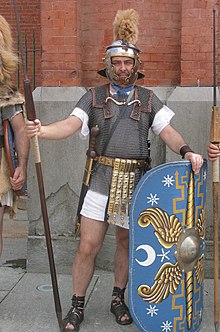
When I think of the "Spirit-filled" life, such a condition can be likened unto the "chain-mail" a soldier would had worn in the Roman army of the 1st century. According to the Zondervan Pictorial Encyclopedia of the Bible, such "chain-mail" (called by the Roman Soldiers lorica) would had protected the heart and vital organs behind the rib cage. 

wikipedia picture

Putting on the Whole Armor of God must begin from the inside to the outside - from the heart and mind to to attitudes then actions. 

The filling of the Holy Spirit means we are guarding the organ of thought and passion for God - the heart. The heart (which again, is the seat of the emotions and in all reality, the causal center of human life itself) must be guarded at all costs. The heart in scripture is described as the well-spring of life (Proverbs 4:23); the source of either the overflow of evils in a man (Matt 15:19) or goodness (Matt 12:34-35). The passions in the heart follow after whatever the mind deems to be the best course of action, whether good or evil (see James 1:13-15). 

Certainly the Holy Spirit's indwelling presence is a must, being that this is after all "the whole armor of God". One must be a Christian to wear the spiritual armor. However, to ensure effectiveness in spiritual warfare and defending Kingdom ground in our marriages (Ephesians 5:22-33); child-rearing (Ephesians 6:1-4) and workplaces (Ephesians 6:5-9), we as Christians must daily be Spirit-filled. This is why Paul's command to put on the full armor of God in Ephesians 6:10-18 comes at the tail end of a string of commands that are about making sure we are walking with God as Spirit-filled believers.

Monday, September 28, 2015

Learning how to pray like Jesus - Cultivating a life around prayer


Mark 1:35 "In the early morning, while it was still dark, Jesus got up, left the house, and went away to a secluded place, and was praying there." 

Do you and I truly enjoy God when we are praying? Jesus did.
When the disciples were following Jesus in the days of His earthly ministry, they were surrounded by numerous examples of "praying people". The Pharisees and teachers of the law had either written or publically demonstrated the so-called "right ways" to pray. The entire Temple System of 1st Century Jerusalem rang out with priests publically offering up prayers. With all the discussion and teaching on prayer, it would seem that the disciples would had been well-versed in how to pray. Yet, once they began to follow Jesus and observe His prayer-life, they knew they were witnessing a prayer-life that was unique and Holy Spirit-empowered. 

When we learn to pray like Jesus, we note how often He enjoyed spending time alone with His heavenly Father.   Almost from the onset of Jesus' ministry we find Him setting the pattern for His busy three and one half year ministry. At times Jesus would be in the seeming height of business and suddenly drop everything to go and pray. Luke 4:42 notes: "When day came, Jesus left and went to a secluded place; and the crowds were searching for Him, and came to Him and tried to keep Him from going away from them." 

Success and popularity followed Jesus wherever he went in those early stages of His work. Many people would look for such opportunities to grab the spotlight and sway the masses - but not our Lord. Luke notes in Luke 5:15-16 "But the news about Him was spreading even farther, and large crowds were gathering to hear Him and to be healed of their sicknesses. 16 But Jesus Himself would often slip away to the wilderness and pray."

The source of Jesus' life and prayer-life while He was ministering on this earth
The true source of Jesus' strength was not the crowds, but the time He had with the Father.  Though Jesus ever remained fully God, yet He chose not to utilize the benefits that come with being fully Divine, but rather chose in His humanity to rely upon the One who had sent Him. Luke 9:18 reveals: "And it happened that while He was praying alone, the disciples were with Him, and He questioned them, saying, “Who do the people say that I am?”  Jesus ever retained the understanding of Who He was and Whose He was.  His prayer life was so powerful and persistent that his disciples requested a lesson from Him on prayer. Luke 11:1-4 records for us the incident: "It happened that while Jesus was praying in a certain place, after He had finished, one of His disciples said to Him, “Lord, teach us to pray just as John also taught his disciples.” And He said to them, “When you pray, say: ‘Father, hallowed be Your name. Your kingdom come. ‘Give us each day our daily bread.  ‘And forgive us our sins, For we ourselves also forgive everyone who is indebted to us. And lead us not into temptation.’ " Jesus enjoyed time with the Father. When we enjoy time with the Father, we will find ourselves wanting to cultivate a life around prayer.

Two Points of Application when it comes to cultivating a life around prayer like Jesus
As we draw today's post on praying like Jesus to a close - we can glean two points of application from Jesus prayer-life. 

1. First, Jesus prioritized the tasks of life around His prayer-life and by His prayer-life.  

Too often we reverse the order and say to ourselves: "I'll pray later" or "I'll pray when my schedule gets better". Jesus shows us that life's busyness never recedes - and that time with the Father regulates all we do.  

2. Secondly, Jesus public ministry was regulated by His prayer-life. 
A man's ability to influence men for God will never exceed how much the man is influenced by God in prayer. Jesus' prayer-life was saturated by the Father's presence - which is why He wielded such power to shape and mold the world around Him. Jesus demonstrates both the priority of prayer by how eager He was to spend time with the Father.  May you and I dear friend take to heart these lessons from the Master.

Sunday, September 27, 2015

Some observations about prayer and why we need Jesus Christ and the Holy Spirit for effective prayer


Hebrews 4:14-16 "Therefore, since we have a great high priest who haspassed through the heavens, Jesus the Son of God, let us hold fast our confession. 15 For we do not have a high priest who cannot sympathize with our weaknesses, but One who has been tempted in all things as we are, yetwithout sin. 16 Therefore let us draw near withconfidence to the throne of grace, so that we may receive mercy and find grace to help in time of need."

Introduction: What unbelievers outside of Jesus Christ understand about prayer
Did you know that non-Christian people pray? Multitudes of devotees from all sorts of religions have prayers and rituals woven into their activities. Such a general observation of mankind's religious bent can be explained by humanity still bearing the image of God and the response to God's general revelation of Himself in the consciences of men and creation (see Genesis 1:26-28; Psalm 8:1-4; Psalm 19:1-6; Romans 1:18-20) 

People outside the Christian faith generally pray only for two reasons: out of fear or out of need. When an unbeliever calls out to God in repentance, God will hear such prayers due to the fact that the Spirit of God has already been at work (see for instance the sailors in the Book of Jonah and 2 Timothy 2:24-25). In other occassions where God responds to unbelievers, it is out of God's choice to respond, being that He is not obligated to unbelievers' prayers. 

At best, this is what natural unbelieving man is able to understand about prayer, namely fear and need. The thought of enjoying God never crosses the non-Christian's mind, due to the fact that outside of Jesus, people can only know about God but not know Him (Acts 17:24-25; 1 Corinthians 2:9,14). Such general observations underscore why we need to look to Jesus in understanding how to pray and why we pray. Jesus alone connects human beings by faith to God. Jesus Christ is the fulness of God's revelation in human flesh. When by the Spirit's working through the specific revelation (i.e the Gospel in the Bible) people respond in saving faith and thus are reconciled to God. Since Jesus Himself, being God, came as a man and retains such humanity to connect God to the Christian, the Christian can now know God and experience Him on a personal level.

What makes prayer unique in Christianity and the Gospel: Personal connection to God through Jesus Christ
What makes the Gospel and Christianity unique is that prayers offered up in Jesus name connect directly to God. As we noted earlier, unbelievers who pray may only pray out of fear or out of need. Whenever a person is born again in saving faith, a new impulse is gained - namely the desire to desire God. 

In the faithwalk with Jesus Christ, the need for God is sought first in order to better understand how to pray for other needs. Additionally, in one's faithwalk with Jesus Christ, fearing God means hating sin and seeking Him at all costs, thus transforming the basis for prayer from fear to faith (see Hebrews 11:1,6). 

To know God and to enjoy Him can only occur when a person by grace through faith has trusted in Jesus Christ (Jeremiah 9:23-24; 2 Corinthians 5:15-21; 1 Timothy 2:5; Jude 1:20-25).  In other words, only within a relationship with Jesus Christ by faith are prayers accepted by God, meaning that He commits Himself in covenant relationship to the Christian who prays in the name of Jesus (see John 9:31; Hebrews 4:13-16). 

Moreover, unlike other religions, the Gospel and Biblical Christianity alone teach that Christians are able to pray in expectation of an answer due to the personal inner working of the Holy Spirit in their lives (Jude 20-23).

The cycle of how God works in the prayer-life of the Christian
If we were to summarize what makes prayer unique in relationship with Jesus Christ, it would be this: God commits Himself to pray in and through the Christian. In other words, the Holy Spirit initiates the promptings of prayer in the Christian's heart, resulting in a prayer offered up to the Father through the Son (Ephesians 2:18; Romans 8:26-27). The Son in turn takes every prayer received and intercedes on behalf of the Christian to the Father (1 John 2:1-2). Then thirdly, the Father responds by excercising His will through the continuing work of the Holy Spirit (Jude 1:20-23). If we can think of this "prayer-cycle" as the Triune God's involvement in the Christian's prayer life, no other religion comes even close to this supernatural, empowered reality of prayer. 

Closing thoughts
In short, every other religion has people trying to reach up to God that they cannot know personally by religion or reason. Only by grace through faith alone in Jesus Christ does God reach down to make Himself known and commits Himself to the continual activity of doing so in the life of the believer. This is why we need Jesus Christ and the Holy Spirit for effective prayer.