Translate

Monday, December 7, 2015

The Scarlet Thread of Redemptive History


Genesis 38:28 Moreover, it took place while she was giving birth, one put out a hand, and the midwife took and tied a scarlet thread on his hand, saying, “This one came out first.”

The Scarlet Thread
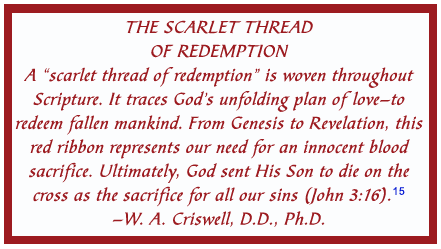
In one of my Bibles I have a red piece of yarn that I call "the scarlet thread".  The reason I have this yarn in my Bible is to remind me of the redemptive plan of God that took place in bringing the Savior to the world. Preachers such as the late Dr. W.A Criswell quoted above have for years made reference to the lineage of Christ's humanity as being a scarlet thread of redemption. In several places in the Old Testament we find remarkable events and people that constituted the bloodline that God would use to bring about Christ's humanity.

Mankind is broken before God
In Genesis 38 we meet one of Jacob's sons - Judah.  Now Judah was a man who lived by his desires and by the moment.  Unlike his father Jacob, we never see Judah exhibit any major quantum leaps in the walk of faith.  In this chapter, we see hypocrisy, treachery, lies, immorality, intrigue, injustice and betrayal.  Judah's spiritual life was littered with the trash of the sin nature he inherited from his father going all the way back to Adam. (1 Peter 1:18)  Judah is a small picture of humanity in need of a Savior.  Little did he know that God was going to use his rebellion and unsavory decisions to Sovereignly work forth the bloodline of redemption.

The bloodline issuing from Judah to Christ
God's hand was upon and in history as He was preparing the way for the arrival of His Son on that first Christmas night.  When we compare the birth records of Jesus in Matthew and Luke, we discover some remarkable features:

-From Adam to Noah is ten generations
-From Shem, Noah's Son, to Abraham is ten generations
-From Judah, Abraham's great-grandson to King David of Israel is ten generations
-Judah and his wife Tamar here in Genesis 38 appear in Christ's geneaology in Matthew
-King David was of the tribe of Judah, which came from Judah the man here in Genesis 38
-The second major prophecy about Christmas was about Judah in Genesis 49:10

The Scarlet thread of redemption signals the hand of God in salvation
At the end of Genesis 38, after a series of shocking events, Tamar, Judah's daughter-in-law, has twins by Judah.  The twisted set of events in this chapter underscore the falleness of man in need of a Savior.  As the twins are being born, the first one pops its hand out and the midwife ties on its wrist a scarlet thread.  Suddenly it goes back in and the little brother forces his way ahead and becomes the first born!  Just like grandfather Jacob - who steals the blessing from his older brother Esau, and just like great-grandfather Isaac whom God chose over the older brother Ishamael, God once again is working to remind man that He is charge. 

Only One who is both God and man could fix what man had broken before God
God was not and could not be twarted in bringing about that first Christmas.  God came through a broken humanity to redeem all who by grace through faith would believe on Him. (John 1:12-13).  A man, Adam, had broken things with God - thus God's justice demanded that man is responsible to fix what was broken.  Likewise, God and God alone could provide salvation - however God is too Holy to just right out forgive sinful man.  God took upon Himself humanity in order to satisfy both conditions. 

That little scarlet thread shows us that God's plan was continuing onward.  God was going to accomplish what He set out to do - to bring the Savior into the world. 

Sunday, December 6, 2015

The Christian Apologetic Task and its Relevance to Christmas

Luke 2:17-20 "When they had seen this, they made known the statement which had been told them about this Child.18 And all who heard it wondered at the things which were told them by the shepherds. 19 But Mary treasured all these things, pondering them in her heart. 20 The shepherds went back, glorifying and praising God for all that they had heard and seen, just as had been told them."
1 Peter 3:15 "but sanctify Christ as Lord in your hearts, always being ready to make a defense to everyone who asks you to give an account for the hope that is in you, yet with gentleness and reverence."

Introduction:
During these last few days we have been taking the time to suggest ways in which one could argue for the historicity and reality of the birth narratives of Jesus Christ. More specifically - we have aimed to demonstrate the reasonability, reliability and significance of the Son of God becoming incarnated or revealed in true humanity by way of the virgin birth. Such a study has included discussions about the possiblity of miracles, the existence of God and the reality of the Person and work of Jesus Christ. It is hoped that the reader has gleaned some ways in which they can share the Gospel in reference to the miracles of the virgin birth and incarnation. 

To know that the incarnation was a real event begs the question: what will you do with Jesus? As we also labored to demonstrate, being that we live in a world where God's direct intervention into history has occured (minimally described by the non-natural events of the beginning of the universe and Jesus' resurrection from the dead), we concluded that there is no reasonable basis for excluding the miraculous from a genuine reading and assessment of the Christmas accounts in Matthew and Luke's Gospels. 

As can be seen, such efforts have relevance for communicating the truth of Jesus' remarkable life and resurrection from the dead. Today's post aims briefly to define what we will call "the Christian apologetical task", with some final closing remarks on its relevance to Christmas. 

Defining the term "apologetics"
In the opening text of today's post we see the mandate given by the Apostle Peter to defend the Christian's hope.  In fact the word translated "defense" is the Greek word "apologia" (a-po-lo-gee-a), from whence we derive the name of the branch of Christian theology called "apologetics".  When a Christian engages in apologetics, they are not saying they are "sorry" for being a Christian, rather they are given reasons to skeptical onlookers as to why they are so full of hope in an otherwise hopeless world.  Dr. R.C Sproul in a sermon entitled "apologetics" gives this definition of apologetics: "A well reasoned defense of the truth claims of the Christian faith." Any well rounded Christian should not only know "what they believe" but also "why they believe". 

Various methods for doing apologetics
With the mandate to defend the faith being clear from scripture and the meaning of apologetics being briefly defined, the next important area has to do with how to go about doing apologetics.  Several methods of defending the Christian faith have been proposed through the more than 2,000 year history of the Christian church.  

a. Classical Apologetics
Ed Hindson and Ergun Caner of Liberty University of the following description of classical apologetics:"the unbeliever is offered
evidence of the existence of God, and the supposition is that the unbeliever can reasonably ascertain that this hypothesis is rational and cohesive". 1  Hindson and Caner then explain further the second area general covered by classical apologetics, namely: "The classical apologist further argues for the reliability of the special revelation (The Bible) as a reliable and authoritative word from God."2  Author Doug Powell has this to say about the classical method: "The emphasis of classical apologetics is on reason. Christianity's logical soundness and internal coherence is exploited in this method. As a result, tests are developed and proofs are given that demonstrate the truthfulness of Christianity and the irrationality of competing worldviews."  Powell later adds: "The classical method is so called because it traces its roots back to the second century and the earliest apologists."3

When defending the Christian faith through the method of classical apologetics, at least two and sometimes three steps are followed in the course of the presentation. 

1. First, reasonable arguments are given to show the reasonability of the Christian faith. Such arguments as showing God's existence from observations in the universe and science (i.e the cosmological argument); the existence of objective moral values (i.e the moral argument); how God is necessary for anything to exist (i.e the ontological argument) and then the evidence for design in the universe (also called the telelogical argument). 

2. The next phase will usually entail demonstrating the reliability of the Bible from the transmission of its words through the thousands of existing manuscripts to the archaeological evidence supporting the accounts we read in the Bible.

3. Usually the final phase will then be showing how the God of the Bible exists due to the resurrection of Jesus Christ from the dead. Some classical apologists will combine this step and the defense of the scriptures, whereas others may only focus on either one. 

b. Presuppositionalist apologetics
Classical apologetics states the the proper starting point for defending the Christian faith is reason to scripture. However other apologists believe that the proper starting point for defending the Christian faith is by pre-supposing God Himself.  Christian scholar Norman Geisler notes: Presuppositional apologetics is the apologetical system that defends Christianity from the departure point of certain basic presuppositions. The apologist presupposes the truth of Christianity and then reasons from that point.4 With the presuppositionalist approach, the emphasis is almost opposite, namely you presuppose God's existence and aim to prove why Christianity alone is most reasonable and possess the greatest justification for believing.  Douglas Powell notes the following about presuppositionalism: "Thus, presuppositionalists are more concerned with what makes evidence evidential and what makes reason reasonable. Because the God of the Bible is the Creator of all things, we know that He is not just the source of all physical things, but all laws whether they be scientific laws, moral laws or logical laws.5

The presuppositionalist contends that since all human beings have the knowledge about God in their hearts, the purpose of apologetics then is to expose the fallacies of their worldview and get them to admit what they have been supressing. A typical presuppositionalist approach would be that without God, we could not use reason in our discussions, since reason itself requires the existence of God to operate. The existence of objective moral values and the underlying laws of such fields as math and even science require the existence of God. Even though presuppositionalism is the minority method in apologetics today, it can be very effective when dealing with such worldviews as Atheism.

c. Evidential Apologetics
In the evidentialist approach, evidence from the world of the sciences, history and observation functions to provide the necessary ammunition for the Christian apologist. Doug Powell notes: Evidentialism's value as a substantial tool to defend the faith rose in the nineteenth and early twentieth centuries as archaeology in particular developed as a science and turned its attention to the Mediterranean world and the Middle East. The findings of ancient manuscripts contributed immensely to our ability to know the original text of the Bible."6
Hindson and Caner give this insight about the evidentialist approach: "the method is the same: arguing the preponderance of the data."7

In the evidentialists mind, if enough evidence is brought forth to the unbeliever, the unbeliever will be backed into a corner, admitting that their evidence cannot compare to the evidence for the God of the Bible. In using events such as the World-wide flood of Genesis 6-9, evidentialists will appeal to virtually every branch of science to support the historical reality of the flood. In showing the flood to had been a real event, the logical follows then that the Bible is realiable enough to be trusted in other areas and ultimately salvation. 

d. Fideism or arguing that the best defense of the Christian faith is the Christian faith itself
Doug Powell observes the following about this fourth major approach: "In sharp contrast to these three methods, fideism rejects reason, evidence, and transcendental arguments as sufficient ways to justify the Christian faith (fide is Latin for faith). Faith and faith alone is the only proper way to understand the truth of Christianity."8  For the fideist, the task of the apologist is to proclaim the truth of the Gospel in the special revelation of the Bible, since the warped human nature necessarily rejects the testimony of God in the general revelation of creation and the conscience. As Hindson and Caner note about this approach: "A fideist, therefore, is one who holds the view that one comes to belief in God on the basis of faith alone, in the absence of or contrary to reason.Unlike the other three viewpoints above, the value of evidence and rational arguments is placed in doubt under the method of fideism. 

Conclusion
We have explored the meaning of apologetics and four main methods for defending the Christian faith: classical, presuppositionalism, evidentialism and fideism. May you and I dear reader know that not only must the Christian hope be defended, but that there are some marvelous ways in which we can go about presenting Christ to a lost a dying world. These two thoughts especially have bearing on this time of year as we consider the family and friends with which we will have contact - some of which have never trusted in Jesus Christ. Would it be that God uses these series of posts to open the eyes of openly hostile or skeptical loved ones and friends who are cynical towards Biblical truths such as the virgin conception and incarnation of Jesus as God in human flesh. The task to proclaim and defend the faith never ends and the relevance of such efforts has never been so urgent. May those who are Christian readers of these posts have a renewed fervor to share Jesus this season.

Endnotes:
1. Ed Hindson and Ergun Caner. The Popular Encyclopedia of Apologetics. Harvest House Publishers 2008. Page 64.

2. Ed Hindson and Ergun Caner. The Popular Encyclopedia of Apologetics. Harvest House Publishers 2008. Page 65.

3. Doug Powell. Holman Quicksource Guide to Christian Apologetics. Holman Publishers. 2006. Page 356. 

4. Norman Geisler, General Editor. Baker Encyclopedia of Christian Apologetics. Baker. 1999. Page 606

5. Doug Powell. Holman Quicksource Guide to Christian Apologetics. Holman Publishers. 2006. Page 360.

6. Doug Powell. Holman Quicksource Guide to Christian Apologetics. Holman Publishers. 2006. Page 359.

7. Ed Hindson and Ergun Caner. The Popular Encyclopedia of Apologetics. Harvest House Publishers 2008. Page 65.

8. Doug Powell. Holman Quicksource Guide to Christian Apologetics. Holman Publishers. 2006. Page 363.

9. Ed Hindson and Ergun Caner. The Popular Encyclopedia of Apologetics. Harvest House Publishers 2008. Page 224.

Saturday, December 5, 2015

Why the miracle of Christmas points to the existence of the Christian God

Luke 2:10-14 But the angel said to them, “Do not be afraid; for behold, I bring you good news of great joy which will be for all the people; 11 for today in the city of David there has been born for you aSavior, who is Christ the Lord. 12 This will be a sign for you: you will find a baby wrapped in cloths and lying in amanger.” 13 And suddenly there appeared with the angel a multitude of the heavenly host praising God and saying, 14 “Glory to God in the highest,
And on earth peace among men with whom He is pleased.”

Introduction and Review
In the last two posts we have been answering the question: what is a miracle? We have proposed the first part of the answer: "miracles are by their essence irregular events". In addition, we borrowed an excellent definition of a miracle from Christian Apologist Dr. William Lane Craig, namely: "a miracle is a naturally impossible event". From the last two posts we have aimed to show that because miracles are possible in our world (contrary to Atheists and skeptics), then we can take Biblical miracles such as Christ's incarnation/virgin birth and resurrection to events of history and fact, as well as faith. From our considerations thus far, we could construct the following argument:

#1 Naturally possible and naturally impossible, irregular events do occur in this world

#2 A Miracle, per our definition, is an irregular event that is naturally impossible

Therefore miracles can occur in this world

Miracles are not violations of nature's laws, rather they evidence the intervention of a supernatural Intelligent agent being involved with nature's laws.Now this first argument articulates that miracles are possible in our world. They're not violations of nature's laws, but rather are included with such laws, representing the intervention of an intelligent, supernatural agent (i.e God). This particular point of the relationship of an intelligent agent to the natural course of events is something that skeptics like the 18th century thinker David Hume missed when he coined the definition of a miracle as being a "violation of nature's laws". The laws of nature are descriptive of what we can expect to see in a given set of events providing we don't include factors such as intelligent beings. The laws of gravity tell me for example that if I drop a rock, it will fall to the ground. However, if I drop the rock and then catch it with my other hand, the law of gravity has not been violated. Gravity is still acting upon the rock. The only difference is that there is a person who has intervened in the rock's descent to the ground, hence another set of laws are evoked to explain what happens when a person has stopped a rock from falling to the ground.

Now the above illustration would not be considered unreasonable, being that the point is to show that nature's laws "describe" rather than "prescribe" how certain objects or events will unfold in the natural world. Furthermore, whenever a natural agent (such as a human being, or a cat or another intervening object) is introduced into the situation, their are other laws of nature that describe that scenario. 

Now let's consider a situation that we could term as "naturally impossible" - that is - a situation that could not arise as a result of the actions of a normal, natural agent. The origin of our universe for example is an event that lies outside the known laws of nature. Science can only approach the beginning of the universe to within a few fractions of a second - with the known physical laws breaking down and scientists having to resort to mathematical models to try to explain how it all began. By definition, the beginning of the universe is a "naturally impossible" event and thus begs for an explanation that is not natural and in-time, but supernatural and eternal - hence a miracle. Clearly the beginning of the universe and the resultant reality around us is in no way a so-called "violation" of any laws, being that the universe's beginning occured before there would had been any such laws to describe it! This is why miracles are not violations of the laws of nature - but instead represent God's direct working with such laws in producing His desired effects. God is not limited by way of miracles, which is why He also choose to work indirectly through acts of Providence or secondary agents and causes. Either method of working (miracles or providence) gives us a framework for understanding that our world is a world that includes the working of God.


The above discussion serves to lead into our discussion on why Christmas points to the existence of the Christian God. Since we have seen that miracles are not violations of nature, but rather God's intervention and direct activity with such laws, this creates oppenness to the plausibility and moreso, the reality of miracles like Christ's incarnation/virgin birth. Whenever we consider the specific context that we find miracles occuring (events connnected with the remarkable life, death and resurrection of Jesus), we can also legitimately identify when a miracle has occurred. Consider the below observations...

Miracles are directly done by God
As we have noted already, in scripture, God's interraction with His creation can be described under two general headings. The first is what Bible teachers call "providence", meaning God's "indirect" Sovereign influence exercised through events, the wills of men and physical processes. God's Providential activity includes the use of secondary agents such as people to achieve His purposes. Thus God's activity in this world, as it relates to providence, is what we could term "indirect". A miracle on the otherhand involves God's "direct" involvement with His creation.  What can be interesting of course is when God performs a miracle through the use of ordinary people and situations.  

The Christmas accounts provides the right context to view the miracle of the incarnation/virgin birthThe literature on the subject of miracles often emphasizes that true miracles occur in specific contexts and for specific purposes. When God wrought forth miracles in the Bible, they always occurred, to borrow a term from Dr. William Lane Craig, in "religiously significant contexts". God's direct intervention in the affairs of people and events is a reminder to us that He is The Personal as well as The Powerful God revealed in the Bible. In the opening chapters of Matthew and Luke, we find the context described by such historical details as geneaologies, the reigns of certain dignitaries (such as Herod, Quirinius and Caesar Augustus), particular settings (1st century Judea, Bethlehem and Nazareth) and prophetic anticipation of a coming Messiah. Factors such as these, and the resulting outcomes (the movement of Mary and Joseph from Nazareth to Bethlehem, and then their later movement from Bethelehem down to Egypt) require an explanation. Certainly, the decrees by such kings as Caesar Augustus can naturally explain such movements, however there are other events (such as the Wisemen) which require both natural and supernatural explanations.

Much like Jesus' resurrection from the dead, we need to spell out the events needing to be explain in the Christmas story and then propose an explanation for those events. Certainly, people can offer naturalistic, non-theistic explanations as to why Mary and Joseph did what they did, why the Shepherds suddenly left their flocks to go to Mary and Joseph and why the Wisemen would travel hundreds of miles to boow the knee to a toddler - but willl such explanations suffice. In other words, does naturalistic explanations alone have the explanatory power and scope to handle such evidence? 

If anything, to deny the existence of the God of Christianity is to do a great disservice to the Christmas accounts.  
Jesus' incarnation and virgin birth represent one of the most significant miracles in the Bible. His remarkable human life began miraculously and supernaturally. Just as Jesus' resurrection from the dead cannot be adequately explained apart from the hypothesis: "God raised Jesus from the dead"; the Christmas story as well forces us to realize that the God of Christianity does exists, and that He was revealed in the incarnation of the Son of God. 

Friday, December 4, 2015

How one may argue for the historical reality of the virgin birth


Hebrews 2:3-4 "how will we escape if we neglect so great asalvation? After it was at the first spoken through the Lord, it was confirmed to us by those who heard, 4 God also testifying with them, both by signs and wonders and byvarious miracles and by gifts of the Holy Spirit according to His own will."

Introduction:In yesterday's post we labored to demonstrate the moderate proposal that miracles are possible in our world. We defined a miracle as entailing two qualities. First, a miracle is a highly irregular event in terms of its frequency and features compared to what we would term regularly occuring events. Then secondly, based upon Dr. William Lane Craig's defintion, a miracle is a naturally impossible event - meaning that given naturalistic explanations, events such as the resurrection could not happen by a natural cause, and thus the only explanation would need to be a supernatural cause. 

Therefore, since non-natural events, as well as natural events do occur in our world, and being that non-natural events (such as Jesus resurrection) has been shown to occur, then it only stands to reason that the God of the Bible exists. 

Some further thoughts on "irregular events" and why miracles can be legitimately considered as part of our world
This point about irregularity is important because so many skeptics will say that miracles are impossible, being that in the normal course of human experience, no such event can happen? However, if there are irregular events that can occur in history, which may not be experienced regularly by human beings, then does that rule out the miraculous? 

For instance, when I lived in central Florida, there was one year where the storm paths of three hurricanes in once season criss-crossed over the very neghborhood where we lived. For even one hurricane to make it that far inland into central Florida had not occurred in 40 years. Imagine the less liklihood of three hurricanes and their storm paths all criss-crossing one another in one season? 

Are we saying that this highly irregular pattern of hurricanes constitutes a definite miracle. Hardly. There are obviously other traits that need to be considered before saying something is a definite miracle. Consider the following logical statement:

#1 We see the possibility of irregular events occuring in the world; 

#2 and miracles are by definition irregular events 

Therefore it can be rightly concluded that miracles can occur in this world. 

What bearing the possibility of miracles has on the incarnation and virgin birth of the Son of God
In establishing the possibility of miracles in our world, we can then begin to make a case for the most important miracle upon which we celebrate Christmas - namely Christ's incarnation through the virgin birth conception. The rest of this post represents more of a sketch, rather than fully completed argument for the historical reality of the virgin birth. Notice the following argument:

#1 Miracles are non-natural events that are naturally impossible events. Only natural events that are naturally possible can occur if in fact the God of the Bible does not exist

#2 History's task is to recount all events that occur, including naturally possible & naturally impossible events

#3 The Gospel records document Jesus' incarnation and virgin birth/conception and have been shown under close scrutiny to be reliable documents

#4 Jesus' incarnation/virgin birth was a miraculous event that could be classified as occuring as a result of non-natural causes

#5 Jesus' incarnation/virgin birth from the dead is a miracle that did occur in history

Now this argument can be shown sound through means of criteria used in validating the historicity of certain events in ancient literature. I will briefly list a couple of those criteria as applied to the Christmas story:

1. Multiple attestation or support from multiple sources (hence Matthew and Luke's Gospel with regards to the genealogies and the 1st century Jewish historian, Flavius Josephus, in his "Antiquities of the Jews")

2. The criteria of embarrasment (Joseph contemplated divorcing Mary upon hearing her pregnancy would had been an embarrasing detail but which is a sign of being genuine fact)

3. Palestinian or 1st century Jewish setting. Matthew and Luke's use of geneaologies; the possible reference of Mary and Joseph finding "no room in the inn" as a technical term pointing to the interior room of a home in and around Judea (i.e Bethelehem). 


Closing thoughts for now
We have shown through our brief study of miracles thus far that miracles are possible in this world. We have also given an example of a brief outline of how one might argue for the historicity and thus plausibility of the Christmas story as it pertains to the miracles of the virgin birth and Christ's incarnation. Hence, the virgin birth/incarnation can be considered as a fact of history.

Thursday, December 3, 2015

The reality of miracles and their relevance to Christmas


Hebrews 2:3-4 "how will we escape if we neglect so great asalvation? After it was at the first spoken through the Lord, it was confirmed to us by those who heard, 4 God also testifying with them, both by signs and wonders and by various miracles and by gifts of the Holy Spirit according to His own will."

Introduction:
How do we define the word "miracle"? This will be the aim of today's blog as we explore some of the major scriptures that speak on the subject of the miraculous. The subject of miracles is relevant to holidays such as Christmas and Easter. Why? Both Christmas and Easter celebrate two of the three most important miracles recorded in the Bible: the incarnation of the Son of God in Jesus and His resurrection from the dead (the other most important miracle being creation). Below I will put forth some of the key scriptures that mention the miraculous and then propose headings that will aid in arriving at answering the question: What is a miracle? 

Miracles are irregular events
In the opening verse of today's post, we find that the message of salvation testified to by the writer of Hebrews is a message that had built-in evidence of confirmation by what is described by three kinds of miracles: miracles or working, signs and wonders. Clearly the writer finds the miracles that accompanied the preaching of the Gospel to be compelling enough to provide confirmation of the message and the messenger. But before we go any further, what does the Bible have to teach us about the meaning of the word "miracle"?

When we search the Old Testament's teaching on miracles, we find the main Hebrew word translated "miracle" in some 70 places. Further word study describe the Old Testament word for "miracle" as referring to something that is difficult to do, beyond one's ability or treated as a distinguished and separate activity. We could summarize this idea of "miracle" by noting that it is an extremely irregular event. 

In like manner, whenever we survey the remainder of scripture, we find that miraculous events cluster around strategic points in history. In the Old Testament we see many of the miraculous events situated around the ministries of Moses/Joshua (1445-1375b.c); Samuel (1100 b.c); and Elijah/Elisha (roughly 900b.c). 

In the New Testament we find Jesus and the Apostles being the main instruments through which miracles occur. The writer of Hebrews uses the three main Greek words associated with miracles in the New Testament: workings of God (miracles proper); "signs" or visible miracles and "wonders" or miracles associated with changes in the physical environment. 

These observations serve to show that in approaching a definition of the miraculous, one needs to think first of the event being "extremely irregular" in terms of infrequency of occurance or the event being unusual in comparison to regular events. Apologist Dr. Norman Geisler notes in his "Baker Encyclopedia of Christian Apologetics", page 472: "a true miracle also produces results; always bring glory to God, bring good to the natural world" and "true miracles never fail." 

An example of how the reality of the miraculous can demonstrate God's existence
Another Christian apologist, Dr. William Lane Craig, refers to miracles as "naturally impossible events", meaning that no natural processes can bring about what is otherwise a miracle. As we just mentioned, a miracle is an extremely irregular event. Dr. Craig's definition specifies the source of miracles - namely an event that cannot be explained by naturalistic methods and thus can only be of supernatural origin.  

In using Dr. William Lane Craig's discussions on miracles and their place in the course of naturally occuring events, we can propose a sample argument for God's existence. 

Take for example Jesus' resurrection from the dead. Known physical laws and processes describe for us a physical reality in which we should not expect dead men to rise from the dead. Yet Jesus' resurrection from the dead is among the most established events in all of human history. Thus in noting the historical reality of Jesus' resurrection, we can only conclude that it is a miracle, and that in being a miracle, a non-natural, albeit a "Supernatural" cause is behind Jesus' resurrection- namely God Himself. The logic for this line of thinking may go something like this:

#1 Miracles are non-natural events that are naturally impossible or extremely irregular events.

#2 History's task is to recount all events that occur, including naturally possible & naturally impossible events

#3 The Gospel records document Jesus' physical resurrection and have been shown under close scrutiny to be reliable documents

#4 Jesus resurrection was a miraculous event that could be classified as occuring as a result of non-natural causes

#5 Jesus resurrection from the dead is a miracle that did occur in history

If we were to apply the same argument to Jesus' incarnation/virgin birth, it could possibly look like the following argument:

#1 Miracles are non-natural events that are naturally impossible or extremely irregular events.

#2 History's task is to recount all events that occur, including naturally possible & naturally impossible events

#3 The Gospel records reliably document Jesus' incarnation/virgin birth and remarkable life

#4 Jesus' incarnation/virgin birth was a miraculous event that could be classified as occuring as a result of non-natural causes


#5 Jesus' incarnation/virgin birth is a miracle that did occur in history

Both arguments' main premises would require evidences from historical studies, any archaelogical evidence and philosophical considerations to show that the arguments are not only valid (in regards to their form) but moreso their soundness (that is, do they correspond to truth and facts). We won't take the time and space to spell out those details, since the main point of this post is to show the relevance of miracles to Christmas. Nevertheless, knowing that their are good reasons for believing in miracles such as Christ's incarnation and the virgin birth will hopefully equip the Christian in the event of potential evangelistic encounters that can occur during this time of year.


Wednesday, December 2, 2015

The Christian's urgency to paying much closer attention to doctrine


Hebrews 2:1 "For this reason we must pay much closer attention to what we have heard, so that we do not drift away from it."

Introduction
We spent the last couple of days considering the overall message of the Book of Hebrews. The twin themes of Christ's supremacy and warnings to not stray away were explored - with the idea of ways in which we can make our faith bullet proof. Today's post focuses particular attention upon what the writer mentions in Hebrews 2:1 with regards to "paying much closer attention". Hebrews 2:1-4 represents the first of five warning sections throughout the Book of Hebrews. The specific concern of Hebrews 2:1-4 is to urge the readership (and us) to not neglect the sound doctrines and thus practices of the Christian faith. 

The opening phrase of Hebrews 2:1 "For this reason" indicates that the writer is getting ready to comment upon what he discussed in Hebrews 1:1-14. Moreover, the concern with the warning of 2:1-4 is to not only urge but to remind readers that the doctrines of the Christian faith are built upon the solid foundations of evidence and testimony. Now it is clear that there are specific truths to which the writer is concerned, being that he then says in Hebrews 2:1 "pay closer attention to what we have heard". Why is this so important? He goes on: "so that we do not drift away from it." The word translated "drift" can also refer to "losing sight" or "wash away" - i.e "erode". 

In other words, sound doctrine prevents the shorelines of the Christian faith from eroding. When we lived in Florida for a time, every so often we would visit one of th beaches of that state. It always amazed me to observe the process of beach erosion, whether witnessing in person or seeing images on television. The communities that based their livelihood on those beaches would spend untold thousands and millions of dollars building up "beach heads" and "bulwarks" so as to prevent nearby homes adjacent to the beaches from sliding into the ocean. This is what I see as the purpose of doctrine spelled out in Hebrews 2:1. 

So the question is, what main doctrines are essential for us to meditate, communicate and put to practice in the Christian life? What doctrines require the Christian's need to pay closer attention as spelled out in Hebrews 2:1? From Hebrews 1:1-14 we can discover the following key truths:

1. Doctrine of God or Theology Proper. Hebrews 1:1 "God". 
What is God like? Who is He? What does it mean when we talk about God being One in existence and yet Three in identity? Such questions address this chief doctrine.

2. Doctrine of revelation. Hebrews 1:1-2 
We discover in Hebrews 1:1-2 that God is a talking God, a God who desires to relate and reveal Himself to His creatures. He has revealed things about Himself in creation or general revelation. He has secondly revealed His will in the scriptures or special revelation. Then in Hebrews 1:2 we see reference to the fullness of revelation in the Son in the New Testament. 

3. Doctrine of Christ or Christology. Hebrews 1:2-13 
The dominate doctrine of this chapter is not just merely a set of propositions or statements, but moreso the Person of Jesus Christ. Hebrews 1 spells out some significant highpoints and details of the Lord Jesus Christ. In 2 Peter 3:18 we read - "but grow in the grace and knowledge of our Lord and Savior Jesus Christ. To Him be the glory, both now and to the day of eternity. Amen." Knowing God and knowing how this God reveals Himself anchors our faith and prevents us from drifting. The fulness of God's revelation in the Person of the Son ensures that our faith won't erode. Notice specifically in short order what the remainder of Hebrews 1:2-14 says about Jesus Christ or the doctrine of Christology...

a. Eternal Pre-existence of the Son. Hebrews 1:2,5

b. Incarnation of the Son. Hebrews 1:2-3a, 1:6

c. Atoning work of the cross. Hebrews 1:3b

d. Ascension (which follows from the implied resurrection) and exaltation of the Son. Hebrews 1:4

e. Enthronement of the Son in Heaven. Hebrews 1:7-9

f.  Second coming of the Son. Hebrews 1:10-13

g. Angels in service to the Son as God in human flesh and to believers. Hebrews 1:7,14

When we consider the three main heads of doctrine emphasized in Hebrews 1 (Theology Proper, Revelation and Christology), we have a three-braided cord that guards our faith-life. Moreover, since the emphasis is placed on Christology, it would seem that if we make ourselves students of the Master, Jesus Christ, we will know God (Theology Proper) and the revelation of Himself (specifically in scripture and appreciating the revelation of Himself generally in creation). Thus let us take seriously this urgency to pay much closer attention to doctrine. 

Tuesday, December 1, 2015

P2 Bullet-proofing your Christian faith - Book of Hebrews


Hebrews 2:1-4 "For this reason we must pay much closer attention to what we have heard, so that we do not drift away from it. 2 For if the word spoken through angels proved unalterable, and every transgression and disobedience received a just penalty, 3 how will we escape if we neglect so great a salvation? After it was at the first spoken through the Lord, it was confirmed to us by those who heard, 4 God also testifying with them, both by signs and wonders and by various miracles and by gifts of the Holy Spirit according to His own will."

Introduction:
The writer of Hebrews is writing out under Divine inspiration what appears to have been a sermon or series of messages to Jewish Christian converts who were tempted to leave Jesus and go back to Judaism. The key theme to the book of Hebrews is showing to us the superiority of Jesus Christ. 

Today's post picks up where we left off yesterday. We wanted to know how a Christian can bullet-proof their faith. Thus far we have considered two points from consideration of the Book of Hebrews:

1. Center your focus on the greatness of Jesus Christ

2. Cling to the greatness of Jesus Christ (by heeding the warnings)

Today we continue and conclude this short two-part study by noting the third way one can bullet-proof their Christian faith....

3. Consider how much greater Jesus is than the temptation
If the first thought has to do with centering on the greatness of Jesus in-and-of-itself and the second has to do with clinging to such greatness, then this last point serves to reinforce the first two by revealing why Jesus is greater than the temptation. Hebrews 2:3 poses the question: "how will we escape if we neglect so great a salvation?" For Jews reading this letter, Jesus would have to be shown greater than every standard of greatness that they knew. Even the greatness of key Biblical figures - wonderful as they are - can become idols if used to substitute for Jesus. Hence, in Hebrews 1 we find Jesus is greater than the angels. In Hebrews 3 we find Jesus is greater than Moses. On and on the writer goes, parading one great Jewish illuminary after another. In Hebrews 7 we find Jesus is greater than Abraham, followed up by Him being greater than the entire Old Testament sacrificial system that looked forward to Him in Hebrews 8-10. 

Now of course most readers of his post have not derived from a Jewish background. However, the principle of considering Jesus greater than our temptation applies readily to us today. 
Even good things like success, money, family, ministry-life, exercise, sports, food and leisure can quickly become idols if we place them is that spot that is reserved for Jesus, and Jesus alone. Certainly the pull of the old-life before conversion issues its siren calls to our flesh. I won't take time to rehearse the numerous scriptures that show the reader the inadequacy and hell-bound trajectory that had been the pre-conversion life (an example: Ephesians 2:1-4,12). 

So often the writers of scripture will put before the reader the incomparable greatness of God in fending off temptation. 1 Corinthians 10:13 is a prime example - "No temptation has overtaken you but such as is common to man; and God is faithful, who will not allow you to be tempted beyond what you are able, but with the temptation will provide the way of escape also, so that you will be able to endure it." I'm reminded of a warning Solomon issues to his son in Proverbs 3:19-22 "The Lord by wisdom founded the earth,By understanding He established the heavens. 20 By His knowledge the deeps were broken up
And the skies drip with dew. 21 My son, let them not vanish from your sight;
Keep sound wisdom and discretion,
22 So they will be life to your soul
And adornment to your neck." 


In as much our hearts are needed in passionately following after Jesus - we musn't forget the mind. If anything, whatever the mind deems to be the highest good will result in the heart following (see Matthew 6:24-33). Considering Jesus as greater than our temptation entails engagement of the mind and heart. Sadly, Christians today do not fill their minds with the great truths of the Word of God. Whenever you read the Book of Hebrews, notice how many scriptures the writer quotes and how much sound doctrine he uses in urging his readers to focus on the greatness of Christ. 

Certainly a Christian faith that is all head and no heart is dry; but a Christian faith that is all heart and no head stands the greatest chance of near-death. Remember: the heart is the seat of your emotional and living personality. The hearts needs a leader. If we are not regularly filling our minds with scripture - what greatest good is there to occupy our thoughts?

If we are going to bullet-proof our faith, we need to consider the greatness of jesus Christ greater than our temptation, as well as center on His greatness and thus cling to it.