Translate

Tuesday, May 3, 2016

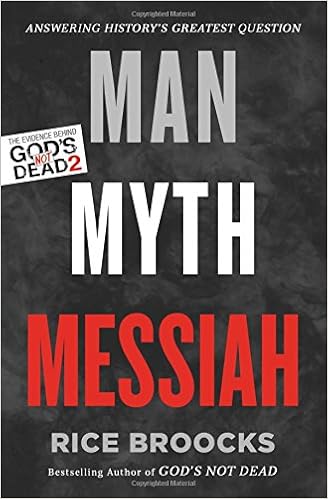
A review of Rice Broocks’ book: Man, Myth, Messiah: The Evidence Behind God’s Not Dead 2


Book Review - Rice Broocks – Man, Myth, Messiah: The Evidence Behind God is not Dead 2. Thomas Nelson. 2016.


Note: For interested readers, this book is $9.99 on Amazon.com
Introduction:
Let me begin this review by inviting people to go see or download the movie: “God’s Not Dead 2”. Why? It presents compelling reasons as to why Jesus is not a myth, nor just a man but truly the Messiah who raised from the dead. In the movie, one of the characters is seen reading the book “Man, Myth, Messiah” authored by Rice Broocks. Dr. Broocks is a substantial author, senior minister of Bethel World Outreach Church in Nashville and scholar in his own right (research PhD from Fuller Seminary, with the focus on defining the office of the evangelist). The foreword of the book was written by world-renowned Christian apologist and Liberty University Professor Gary Habermas, who is among the world’s foremost experts and defenders of Jesus’ resurrection. For anyone concerned about the validity of this book as a sound resource: such fears can be laid to rest. Now to the book.

As Dr. Broocks unfolds his case over ten chapters, his arguments are accessible and well-researched. Chapter One deals with what he calls “The Great Question”, based upon Jesus’ question: “who do men say that I am” in Matthew 16. In chapter two, we find what is called the “Minimal Facts Approach” (“minimal facts” being those details of the Easter accounts agreed upon by skeptical and believing New Testament scholars and which are unmistakably demonstrated). 

Dr. Broocks’ central idea in these first two chapters is to show that Jesus was indeed a real, historical person who lived, died and resurrected from the dead. In chapters 3,4 and 5, we find sound arguments and evidence for the reliability of the Gospels, the crucifixion and resurrection.

It is from the credibility of Jesus’ existence and the resurrection accounts that Dr. Broocks unravels skeptical notions of Jesus’ resurrection mimicking pagan myths. This idea is actually turned on its head, since Christianity was situated in the soil of 1st century Judaism, rather than Greek Mythology. In many cases, either the myths turn out not to teach what skeptics claim or appear to actually borrow from Christianity itself! In chapter 8, Dr. Broocks addresses the so-called “problem of miracles”, wherein he writes on page 175: “In other words, in order to believe no miracles ever happened, one must begin by assuming that no miracles can happen. This logic is circular reasoning and therefore self-defeating from the onset.” I found this chapter to be particularly strong, since he appeals not only to logically sound arguments, but also to valid contemporary examples and further resources on miracles.

Undoubtedly Dr. Rice Broocks’ well-reasoned and very readable style makes a strong case for Jesus Christ being the Messiah who raised from the dead. However, the last two-chapters were perhaps the most helpful parts of the whole book with respect to the local church. In chapter nine, Dr. Broocks outlines a four step process for discipleship or following Jesus: engage unbelievers, establish foundations of faith, equip Christians to share their faith and empower them to do the ministry. Such a process is what he uses in the church he pastors and the ministries God has used him to plant. His definition of discipleship is right-in-line with Jesus’ teaching on the subject: deny yourself, take up your cross and follow Him.

Chapter ten then links together the tasks of Christian apologetics (articulating and defending the faith) and evangelism. Dr. Broocks’ discussion includes a four-step strategy for beginning evangelistic conversations through what he calls S.A.L.T: Start a conversation, Ask questions, Listen and Tell the story. To facilitate this method, Dr. Broocks mentions an app and a tool called “The God Test”. The tool has a series of questions that are designed for either those who believe in God or for those who claim they don’t. 

As a communicator, pastor and evangelist, Dr. Broocks’ process for sharing the Gospel and defending it also entails an acrostic that he calls “G.R.E.A.T” – Gospel, Reasons, Empathy, Approach and Tools. By combining his “S.A.L.T” into his overall approach to sharing the gospel, the author concludes by appealing to great figures of the past who as skeptics or hostile unbelievers were transformed by the Gospel. I commend this book to Christians who want to be equipped to handle contemporary objections to the Christian faith and be more adept to sharing their faith with friends and loved ones. As a final note: grab some popcorn and see the movie “God is Not Dead 2”! – reviewed by Mahlon Smith

Monday, May 2, 2016

A new, must read blog site for everyone to check out


Today I wanted to take this opportunity to promote a blog that my wife recently started to write. Debi has appeared in past postings as a "guest blogger", meaning that her materials, writings and thoughts have been placed on this blog site. It excites me to see her launching her own site. I would urge any readers here to explore what she has written. You will find encouragement and blessing! Here is the link: https://helovesmybeautifulmess.wordpress.com/ 

Sunday, May 1, 2016

Discerning God's voice through His word

Proverbs 1:8 "Hear, my son, your father’s instruction and do not forsake your mother’s teaching."

Introduction:
As a pastor who proclaims the words of the Bible every week, there is a conviction that the voice of God is heard through the words and their meaning. Once the meaning of the words of the Bible has been discerned, the voice of God connects with those who are ready to hear, listen and live out those words. Such words carry the authority of Divine revelation, inerrant and infallible and thus incapable of failure. The words of the Bible and the meaning thereof is the Word of God, whether the hearer is ready to receive or not. 

Without a doubt the first nine chapters of Proverbs are dedicated to character transformation. But how is this achieved? By discerning God's voice in His word. Solomon, by the superintendence of the Holy Spirit, instructs readers about the step-by-step process one undergoes when discerning God's voice in His words. After some opening remarks, Solomon writes in Proverbs 1:20-21 "Wisdom shouts in the street, She lifts her voice in the square; 21 At the head of the noisy streets she cries out; At the entrance of the gates in the city she utters her sayings". Then near the latter end of Proverbs 1-9 we read these words in Proverbs 8:1 "Does not wisdom call, and understanding lift up her voice?" This rhetorical question is posed with the underlying premise that unless people have positioned themselves to hear God's word, with the intent to listen and for the purpose to do what God had said, then the only outcome can be disaster. 

Today I want us to briefly consider what all goes into discerning God's voice through the scriptures. Proverbs 1-9 gives what I would classify a repetition of a three-step process in grasping what we mean by this idea of "discerning God's voice through the scriptures". Let's consider each step....

1. Hear the word. Proverbs 1:8; 4:1,10

Gathering together at church, or at a Bible study or in front of our Bible for private devotions is getting into position to read and "hear" the scriptures. This first step to "hearing God" in the scriptures is simply a matter of positioning oneself. Just as a fisherman may bring his boat, fishing tackle and bait to a lake to prepare for an afternoon of fishing, the hearer of the Word is gathering to hear the Bible being spoken. Proverbs 4:1,10 notes: "Hear, O sons, the instruction of a father, And give attention that you may gain understanding"; "Hear, my son, and accept my sayings and the years of your life will be many."

Little do we realize what all takes place in this first stage. Psalm 119:105 and 119:130 reminds us about the nature of the words of the Bible: "Your word is a lamp to my feet And a light to my path"; "The unfolding of Your words gives light; It gives understanding to the simple."

When I come to the Bible with the intent to "hear it", the aim is to find out my "duty" or "obligation". In the "hearing stage", God is granting a measure of light to me. If I choose to take in the light (which will entail the second step - 'listening'), then I will have all I need to carry out whatever God tells me (hence the third step of 'living out the word). If I should reject the measure of light given to me in this first stage of hearing, then a corresponding level of darkness will be permitted to work in my life. Thankfully God gives us more than one chance to "take another run". I think this is one reason why Jesus so often made the statement: "He who has ears, let Him ear" (see Luke 8:8 and the seven churches in Revelation 2-3). 

Hearers aim to know what "has to be done". At this stage of the hearing process, I may or may not conclude that the words have anything to do with me. Many people think they are judging the Bible, when in reality we are judged by it. My judgment of the Bible, whether accurate or not, does not affect its truth value nor its quality as God's word. James 1:22-23 states - "But prove yourselves doers of the word, and not merely hearers who delude themselves. 23 For if anyone is a hearer of the word and not a doer, he is like a man who looks at his natural face in a mirror." The point James is making is that we begin at the point of "hearing" God's words, but we mustn't remain only hearers. Henceforth the second stage in Discerning God's voice through the scriptures is....

2. Listen to the word. Proverbs 2:1-6; 5:1,7

Some may question whether there is a difference between "hearing" and "listening". The case can be easily made that there is a difference. When a parent calls to their child to do their chores, the child may physically hear the voice and yet not move to action. The parent will then change their tone and say something to the effect: "are you listening?" Hearing entails the physical ears, whereas listening entails the ears of the heart. Again, Jesus so often spoke of how in reality, we have two sets of ears. All people can hear the Bible preached or taught with the physical ear, however not everyone will listen and respond with the ears of the heart.

Jesus makes the following statement about this second set of ears in Luke 9:43-45   "And they were all amazed at the greatness of God. But while everyone was marveling at all that He was doing, He said to His disciples, 44 “Let these words sink into your ears; for the Son of Man is going to be delivered into the hands of men.” 45 But they did not understand this statement, and it was concealed from them so that they would not perceive it; and they were afraid to ask Him about this statement." 

Proverbs 2:1-6 details what happens in this second stage of listening: "My son, if you will receive my words and treasure my commandments within you, 2 Make your ear attentive to wisdom, Incline your heart to understanding; 3 For if you cry for discernment, Lift your voice for understanding; 4 If you seek her as silver And search for her as for hidden treasures; 5 Then you will discern the fear of the Lord and discover the knowledge of God. 6 For the Lord gives wisdom; from His mouth come knowledge and understanding." 

This second stage of discerning God's voice in the Christian life is a combination of God's supernatural grace having begun in the human heart and our being positioned to respond. The measure of light given by God in the first stage of hearing is agreed upon by the believer in this second stage. This is where we go from "having to do" God's word to "desiring to do God's word" (see Proverbs 5:1,7 and 7:1-2). If I have a jar of fresh honey in front of me (I really like honey by the way!); we could liken "hearing" to gathering facts about the honey (it is gold in color; it takes 2 million bees to make the jar I may have) and listening to opening up the jar and beginning to taste and savor it. 

We could summarize the difference between "hearing" and "listening" in the following way: hearing sees what needs to be done; listening responds with a desire to get it done." So, in discerning God's voice in His word, I must position myself to hear the scriptures, followed by a internal, Spirit-wrought, voluntary desire to hold firm and delight in what I've heard. However, these first two steps must be followed by a third and final step, namely....

3. Live out the word. Proverbs 8:32-36

Notice what Solomon writes near the end of his first section of Proverbs 1-9 in Proverbs 8:32-35 “Now therefore, O sons, listen to me, for blessed are they who keep my ways. 33 “Heed instruction and be wise, and do not neglect it. 34 “Blessed is the man who listens to me, Watching daily at my gates, Waiting at my doorposts.
35 “For he who finds me finds life
And obtains favor from the Lord." In the Jewish way of thinking, one cannot prove that they have "gotten God's truth and its meaning" until they are living it out for themselves. The three steps we have outlined in this post function as a three-braided rope. Jesus reaffirms what we just noted in Matthew 7:24-27 
“Therefore everyone who hears these words of Mine and acts on them,may be compared to a wise man who built his house on the rock. 25 And the rain fell, and the floods came, and the winds blew and slammed against that house; and yet it did not fall, for it had been founded on the rock. 26 Everyone who hears these words of Mine and does not act on them, will be like a foolish man who built his house on the sand. 27 The rain fell, and the floods came, and the winds blew and slammed against that house; and it fell—and great was its fall.” James echoes similar sentiments in James 1:18-25.

The point? We demonstrate we have discerned God's voice in His word when we are living it out with delight. 

Closing thoughts
The first nine chapters of Proverbs are dedicated to communicating the need for character transformation. But how is that accomplished? By discerning God's voice in His word. We discern God's voice in His word by the following three steps:

1. Hear His words (that is, position yourself in relationship to the words of scripture)

2. Listen to His words

3. Live out His words

Saturday, April 30, 2016

Jesus Christ - Personal Lord and Savior

Titus 3:4-5 "But when the kindness of God our Savior and His love for mankind appeared, 5 He saved us, not on the basis of deeds which we have done in righteousness, but according to His mercy, by the washing of regeneration and renewing by the Holy Spirit."

Introduction and review
We began yesterday to think about the title given to Jesus in the New Testament: "Savior of the world". Such a notion is rooted in God's revelation of Himself in the Old Testament. We explored how God is the eternal redeemer. Further thought included how God subsists through the Three Persons of the Trinity, with each Person full expressing this Divine reality of God as Savior. We ended yesterday reflecting upon how the New Testament demonstrates Jesus Christ as Savior in two respects: Savior of the world and Savior of His people (the church). Today we want to move onto grasping what is meant when we say Jesus Christ can be your Personal Savior.

How the Savior of the world, who came to save His people, becomes each believer's personal Lord and Savior
The idea of God being the Personal Savior of His people isn't just a New Testament idea. In 2 Samuel 22:3, David speaks of God being his "Savior and Redeemer". Such personalized language was how the Old Testament saints came to understand their personal relationship with Yahweh. Granted, Yahweh's relationship with His people was understood in more national terms than personal. Nonetheless, the personal dimension was there, not only with respect to David, but with Abraham (Genesis 18); Moses (Exodus 33); Job (38-42) and others. 

When we come into the New Testament, we find Jesus Christ engaging in personal conversations with people. The acknowledgement of Jesus as "Savior of the world" by the Samaritans in John 4:42 follows on the heels of the Samaritan's woman trust in Him as Personal Lord and Savior. Clearly the understanding of Him as "Savior of the world" was illumined by the Spirit to her, with her in turn freely associating herself with the need to trust in Him by saving faith. 

Reflecting upon such conversion experiences as the woman at the well in John 4 reminds us of what is now the Holy Spirit's mission in drawing lost sinners to Jesus Christ. The Spirit's job in coming into the world - following Jesus' ascension - was to search and rescue. Search and rescue missions are distinct in that the prospect of finding life is included. In this instance, the Spirit is the one that imparts life to sinners at the moment of saving faith (James 1:18; 1 Peter 1:23). The sinner's genuine response of saving faith is necessary and sufficient for them to be justified or declared "righteous" by God and credited with all that Jesus did.  

The Spirit's search and rescue has the expectation of finding all kinds of people from every nation (John 16:8-12). The Bible doesn't teach universal salvation, but instead teaches the Savior offered to all in the Gospel in a legitimate offer. All who embrace Jesus do so because of grace (like Lydia the purple trader in Acts 16:14 who was the first convert to Christ on European soil).  All who reject Jesus due so because of their own accord and choice to reject such grace (see Acts 13:46-47). 

Salvation entails God opening eyes and hearts and people convinced in their free and genuine response to the Spirit's call to believe on Jesus Christ as personal Savior. Such an event is a Divinely wrought miracle in the human soul that is called by scripture "regeneration". 

The Baptist Faith and Message 2000 summarizes:  Regeneration, or the new birth, is a work of God's grace whereby believers become new creatures in Christ Jesus. It is a change of heart wrought by the Holy Spirit through conviction of sin, to which the sinner responds in repentance toward God and faith in the Lord Jesus Christ. Repentance and faith are inseparable experiences of grace.  

The result of the new birth involves the sinner embracing Jesus Christ - who being Savior of the world and Savior of His people, becomes Personal Savior and Lord (John 1:12-13; 16:8-12)

Closing thoughts
Time was taken today and yesterday to consider the meaning of Jesus as "The Savior of the world"; "Savior of His people" and "Personal Lord and Savior". In short, He always was and will ever be the Redeemer. He came into the world to save the world in one sense and to be the Savior of His people in another sense. Upon the reception of God's free offer of faith in saving grace, such a genuine response takes in Jesus Christ as one's Personal Savior. Such thoughts capture the overall scope of the Bible's revelation of Jesus as "The Savior". 

We also saw how the Son had agreed with the Father and the Spirit in eternity to come and incarnate Himself as the historic person of Jesus of Nazareth. He would, in His assumed humanity - die, rise and ascend. As God, the Son would ever remain Deity veiled in true humanity and humanity expressing forth the glory of deity. He is the God man, the One mediator, the Savior. The question is: have you trusted in Him as your own? 

Friday, April 29, 2016

Jesus is the Savior of the world and Savior of His people


1 Timothy 4:10 "For it is for this we labor and strive, because we have fixed our hope on the living God, who is the Savior of all men, especially of believers."

Introduction:
In yesterday's post we began to consider how God has always been the eternal Savior and Redeemer. We looked at how this proper identity is expressed with the Triune nature of God. We also got to glimpse at what the scripture teaches about the plan of salvation worked out between the Father, Son and Spirit. Then we concluded by making some remarks concerning God's revelation of this plan in history through both the Old and New Testaments. Today we narrow our focus upon the Person of the Son as He revealed Himself in His incarnation. 

Such truths are rooted in the overall doctrine of the Trinity and God's eternal identity as Savior. We will see how it is that Jesus Christ is the Savior of the world and the Savior of His people. 

How the Person of the Son has been eternally the Savior
The plan of redemption was worked out by the Triune God before time began (2 Timothy 1:9; Titus 1:2). The Father's plan of salvation is described by scripture in the language of foreknowledge, predestination and election (Ephesians 1:4-11; Romans 8:28-31; 2 Peter 1:1) or what the Baptist Faith & Message 2000 describes in its fifth article as "God's Elective Purpose of Grace". Let the reader be reminded that such a purpose of grace has no conflict with the Biblical teaching on man as a responsible moral agent who is to repent and believe on Jesus Christ as Personal Lord and Savior. 

In sharing the same full Deity with the Father and Spirit, the Son agreed with the Father's plan and chose to come into history. He after all is described as the "Lamb of God, slain before the foundation of the world" (Hebrews 10:4-5; Revelation 13:8). 

The Son would assume unto His Person full humanity by way of the virgin birth and be revealed what He had always been - namely, "the Savior of the world" (Galatians 4:4; Hebrews 10:4-5). 

As a man, the Son would die for the sins of the world in a general sense and be the Savior of His people in a specific sense (1 Timothy 2:2; 4:10; 1 John 2:2; 2 Peter 3:9-10).   

Passages such as Luke 19:10 describe the Son's coming into the world as a search and recovery mission (Luke 19:10). In any search and recovery mission, the expectation is not to find life, but corpses. Such stark imagery describes the spiritual condition of every sinner born or ever born into this world. All are spiritually dead, in need of a new birth issuing forth from the Son Himself (John 5:24-28; James 1:18; 1 Peter 1:23). Sinners are incapable of contributing anything to their salvation apart from God's grace (Romans 3:10-21; Ephesians 2:1-4).

The Baptist Faith and Message 2000 includes this idea of God having been always the eternal Redeemer and thus Savior in its article on "God":

"There is one and only one living and true God. He is an intelligent, spiritual, and personal Being, the Creator, Redeemer, Preserver, and Ruler of the universe. God is infinite in holiness and all other perfections. God is all powerful and all knowing; and His perfect knowledge extends to all things, past, present, and future, including the future decisions of His free creatures."

The Son as Savior of the world also came to be the Savior of His people
The Son as eternal Savior and redeemer came to save the world from swift Divine judgment. As we already noted, He came historically to save the world and thus post-pone judgment for the sake of the Gospel going forth to all nations (Matthew 24:14; Acts 17:31; 2 Peter 3:9). His achievement on the cross as Savior of the world was also focused on the target of saving His church, hence with respect to redemption being the Savior of His people (Acts 20:28; Ephesians 5:23). 

Such a binocular understanding of Jesus as Savior of the world and Savior of His people aids in handling all the relevant passages that speak of Him as the Savior. Tomorrow we will consider Jesus Christ as Personal Lord and Savior.

Thursday, April 28, 2016

How God is the eternal Savior and Redeemer

John 4:42 "and they were saying to the woman, “It is no longer because of what you said that we believe, for we have heard for ourselves and know that this One is indeed the Savior of the world.”

Introduction:
When we consider the various titles used in the Bible for Jesus Christ, some describe "who He is" and others unfold "what He does". A case in point is the title "Immanuel", which means "God with us". He is God as the Person of the Son, the second Person of the Trinity who became the man - Jesus of Nazareth. He never ceased being God nor will He ever cease being God. 

In His incarnation, the Son assumed unto His Person a second way of expressing His existence - albeit a second nature, a human nature. Henceforth from His virgin birth did the Son go forth to be God in human flesh (see John 1:14). Such titles as "Immanuel", as well as "Son of God " and "Prince of Peace" speak of the Person of Jesus Christ with respect to His identity.

Today's post focuses upon a title that describes Jesus Christ with regards to His activity - namely "Savior of the World". 

In what way was God the Savior before time began
Before God ever did anything in time, He first of all was and had always been existing. God as Redeemer and Savior was such in His eternal identity. God is the ultimate reality that subsists in, through and by the interlocking Triune Persons of the Father, Son and Spirit. Indeed the Person of the Father is described as "Savior" in the Old Testament (Exodus 14:30-31; Isaiah 45:18,21-22). 

To understand God as the eternal Savior is important, since His activity of "saving" or "redeeming" stems from the kind of God He is in and of Himself. God was not forced to provide salvation nor was it His knee jerk reaction to Adam and Eve's fall into sin in Genesis 3. Rather, redemption and salvation are as much a part of God's eternal identity as His holiness, self-sufficiency and omnipotence. 

When God begins to make Himself known to human beings following the rupture of the fall in Genesis 3, we find God desiring to set His plan of salvation into motion among human beings. Isaiah's prophecies especially highlight how Yahweh is not only the Savior of Israel (which is clear from such texts as Exodus 14:30-31), but alsoof the nations (Isaiah 19; 45). 

This strategic move in God's revelation of Himself would set the stage for the New Testament declaration of the Person of the Son being the Savior of the world (John 4:42; 1 John 4:14). Remarkably, the Person of the Son is described as Savior in Paul's quotation of Isaiah 45 in Philippians 2:5-11. In the Philippians passage, we see every knee someday bowing to Jesus at the end of all time. This amazing revelation reveals that the Father and Son share in the same Divine nature as One God who saves and redeems. 

With the inclusion of the Spirit's co-equal sharing of the one Divine essence of Deity, the point is clear - God has been and will always be the Savior. Henceforth there is none other that can save from sin other than God. After all, salvation is of the Lord (Jonah 2:9)

More tomorrow.....


Wednesday, April 27, 2016

How to Alphabetically Apply the Book of Proverbs to Your Life - Conclusion


Proverbs 1:1-7 "The proverbs of Solomon the son of David, king of Israel: 2 To know wisdom and instruction, To discern the sayings of understanding, 3 To receive instruction in wise behavior, righteousness, justice and equity; 4 To give prudence to the naive, To the youth knowledge and discretion, 5 A wise man will hear and increase in learning, and a man of understanding will acquire wise counsel,
6 To understand a proverb and a figure,
The words of the wise and their riddles.
7 The fear of the Lord is the beginning of knowledge; Fools despise wisdom and instruction."


Introduction:
One of the valuable reasons for studying the Book of Proverbs is to gain the skill needed to relate to others and to God for His glory. Such a reason is how we can so define wisdom itself - which is the whole point of the book. Oftentimes I find myself in situations where people may ask for advice, or where I need advice on life's pressing issues. Since Proverbs is primarily arranged in a topical form, it is fruitful to comb through the entire book and arrange the verses under topical headings. Today's post concludes the alphabetical listings of topics that can be used in advisory or counseling situations. In the last four posts we have considered topics ranging from A-T. Today we conclude out study by considering subjects beginning with letters U-W. All the verse references below derive from Proverbs.

U.
Upholding your reputation. 25:9-10

W.
1. Verses on fools. 26:1,3; 27:3,22

2. Virtuous woman/wife. 12:4; 14:1; 18:22; 19:14; 31:10-31

W.
1. Wait on God. 20:22

2. We are to feed the hungry. 6:30

3. What hatred does. 10:12,18; 15:17

4. What wisdom does. 3:19,20

5. What love does. 10:12

6. What to do if you make a pledge. 6:1-5

7. What children can do for their parents. 10:1

8. What to do when people are kind to you. 3:27,28

9. Wisdom is preferable and good 23:14-16,23; 24:3-7; 25:11-13

10. Wisdom must not be rejected. 1:24-32; 2:18-19,22,33-35; 5:12-14; 8:36; 9:12-13; 12:8; 17:12,16; 21:16; 28:26,29

11. Wisdom and the things of God. 1:23,33; 2:1-5; 6:1017,21; 3:10,13-18,21,23,33-35; 4:6-9, 11-13; 5:2; 8:35; 9:6,11-12; 10:13-14,17; 11:12; 12:8,14,22,23; 13:14-16; 14:8,15-18,35; 15:2,14,20; 16:16,21-23; 18:4,13,15; 19:11,25; 21:19; 22:17-19,20-21; 23:12; 27:14;29:3

Conclusion:
It is hoped that the reader will take these posts and begin to use them in their own lives or in ministering God's love and wisdom to others. We need wisdom in today's world. May God be glorified through whatever efforts may ripple from these posts.