Revelation 12:5-7 And she gave birth to a son, a male child, who is to rule all the nations with a rod of iron; and her child was caught up to God and to His throne. 6 Then the woman fled into the wilderness where she *had a place prepared by God, so that there she would be nourished for one thousand two hundred and sixty days.
Introduction:
When people turn to the Bible to consider the meaning of Christmas, most do not realize that the Book of Revelation touches upon the theme of Christ's first coming. In today's post we will focus specifically on Revelation 12 in how it relates what Jesus did in His first coming to what He will do in His second coming. The following outline of Revelation 12 can be used to navigate the chapter:
1. The King's Cradle. Revelation 12:1-4
2. The King's Cross. Revelation 12:5
3. The King's Crown. Revelation 12:6-17
So let's explore Revelation 12 to see how it points us to Christ's 1st and 2nd comings. We will explore first how God used Old Testament history and allusions to prepare for the events hinted at or spoken of in Revelation 12.
How God used Israel through the Old Testament to lead up to the King's Cradle
Revelation 12 details the history and career of Israel, Satan and the Lord Jesus Christ. Israel was used by God to bring about the point in history where the Savior would be born (i.e the cradle), as well as having to endure the persecution of the Evil One throughout the Old Testament. As Galatians 4:4 reminds us: "But when the fullness of the time came, God sent forth His Son, born of a woman, born under the Law." Thus Revelation 12:1-2 gives us a summary of Israel's part in God's plan to bring about the King's cradle.1
So what does John first see? He sees a woman clothed in the sun. The woman in question represents Israel from the days of her beginnings in Abraham, Isaac and Jacob all the way up to the days of Jesus' birth. Steve Gregg in his commentary notes: The support for this identification of the woman is found in the description of her as being clothed with the sun, with the moon under her feet, and on her head a garland of twelve stars (v. 1). This has obvious reference back to Joseph's dream in Genesis 37:9, in which the sun and moon and twelve stars (eleven plus Joseph) represented the family of Jacob, the people of Israel."2 So the career of Israel throughout the Old Testament is presented in Revelation 12:1-2.
The History and Career of Satan in the Old Testament
However John sees another sign appear, and the same general period of Old Testament history is presented yet again, only this time with reference to a second major character - Satan, in Revelation 12:3-4. Satan's career began in heaven when he was initially cast out for leading a rebellion against God, as alluded to in passages such as Ezekiel 28:11-19. Throughout his Old Testament career, Satan had waged war, beginning with Adam and Eve (Genesis 3), as well as Israel in her wanderings, believers like Job (Job 1-2) and David (1 Chronicles 21:1) and even launching accusations against priests (Zechariah 3:1-5). His dragon-like character here in Revelation 12:3-4 is extensively documented in the Bible in passages such as Isaiah 27:1; Ezekiel 29:3; Revelation 13:2, 16:13, 20:1.3
How Old Testament History led up to the cradle of Bethlehem
Thus far John has been shown two key figures that we meet in Revelation 12:
a). the woman (Israel)
b). the dragon (Satan).
Now John sees a third key figure in Revelation 12:4b-5a ...."And the dragon stood before the woman who was about to give birth, so that when she gave birth he might devour her child. 5 And she gave birth to a son, a male child...". Who is this male child? It seems pretty clear that Old Testament history, with its conflict between Israel and Satan led up to the incarnation and virgin birth of Jesus Christ. As the New Geneva Study Bible notes: The Old Testament saints are in view. Mary the mother of Jesus is included in this group, but only as an outstanding member of the whole."4
Truly this sweeping portrayal of Old Testament history serves to lead the reader up to the first major Divinely ordained event of the King's cradle.5 We have thus beheld the King's Cradle, however the cradle was ordained by God to lead to a second major ordained event alluded to in Revelation 12:5...
How the King's Cradle at Bethlehem points to The King's Cross at Calvary
The cradle of the Son served to point to the chief purpose of His first coming - the cross, whereby He would destroy the works of the Devil (1 John 3:8), rise from the dead and be caught up into heaven as stated in Revelation 12:5. Now why are we calling this section of the post "the King's cross' when the cross is not explicitly mentioned in Revelation 12:5? Undoubtedly the passage is connecting Christ's first coming (his birth to ascension) to what He will do in His second coming (rule the nations).
Often when the New Testament authors are summing up a portion of Jesus' life, they may very well focus on one or two main points without mentioning all the details. (compare 1 Timothy 3:15-16 and Titus 2:11-15) It must be understood that without the cross, the purpose of Christ's incarnation and birth would not be understood, nor would He have the grounds for returning back to earth for a second time. When one reads back to Revelation 5:9, the link between the cross and second coming is established: "And they sang a new song, saying, “Worthy are You to take the book and to break its seals; for You were slain, and purchased for God with Your blood men from every tribe and tongue and people and nation."
It must be recalled that in the accounts of Jesus birth and childhood, the shadow of the cross so-to-speak was ever present. Simeon, upon seeing the Christ-child said to Mary in Luke 2:35 "and a sword will pierce even your own soul—to the end that thoughts from many hearts may be revealed." That prediction of course came true when she stood at the cross and experienced the sorrow of seeing Jesus crucified and hearing him say "woman, behold your son" and to John "behold your mother!" (John 19:26-27) John depicts Jesus Christ ascended in heaven, awaiting to return to earth in Revelation 12:5. Truly the cradle in history had to precede the cross, which in turn meant that the cross was necessary for their to be a crown.
The King's Cross and resurrection points the way to the The King's Crown
Then of course the remainder of Revelation 12:6-17 thrusts the reader forward into the future latter-half of the tribulation period wherein Satan is waging war against Israel and ultimately Jesus Christ. Dr. John Walvoord, quoting C.A Coates, gives this insightful observation about Satan's activity beginning here in Revelation 12 and extending into Revelation 13-14: "Coates observes that Satan is seen in three characterizations in opposition to Christ. As accuser of the brethren, he is in opposition to Christ as priest; as the one who brings forth the first beast, he is in opposition to Christ as King; as bringing forth the second beast, the false prophet. he is opposed to Christ as prophet."6
The war that Satan will wage in the latter half of the tribulation period will begin with Satan attempting a final coup in heaven, only to be thwarted by Michael the Archangel. (Revelation 12:7-9) This failed effort will lead to Satan's permanent and final expulsion from heaven. This expulsion will correspond to the middle of the tribulation period and will set up the efforts of Satan to push his man the anti-Christ into the full limelight of his diabolical schemes later on in Revelation 13.
The statement of the loud voice in 12:10-12 about the kingdom and authority of Jesus Christ makes what Christ will do in defeating the Anti-Christ and Satan's forces at His second coming a forgone conclusion. The crown of the King is within view, with only 3 1/2 years remaining of the tribulation period until the King comes from heaven to earth.
The final section of Revelation 12:13-17 serves to explain the anger Satan will have in his aggression against Israel. His diabolical plot to destroy Israel in history and Jesus in His incarnation/virgin birth failed (12:1-5), and so will his plot to try to destroy Israel in the future tribulation period. (12:6-17) It is that sequence of attacks and failed plots, as well as his final expulsion from heaven that will set off a chain of events lasting through Revelation 13-14. The cradle led to the cross, which in turn led to the crown. The prediction of King Jesus' defeat of Satan and his plots serve to proving yet again that Jesus Christ is King of Kings. (especially note Revelation 19)
Endnotes:
1. John of course is very fond of the word "sign" in Revelation 12-19, using the word to mark off portions of the various visions being shown to him. (Revelation 12:1,3; 13:13,14; 15:1; 16:14; 19:20)
2. Steve Gregg. Revelation Four Views - A Parallel Commentary. Nelson. 1997. Page 254.
3. In Jewish thought that was popular in the time between the Old and New Testament, God was believed to had set a time in which He would end history with an epic battle against Leviathan, a battle which of course God will decisively win.
4. The New Geneva Study Bible. Note on Revelation 12:1. Thomas Nelson. 1995.
5. The passages we use in the Christmas season to understand the event of Christ's birth and incarnation (Matthew 1:20-23; Luke 2:8-50; Philippians 2:5-11) & His Kingship even as a toddler who was worshipped by the wisemen two years following His birth (Matthew 2:1-12) are certainly appropriate cross references for shedding light on the significance of what John is seeing in Revelation 12:1-4.
6. John Walvoord. The Revelation of Jesus Christ - A Commentary. Moody. 1966. Page 191

Welcome to Growing Christian Resources, where you can search over 2,000 resources pertaining to your Christian walk, the explanation and defense of the Christian worldview and links to audio and video resources. Please checkout the New Hope podcast at www.gcrpodcast.wordpress.com and www.newhope-ny.org. For those desiring to dig-deeper into the scriptures, please check out www.biblicalexegete.wordpress.com.
Friday, December 23, 2016


Thursday, December 22, 2016
A suggested way to argue for the virgin birth

1 Peter 3:15 "but sanctify Christ as Lord in your hearts, always being ready to make a defense to everyone who asks you to give an account for the hope that is in you, yet with gentleness and reverence."
Note: Today I want to point readers to a series of posts I wrote on my other blog-site concerning the doctrine of the virgin birth. In the series, we consider how one may argue for the reality of the virgin birth. The links for all the post can be found at the following link:
https://biblicalexegete.wordpress.com/2016/12/22/arguing-for-the-historicity-of-the-virgin-birth/ . To God be the glory!
Wednesday, December 21, 2016
God's Perfect Timing

Galatians 4:4 "when the fullness of the time came, God sent forth His Son, born of a woman, born under the Law".
Introduction
It always astonishes me how much time and effort is expended in preparing for the celebration of Christmas. People spend months preparing for the big day. Churches will spend months in choir rehearsals, newspaper ads and sermon series to make way for the focus on Jesus. These two observations pale in comparison to the great lengths God took in preparing for the entry of the Son into history. Sometimes Biblical theologians refer to the 400 year period of time between the Old Testament and New Testament eras as the "silent years". This term is used due to God not revealing further written revelation between Malachi and Matthew. As will be seen today, much activity was underway as God worked behind the scenes and in history to prepare the way for the first coming of Jesus Christ. Lets consider today God's preparation for the arrival of the Son into time.
1. God prepared the way for Jesus by way of a particular nation - Israel
We can sketch out how God was working from the beginning of history to bring about the nation of Israel, which in turn would be responsible for providing the humanity of Jesus through Mary. In Genesis 5, we find that from Adam to Noah = 1656 years. Then, in Genesis 6-12, we discover that from Noah to Abraham = another 350 to 400 years. Genesis 12-50 then records that from Abraham to the end of Genesis = around 250 or so years. When we turn to the book of Exodus and trace Biblical history all the way to 1 Samuel, we find that from Moses' day in Exodus to David's time in 1 Samuel is around 400 years. Then in rounding out our survey of the Old Testament, from David's days in 1 and 2 Samuel to the prophet Malachi's day in the Book of Malachi (the last Old Testament book in our English Bibles) is roughly 600 years.
2. God prepared the way for Jesus' first coming by the provisions of history outside of the nation of Israel
From Malachi to Matthew we see no new written revelation. Just because God hid His face did not mean His hand was not at work behind the scenes. As we noted already, three world empires rose and fell. The Book of Daniel in chapters 2 and 7-11 would focus mainly on the events that would unfold between Malachi and Matthew.
Not only was God working in and through the nation of Israel (which is the chief focus of His Old Testament revelation), but He was also working in the surrounding nations to prepare the way for the coming of Jesus. God orchestrated the rise and fall of at least four world empires in between the Old and New Testaments (Babylonia, Persia, Greece and Rome). Amazingly, from each of these pagan empires would come detailed contributions that appear in the life and crucifixion of Jesus.
At the end of the Old Testament, Babylon was in power. It would be from the Babylonians that would derive the Aramaic language, the common language of Israel spoken in the days of Jesus. In 539 b.c Babylon would fall to the Medo-Persia Empire led by Darius the Great. This empire, predicted and spoken of in Daniel 2 and 7, was the first to begin the practice of crucifixion.
Next came the Greeks, under Alexander the Great in 333 b.c. After conquering Persia, Alexander began his program of making the whole world like the Greeks. Everyone under his domain would speak Greek. This language would be the language of the New Testament. The Jews also made the world's first Bible translation - the Septuagint, in 275 b.c.
Greece gave away to Rome and the Roman empire devised the 50,000 mile roadway system throughout the Mediterranean world called "The Roman Road". It would be quite useful, especially when the early church would come to spread the Gospel of Jesus Christ.
3. God prepared the way for Jesus' arrival through prophetic fulfillment
We've seen thus far how God used a particular people (Israel) and the provisions of history to set the stage for Messiah's first coming. Unmistakably these two theaters of Divine preparation were not hermetically sealed off from one another. Israel was situated in a specific context and place in history. Her exiles and historic battles would lead her path to cross with those of the other nations. God's program for Israel and the nations not only included their historic circumstances, but also their prophetic ones.
When you count up all of the prophecies that predict the first coming of Jesus Christ, the grand total comes to 109! Some of these are so extraordinary, they are worthy of mention. Genesis 49:10 tells us what tribe in Israel the Messiah would derive - from Judah. Isaiah 7:14 tells us He would be virgin born, with Isaiah 9:6-7 revealing Him as both human and Divine. Isaiah 53 reveals He would suffer and die, with Zechariah 12:10 using the term "pierced" to describe the marks on his hands and feet. Psalm 22 unfolds the words He would speak on the cross and Micah 5:2-4 uncovers the place of His birth.
Closing thoughts
We saw how God's perfect timing worked in preparing for the first coming of Jesus. In today's post we noted three areas used by God:
1. Particular bloodline of Israel
2. Provisions of history
3. Prophetic fulfillment
All in all, God alone can cover the scope of the timing of events, peoples and places - for He alone is Big enough, Powerful enough and knowing enough to accomplish it. If anything, the timing of Christmas shows us that salvation is of the Lord!
Tuesday, December 20, 2016
How Christ's Miracle Birth Is The Basis For the Christian's Miracle Birth

John 1:12-14 "But as many as received Him, to them He gave the right to become children of God, even to those who believe in His name, 13 who were born, not of blood nor of the will of the flesh nor of the will of man, but of God. 14 And the Word became flesh, and dwelt among us, and we saw His glory, glory as of the only begotten from the Father, full of grace and truth."
Introduction and Review
Yesterday we began considering the Person of the Miraculous Son. We discovered that the four gospels portray two starting points for getting to know Jesus Christ. The first is what Bible teachers and theologians call "Christology from above", meaning we start by considering Jesus Christ as the Eternal Son Pre-existing in eternity with the Father and Spirit as One Triune God. The journey the Son makes from eternity into time entails his entryway through the virgin birth/conception, his life, death, burial, resurrection and ascension. John's Gospel appears to offer us this starting point for considering the miraculous Son.
The other three Gospels, Matthew and Luke, as well as Mark, present what Bible teachers and theologians call a "Christology from below", meaning we begin with Jesus from the standpoint of his humanity, and based upon his virgin birth, later adult life, miracles, teachings, relationships, death, burial, resurrection and ascension, we are brought to the conclusion that Jesus is Who He said He was - God in human flesh.
Both starting points are equally important. Considering Jesus Christ
"from above" reminds us that God was burdened enough to provide redemption as to come down Himself in the Person of the Son to become what He came to save: His people. Likewise, when we consider Jesus Christ from the standpoint of "here below", we are reminded of how personal He is and how marvelous it is to have fellowship with the miraculous Son through faith Who is God in human flesh.
Those were some of the thoughts we explored in yesterday's post. Today we want to consider one of the main reasons the Miraculous Son came: to achieve a miraculous birth.
Jesus Christ in his humanity had a miraculous birth so as to provide the basis for the New birth in salvation
What is Advent or Christmas really all about? The central event is the birth of Jesus Christ into this world. It must be realized that such an event was necessary if salvation's beginning point was to be established. For many years I have read and re-read John 1:1-18 and have enjoyed its profound truth. However it was not until recently that I noticed how the truth of the New birth in salvation is literally presented next to the truth of Jesus Christ's incarnation. Many others throughout church history have noted the link - a link which is undoubtedly intentional on the part of John as he wrote under the inspiration of the Holy Ghost. Matthew Henry, the great commentator, notes:
"Many say that they are Christ's own, yet do not receive him, because they will not part with their sins, nor have him to reign over them. All the children of God are born again. This new birth is through the word of God as the means, 1Pe 1:23, and by the Spirit of God as the Author. By his Divine presence Christ always was in the world. But now that the fullness of time was come, he was, after another manner, God manifested in the flesh."
We can outline John 1:12-14 as follows:
The reality of the Christian's New Birth. John 1:12-13
John 1:12-13 notes about the New birth in salvation: 12 "But as many as received Him, to them He gave the right to become children of God, even to those who believe in His name, 13 who were born, not of blood nor of the will of the flesh nor of the will of man, but of God." The above text deals with the beginning of one's salvation - what the Bible calls "The New Birth" or "Regeneration". The Baptist Faith and Message 2000 (the doctrinal statement of the Southern Baptist Convention) defines the "New Birth" accordingly:"Regeneration, or the new birth, is a work of God's grace whereby believers become new creatures in Christ Jesus. It is a change of heart wrought by the Holy Spirit through conviction of sin, to which the sinner responds in repentance toward God and faith in the Lord Jesus Christ. Repentance and faith are inseparable experiences of grace."
The New Testament speaks of the beginning of Christian salvation as being that of a "New Birth". Jesus for example in John 3:1-8 discusses with Nicodemas what it means to be "born-again". Peter too talks about being "begotten" or "born again" by God in 1 Peter 1:3-5 and 23. This language of "birthing" and "regeneration" to describe saving faith is used in Titus 3:5 - "He saved us, not on the basis of deeds which we have done in righteousness, but according to His mercy, by the washing of regeneration and renewing by the Holy Spirit."
The root of the reality of the Christian's new birth - Jesus' incarnation. John 1:14
John 1:14 connects the reality of the New birth to the Miraculous Son's miracle birth - "And the Word became flesh, and dwelt among us, and we saw His glory, glory as of the only begotten from the Father, full of grace and truth." The Evangelical Dictionary of Theology, page 239, has this to note about the significance of Jesus' incarnation:
"The virgin birth and resurrection are signs that here we have something unique in the realm of humanity. Who or what He is can be discovered only by contrasting Him with others, and it shines out most clearly when all others are against Him. The event of his coming to suffer and triumph as man in our midst is absolutely decisive for every individual he encounters and for the destiny of the whole world. (John 3:16-18; 10:27-28; 12:31; 16:11; 1 John 3:8).
The reflection of the Miraculous Son's humanity is to be seen in the Christian's humanity
What then are we saying? As seen in today's post, everything Jesus came to achieve in the realm of His humanity was so that all who by grace through faith heed the call to salvation can experience everything he experienced. Jesus Christ had a miraculous birth so that all sinners Divinely affected by the Spirit through the scriptures, and responding in savimg faith, could have a miraculous birth. When Jesus died on the cross as the crucified One, this meant that the Christian could say: "I have been crucified with Christ...." (Galatians 2:20).
When Jesus raised from the dead, guess what? Every Christian could also say they too have been raised to walk forth in newness of life! (Romans 6:4-11; 8:11) Then of course as Jesus Christ ascended into heaven in glorified, physical, resurrected humanity - the Christian now can say they are spiritually seated in the heavens with Jesus and look forward to when He returns to give them a glorified, physical, resurrected body like His own. (Ephesians 2:6-11; 1 Corinthians 15:35-58)
Closing thoughts
The Miraculous Son came, was to achieve a miraculous birth. As I heard one preacher state years-ago: "At salvation, supernatural Jesus stepped inside natural me, which in turn by faith natural me stepped inside Jesus Christ, and natural me was born-again to become supernatural!"
Monday, December 19, 2016
Two ways of viewing one miraculous life
.jpg)
Matthew 1:23 “Behold, the virgin shall be with child and shall bear a Son, and they shall call His name Immanuel,” which translated means, “God with us.”
John 1:14 "And the Word became flesh, and dwelt among us, and we saw His glory, glory as of the only begotten from the Father, full of grace and truth."
Two Biblical ways of thinking about the miraculous life of Jesus Christ
Today's post wants to consider Jesus Christ from the standpoint of His miraculous life. Advent season focuses upon the miracle that took place in Mary's womb when the Holy Spirit joined a truly human, sinless nature to the Divine Person of the Son of God. One way to consider the Son is to view Him from His pre-existence in eternity to the point where He entered into history by the gateway of the virgin's womb. The other way is to consider the miraculous Jesus from the inception of His humanity through His earthly life, crucifixion, resurrection and ascension. The former way is called "Christology from above" and the latter method is referred to as "Christology from below". Both John's Gospel and the two other Gospels of Matthew and Luke present to us these two starting points for considering the miraculous Person of Jesus Christ. Mark's Gospel joins in with Matthew and Luke, with the difference being that Mark begins considering Jesus from the beginnings of His earthly adult life and ministry.
Thinking about Jesus Christ as God who came down to be God in human flesh
John begins with the identical wording of Genesis 1:1, namely "in the beginning". The Son is described as co-existing with the Person of the Father in eternity, or what Bible teachers call the Son's "Pre-existence". When we talk about Jesus Christ in the manner described by John, we talk of Him as Eternal Deity, sharing in the same Divine nature with the Father and the Spirit. John's goal in his Gospel is to demonstrate how this Eternal Person of the Son came into time and history through the virgin birth and became God in human flesh. In summary, John presents Jesus Christ as "from above" and demonstrates how the Eternally Divine Son, by way of His incarnation as a human being, lived, died, raised and ascended as God in human flesh.
Thinking about Jesus Christ, with regards to His humanity, as having a beginning in time starting with the virgin birth conception
Matthew and Luke present the starting point for talking about Jesus Christ from the vantage point of His humanity. Matthew and Luke begin with Jesus' genealogy and virgin birth, while Mark's Gospel begins with His public ministry. These three Gospels emphasize Christ's humanity while reminding the reader of Christ ever-remaining God throughout their narratives. Matthew, Mark and Luke introduce the miraculous life of Jesus to us at "ground-level" or looking at Jesus from below".
The miraculous life of Jesus of Nazareth is tied to the miraculous phenomena of prophetic testimony and prediction from the Old Testament. By appealing to the promises and prophecies of the Old Testament, the first three Gospels, as well as John, affirm the Son's pre-existence while reinforcing the reality of the beginning of his human life in the virgin-birth conception.
Such a miraculous life is not portrayed as a still life painting to be admired from afar, but a vivid, living breathing Person who came to bring about miraculous life.
Both the above portraits compose one complete masterpiece in the four Gospels. Jesus Christ, in regards to his humanity, was conceived in the virgin's womb, was born, lived, died, raised and ascended into Heaven as a man.
Throughout the Gospels of Matthew and Luke we are reminded that Jesus ever retained His fully Divine nature. John's Gospel reiterates the fact that Jesus became and remained a genuine human being. When combined with Mark's testimony of Jesus' mission and ministry, we have a composite picture of the Miraculous Son as God in human flesh who was virgin conceived, born, lived, died, raised from the dead and ascended. Mark's Gospel begins with Jesus the Son as an adult man who has been alive for 30 years and is getting ready to begin His public ministry.
Closing thoughts
Jesus Christ the Miraculous Son not only came in a miraculous fashion but lived a life that was woven in the miraculous and demonstrated the reality of such in the realm of ordinary human life. Jesus would end up performing 35 miracles, preaching five recorded sermons, telling over 50 parables, calling twelve disciples and fulfilling 109 prophecies all before ascending into Heaven following his crucifixion and resurrection. Such a miraculous Person as Jesus Christ, Who exists as both Eternal God and finite resurrected man must not be conceived of as stuck in the pages of history or sealed off somewhere in heaven. His miraculous life was lived so that He could save and redeem His people who are called to a redeemed, miraculous life for the glory of God.
Sunday, December 18, 2016
Some Thoughts On The Fourth Sunday In Advent

John 1:1-5 "In the beginning was the Word, and the Word was with God, and the Word was God. 2 He was in the beginning with God. 3 All things came into being through Him, and apart from Him nothing came into being that has come into being. 4 In Him was life, and the life was the Light of men. 5 The Light shines in the darkness, and the darkness did not comprehend it."
Introduction:
These last few Sundays have been devoted to offering reflections upon the season known on the Christian calendar as "Advent". Advent is a word which means "coming" or "arrival". For the reader's convenience, I have included links to the last three Advent Sunday related posts:
1.http://www.growingchristianresources.com/2016/11/celebrating-first-sunday-of-advent-some.html
2. http://www.growingchristianresources.com/2016/12/some-thoughts-on-second-sunday-of-advent.html
Each Sunday of Advent aims to prepare people to celebrate and to reflect on Christ's first "advent" or "coming". The first Sunday of Advent emphasized the theme of "hope"; the second, "faith" and the third "joy". This fourth Sunday of Advent centers around the theme of "peace". These various themes of course inform the lighting of what are called "Advent candles". At our church we have been lighting the Advent Candles and have followed up such events with a brief reading of scripture. Whenever we think of "peace", we think of how Christ came into our world to bring about and provide Himself as the embodiment of peace with God.
In the opening passage of today's post, we find reference to Christ as He was in eternity. Jesus Christ was and ever remained God. When He came into this world, He brought unto His Person a truly human nature through the virgin birth conception. The uniting of true humanity and true Deity in one Person signaled the essence of His mission: to make definite the meeting place within Himself for the bringing together of God and human beings who respond in faith to Him.
Such bringing together of God and man in One Person would be the pattern for the goal of salvation: reconciliation. To reconcile sinful man and Holy God results in peace. We read in Ephesians 2:13-18 "But now in Christ Jesus you who formerly were far off have been brought near by the blood of Christ. 14 For He Himself is our peace, who made both groups into one and broke down the barrier of the dividing wall, 15 by abolishing in His flesh the enmity, which is the Law of commandments contained in ordinances, so that in Himself He might make the two into one new man, thus establishing peace, 16 and might reconcile them both in one body to God through the cross, by it having put to death the enmity. 17 And He came and preached peace to you who were far away, and peace to those who were near; 18 for through Him we both have our access in one Spirit to the Father." Consider Romans 5:1-5, which speaks more poignantly about this peace applied to the sinner at saving faith: "Therefore, having been justified by faith, we have peace with God through our Lord Jesus Christ, 2 through whom also we have obtained our introduction by faith into this grace in which we stand; and we exult in hope of the glory of God. 3 And not only this, but we also exult in our tribulations, knowing that tribulation brings about perseverance; 4 and perseverance, proven character; and proven character, hope; 5 and hope does not disappoint, because the love of God has been poured out within our hearts through the Holy Spirit who was given to us."
Closing thoughts
Years ago there used to be bumper-stickers that read: "No Jesus, No Peace / Know Jesus, Know Peace". This play on words captures the heart of what this fourth Sunday in Advent is all about. Since Jesus came into our world over 2,000 years ago, there has been available to all who trust in Him by faith the resource for hope, faith, joy and peace. May we look to Jesus and pray for His Second Advent. He is our hope. He is our faith. He is our joy. He is our peace.
Saturday, December 17, 2016
P3 God's Perfect Gift - Reflections on Jesus' Presentation at The Temple in Luke 2:21-40
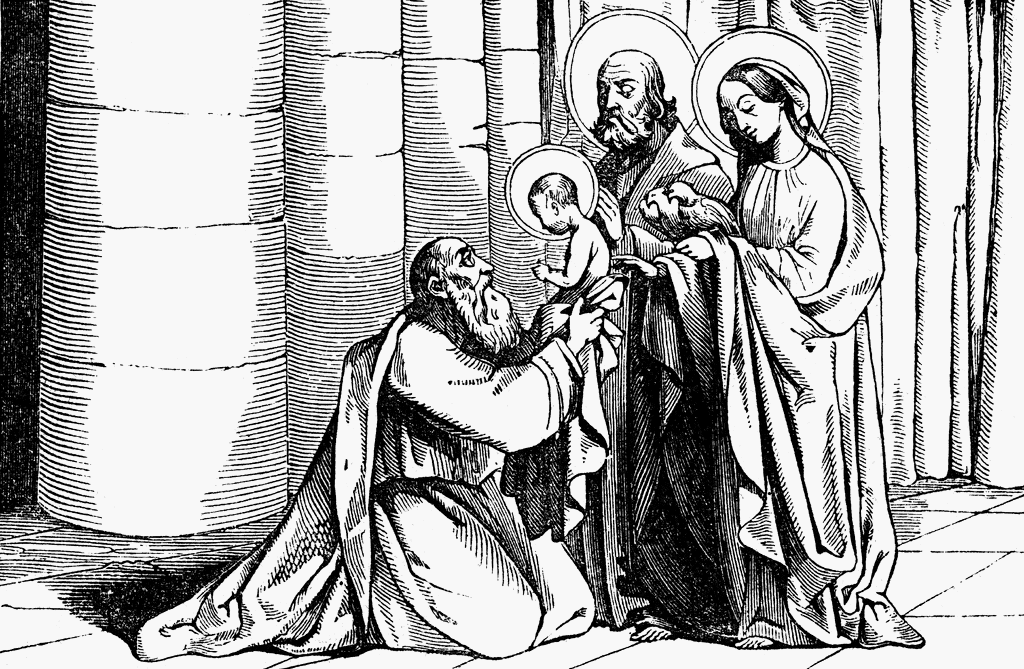
Luke 2:25-33 "And there was a man in Jerusalem whose name was Simeon; and this man was righteous and devout, looking for the consolation of Israel; and the Holy Spirit was upon him. 26 And it had been revealed to him by the Holy Spirit that he would not see death before he had seen the Lord’s Christ. 27 And he came in the Spirit into the temple; and when the parents brought in the child Jesus, to carry out for Him the custom of the Law, 28 then he took Him into his arms, and blessed God, and said, 29 “Now Lord, You are releasing Your bond-servant to depart in peace, According to Your word;
30 For my eyes have seen Your salvation, 31 Which You have prepared in the presence of all peoples, 32 A Light of revelation to the Gentiles,
And the glory of Your people Israel.”
33 And His father and mother were amazed at the things which were being said about Him."
Introduction:
Over the last couple of days we have been considering how Jesus' presentation at the temple by Joseph and Mary portray Him being God's Perfect Gift. Thus far we have noted how He is the Gospel's Savior and the fact that He is infinitely holy. Today we want to consider two final reasons: The fulfillment of prophecy and the fact that Jesus is the treasure of grace.
The Spirit of prophecy that was present on the day Jesus was presented at the temple
We find two important figures in this episode of Jesus early human life. Simeon is described as a devout man. We can further note that Simeon was functioning in a prophetic role, since Luke 2:25 states how "the Holy Spirit was upon Him." Simeon had upon him the Spirit of prophecy that enabled Him to utter incredible predictions concerning the Lord Jesus Christ. Anna the prophetess is presented as well, solidifying to reads the presence of prophetic activity in this scene.
We know from other passages in the Bible the role the prophetic office had in preparing the way for the coming of the Messiah. 1 Peter 1:10-11 states - "As to this salvation, the prophets who prophesied of the grace that would come to you made careful searches and inquiries, 11 seeking to know what person or time the Spirit of Christ within them was indicating as He predicted the sufferings of Christ and the glories to follow. 12 It was revealed to them that they were not serving themselves, but you, in these things which now have been announced to you through those who preached the gospel to you by the Holy Spirit sent from heaven—things into which angels long to look." Jesus Himself notes in Luke 24:44 "Now He said to them, “These are My words which I spoke to you while I was still with you, that all things which are written about Me in the Law of Moses and the Prophets and the Psalms must be fulfilled.”
By the time Jesus would finish His ministry and go to the cross, more than 100 prophecies would be fulfilled. The presence of Simeon and Anna both signify how it was that Jesus Christ was God's Perfect Gift - He fulfilled prophecy. So, we have seen thus far how Jesus is God's perfect gift: He is the Gospel's Savior, infinitely holy and the fulfillment of prophecy. Now lets consider one final reason as we close out this blog series...
Jesus Christ, as God's perfect gift, is the treasure of grace.
In Luke 2:39-40 we read - "When they had performed everything according to the Law of the Lord, they returned to Galilee, to their own city of Nazareth. 40 The Child continued to grow and become strong, increasing in wisdom; and the grace of God was upon Him." Jesus Christ came as the embodiment of grace. John 1:17 states - "For the Law was given through Moses; grace and truth were realized through Jesus Christ. Or again, Titus 2:11-12 "For the grace of God has appeared, bringing salvation to all men, 12 instructing us to deny ungodliness and worldly desires and to live sensibly, righteously and godly in the present age." Now we know, going back to Luke 2, that Jesus was treasured by the response to the earlier announcement by the shepherds we see in Mary herself in Luke 2:19-20 "But Mary treasured all these things, pondering them in her heart. 20 The shepherds went back, glorifying and praising God for all that they had heard and seen, just as had been told them."
Years ago I heard a preacher speaking at a conference. He told the crowd that when we proclaim Jesus Christ in our Gospel presentations, we rightly refer to Him as "Savior" and "Lord". The first title speaks to our rescue from wrath and sin and the second speaks of Christ's authority over the believer from conversion through sanctification and into eternity. However, there is that third element that speaks of the affections one ought to have for this Savior and Lord - namely that He is "treasure". Colossians 2:3 communicates this point of Jesus Christ being the treasure of grace: "in whom are hidden all the treasures of wisdom and knowledge." Would it be that as we contemplate God's Perfect gift, Jesus Christ, that we would grasp the fact that He is the treasure of grace.
Closing thoughts
We have spent these last few days considering God's Perfect Gift. We have looked at how Jesus' presentation at the temple by his parents has quite a bit to teach us about this truth. We utilized the acrostic g.i.f.t to flesh out what is meant when we say that Jesus Christ is God's Perfect Gift.
Gospel's Savior - Luke 2:21
Infinitely Holy - Luke 2:22-24
Fulfillment of Prophecy - Luke 2:25-38
Treasure of Grace - Luke 2:39-40
Subscribe to:
Posts (Atom)