Translate

Saturday, April 8, 2017

The Sweeping Message Of The Last Seven Sayings Of Jesus From The Cross

Image result for seven sayings of Jesus
Hebrews 12:2-3 "fixing our eyes on Jesus, the author and perfecter of faith, who for the joy set before Him endured the cross, despising the shame, and has sat down at the right hand of the throne of God. 3 For consider Him who has endured such hostility by sinners against Himself, so that you will not grow weary and lose heart."

Introduction: The Seven Sayings of Jesus

    Today's post features the seven statements that Jesus uttered from the cross during His six hours of crucifixion. First, let's consider all seven sayings in their chronological order:

1. “But Jesus was saying, ‘Father, forgive them; for they do not know what they are doing.’ And they cast lots, dividing up His garments among themselves.” Lk 23:34 

2. “And He said to him, “Truly I say to you, today you shall be with Me in Paradise.” Lk 23:43 

3. “When Jesus then saw His mother, and the disciple whom He loved standing nearby, He said to His mother, “Woman, behold, your son!” 27 Then He said to the disciple, “Behold, your mother!” From that hour the disciple took her into his own household.” Jn 19:26-27

4. About the ninth hour Jesus cried out with a loud voice, saying, “Eli, Eli, lama sabachthani?” that is, “My God, My God, why have You forsaken Me?” Mt 27:46. Compare Mk 15:34. 

5. “After this, Jesus, knowing that all things had already been accomplished, to fulfill the Scripture, said, “I am thirsty.” John 19:28 

6. “Therefore when Jesus had received the sour wine, He said, “It is finished!” And He bowed His head and gave up His spirit.” John 19:30 

7. And Jesus, crying out with a loud voice, said, “Father, into Your hands I commit My spirit.” Having said this, He breathed His last.” Luke 23:46 

Considering the whole message of the seven-sayings of Jesus from the cross.

    These "sayings" occupy a total message that is strung together like seven perfect pearls. Writers have noted the pattern and have found meditating upon these sayings a valuable exercise for the Christian's faith and spiritual vitality. The great 19th century Baptist preacher C.H Spurgeon has deemed the seven sayings as follows:

1. The First Word (Forgiveness)
2. The Second Word (Salvation)
3. The Third Word (Affection)
4. The Fourth Word (Anguish)
5. The Fifth Word (Suffering)
6. The Sixth Word (Victory)
7. The Seventh Word (Contentment)

As Spurgeon comments in his book on the seven sayings - "Christ's Words From The Cross": 

"There are many other ways in which these words might be read, and they would be found to be full of instruction. Like the steps of a ladder or the links of a golden chain, there is a mutual dependence and interlinking of each of the cries, so that one leads to another and that to a third. Separately or in connection, our Master's words overflow with instruction to thoughtful minds."

    To give one more example of how various authors have considered these seven sayings of Jesus as a collection, Andrew W. Blackwood notes in his book - "The Voice From The Cross", the following headings for each saying:

1. The Prayer of Forgiveness
2. The Promise Of Life
3. The Word of Kindness
4. The Cry Of Derelection
5. The Call For Help
6. The Shout Of Triumph
7. The Prayer of Trust

Here again, we see the sayings portrayed as a shimmering string of pearls. 

How we can understand these seven sayings in light of considering the major themes of the four Gospels. 

    In look at these sayings and considering what various authors have written about them, one must take into mind the intentions of each of the Gospel authors. Sayings #1, #2 and #7 derive from Luke's Gospel, which aimed to show Jesus as the perfect Son of Man (see Luke 19:10). Sayings #3, #5 and #6 derive from John's Gospel, whose aim is to present Jesus Christ as God in Human flesh or the Perfect Son of God (see John 1:14; 20:30-31). Then there is that middle saying, saying #4, which is found in Matthew and Mark's Gospels. 

    Matthew presents Jesus Christ as the royal King coming to save His people from their sins (Matthew 1:23; 20:28; 28:18-20). Mark presents Jesus as the suffering servant willing to give His life a ransom for many (see Mark 10:45). 
    Such considerations of the Four Gospel writers can aid us in understanding how these seven sayings incorporate a full-orbed view of Jesus Christ as the King, Suffering Servant, Perfect Son of Man and God in human flesh.

Final thoughts and reflections on the seven sayings of Jesus

    When we look at the sayings together, there is undoubtedly a plot-line and symmetry. The plot-line proceeds from Jesus crying out as the propitiatory sacrifice in saying #1 (i.e satisfying or staying God's wrath on sinners) to having full confidence that His offering for sins is fully accepted in saying #7 as the atonement for sins. The others sayings touch upon pieces of human experience (loneliness in saying #3; forsakeness in saying #4 and thirst in saying #5). 

    These particular sayings remind us that Jesus was truly man and was indeed fulfilling the prophetic picture of the suffering Messiah in Isaiah 53. This was no supposed suffering. Rather, this was a genuine suffering by the Person of the Son in true humanity. Sayings #2 and #6 reminds us of Christ's Divine authority. The whole Person of Christ was on the cross. It was His humanity that had the nails and lashes of the whip driven in and brutally applied. In His Deity, the inestimable value of the atonement was paid. The totality of all that Jesus did is carried forth on these seven sayings. 

Friday, April 7, 2017

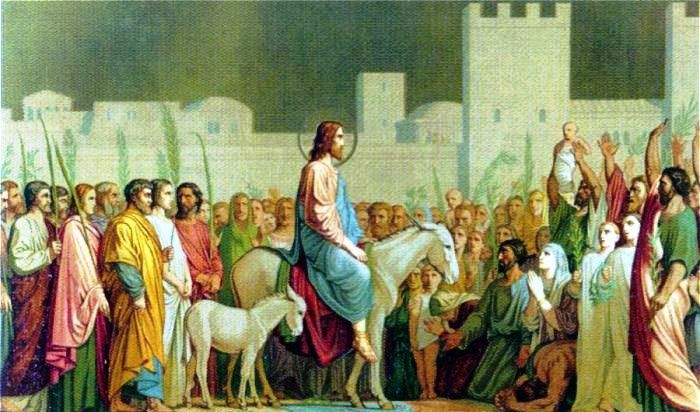
How Much Of You Does He Have? Considering The Background & Applications Of Palm Sunday - Luke 19:28-48

Related image
Luke 19:28-33 "After He had said these things, He was going on ahead, going up to Jerusalem. 29 When He approached Bethphage and Bethany, near the mount that is called Olivet, He sent two of the disciples, 30 saying, “Go into the village ahead of you; there, as you enter, you will find a colt tied on which no one yet has ever sat; untie it and bring it here. 31 If anyone asks you, ‘Why are you untying it?’ you shall say, ‘The Lord has need of it.’” 32 So those who were sent went away and found it just as He had told them. 33 As they were untying the colt, its owners said to them, “Why are you untying the colt?” 34 They said, “The Lord has need of it.”

Introduction:


In the last post, we considered the various motives and responses to Jesus that one finds in Luke 19. Jesus' triumphal entry into Jerusalem is situated within the wider context of Luke 19. Each of the four Gospels include Jesus' entry into Jerusalem (Matthew 21:1-11, 14-17; Mark 11:1-11; Luke 19:29-44; John 12:12-19). We want to consider Luke's version of the event by focusing on two main areas. We first want to better understand why Jesus chose to ride in on a donkey, since His choice of mount communicates much of what He intended to present to the people. Then secondly, today’s post aims to have you examine your heart to see how much of your life He has. The goal will be to urge us all to give our all to this King Jesus Who so desires a triumphal entry into our lives.

Historical background of Jesus' entry into Jerusalem

The choice of a donkey in preference to a white stallion was intentional on Jesus' part. The donkey and two other details of Jesus' entry merit further examination to discern what exactly what happening on the first Palm Sunday. 

First, Roman generals rode stallions, and thus if Jesus would had ridden into Jerusalem in this manner, it would had attracted the wrong kind of attention - leading to possible pre-mature execution. By the end of the week, Jesus would be executed by the Roman authorities, per God's timing and plan (Acts 2:22-24). The timing of everything was in view. If anything, the choice of a donkey was intended for the Jews gathering to celebrate the Passover.

Jesus desired to communicate His intent of presenting Himself as Israel's King. The best way to do this while obscuring any unwanted attention at the same time would involve appealing to the ancient way in which Israel's kings would ride. 1 Kings 1:38-40 records the coronation of young King Solomon: 

"So Zadok the priest, Nathan the prophet, Benaiah the son of Jehoiada, the Cherethites, and the Pelethites went down and had Solomon ride on King David’s mule, and brought him to Gihon. 39 Zadok the priest then took the horn of oil from the tent and anointed Solomon. Then they blew the trumpet, and all the people said, “Long live King Solomon!” 40 All the people went up after him, and the people were playing on flutes and rejoicing with great joy, so that the earth shook at their noise."

The second detail of Jesus' triumphal entry has to do with the actions of the people spreading their cloaks before Jesus. Just like the donkey, the spreading of cloaks harkens back to the practice associated with Israel's history of it's monarachs. 2 Kings 9:13 records the coronation of King Jehu, another King in Israel's history: "Then they hurried and each man took his garment and placed it under him on the bare steps, and blew the trumpet, saying, “Jehu is king!”

Then thirdly, we find the people picking up branches of various sorts - and more specifically, palm branches - to wave at Jesus as He entered. William Heinrich in the journal "Bible and Spade", volume 14, Spring 2001, page 15, writes in his article: "The Enigma Of The Palm Branch":

"Although presentation of palm branches was mentioned by only one Gospel writer, I suggest their use at the Triumphal Entry was a deliberate act, full of symbolism. The people were proclaiming nationalistic pride and their desire to be free of Roman rule. As Jesus rode by the crowd they shouted “Blessed is the king of Israel.” The message was clear. They were looking for deliverance from Roman tyranny and they tied that hope to Jesus, whose miraculous powers made Him a powerful foe to the Romans. By presenting the palm branches to Him, the people were declaring their loyalty to Him as a victorious general or king might expect."

These three details show us not only Jesus' actions in clearer detail, but also the people's intentions. The people were ready to make Jesus their King - however, their conception of the type of King they wanted versus what Jesus came to portray were diametrically opposed. In short, thought the people proclaimed with their lips "Hosanna", their concept of kingship rejected Jesus. 

Life-practical applications of Jesus' triumphal entry in Luke 19

As we already mentioned, the scene of Jesus riding into Jerusalem depicts various attitudes and levels of reception. Jesus' response to the scene is telling. We find that in the final analysis, the people were willing to give only part of their lives to Jesus. Jesus is an all or nothing Savior. Either we give Him all our hearts or we will find our souls in a tug of war between our allegiance to Him on the one hand and the world on the other. As Jesus reminds us: "you cannot serve two masters, for either you will love the one and hate the other, or cling to the one and despise the other" (Matthew 6:24).
When it comes to our hearts, Jesus wants to have your….

1. Allegiance, not admiration. Lk 19:37-38

The people admired Jesus for His miracle working powers, as seen in the parallel account of John 12:18 and in Luke 19:37. As one preacher has noted, these people were "fans", not "followers".

2. Adoration, not appearances. Lk 19:39-40

The Pharisees were wanting the fanatical crowds to silence their shouts of Hosanna for what might had been partly legitimate reasons. Nevertheless, Jesus' could see deep down in their hearts. The Pharisees were not merely concerned about the crowds possibly stirring up unwanted trouble from the Romans. Jesus saw there truest and deepest intent: namely, the Pharisees didn't feel that Jesus the worth the praise, whether ill-conceived by most in the crowd or truly meant by His closest followers. After all, the worshipers were quoting Psalm 118! All we know is that by the end of Luke 19, the Pharisaic and Jewish rulers revealed their true colors. Things were going to quickly unravel and it would be a matter of days until they had their sworn enemy crucified.

3. Reception, not Resistance Lk 19:47
As was just mentioned, things were unraveling. The undercurrent of hatred for the Lord Jesus Christ was poised to boil-over.

Jesus’ response: Sorrow & Cleansing. Lk 19:41-46

Here we find Jesus weeping over Jerusalem, parallel in Matthew 23. The sorrow of His heart followed up by what we know to be His second cleansing of the temple (the first recorded near the beginning of His ministry in John 2). Jesus' symbolic cleansing of the temple court was specifically the area where worshipers would enter. It was also the only place where Gentiles were allowed to be (since signs were posted forbidding Gentiles to enter anywhere beyond the outer-court of entry, where Jesus likely did this act). Again, Jesus' activities were in fulfillment of prophetic scripture. Isaiah 56:7 reads for example: "Even those I will bring to My holy mountain 
And make them joyful in My house of prayer. Their burnt offerings and their sacrifices will be acceptable on My altar; For My house will be called a house of prayer for all the peoples.”

4. How much of you ought Jesus have? Lk 19:1-10; 48b
As we close out this post today, we have considered the historical backdrop of Jesus' entry into Jerusalem in Luke 19. We have also considered some life-practical lessons to be gleaned from this account. So the question is: How much of you ought Jesus to have? The answer is "all of you" and "all of me". We read in the latter part of Luke 19:48 that the "people were hanging on to every word He said." When we couple this statement with the example set by Zaccheus in Luke 19:1-10, we find that Jesus ought to have all our life, time, possessions and attention. As the saying goes: "He is either Lord of all or not Lord at all". 

Thursday, April 6, 2017

What Kind Of Reception Does Jesus Have In Your Life? Considering The Different Receptions Of Jesus In Luke 19

Luke 19:1-6 "He entered Jericho and was passing through. 2 And there was a man called by the name of Zaccheus; he was a chief tax collector and he was rich. 3 Zaccheus was trying to see who Jesus was, and was unable because of the crowd, for he was small in stature. 4 So he ran on ahead and climbed up into a sycamore tree in order to see Him, for He was about to pass through that way. 5 When Jesus came to the place, He looked up and said to him, “Zaccheus, hurry and come down, for today I must stay at your house.” 6 And he hurried and came down and received Him gladly.

Introduction:

Whenever we reach the 19th chapter of Luke's Gospel, we are getting ready to enter into what will be the final week of Jesus' life before His crucifixion. It is in this chapter that we find Luke portraying what New Testament Scholar Robert L. Thomas calls in his book: "Charts of the Gospels and the Life of Christ": "The Formal Presentation of Christ to Israel and the Resulting Conflict." My interest in this particular post is to consider the various receptions of Jesus we find in Luke 19. Luke 19 is not only a significant chapter for transitioning us from Jesus' public ministry to what will be the week leading up to His crucifixion and resurrection, but the chapter also contains the key verse to Luke: Luke 19:10. In Luke 19:10 we are reminded of why Jesus came: "For the Son of Man has come to seek and to save that which was lost.”

As Jesus presents Himself formally as King and Messiah to the nation of Israel, we find a major thread running through Luke 19: receptivity. I get this notion from the words we read concerning Zaccheus the Tax-collector's response to Jesus in Luke 19:5-6 "When Jesus came to the place, He looked up and said to him, “Zaccheus, hurry and come down, for today I must stay at your house.” 6 And he hurried and came down and received Him gladly.

This idea of "reception" or "response" is repeated again and again throughout the chapter. What Luke 19 has to say regarding the ultimate responses to Jesus' formal presentation of Himself as King and Messiah not only speaks about the spiritual condition of the eharts of first century Israel - but more so the spiritual heart condition of 21st century men and women in the church. To help us walk through this chapter, I will give some headings centered around the following question: What kind of reception does Jesus have in your life?

1. A Real, Glad Reception of the Person of Christ. Luke 19:1-10

Zaccheus was not interested merely in what Jesus could offer. Zaccheus was willing to give up all he had and more to have the Master in His home and in His life. Luke 19 definitely begins with the kind of reception we all ought to have. This kind of reception also indicates a true heart change in Zaccheus life, leading to the life-change he intended to pursue as He followed Jesus. Zaccheus typifies the glad reception of the Person of Christ.

2. A reluctant reception of the authority of Christ. Luke 19:11-27

Space does not permit a whole lot of analysis of this parable told by Jesus. In most parables, one overarching point is being conveyed by Jesus to the audience that was listening to him. One detail sticks out in Luke 19:14 that suggests the overall attitude Jesus perceived from many of the people to whom he spoke. Luke 19:14 reads - "But his citizens hated him and sent a delegation after him, saying, ‘We do not want this man to reign over us.’" Jesus used this statement to get his audience's attention, since it referred to a recent historical event contemporary to their time. 1 What makes Jesus' parable so powerful is that the emotional responses of the people to a former ruler in their day mirrors what would be the deep-seeded attitudes they either had or would have towards Jesus. In short, we see an attitude of reluctance being exposed by Jesus with regards to his listeners. As he closes out the parable, we read its main point in Luke 19:26 "I tell you that to everyone who has, more shall be given, but from the one who does not have, even what he does have shall be taken away."

3. A Rushed Reception of the Perceived Benefits of Christ. Luke 19:28-44

We have seen thus far a glad reception by Zaccheus and the exposure of a reluctant reception of Jesus concerning the nation as a whole. Now we are introduced to the seen of what many have called Jesus so-called "triumphal entry". On the surface, this familiar seen does indeed appear triumphal. Churches today celebrate Palm Sunday to commemorate this event in Jesus' ministry whereby He formally presents Himself to Israel. Further examination of the motives of most in that seen however will reveal that their zeal for Jesus was more so over perceived benefits. John 12:9,17-18 gives us the parallel account of Jesus entry into Jerusalem, which per John's record, occurred on the heels of the miracle of raising Lazarus from the dead. Many of the zealous people in the crowd were attracted to Jesus for His wonder-working power. With the combined political and mis-placed ideas the people had about what Messiah should be in contrast to what Biblical prophecy and Christ Himself had taught, we can say that the triumphal entry represents a rushed reception.2 

This certainly reminds us of people, even today, who make an emotional response to the Gospel and yet such responses are unaccompied by true, saving faith. People will profess Jesus with their lips with perceived expectations about what Jesus can do for them. In short, many people want the benefits without the benefactor. 

4. A religiously cold reception of Christ. Luke 19:39-44

So what was the fall-out resulting from Jesus' entry into Jerusalem? The Pharisees told Jesus to silence His followers. Jesus' response? Luke 19:40-42 states -  But Jesus answered, “I tell you, if these become silent, the stones will cry out!” 41 When He approached Jerusalem, He saw the city and wept over it, 42 saying, “If you had known in this day, even you, the things which make for peace! But now they have been hidden from your eyes." Jesus then follows-up with a prediction of what would be the destruction of the Temple in Jerusalem in 70 A.D. We then see Jesus' further response to the spiritual decline he witnessed by the way he cast out the money changers in Luke 19:45-47. The coldness of reception undoubtedly brought much sorrow to Jesus. Nevertheless, such a sequence of events was ordained by the Father in preparation for the giving of the Son by the end of the week in His crucifixion. 

Closing thoughts and applications
So as we close out this post today, my question to you, the reader, is this: what kind of reception does Jesus have in your life? Are you like Zaccheus, possessing a real, glad reception? Are you like the people in Jesus' parable, reluctant to have Jesus' authority? Are you like the crowds, who wanted benefits but not the benefactor? Are you like the Pharisees, who were cold and ritualistic towards Jesus? I'm sure that many Christians can say they have had seasons where these attitudes can creep in. 

What ought our response be? Certainly, Zaccheus sets the example before us: we ought to always be gladly receiving Jesus. I would secondly suggest we adopt the posture of some of the people at the end of Luke 19:48, namely, "for all the people were hanging on His every word". When you and I hang onto every word of Jesus and align our hearts to gladly receive Him like Zaccheus, we will come to enjoy Jesus for Who He is, as well as what He is able to do in our lives. 


Endnotes:

1. Jesus' listeners would had recognized an allusion to a recent event in their day that involved a former ruler over the province of Judea: Herod Archaleus, who was treacherous and was eventually banished by Caesar himself for his ill treatment of the Jews. The Jews of course had come to resent Archaeleus for his heavy-handed treatment of them. Needless to say, when Archaeleus was banished, the Jews - in no uncertain terms - expressed their contempt and in no wise wanted Archaelus to rule over them any longer (this summarizes the account found in Josephus' Antiquities of Jews, Books 17 and 18).  

2. Many of the people laying palm branches at Jesus' feet thought Jesus was coming to deliver them from Rome's Tyranny.  The Palm branch was a universal symbol of victory and celebration in the ancient world. Among many of the Jews, the palm branch connected back to an earlier time when a group of Jews called the Maccabees, led by their leader - Judas Maccabeus, withstood the evil forces of the Syrian ruler Antiochus Epiphanes in 168-165 b.c. In much of the Jewish literature outside the Old Testament (for example the Jewish Apocryphal book, 1 Maccabees), we read the entire account of these Maccabean wars, and how such wars informed the Jews perceptions of what they thought Messiah ought to be. 

Wednesday, April 5, 2017

Some Thoughts On How Divine Aseity Gives Understanding To Christian Identity And Biblical Manhood

Related image
Isaiah 48:11 “For My own sake, for My own sake, I will act; For how can My name be profaned? And My glory I will not give to another."

Introduction:

In the last post we explored God's Divine Aseity (A-say-i-tee). To grasp once again this core trait of God's Aseity, I quote from the great Christian scholar and defender of Biblical Christianity, Dr. William Lane Craig: 

"When we come to the subject of God’s self-existence that we’ve been looking at, we can say that the Scripture clearly teaches that God is uncreated and independent of anything else. Everything other than God depends upon God for its existence, whereas God depends upon nothing." 

In today's post I want to consider how focusing on God's Divine Aseity can greatly clarify God's identity and its relationship to Christian identity. This study will offer a starting point for considering how true Biblical manhood can be sculpted by considerations centered-on God. Specifically, we will see how Christian men (and women of course) can benefit from focusing upon this incredible quality of God's Divine Aseity.

How Divine Aseity is core to God's Identity

Isaiah 48 and 49 are among some of the greatest chapters in the Old Testament to get a glimpse into the Triune identity of God. Isaiah 48:1-11 has the Lord affirming the Oneness of His being, namely that He and he alone is God, and that He does not share His glory with another. In fact as we have been noticing the past couple of days, the phrase "I am the first, and I am the last" and other phrases like it affirm the Oneness and uniqueness of God in His Aseity (a-say-i-tee). 

To remind the reader again, God's Aseity refers to how He is independent and His own source of life and existence. Bible teacher John MacArthur comments on Divine Aseity in his exposition of John 5:26:

"But now when you talk about His self-existence, you’re talking about the essence of His nature. One is eternality, two is equality, three is essence. His self-existence is critical. Through the years, this has kind of been an abstract idea, kind of left in the back waters of theology and theologians have a word for this, they call it the aseity of God … a-s-e-i-t-y, the aseity of God, very obscure term but it means the self-existence of God."

MacArthur continues on: 


"What does it mean that He is self-existent? It means in simple language, go down to verse 4, here it is again, four words. I told you John’s economy of words is stunning. “In Him was Life.” In Him was Life.” John 5:26 says it again, that in God is life and in the Son is life. This is an amazing statement. Life not bios, not just physical life, but zoe, the biggest, broadest term for all kinds of life. And what it’s saying is this. Life was in Him. What do you mean by that? Well look at it from a negative standpoint. He didn’t receive life from any from any other source. He didn’t develop life from some other power. This is self-existence. He wasn’t given life, He didn’t receive life, He possesses it as an essential of His nature. In Him was life."

All things, whether people, angels, rocks or stars depend on God for their existence or life. God however is different and is the only Being who is self-sufficient, meaning then that He alone can Create, Perform Salvation and reign over all things. As was already noted in previous posts, Divine Aseity is what defines God as God; aseity is God's "Godness". 

Men in particular need a fresh, powerful appreciation of Divine aseity

This trait is important in Isaiah's overall argument against idolatry and the worldliness that was stealing away the hearts of his people and which still attempts to grab hold of our hearts today. Men in particular prize the thought of self-sufficiency. The autonomy of humanity is a major by-product of fallen man. God alone is self-sufficient. Whenever a man tries to "do it all on his own" or "be the lone-ranger", emotional, spiritual and relational burnout in marriages, jobs and life result. As a man myself, I constantly have to battle that tendency to be a "lone-ranger" and see my own insufficiency. Asking help from others and being immersed in a Christian community (i.e the local church) reinforces this notion that we as creatures are dependent on outside sources, and God alone is sufficient in-an-of-Himself.

Men in the Bible who were transformed by the revelation of God in His Divine Aseity

When we scan the scriptures in both Old and New Testaments, we find God revealing Himself to men to effect change in their lives and to clarify His calling to them. Think of Moses for example. In Exodus 3, we find God revealing to Moses His very Divine name that is centered around Divine aseity - namely "I am who I am" or Yahweh, Jehovah. Moses' life and character was radically changed as a result of that encounter, resulting in a catapulting of him into leadership and service to God. 

Other Biblical characters could be mentioned: Abraham, David, the 12 Apostles and the Apostle Paul. A moments reflection and further study of the relevant Biblical texts will show how much Divine aseity can transform a man into a man of God. We can of course apply all that has been said to the women of the Bible such as Sarah, Hannah, Mary and Martha. 

Mankind's purpose is to know God and he derives His purpose from God

Mankind was originally designed to be a being in relationship with others. In marriage, men are to relate to their wives. As fathers, the man is to consider his children's needs above His own. Then of course, the Christian man must remember that he derives his identity and sense of being from God. Manhood is best cultivated in the context of relationships.

God in His own unique way expresses His very essence by the inter-relating of the Three Persons of the Godhead. This One God identifies Himself in a plural way in Isaiah 48:16 as the One who was sent by the Lord God, along with the Spirit of God. Though only brief, the passage gives us a glimpse into the three-fold identity of God that is Father, Son and Holy Spirit. 

Applications for understanding Christian identity and Biblical manhood in light of God's Divine aseity

As we close out today's post, I want to suggest the following life-practical applications of Divine aseity to understanding Christian identy in general and Biblical manhood in particular:


1. God's Divine Aseity means we as dependant creatures are accountable to Him.

Knowing that we are accountable to Him in both this life and the one to come ought to affect how we treat fellow Christians, those outside the faith and prompt us to encourage everyone for Jesus sake. 

2. God's Divine Aseity means that God is sufficient and that without Him, we are insufficient.

Divine Aseity reminds me that Jesus is All-sufficient and that you and I by ourselves are insufficient. Christian men ought to take notice. The Lord and His word is the norm by which we live in an otherwise abnormal world that is dying and in need of Jesus Christ. 

3. God's Divine Aseity means God, rather than culture, is the norm by which we ought to live.

Culture attempts to conform men to its image apart from God. Jesus Christ, though sharing fully in the One Divine nature with the Spirit and the Father, still shares in our humanity. He by His Spirit urges us to love our neighbor as ourselves and to love His Father with all our hearts, souls mind and strength. (Matthew 22:37). 

4. Divine Aseity reminds us that apart from God, true manhood cannot be grasped, since the eternal Son took unto His Person a truly human nature

Without God, true manhood cannot be grasped. Afterall, the eternal Person of the Son chose to unite to His Person a truly human nature by which we could behold true humanity and true manhood in action. 

Closing thoughts:

May we ever depend upon our Master in heaven, upon whom we depend for everything that pertains unto life and to godliness through His word (compare 2 Peter 1:4-11).

Tuesday, April 4, 2017

Some Major Biblical Passages On Divine Aseity

Image result for infinity symbol
Genesis 21:33 "Abraham planted a tamarisk tree at Beersheba, and there he called on the name of the Lord, the Everlasting God."

Introduction:

In our last post we considered the concept of God's Divine Aseity. We noted how this quality of God's being is what makes God - God. We also referred to Divine Aseity as: "God's "Godness". Theologian R.C Sproul notes about aseity:

"Because God Himself had no beginning, He was already there in the beginning. He antedates the created order. When we affirm that God is eternal, we are also saying that He possesses the attribute of aseity, or self-existence. This means that God eternally has existed of Himself and in Himself."

The patriarch Jacob in the opening verse above refers to God as "El Olam" or "God-eternal". Such a title points us to considerations about Divine Aseity. 
In today's post, I want to list some of the major Biblical texts that express this central feature of God's being - offering brief commentary that shows the life-practicality of Divine Aseity to daily living. So, let us look at some key Biblical texts on this subject.

1. Exodus 3:14 "God said to Moses, “I AM WHO I AM”; and He said, “Thus you shall say to the sons of Israel, ‘I AM has sent me to you.’”

Here we see God revealing His most intimate, covenant name - Yahweh or I am who I am. Is it not interesting that at the heart of God's redemption of His people that He would reveal His very name as His very character as the self-sufficient God? This is highly appropriate for God to do, showing that He is uniquely able to save His people. 

2. Psalm 90:1-4 "Lord, You have been our dwelling place in all generations.
2 Before the mountains were born
Or You gave birth to the earth and the world, Even from everlasting to everlasting, You are God. 3 You turn man back into dust And say, “Return, O children of men.” 4 For a thousand years in Your sight Are like yesterday when it passes by, Or as a watch in the night."

Here we find God's Divine aseity as a source of comfort to His people. Moses is the author of this Psalm and had been the first man in history to had received the revelation of God's covenant name "Yahweh" which refers to His self-existence or aseity.

3. Psalm 102:25-27 “Of old You founded the earth, And the heavens are the work of Your hands. 26 “Even they will perish, but You endure; And all of them will wear out like a garment; Like clothing You will change them and they will be changed. 27 “But You are the same, And Your years will not come to an end."

This precious text contrasts God's divine aseity with the relative brevity of the universe. Theologians and philosophers refer to the universe and all of its contents as being "contingent", meaning that it depends on something greater and outside of it for its existence. God is a se or from Himself, which is to say, God is self-sufficient and without need of the universe to sustain Himself. Interestingly enough, Hebrews 1:4-13 incorporates Psalm 102:25-27 to describe the deity of the Lord Jesus Christ. 

4. Isaiah 40:28-31 "Do you not know? Have you not heard? The Everlasting God, the Lord, the Creator of the ends of the earth Does not become weary or tired. His understanding is inscrutable.
29 He gives strength to the weary,
And to him who lacks might He increases power. 30 Though youths grow weary and tired, And vigorous young men stumble badly, 31 Yet those who wait for the Lord Will gain new strength; They will mount up with wings like eagles, They will run and not get tired, They will walk and not become weary."

Isaiah is centering on God's Divine aseity to provide comfort to the people of God. 

5. Isaiah 43:10-11 “You are My witnesses,” declares the Lord,
“And My servant whom I have chosen,
So that you may know and believe Me
And understand that I am He.
Before Me there was no God formed,
And there will be none after Me.
11 “I, even I, am the Lord,
And there is no savior besides Me."

Isaiah uses the phrase: "there was no God formed and there will be none after me" to demonstrate why the pagan deities possess neither reality nor are worthy of worship. We find this similar type of language used by Isaiah in Isaiah 44:6; 45:6, 11,18. Sometimes we find the best way to begin thinking about God, and such mind-bending concepts as Divine aseity, through describing what God is "not". God is not finite, but infinite. God is not material, but immaterial or spiritual. God is not mortal but immortal. This way of describing God is what we call "apophatic theology", meaning that we state what "God is not". It is oftentimes discovered that once we have asserted what God is not, we exclude all other created things from the category of being we call God. God, and God alone is self-sufficient or aseity. 

6. John 5:26 "For just as the Father has life in Himself, even so He gave to the Son also to have life in Himself".

When Jesus asserted the Divine aseity of the Father, He was hardly stating anything controversial, since the Old Testament plainly expresses the Divine Aseity of the Father. However, when Jesus claims that He too possess this same quality, now his opponents find all sorts of red-flags raised in their minds. This is one of several statements found throughout the four-Gospels where Jesus claims Himself to be truly Divine. Divine aseity is at the heart of what makes God-God. Touching His Deity, the Son of God is aseity.

7. 1 Timothy 6:16 "who alone possesses immortality and dwells in unapproachable light, whom no man has seen or can see. To Him be honor and eternal dominion! Amen."

As Paul closes out his letter to young pastor Timothy, he ends with a doxology or exclamation of praise to God. Paul wrote 1 Timothy to instruct a young Pastor on what he needed to preach and how to pastor. Timothy needed to possess a high view of God. Divine Aseity would be at the center of this young pastor's God-centered ministry. This ought to give us a clue today concerning how big of a vision of God we need in the contemporary church.

8. Revelation 1:8 “I am the Alpha and the Omega,” says the Lord God, “who is and who was and who is to come, the Almighty.”

The Apostle John sees a profound vision of Jesus. This verse is truly a commentary on that one, ineffable holy name "Yahweh" first revealed to Moses in Exodus 3:14. We find references to Divine Aseity in other places in Revelation such as Revelation 4:10-11.

Closing thoughts:

Today's goal was to introduce the reader to some of the major verses in the Bible that speak about God's Divine aseity. May these verses lift our minds and heart up to God's throne and cause us to depend all the more on Him. 

Monday, April 3, 2017

Reflections On What Makes God, God - i.e Divine Aseity - And Why It Matters To You

Image result for divine aseity
Isaiah 43:10-11 “You are My witnesses,” declares the Lord, “And My servant whom I have chosen, So that you may know and believe Me And understand that I am He. Before Me there was no God formed, And there will be none after Me. 11 “I, even I, am the Lord, And there is no savior besides Me.

Introducing Divine Aseity (A-say-i-tee)

When you read through Isaiah 43-44, you find celebrated a characteristic of God that is unique to Himself - a trait that Bible teachers call "aseity" (a-say-itee). I like to think of this eternal quality of God as being "God's Godness" or "what makes God - God". Theologian Dr. R.C Sproul writes concerning God's Divine Aseity: 


"When we affirm that God is eternal, we are also saying that He possesses the attribute of aseity, or self-existence. This means that God eternally has existed of Himself and in Himself."

God's Divine Aseity (from two Latin words: "a" and "se" meaning "from oneself") refers to God's uniqueness and independence from the rest of creation. Unlike everything else, which derives its existence from God (whether the universe, galaxies, people, animals, plants, and so forth) - God is His own source of His own life. The universe itself is dependent on God, since it was He who spoke it into existence (Genesis 1:1-2; Psalm 33:6). Theologians throughout the centuries have pointed to particular Biblical texts that express God's Divine aseity, such as Psalm 90:1-4; 102:25-27; Isaiah 40:28-31; 43:10-11; 44:6; John 5:26 and Revelation 4:10.

Why God's Divine Aseity is so important 
The modern classic book on the doctrine of God by J.I Packer, "Knowing God", lays out the practical and profound reasons why Christ-followers ought to include God's aseity in their everyday lives:

"In theology, endless mistakes result from supposing that the conditions, bounds, and limits of our own finite existence apply to God. The doctrine of his aseity stands as a bulwark against such mistakes. In our life of faith, we easily impoverish ourselves by embracing an idea of God that is too limited and small, and again the doctrine of God’s aseity stands as a bulwark to stop this happening. It is vital for spiritual health to believe that God is great (cf. Ps. 95:1–7), and grasping the truth of his aseity is the first step on the road to doing this."

Below the reader will find four life-practical reasons for focusing on God's Divine aseity.

1. Aseity is the essential starting place for the worship of God

To begin, Divine Aseity is important for the worship songs we commonly sing. One of my favorite hymns that celebrates the Aseity of God is the song "Come Thou Fount of Every Blessing." The lyrics of the hymn begin as follows: 

"Come thou fount of every blessing Tune my heart to sing Thy grace Streams of mercy never ceasing Call for songs of loudest praise". 

How do great songs of worship like this hymn rely on God's Aseity? The fact that God is described as a fountain means that He is His own source of blessing. We are dependent on God for everything and celebrate the Triune God of scripture that alone is our source of life and eternal life. A fountain of water feeds itself in producing a beautiful stream of water to be enjoyed by all who look upon it. Likewise, God's Aseity refers to all that we see of Him flowing outwardly from within the kind of God he is: eternal, self-sufficient, infinite, holy, immaterial, changeless, uncreated and many more attributes expressed in the Bible. There is God. There is everything else. The universe and all it contains is not even a footnote in comparison to the vast aseity of God. 

The Apostle Paul's burst of worship in Romans 11:36 assumes Divine Aseity: "For from Him and to Him and through Him are all things. To Him be the glory for ever and ever, amen."

2. Aseity is essential to understanding God in His Word

Another reason we could cite as to why God's Aseity is so important is in how the revelation of Himself to us in His Word requires Him to possess this quality. Isaiah brings out three main titles of God: Savior (Isaiah 43:3), Creator (43:15) and King of Israel (43:15). As you read these chapters, you find a repeated phrase that speaks of God's Aseity - namely that God is the only Lord, and there is no other, neither before nor after Him. (Isaiah 43:10-11; 44:6-8).  God's Aseity insures that God is the sole source of salvation, the sole source of all things as Creator and the Sole King over His people.

3. Aseity is essential to waging war on worldliness

Isaiah then contrasts God who is Aseity to that of man made idols that are not gods at all (Isaiah 44:9-20). Quite the opposite of Aseity is the fact that idolatry is foolishness, since men take blocks of wood or stone and take half for firewood and half to make an image.  Those false gods cannot save, only condemn. 

Furthermore, idols cannot create but only destroy and they cannot reign but only be worthless. The idols that we combat are those idols that come up in our hearts. Whenever we begin to think that God or Christ is not enough, and that we need to "supplement" He and His word, we have drifted into the realm of idolatry or worldliness (1 John 2:15-17). Only when we see God in His Aseity do we realize the lie of sin, that nothing can fully complete except God alone.

4. Aseity is essential for the work of salvation

Only the God that is Aseity, the God that is His own Source of life and eternal power, can redeem and forgive (Isaiah 43:10-11;44:21-28).  For example, when you turn to Colossians 2, you discover two essential truths about Jesus Christ: He being truly God and truly man. Take everything you just learned about God in Isaiah 43-44 and apply it to the Son, Jesus Christ. The Lord Jesus Christ, touching His Divinity, shares the same exact qualities with the Father, being the "fulness of Deity in bodily form" (Colossians 2:9). 

The Son shares in the same nature of aseity as the Father, meaning He can be regarded as the Savior, Creator and King (Colossians 2:10-11). Equally important is the fact that the Son came to begin sharing in our humanity, meaning He could now die for our sins and raise from the dead (Colossians 2:11-15). By being both truly God and truly man, Jesus Christ's saving work carries with it infinite value and is effectively applied to all who by grace through faith believe on Him (Colossians 2:1-7).

Closing thoughts:

Celebrate God's aseity. Praise Christ today for His aseity - the quality that makes Him an equal sharer with the Father and the Spirit and thus the source of your salvation. Also praise Him that He came to share in your humanity so that He could shed His blood for you and rise from the dead.

Saturday, April 1, 2017

Behold Your God! Outlines And Reflections Of Isaiah 40

Image result for know God
Isaiah 40:9 "Get yourself up on a high mountain, O Zion, bearer of good news, lift up your voice mightily, O Jerusalem, bearer of good news; Lift it up, do not fear. Say to the cities of Judah, “Here is your God!”

Introduction:

There are certain chapters in God's Word that contain enough revelation about God to provide a sweeping overview of His essence and attributes in one place. Isaiah 40 is a Mount Everest in the study of "Theology Proper" or the doctrine of God. Isaiah's marvelous chapter functions like a Divinely revealed telescope, giving the reader the opportunity to view the reality, the being and attributes of God. Its as if Isaiah is beckoning us to run to this chapter and urging us to "behold your God!". In this one chapter we get thoroughly introduced to the God of sacred scripture.  In today's blog I want to give you the reader an outline of this marvelous chapter. The goal is to whet the appetite for more of God!

The prophet Isaiah begins the chapter with God being the source of comfort and ends with the same truth. We as human beings search for comfort in created things and then consider God. Whenever we turn to the Old and New Testaments, the order is reversed!  To paraphrase the great Christian thinker A.W Tozer's practical application of theology proper: whatever enters into a person's heart when they think about God represents the most important thing about that person. To summarize Tozer's point - the one goal of life is this: to know God. In contrast to pagan deities, Isaiah is aiming to show his readers and us what kind of God God is with respect to His being, attributes and character. 

What kind of God is the God of the Bible and Who is he revealed to be in Isaiah 40?  

1. God is One God Who is Personal.    Isaiah 40:1-9

Note: The seeds of thought pertaining to God's Triune identity in the New Testament are found in the first nine verses of Isaiah 40. God is indeed One in being and plural in terms of His identity. God's capacity to relate within Himself explains why human beings made in his image are by nature relational. Isaiah begins his chapter by showing us how God is one and yet Personal.
  
A. God is the Personal God that is the  One True God.  Isaiah 40:1

B. This Personal God is Father, Son and Spirit. Isaiah 40:2-9 
    
2. God is Perfectly Infinite.    Isaiah 40:10-26


Note: Christian thinkers refer to what is called "Perfect Being Theology". God as a Perfect Being refers to how He is the greatest being that can be conceived. Many of the major characteristics or attributes describing God's very being are found in Isaiah 40:10-26. Like rays of the sun, the attributes of God carry in them the totality of both their source and the other qualities of God. Thus, for example, God is all-knowingly wise and all-wise in terms of the knowledge He possesses. We sometimes refer to God's perfections as "The Perfect Being" as being necessarily perfect, meaning that He cannot be any other way. You and I, dear reader, are not necessary beings, but what we call "contingent", meaning that we could had possessed different qualities than what we have. I could be shorter or taller, fatter or thinner. God, however, is unchanging and thus necessarily exists, possessing the following attributes as described by Isaiah.

A. All-Good God (Omni-Benevolent)     Isaiah 40:10-11

B. All Wise God (Omni-sapient)
    Isaiah 40:12

C. All Knowing God (Omni-scient)
    Isaiah 40:13-14

D. Infinite.               Isaiah 40:15-17

E. Self Existent (Aseity).

    Isaiah 40:18-20

F. All Present (Omni-present) 

   Isaiah 40:21-22

G. All Powerful (Omni-potent) 

    Isaiah 40:23-26

3. God is the Providing God.   Isaiah 40:27-31


Note: When we study theology proper or "The Doctrine of God", we not only discover how God is above His creation or "transcendent", but also how He is ever relating to and near to His creation or "immanent". God's provisions bring home most practically this point.

A. He is able to provide.                           Isaiah 40:27-28

B. He knows how to provide.

    Isaiah 40:29

C. He knows to whom to provide.

    Isaiah 40:30-31

To God be the glory! May you and I dear reader find our strength in Him as we enjoy Him!