Translate

Monday, June 11, 2018

Four Identifying Marks Of God's Love In The Christian Life

See the source image
1 John 4:7 "Beloved, let us love one another, for love is from God; and everyone who loves is born of God and knows God."

Introduction: The story of the little creek that turned into a mighty river

I can recall, as a little boy, a little creek running through the middle of our property. In the dry summertime, that little creek would get so low as to become barely a trickle. I would often find big rocks and sticks to create dams so as to observe how high the water would get. The water would momentarily dam up. But then, no sooner had the water formed a dam as to then suddenly break through the makeshift obstructions. 

Over the course of the year, the bottom of that little creek would become littered with big rocks and fallen logs. When spring came, the heavy rains of April would turn that little creek into a mighty river. As the water swelled its banks, all of the obstructions and debris would wash downstream. That mighty channel was unstoppable. In its wake, the creek bed was left clean for the little creek to run its course.

Christians are dry river beds in need of God, the mighty stream

Whenever we turn to the writings of the Apostle John in the New Testament, the theme of "God's love" runs through "the banks" his words. One of John's fondest expressions is: "love one another", deriving from Jesus' final instructions to his disciples involving the same command (see John 13:34; 15:12,17; 1 John 2:7; 3:11,23; 2 John 1:5). 


Whenever we turn to John's 1st letter, and particularly 1 John 4, we observe the mighty river of God's unfailing love. God's love isn't just a stream - it's a mighty ocean in the banks of 1 John 4. As Christians, we fail to remember that without the Lord, we are dry river beds. In another of John's writings, the Gospel of John, he quotes Jesus stating in John 7:37-39 -

"Now on the last day, the great day of the feast, Jesus stood and cried out, saying, “If anyone is thirsty, let him come to Me and drink. 38 He who believes in Me, as the Scripture said, ‘From his innermost being will flow rivers of living water.’ 39 But this He spoke of the Spirit, whom those who believed in Him were to receive; for the Spirit was not yet given, because Jesus was not yet glorified."

Jesus promised that the Father would send the Holy Spirit in His name. This promise of the Holy Spirit came to pass in Acts 2. Now that the Holy Spirit is active in the lives of all true Christians, we come to understand that He sheds the love of God abroad in our hearts (Romans 5:1-5). Literally, God by the Person and work of the Spirit operates as that mighty river. The Holy Spirit brings through the child of God the mighty torrents of the Father's mighty power and Jesus Christ's incomparable Person. The Spirit is, after all, the Ambassador of the Trinity.


Like the little creek mentioned earlier, we as Christians often have the clutter of life filling our hearts. We are in need of God. God, in the totality of the active love shared between the Father, Son and Holy Spirit, is comparable to the living, mighty river of love. Whenever God's love get's involved, He can clear away whatever is obstructing our growth and passion for Him. Love isn't just an emotion. Instead, love is a conscious decision to give of oneself for the betterment of another. The three persons of the Godhead have done this for all eternity. Whatever love humans express is an echo of such love that makes up our identity as bearing the image of God. Whenever a person converts to Christ by faith, their marred image is made anew into His own, meaning that God's love can flow unhindered (compare Colossians 3:10).

Identifying Marks of God's love

So how can you and I tell when God's love is flowing in our lives and in the lives of others? In using the acrostic l.o.v.e, we can discover from 1 John 4:7-21 the following four traits of God's love:

Lives through the cross. 1 John 4:9,10,19

1 John 4:9-10 states -


"By this the love of God was manifested in us, that God has sent His only begotten Son into the world so that we might live through Him. 10 In this is love, not that we loved God, but that He loved us and sent His Son to be the propitiation for our sins."

God's love was manifested through the cross. Paul, in Romans 5:8, uses the language of "demonstration" to prove what God did in showing His love. We know that God's love, in the sending of His Son, was effective. Christ's finished work "propitiated" or "satisfied" the wrath of God. What Jesus Christ as God in human flesh accomplished in six hours on the cross would require the book of Acts and 21 New Testament Epistles to unfold its meaning. The application of Christ's finished work at saving faith works itself through every person trust in Him by faith.

The incredible love of God flows unceasingly and unhindered from the cross. Though the cross is barren, and though our risen and glorified Savior is at the Father's right hand, yet, God's love lives through and around the cross. A Christian who is operating in God's love will have the cross in their hearts and Jesus' name on their lips. But notice another trait of God's love here in 1 John 4:7-21...

Overcomes anything. 1 John 4:7,12,17,18,20,21


1 John 4:7 states -


"Beloved, let us love one another, for love is from God; and everyone who loves is born of God and knows God." 

In this section of 1 John we see God's love overcoming the following:

a. Disunity (1 John 4:7,12). The command to love one another with God's love is the only thing that can diffuse disunity, bitterness and hurt that we so often see in churches today. My love is limited. His love is unlimited. My love will make conditions. God's love has no strings attached. My love can wane and waver. God's love does not wane and cannot waver.

b. Fear (1 John 4:17,18). 1 John 4:18 tells us that "perfect love cast out all fear". Whenever you see that phrase "perfect love", of what sort of love is John speaking? It certainly isn't human love, since sinless perfection is not attainable in this life. Only God's love is without flaw and without limitation. Every phobia and psychological disorder is traceable to fear or anger. Whenever Adam and Eve hid in the garden, they hid because they were fearful. Only God's love can destroy fear.

c. Anger (1 John 4:20-21). Of the 10,000 times we sin mentioned in the Bible, bitterness or anger against another person is mentioned some 2,000 times. God warns us about the dangers of anger and bitterness more than any other sin. This is why we need His love.


So far, we've observed the traits of God's love as: lives through the cross and overcomes anything. Notice with me a third quality...

Validated by the Spirit. 1 John 4:13


1 John 4:13 makes this observation -


"By this we know that we abide in Him and He in us, because He has given us of His Spirit." 

The Holy Spirit is the Third Person of the Triune Godhead - meaning that:

a. He possesses all of the properties of deity along with the Father and Son
b. He is a Person, possessing intellect, emotions and a shared will with the Father and the Son 
c. He comes to abide within every Christian at salvation (John 14:17,23; 16:8-16; 1 Corinthians 2:12, 3:16, 6:17-18, 8:16-17).

The Holy Spirit in the Christian bears witness of who that Christian is and who it is that owns them (namely Jesus). Included in this witness of the Spirit is the reality of God's love(Romans 5:1-5). The Holy Spirit's ministry on the inside takes "God's love" from the realm of an idea to that of practical living on the outside. Let's consider one more trait of God's love flowing in the life of the Christian....

Expressed in sound doctrine 1 John 4:14-19

As we close out today's blog, we note that God's love is evidence by life through the cross, overcoming all things and validated by the witness of the Spirit. In terms of expressing such truth, sound doctrine - and our attitude toward it, will often tell whether or not we have God's love. If we love God, we will also love His truth. In 1 John 4:14-19 we see the following sound doctrines:

a. Person of Christ (truly God and truly man) 4:14-19.

b. Work of Christ (you cannot separate His Person from His work) 4:14-19.

c. Righteousness of Christ (relying on His act and accomplishment in both His perfect life and substitutionary death) 4:18.

d. God's unchanging love 4:19.


We cannot love God and love others rightly if our doctrine is not right. Attention to the truth of God is crucial is we are going to express and experience of the love of God. These then are the marks of God's love in the believer's life:

Living through and around the cross
Overcoming anything
Validation by the Spirit
Expressed in sound doctrine

Saturday, June 9, 2018

P2 - A Biographical Sketch Of The Apostle John, The Man Who Loved Jesus: He Had Fervancy For Jesus

See the source image
Luke 9:51-56 "When the days were approaching for His ascension, He was determined to go to Jerusalem; 52 and He sent messengers on ahead of Him, and they went and entered a village of the Samaritans to make arrangements for Him. 53 But they did not receive Him, because He was traveling toward Jerusalem. 54 When His disciples James and John saw this, they said, “Lord, do You want us to command fire to come down from heaven and consume them?” 55 But He turned and rebuked them, [and said, “You do not know what kind of spirit you are of; 56 for the Son of Man did not come to destroy men’s lives, but to save them.”] And they went on to another village."

Introduction:

I can recall in my childhood days hearing my parents tell me:

"Mahlon, you are sometimes like a bull in a china closet".

Admittedly, they were more than justified in their assertions. I was (and still can be) strong-willed, stubborn and singular-focused, to a fault. I find it humorous to discover that the Apostle John (and his brother James, known as "James the Son of Zebedee) were together called by Jesus: "sons of thunder". This comical point is highlighted by Mark in Mark 1:37

"and James, the son of Zebedee, and John the brother of James (to them He gave the name Boanerges, which means, “Sons of Thunder”)."

John the Apostle was bold by nature. It is hard to imagine the man who loved Jesus with such strength of grace and courage in his latter years was the sort of man you would rather had avoided in his youth. Yet, as is often the case with all new converts to Christ, the process of sanding off the rough edges must begin with the rough edges. Amazingly, what are often liabilities in our personalities are transfigured into benefits for the Kingdom.

In today's post, we once again take a look at the Apostle John to understand how we can better love the Lord Jesus Christ. We saw last time that, like John, we too must begin this journey of love by following Jesus (for the previous post, click here: http://www.growingchristianresources.com/2018/06/p1-biographical-sketch-of-apostle-john.html ).

In today's post, we will add on a second trait: fervency for Jesus.

John's fervency to follow Jesus

Luke 9:51-56 records an episode where Jesus was transitioning his ministry from primarily focusing upon Galilee to the North to gradual priority upon Judea and Jerusalem to the South. In Luke's version, stretching from chapters 10-17, we find unique material devoted to Jesus' ministry in Perea along the Western side of the Jordon River. Jesus and his disciples were looking to lodge in Samaria for the night before continuing their journeys (see map below):
See the source image

As Luke's narrative reports, Jesus sent a couple of his disciples to inquire about lodging. Their request was denied due to the animosities between the Samaritans and the Jews. As a historian, Luke then reports the responses of the disciples, especially a then young apostle John. As a "son of thunder", John makes the astonishing suggestion in Luke 9:54 -

 "When His disciples James and John saw this, they said, “Lord, do You want us to command fire to come down from heaven and consume them?”

Wow! One would think that the man "whom Jesus loved" would never had made such a radical suggestion. John expressed untampered zeal. Yet, John did. How many of us, in our Christian walks, have made those impetuous choices or inserted our foot in the mouth? John's statement is met with a rebuke from Jesus, reminding him in Luke 9:55-56

"But He turned and rebuked them, [and said, “You do not know what kind of spirit you are of; 56 for the Son of Man did not come to destroy men’s lives, but to save them.”] And they went on to another village."

A.B. Bruce's classic study on the disciples: "The Training Of The Twelve", page 234, give the following insight:

"It shows how slow the best are to learn the heavenly doctrine and practice of charity. How startling, again, to think of the same John, a year or two after the date of this savage suggestion, going down from Jerusalem and preaching the Gospel of Jesus the crucified in 'many of the villages of the Samaritans', possibly in this very village which he desired to see destroyed!"

Bruce's reference to John's change of heart is found in Acts 8:14-17

"Now when the apostles in Jerusalem heard that Samaria had received the word of God, they sent them Peter and John, 15 who came down and prayed for them that they might receive the Holy Spirit. 16 For He had not yet fallen upon any of them; they had simply been baptized in the name of the Lord Jesus. 17 Then they began laying their hands on them, and they were receiving the Holy Spirit."

John's fervent temperament spilled-over in those early days of his conversion. In the hands of Jesus, John's fervency in the flesh was ever-slowly transformed into a fervency of love for Him. For sure, John and his brother both exhibited strong passion in their life. At one point in their journey's with Jesus, they request of Jesus to sit at his right and left hand in the kingdom (compare Mark 10:35-40). Jesus tells them that they are ignorant of the manner of their request, and warns them of the possible implications (namely, martyrdom). John and James both assert they're able to take whatever consequences, if it will mean the granting of their request. 

We may look at John's behavior and cast a swift verdict. However, how many times have any of us, even after walking with the Lord for many years, who name "the name of Christ", gotten wobbly, excessive or out-of-turn? Thankfully, the Lord Jesus Christ is merciful. Patient.

Like all Christians, John bore the left-over remnants of the old nature. Like rust on a car, the fragments of that old way of thinking clung to the newly regenerated nature.  Excesses are traced to the flesh - or "old man" (see Colossians 2-3). John had his boxing ring, set in the heart, with the new nature duking-it-out with his old-ways. Still, the fervor characterizing John's temperament became useful in Jesus' hands.

Fervency of the flesh gradually gives way to fervent love for Jesus

Whenever we look at John's progression in discipleship, we witness transformation. The fervency of the flesh is slowly melting away to the fervency of God's love coursing through his heart. The scenes of John with Peter and James upon the Mount of Transfiguration gives us a glimpse into the beginnings of such changes (see Matthew 17; 2 Peter 1:16-21). While Peter is peppering Jesus with frantic questions and excitement, we hear not a word from John's lips (compare Matthew 17:1-13).

Or consider how few of words he is at the final meal between Jesus and his disciples in John 13:22-25. It is at this juncture that we find John reclined on Jesus. The practice of leaning on one another at an oriental meal, on the ground, would explain why John was pressed in on Jesus' side. Once Jesus reveals that He is going to undergo betrayal, John (described in John 13:23 as "the one whom Jesus loved) asks Jesus in 13:25 - "Lord, who is it?" John's listening and watching of the Master takes over those earlier episodes where he would boldly stride in like the proverbial "bull in a china-closet".

John's fervency is reined in by an ever-increasing Christ-like humility. The forging together of fervency and humility yields that Biblical alloy of meekness (compare Moses in Numbers 12:3, KJV). By the time we arrive at the foot of the cross in John 19:25-27, we see the fervency of love most poignantly displayed:


"Therefore the soldiers did these things.
But standing by the cross of Jesus were His mother, and His mother’s sister, Mary the wife of Clopas, and Mary Magdalene. 26 When Jesus then saw His mother, and the disciple whom He loved standing nearby, He said to His mother, “Woman, behold, your son!” 27 Then He said to the disciple, “Behold, your mother!” From that hour the disciple took her into his own household."

John's fervent love for Jesus grew despite the pressures and persecutions

John's place at the foot of the cross, beside Jesus' mother according to the flesh, befits this disciple as the man par excellence in matters pertaining to love for Jesus. Jesus knew John was the only one able and willing to care for Mary. None of Jesus' half-brothers per the flesh were given this privilege (besides the fact they were not-yet-followers of Jesus as Messiah). John's fervency of love for His Lord is observed by being the first disciple to reach the empty tomb. John would express faith (albeit, the beginnings of such), that Jesus had risen (John 20:6,8). John was there with the other 120, awaiting for the promise of the Spirit spoken of by Jesus (Acts 1:13).

It was this same John that partnered with Peter in launching out the initial apostolic mission in and around Jerusalem and Judea (see Acts 3:1,3,4,11; 4:13,19; 8:14). John's brother, James, was martyred for his faith in Christ, echoing the fervent love of his brother (Acts 12:12). John's fervent love was so much so that he was known in the early church as a "pillar" of the church (compare Paul's remarks in Galatians 2:9). 

Closing thoughts and applications: fervent love, expressed in John's writings

By the time John reaches his mid-eighties, he has already followed Jesus with fervent love for some 50-60 years. The three epistles that bear this include this term "love" 26x in 1 John, 4x in 2 John and 3 times in 3 John. John's Gospel, penned very shortly before or at the same time as his little letters, mentions love from Christ or towards Christ nearly 40x. The final book John would pen under the inspiration of the Holy Spirit, his Apocalypse or Revelation, mentions such fervent love as central to Christian living. Revelation 12:11 states -

"And they overcame him because of the blood of the Lamb and because of the word of their testimony, and they did not love their life even when faced with death."

John's fervent love is deeper, higher and wider for Jesus as he pens that glorious book of Revelation on that small Island of Patmos. Life got harsher for this apostle. Yet, the love of Jesus grew only sweeter. Can the same be said of you and me, dear reader. Loving Jesus certainly begins with following Him. However, the fervor of love for Him ought to grow all the more sweeter. Might we consider John's example and by the power of the Spirit, love the Lord Jesus with such fervent love.  


Thursday, June 7, 2018

P1 - A Biographical Sketch Of The Apostle John, The Man Who Loved Jesus: He Began By Following Him

See the source image
John 1:35-37 "Again the next day John was standing with two of his disciples, 36 and he looked at Jesus as He walked, and said, “Behold, the Lamb of God!” 37 The two disciples heard him speak, and they followed Jesus."

Introduction:

My grandfather was a minister of the Gospel for 60 years. He pastored three churches in Southeastern Kentucky for thirty years and then moved to Pennsylvania to further minister for 30 more years. In his last few years, my grandfather built a makeshift chapel where he would conduct Bible courses. On the back wall of the little chapel was an enormous map depicting the chronology of prophetic events. No matter how few or how many people came, my grandfather gave his life to the exposition of God's book.

My grandfather, in all of his 83 years of life, was faithful. He was faithful to the Gospel. Faithful to the church of Jesus Christ that he pastored, no matter the locale. My grandfather was faithful to his first wife of over thirty years, Louise, that died in 1967. He was then faithful to his second wife, Jennie, of 16 years. He loved Jesus. He loved his children. He adored his grandchildren. He lived his faith. Boaz Obed Smith, my grandfather, was faithful to the end.

Whenever we turn to the New Testament, we are introduced to a man simply known as "John". By the time we read through John's Gospel, three epistles and his Apocalypse (or "Revelation"), we see John as he was well into his nineties. But how did His walk with the Lord begin?

Several men are known by this simple name: "John". In the opening text of today's post, we see the forerunner of Jesus the Messiah - "John the Baptist" - performing baptisms and announcing the coming of the one whom he would baptize. John the Baptist had students, learners or "disciples". One of those disciples carried the same name as he.

The disciple "John" would eventually leave his "rabbi" or "master" and follow this new Rabbi, deemed: "The Lamb of God". The disciple John would, along with eleven other men, follow Jesus for over three years through Galilee, Samaria, Judea and ultimately to Jerusalem. This "disciple John" would learn what it meant to follow Jesus and would eventually become known as "the disciple whom Jesus loved" (compare John 13:23).

In today's post, we want to do a biographical sketch of the Apostle John. The goal of this little study is to discern what qualities were in his life that lent to him not only becoming the disciple "whom Jesus loved", but also how Jesus became to Him "the one whom He loved". In this post we want to explore what it means to be like John: the man who loved Jesus.

To Love Jesus Begins By Following Him

John's own personal account of his encounter with Jesus while following John the Baptist in John 1:35-37 gives the impression that the disciple John's decision to leave John the Baptist's side was done so without forethought. John MacArthur notes in his book: "One Perfect Life", page 80, footnote b:

"The 'following' here does not necessarily indicate that they became permanent disciples at this time. The implication may be that they went after Jesus to examine Him more closely because of John's testimony."

In other words, the disciple John (note how he never names himself in any of his writings, but only refers to himself as "the other disciple") is testifying of how he heard what theologians refer to as "the outward" call to Jesus. This outward call impacts the mind, maybe even the emotions, but not so much the heart. John was curious, but not committed. There was no exchange of faith in John's heart at this point. John was not, as some imprecisely say: "a seeker". The only persons that seek Jesus are the truly converted in saving faith. Rather, John was on a fact-finding mission, with the assumption of returning to his master, "John the Baptist". What John needed was an inward call to the heart, the kind so described by Paul in Romans 10:8 by the phrase: "the word is near you, in your mouth and in your heart".

John the disciple's radical commitment to follow Jesus
John the disciple experiences such an "inward call of the heart" in what would become a second encounter with Jesus some months later.  Whenever we read the other three Gospels in Matthew 4:13-22 and Mark 1:16-20, we find Jesus walking along the shore of the Sea of Galilee. Matthew 4:21-22 in particular records the striking scene:

"Going on from there He saw two other brothers, James the son of Zebedee, and John his brother, in the boat with Zebedee their father, mending their nets; and He called them. 22 Immediately they left the boat and their father, and followed Him."

Mark 1:20 adds the following detail:

"Immediately He called them; and they left their father Zebedee in the boat with the hired servants, and went away to follow Him."

The difference between that first encounter in John 1:35-37 to that of the later encounter with Jesus in Matthew and Mark is striking. John, the disciple of John the Baptist and son of Zebedee, owner of a fairly lucrative fishing trade, immediately left the nets and his former master for Jesus.

To follow Jesus means you forsake reliance upon any former allegiances. To follow Jesus centers around decentering yourself and focusing on Jesus (compare Luke 9:23-24). John's first encounter with Jesus led him to analyze Jesus as a subject of curiosity. This latter encounter, recorded by Matthew and Mark, turned the tables on John. John became the object of Jesus' scrutiny. Jesus was not on a fact find mission with John (He already knew everything He needed to know about John). Instead, Jesus was on a "faith-finding" mission in John's heart. Per Galatians 3:23, "faith came" that day into John's heart and life. The nets were dropped. The bridges burnt. John forsook everything to follow Jesus.

Closing thoughts:

The decision to follow Jesus was not half-hearted. John didn't hedge bets and say to himself: "well, if this don't work out, I can always return home to dad and go back to fishing, become partner and hopefully make a decent living. No. This was a radical break. John the disciple's heart was captured by the voice of the one calling him from the shoreline. His journey of loving Jesus began by following him in faith. Not just any faith, but the saving-kind of faith that radically concludes that when I give up everything, and Jesus is all I have, I have everything. May you and I follow Jesus. Only by following him can we too become characterized as those that, due to first loving of us, also respond in ever-growing love to Him. 

More next time.....  


Monday, June 4, 2018

Encountering Jesus Christ In Revelation 1

Image result for book of revelation
Revelation 1:1 "The Revelation of Jesus Christ, which God gave Him to show to His bond-servants, the things which must soon take place; and He sent and communicated it by His angel to His bond-servant John"

Introduction:

In the 66 books composing the Bible, we discover some 200 or so names that are attributable to the Son of God. Some of those names point to the Son as He was in His pre-incarnate, pre-eternal existence (for example, "The Word" in John 1:1, 14). Other names speak of the Second Person of the Trinity as He is in His co-equality with the Father and the Spirit (i.e. "the Son", "the only-begotten Son"). Still other titles are ascribed to the Son following His incarnation (i.e. "Jesus"). The names of Christ bridge to His people a true knowledge of His character and dual-natures as God and man. 

Of those 200 or so names,titles or descriptions, nearly 40 of them are found in Revelation 1.  To say that the Book of Revelation is an incredible book is a monumental understatement. The Apostle John, the author of the book of Revelation or as it is also known by its Greek title, "The Apocalypse", is provided a revelation of the post-ascended Jesus that most profound, personal and powerful.  In today's post, I want us to sketch out the five ways we encounter Jesus Christ in Revelation 1.

1. Jesus Christ the Savior. Revelation 1:1,5,7,13, 18

As much as the Book of Revelation focuses upon Jesus Christ's Second Coming, reference is often made to the accomplishments of His first coming.  For example, we are reminded in Revelation 1:5 that Jesus is the resurrected "firstborn" from the dead. To say Christ is the "firstborn" refers to Him as "heir of all things" (Colossians 1:18). 

This particular title: "firstborn", expresses how Christ ascended into Heaven to His coronation as King. Two senses convey the meaning of this title. First, Christ began His Kingly reign over His church. Second, He spiritually inaugurated what will become His physical, earthly reign upon His second coming. Hence, as mentioned already, the term "firstborn" suggests that Christ is the rightful heir of all things. This title entails Christ's true deity and excludes any notion of He being some sort of "highest created being" as asserted by groups such as the Jehovah Witnesses. Therefore, Jesus is the Savior who is heir of all things.  

As Savior, Jesus Christ is never disconnected from what He endured on the cross. In Revelation 1:7, mention is made of how the tribes of the earth will see Him who was "pierced". John references the Hebrew Old Testament over 200 times in His apocalypse. The term "pierced" is an echo back to Zechariah 12:10. Why is it that the Holy Ghost saw fit to include this word "pierced"? To remind readers that, even in His now glorified humanity, Jesus still bears the marks of nail prints in His hands and feet.  Jesus Himself testifies in Revelation 1:18 that He is the Living One who was once dead but Who is alive forever more.

2. Jesus Christ in His Deity.  Revelation 1:1,7,8,9,10,13-17

When Jesus came the first time, He came in the virgin birth to take unto Himself true humanity. As man, Jesus could die. However, as God at the same time, the value of what He accomplished was infinite. To summarize Dr. Adrian Rogers:  

"He is so much man as to not be God, and yet so much God as to not be man. This same Jesus is, one and at the same time, truly God and truly man."

The Divine titles we see associated with Yahweh in the Old Testament are assigned to Jesus here in Revelation 1.  Perhaps one of the clearest examples is the title "Alpha and Omega" in Revelation 1:8.  In Isaiah 44:6 we read these words - 

"Thus says the Lord, the King of Israel and his Redeemer the Lord of hosts, 'I am the First and the Last; besides me there is no god."

The logic of the Apostle John is inescapable:

God is, by definition, the first and the last, the only God.

Jesus Christ is the "Alpha and Omega", the first and the last.

Therefore, Jesus Christ is God.

3. Jesus Christ the Priestly Mediator.  Revelation 1:5-6,13

Theologians have used the term "session" to describe what Christ is currently doing in His ministry to His people and over History. This "session" refers to the three particular roles or offices He occupies: prophet, priest and king. In scripture we see Jesus occupying these three offices. 

First, He is our King, who right now rules over His church in Heaven and Who is coming back to set up His throne here on earth (Colossians 1:15-20; Revelation 1:5). 

Secondly, Jesus Christ is the Believer's High Priest, representing us to God the Father (1 John 2:1-2; Revelation 1:7).  

Thirdly, He is the Prophet which is the Full Revelation of the Invisible Father and the fullness of the Godhead in bodily form, ever speaking by the Spirit through the scriptures (Colossians 2:9; Hebrews 1:1-3; Revelation 1:12-16)

4. Jesus Christ the King. Revelation 1:5,6,8,20

Though we have already shown Jesus as the King, the title "Ruler of the Kings of the Earth" is worth mentioning (Revelation 1:5). In the study of Bible prophecy, scholars use a little phrase: "already/not yet", to explain prophecies wherein an event has begun but has not yet reached its full manifestation. Christ is ruling right now in Heaven over His Kingdom in a spiritual sense and over the church in particular manner. 

In some sense, He is already reigning in Kingly authority over the Kings of the earth. However, He has not yet fully manifested this reign. Christ's kingdom won't manifest fully until He returns as revealed in Revelation 19-20 to set up His 1,000 year Millennial Kingdom. 

5. Jesus Christ the Prophet. Revelation 1:6,16 

As the "Prophet", Jesus Christ brings God to us because of the fact He is God Himself.  Throughout the New Testament, we see Jesus ascribing to Himself Deity (John 8:58).  He tells Phillip in John 14:9 - 

"If you have seen me, you have seen the Father." 

The Apostle Paul writes in both Philippians 2 and 1 Timothy 3:15-16 that in essence, Jesus Christ is "God in Human Flesh". Jesus Christ is the Prophet Who is the full-orbed revelation of the invisible God (Hebrews 1:1-2).  Jesus Christ as God in Human Flesh shares in the same Undivided nature with the Father.  1 Corinthians 8:6 for example tells us that the Father is the One "from whom all things exists" and the Son at the same time is the One "through Whom all things consist".  

In addition to the New Testament, the Old Testament hints at the fact that even in His pre-incarnate state (before the flesh state), the Son made various appearances and revealed the glory of the invisible God to the patriarchs and prophets (one can compare Isaiah 6 with John 12:41 and Proverbs 30:4-5)

Closing thoughts:

In today's post, we explored five ways we encounter Jesus Christ in Revelation 1. We noted firstly, Jesus Christ the Savior. Second, Jesus Christ in His Deity. Thirdly, Jesus Christ the Priestly Mediator. Fourthly, Jesus Christ the King. Fifthly and finally, Jesus Christ the Prophet. Meditating on these five main points can aid in meditating on John's opening vision in his glorious Apocalypse. 

Monday, May 28, 2018

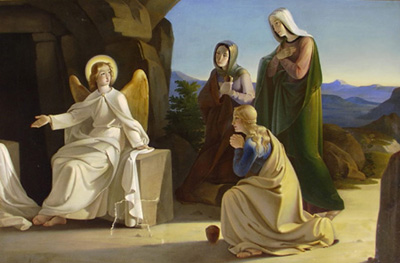
Understanding The Meaning Of The Angels At The Empty Tomb

Image result for angels at the empty tomb
John 20:11-13 "But Mary was standing outside the tomb weeping; and so, as she wept, she stooped and looked into the tomb; 12 and she *saw two angels in white sitting, one at the head and one at the feet, where the body of Jesus had been lying. 13 And they said to her, “Woman, why are you weeping?” She said to them, “Because they have taken away my Lord, and I do not know where they have laid Him.”

Introduction:

When one reads the Gospel narratives of Christ's resurrection, the presence of angels are embedded in the testimony. Inasmuch as we are witnessing a sequence of historical, literal events that transpired in time and in space, we must include the reality of angelic beings. When it comes to what needs explanation concerning the events of Christ's resurrection requiring explanation, three main details are cited by the majority of New Testament historians:

1). The discovery of the empty tomb

2). Jesus' post-mortem appearances 

3). The cause for the disciple's belief in the resurrection.

New Testament historians of all stripes (evangelical and skeptical alike) list the above main points as objects of historical inquiry. Whatever explanation they assign to the events in question (whether naturalistic explanations or the proposal: "God raised Jesus from the dead") results in the wide spread opinions concerning the meaning of what took place that first Easter morning. This author has argued in other posts that the proposal: "God raising Jesus from the dead" is the best explanation of facts in question. For example, click here: http://www.growingchristianresources.com/2018/03/what-happened-on-that-first-easter.html

As a pastor, my responsibility is to expound on all the text. Angels are nothing to be ashamed of when it comes to interpreting the text of scripture. The majority of scholarship today ignores the presence of the angels. As much as some may cite that angels lie outside the task of the historian, such refusal to interpret the meaning of angels is not due to the constraints of historical investigation as it does to a philosophical bias against anything supernatural. Frankly, if we assert that Jesus' resurrection was indeed a Divine act, then explaining the significance of angelic intervention in those accounts ought not seem so far-fetched. 

Acquiring a fundamental grasp of the Bible's teaching on the angelic realm (called: "angelology") aids greatly in understanding why angelic activity is appropriate with respect to the events surrounding the resurrection of Jesus from the dead. Once one traces an outline of the Biblical teaching on angels, the details of their activities relative to the empty-tomb doesn't appear as foreign as it does upon first glance. 

With these thoughts in mind, I'd like to offer some reasons why the Gospel writers included angels in their reporting of the events of Christ's resurrection. For those (like myself) who take the Gospel narratives as reliable historical documents which are inerrant and infallible written revelation from the hands of the Apostles, explaining the point of the angels at the resurrection is a pre-requisite if we're to arrive at a clearer understanding of the Gospel records. What were the angels achieving as they ministered the glory of Christ's resurrected power to the Apostles? Moreover, what can we learn and apply to our lives regarding Jesus' resurrection power for today? Please note the following thoughts:

1. Angels protected the message and messengers who proclaim Jesus' resurrection from the dead


We will first turn to Matthew's Gospel to observe the activity of angels at the empty tomb. Matthew 28:3-4 states: 

"And his appearance was like lightning, and his clothing as white as snow. 4 The guards shook for fear of him and became like dead men."  

When we look at these verses, we can note the following observations. 

1. First, the women were already on their way to finish the final stages of the interment of Jesus' body in Matthew 28:1. 

2. Second, the detail about the guards mentioned by Matthew in 28:3-4 reminds the reader of the manifest impossibility of anyone coming to steal the body of Jesus. The enemies of Jesus had arranged the tomb to be guarded in Matthew 27:62-66. 

3. Thirdly, when we realize that the presence of angels led to the collapse of the soldiers, it suggests that the angels were sent to protect the women and those who would be peering into the empty tomb. 

4. Fourthly, on a practical note, it was an angel that moved the stone of the tomb aside so that the disciples (and us) could see its vacancy (see Matthew 28:2). 

As we noted already, surveying additional Biblical teaching on angelic activity alongside God's people aids in arriving the suggestion of angelic protection afforded to the disciples at the empty tomb. Passages such as 2 Kings 6; Psalm 34:7; 91:11 and Hebrews 1:14 remind us of how angels defend or protect God's people. By protecting the disciples, and particularly the women, the angels were dispatched by God to protect the message they would communicate to the disciples. But now notice a second significant reason for the presence of angels in the events of the Risen and Ascended Christ...

2. Angels aided in the declaration and explanation of Jesus' resurrection from the dead.

We read in Matthew 28:5-7 -

"The angel said to the women, “Do not be afraid; for I know that you are looking for Jesus who has been crucified. 6 He is not here, for He has risen, just as He said. Come, see the place where He was lying. 7 Go quickly and tell His disciples that He has risen from the dead; and behold, He is going ahead of you into Galilee, there you will see Him; behold, I have told you.” 

The Hebrew and Greek words translated "angel" speak of "messengers" or "emissaries" of God. Angels are seen throughout scripture as God's emissaries announcing God's message to His people. We see angels functioning as God's messengers for instance in Acts 1:9-11  -

"And after He had said these things, He was lifted up while they were looking on, and a cloud received Him out of their sight. 10 And as they were gazing intently into the sky while He was going, behold, two men in white clothing stood beside them. 11 They also said, “Men of Galilee, why do you stand looking into the sky? This Jesus, who has been taken up from you into heaven, will come in just the same way as you have watched Him go into heaven.” 

In Stephen's sermon to his Jewish opponents in Acts 7, we are reminded of how the angels assisted in the dispatching of God's Law on Mount Sinai in Acts 7:53 - "you who received the law as ordained by angels, and yet did not keep it.” The angels were doing what they were created to do: declare and explain the glory of God (Psalm 68:17). Moreover, angels are described as pointing people to the equal and shared glory of the Son (Luke 2:14). Since angels served to facilitate the revelation of God's Word and salvation in general, it makes much more sense as to why they would aid the women is grasping the true explanation of the empty tomb: "God raised Jesus from the dead". 

So in addition to protecting the messengers of God and  facilitating the clarity of God's message, observe a third significant reason as to why angels are included in the resurrection and ascension accounts of the Living Christ...

3. Angelic presence demonstrated the Deity and humanity of Christ in His resurrection from the dead


The Old Testament makes it abundantly clear that the angels function in the capacity of a royal court demonstrating the Deity of Yahweh. As we jog through the following Old Testament scriptures, we can apply our observations to understanding why angels appear in the resurrection narratives.

1. We see the angels, from the inception of their creation, exalting God for His creative power in Job 38:7 and Psalm 104:1-4. 

2. In Psalm 68:17, we see angels attending the giving of the law atop Mount Sinai, demonstrating before the newly redeemed Hebrew nation the uncontested royal deity of Yahweh. 

3. Daniel 7:10-13 portrays God by the title: "The Ancient of Days". In the wider circle of the Biblical teaching on the Trinity, we can reasonably assume that the figure of "The Son of Man" is non-other than the Pre-incarnate Son of Man in royal Deity (see Jesus' self-reference of Himself as the "Son of Man" in Matthew 26:64). If we take these thoughts to their full conclusion, one could propose the "Ancient of Days" as being the Person of the Father, and "the Son of Man" as the eternal Son sharing in the one Divine nature with the Father. Back-reading the New Testament truth of Christ's co-equality with the Father explains, for example, why Jesus used the title "Son of Man" to refer to Himself more often than any other self-designation (over 80 times in the four Gospels). Thus, we can see why Daniel 7:10-13 includes "the Ancient of Days" and "The Son of Man" attended by an innumerable angelic court. 

4. As a final example, Daniel 12:1-3 depicts Michael the archangel assisting in some fashion what will undoubtedly be the Divine power of God Himself raising believers from the dead in the resurrection of the righteous and unbelievers in the later resurrection of the wicked. To see angels present at Christ's resurrection reinforces the profound nature of the events in question.

Such associations between Yahweh's Deity and angelic presence aids greatly in how we approach the presence of angels at the empty tomb. The Living Christ who came out of the tomb on Sunday morning had angels attending to assert the fact that He is as much true Deity as He is truly glorified, resurrected humanity.


Closing thoughts
We attempted to offer reasons why angels are a part of the resurrection narratives found in the four gospels. By including the wider-biblical testimony on angelology or "doctrine of angels", one arrives at a clearer explanation of angelic presence at the empty tomb. We discovered three reasons for why angels were involved in the events of that first Easter morning:


1. Angels protected the message and messengers who proclaim Jesus' resurrection from the dead.

2. Angels aided in the declaration and explanation of Jesus' resurrection from the dead.

3. The angels' presence demonstrated the Deity and humanity of Christ in His resurrection from the dead