Translate

Saturday, April 6, 2019

Praying by way of God's attributes - prayer and Divine simplicity

Image result for prayer

Romans 11:33-36 "Oh, the depth of the riches both of the wisdom and knowledge of God! How unsearchable are His judgments and unfathomable His ways! 34 For who has known the mind of the Lord, or who became His counselor? 35 Or who has first given to Him that it might be paid back to him again? 36 For from Him and through Him and to Him are all things. To Him be the glory forever. Amen."

Introduction:

It wasn't to long ago that I found myself having one of those days that left me anxious about a whole host of areas in life. As I prayed, I asked God to help me arrive at a point of peace about the situations in question (Philippians 4:6-7). As I continued to pray and wrestle with the thoughts going through my mind, a sudden idea occurred: "why not select an attribute of God and pray about the situations through that attribute?" I don't doubt that at that very moment, the Holy Spirit was illuminating me to an insight. So, I focused on God's attribute of "Divine Impassibility", which refers to the way in which His emotional life, unlike my own, is not subject to sudden shifts due to the response to life's circumstances. Within that word "impassible" is the root-word "passion" which speaks of the particular way in which human emotions function out of response to things. The Apostle Paul had to remind his listeners in Acts 14:15 

"and saying, 'Men, why are you doing these things? We are also men of the same nature as you, and preach the gospel to you that you should turn from these vain things to a living God, who made the heaven and the earth and the sea and all that is in them."

Paul is saying in this passage that he and his fellow laborers were no different from them in the realm of possessing "like-passions". Paul urged this point upon his audience to stave off unsolicited worship of him as one of their deities. Paul's words about himself and his ministry partners contrast with the true and living God that doesn't have "up-and-down emotions" (i.e. an impassible God). 

God's emotional life is consistent, always in operation and unimpeded. The classical doctrine of Divine impassibility teaches us that God, in terms of His emotional-life, cannot be any worse or any better, since He is always at His best and thus, never varying. If for anything, this teaching shows us that God is far more emotional than we as human beings could ever hope to be!

So I sought the Lord at that moment as a God that I knew was always loving, always merciful, always opposed to sin, always happy with Himself, unchanging in His love for me and always loyal in knowing about my circumstance. Do you know that the instant I prayed that prayer, an enormous peace came over me! Since that day, I have pondered on what it would be like to base one's prayer-life on the attributes of God.  Thus, today's post on God’s attributes as a way of strengthening the Christian’s prayer-life. 

What are God's attributes?

An attribute is a quality or characteristic of God that describes Him. To be more exact, an attribute of God is a perfection that is an expression of His essence as God. To take but one example, we read in 1 John 4:8 that "God is love". For God, love is not just an attribute that God possesses as a feature, but rather, love is God's very essence expressing itself as the perfection of love. In other words - "God is love", incapable of being less or more in how that expression could ever be express from the standpoint of what He is as God. Another example is found in Psalm 99:5, were we read: "holy is He". God doesn't merely "have" holiness", He is Holy". Holiness is a perfection that is an expression of His very essence.  

As we think about God and His attributes, all of His attributes are rooted in His very essence. No one single attribute is better than the other. All of them, without exception, capture and grant to us all of who God is (as Father, Son and Holy Spirit) and what God is (the One, undivided God). Concerning that latter statement of "what God is", we come to find that God is indeed the "undivided God" or what theologians refer to as "Divine simplicity". Thus, in the above examples, God is "lovingly-holy" and "holy-loving".

Divine simplicity and the believer's prayer-life

Divine simplicity means God is not composed of parts, whether we speak of attempting to separate God's attributes from His Divine being or presupposing some cause that brought about God. Put another way, Divine simplicity means every attribute equally grants us God, His eternal perfections and identity.  When we bring Divine simplicity down to the most practical level of prayer, we refer to how God is never at odds with Himself, and thus undivided when we come to Him in prayer. One writer has noted that due to God not being composed of parts, that means that when I'm falling apart, God can hold me together by virtue of His Divine simplicity.

Divine simplicity may very well be an attribute which is hardly discussed today, yet, it can help us in gaining confidence in God in prayer. How is it that we can pray to God according to His Divine simplicity?

1. Praying through Divine simplicity affirms we have God’s undivided attention. Romans 11:33-35

Sometimes Debi, my wife, will ask: "are you here?"; because my mind is thinking in different directions. We all have “divided-attention”. We all, like every other created thing, can never be all nor give all of ourselves to everything. God alone can because He is "Divinely-simple”. Wherever you see Biblical phrases like “God is” or “is He” or God acting out an attribute, that 
points us to God’s divine simplicity. Consider the following passages: 

1. Psalm 99:5 “Holy is He”. 

2. Malachi 3:6 “I the Lord do not change”. 
    
3. James 1:17 “…with whom there is no variation or shifting of shadow.” 

4. 1 John 4:8 “….God is love”.   

The Apostle Paul in Romans 11:33-36 indicates how God is undivided with respect to His abilities to give attention. Paul references God's Wisdom, Knowledge and ways as undivided and thus - unfading. My favorite passage in all the New Testament hints at God's Divine simplicity, namely Romans 11:36 - "for from Him, and to Him and through Him are all things". 

Therefore, no matter what I am praying for, I realize that to God, past, present and future are one-big eternal now with respect to His omniscience, and that particular attribute grants me access to all His other attributes which He steadily applies in bringing about His will in my life. God's Divinely simple nature as "the undivided God" means I have His undivided attention. But notice also how this attribute strengthens our faith in prayer...

2. Praying through Divine simplicity affirms we have God’s undivided ability at hand. Romans 11:36 

No one is good at everything. Even in our universe, we see varying levels of stars, things wearing out, things changing. God’s ability alone never diminishes. His attributes, or perfections, never fade. Such thoughts grant confidence in prayer. How?   Practically, as mentioned above, God won’t ever fall-apart because He has "no parts" as defined by the doctrine of Divine simplicity. In other words, God's essence or "what He is" and existence or "that He is" are not divided and are not separated from His perfections. 

As Divinely simple, God is incapable of improvement and without need of anything. When it comes to prayer, God is our all sufficiency in prayer because    He needs nothing to make Him better. We on the other hand need God, since without Him and His perfection of omnipotent, I can never have that endless source of strength needed to get through everyday life.

Again, certain passages imply to us God's Divine simplicity by the way they mention other attributes. For example, God's immutability or His inability to change, as stated in Numbers 23:19 

“God is not a man, that He should     lie, Nor a son of man, that He should repent; Has He said, and will He not do it? Or has He spoken, and will He not make it good? 

Or again, the prophet Malachi writes in Malachi 3:6 

“For I, the Lord, do not change; therefore you, O sons of Jacob, are not consumed."

One more example in the New Testament, James 1:17 

“For I, the Lord, do not change; therefore you, O sons of Jacob, are not consumed."

Since God's Divine simplicity grants me access to every attribute that He is as God, this means that at any given point, I have all of God's unending ability to bear on the things I pray about in everyday life. Put another way, Divine simplicity teaches that since every attribute equally grants us God, we have perfections and Personal identity involved with us every step of the way.

Closing thoughts

Today we emphasized praying by way of God's attributes. We focused upon God's Divine simplicity, which refers to God being "undivided", whether in terms of His attributes, being or existence. Such a God grants us all the confidence we need in prayer. As Divinely simple, God grants to us His undivided attention and undivided power by how we have accesses to all that He is and who He is in prayer.  

Saturday, March 30, 2019

How a remarkable feature of the universe is best explained by God's existence - the argument from the fine-tuning of the universe

Image result for galaxies
Acts 14b-17 "God, who made the heaven and the earth and the sea and all that is in them. 16 In the generations gone by He permitted all the nations to go their own ways; 17 and yet He did not leave Himself without witness, in that He did good and gave you rains from heaven and fruitful seasons, satisfying your hearts with food and gladness.”

Introduction:

In the last post, we surveyed various sorts of arguments for God's existence that focus on perceived patterns and purpose in nature, here: http://www.growingchristianresources.com/2019/03/surveying-design-arguments-for-gods.html. 

Such arguments are referred to historically as "teleological arguments" ("telos" = purpose, "ology" = study of). If readers want to review the first post in this series, which introduces people to what is meant by: "teleological arguments", they can click here: http://www.growingchristianresources.com/2019/03/introducing-natural-theology-and.html

In this final post of our brief series of posts, we will consider the latest and perhaps most cutting edge teleological argument: the argument for God's existence from the fine-tuning of the universe. To view a video that illustrates the argument for God's existence from fine-tuning, the reader may click here: https://www.reasonablefaith.org/media/other-videos/the-fine-tuning-of-the-universe/

Defining and exploring cosmic fine-tuning

Over the last decades, astronomers have been stunned by a feature of the universe they refer to as “fine-tuning”. To grasp this concept, I think of how often I used to bake bread every week. 
Image result for loaf of bread

The recipe I used was “fine-tuned”, with a statistically narrow range of possibilities available to alter the recipe of six ingredients to produce “edible bread” and hundreds of ways to make “inedible bread”. In our fine-tuning of bread example, we would want to know how to explain the production of edible bread, when inedible bread, given all the possible variations, was far more likely. 

When we turn to our universe: with its constants (over 120) and extremely delicate initial conditions, what best explains embodied, intelligent life?  

Astronomers Luke A. Barnes and Geraint F. Lewis define "fine-tuning" in the opening chapter of their book: "A Fortunate Universe - Life in a Finely Tuned Cosmos" - 

"Fine-tuning is a technical term borrowed from physics, and refers to a contrast between a wide-range of possibilities and a narrow range of a particular outcomes or phenomenon." 

Robin Collins, a philosopher of science and specialist in the field of fine-tuning, offer his definition in his article on "the teleological argument" in the reference work: "The Blackwell Companion to Natural Theology", page 204:

"the claim that the laws and values of the constants of physics, and the initial conditions of any universe with the same laws as our universe, must be set in a seemingly very precise way for the universe to support life." 

The idea of "fine-tuning" is immune from charges of attempting to smuggle God into science or committing what philosophers call a “God-of-the-gaps argument”, since we’re exploring things we’ve already discovered, rather than those things we haven’t. 

As author William Lane Craig once said:

"Science can provide evidence in support of a premise in a philosophical argument leading to a conclusion that has theistic significance."  

Fine-tuning research tests models of variations of the constants, quantities and initial conditions in our universe. 

Image result for stars
To take a specific example, Barnes and Lewis discuss in their book the fine-tuning of stars:  

“Stars….are stable thanks to a balance between the crush of gravity and the push of thermal pressure.” 

They continue:


“This balance requires a star with masses within a certain range. Too small, and the ball of gas will not be squeezed tightly enough by gravity to ignite nuclear reactions. Too large, and the star’s over-excitable core will burn fuel very quickly, and is liable to blow off its outer layers of gas. Our observations confirm these limits: nothing fewer than 1 x 10 to the 56th power particles shines, and no star with more than 3 x 10 to the 59th power particles has been found. That’s the window.”

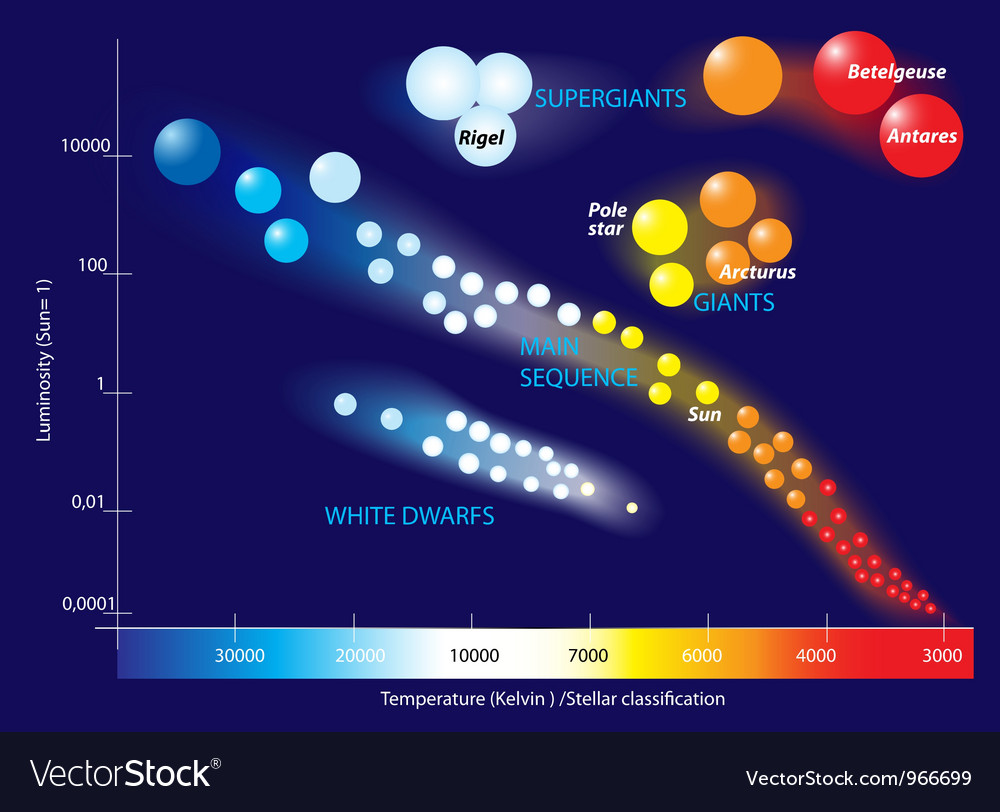
A chart of the various sizes and ranges in which stars are found (such as the Hertzsprung-Russell chart) illustrates the limits in both size and luminosity of every star we've observed (notice how our sun is near the center of the chart). 

Related image

A metaphor used to describe cosmic fine-tuning is lifted from the nursery rhyme “Goldilocks and the Three Bears”. 

Image result for goldilocks and the three bears
I recall years ago reading of how our planet functions in its own “goldilocks zone” or “habitable zone” from the sun. If we were but 10-15% closer or further away, we’d either roast like Venus or freeze like Mars. 

Image result for habitable zone planets
Such examples are a small portion of hundreds of other cases that give evidence for the fine-tuning of the universe. 

What accounts as the best explanation for cosmic fine-tuning?

In crafting a teleological argument based on fine-tuning, one version goes as follows:

Premise #1 The fine-tuning of the universe is due to chance, necessity    
or design

Premise #2 The fine-tuning of the universe is not due to chance or 
necessity

Therefore: The fine-tuning of the universe is due to design

The above argument states the optional explanations for fine-tuning in the scientific literature as that of chance, necessity or design. As the first premise states: 

Premise #1 The fine-tuning of the universe is due to chance, necessity or design

So, is fine-tuning due to “chance”? Roger Penrose, a physicist at Oxford University, has calculated the chances of the solar system resulting from a random collision of particles is 1 x 10, raised to the power of 10, to the power of 60 (1 followed by 10, to the power of 10, to the power of 60 zeros, which could not be written out even if the whole universe were a sheet of paper)! So, what about the chances of our universe's fine-tuning arising by chance? Penrose notes that this probability makes the number about the solar system forming from chance look like "utter chicken feed" - namely 1 x 10, to the power of 10, to the power of 123! 

So, perhaps the universe’s fine-tuning is due to necessity, that is, it had to be this way, otherwise, we wouldn’t be here! Necessity advocates fail to realize that the constants in our universe (such as gravity, the speed of light) function independently of the laws of nature, meaning that nature’s laws could had been configured in a vast number of ways. Nature’s laws don’t “prescribe” the universe’s behavior, but only “describe” how it behaves under various conditions. 

Some have attempted to avoid the fine-tuning problem altogether by proposing the so-called “multi-verse” hypothesis. This idea proposes that our universe could be one of a possible 1x10 to the 500 power universes, with enough combinations to produce a universe that would necessarily be just-right for life. The problem with this proposal is that the alleged mechanism for the multi-verse itself would need even more exquisite fine-tuning. 

So, by ruling out “chance” and “necessity” as explanations for the fine-tuning of the universe, we confirm the second premise of our argument:

Premise #2 The fine-tuning of the universe is not due to chance or 
necessity

With the argument having valid premises that are sound in terms of their correspondence to known facts, we’re left with the third option which necessarily follows: 

Therefore: The fine-tuning of the universe is due to design

If space permitted, I could bring in other sorts of arguments that consider how this designer would be an immaterial, all-powerful, all-knowing, everywhere present, necessarily existing, un-embodied mind – otherwise known as: “God”. Therefore, God is the best explanation for the fine-tuning of the universe.

Conclusions:

My hope is that these last few posts have both informed and equipped readers with the understanding that the evidence for God's existence is abundant. Might these posts contribute, in a small way, toward advancing the cause for Jesus in our 21st century world.   

Monday, March 25, 2019

Surveying design arguments for God's existence

Related image
Romans 1:20 For since the creation of the world His invisible attributes, His eternal power and divine nature, have been clearly seen, being understood through what has been made, so that they are without excuse. 

Introduction:

In our last post, here: ( http://www.growingchristianresources.com/2019/03/introducing-natural-theology-and.html ), we began looking at a particular type of argument for God's existence called "the teleological argument". A teleological argument uses perceived patterns and purposes of creation to draw together particular conclusions about the intelligent creator of the universe. Such an argument looks for certain marks of design in nature as tell-tale signs of a designer. Modern examples of such teleological arguments include those of the the intelligent design movement. Molecular biologist Michael Behe and Mathematician William Dembski have spoken of such traits as "specified complexity" (i.e. a system that has a low probability of having a developed by chance, such as a watch) and "irreducible complexity" (i.e. a system that required a minimum amount of already functioning parts in operation from its beginning, such as a mouse trap).   

Another modern example of a teleological argument (which will be the focus of the next post) is the so-called "fine-tuning of the universe" for intelligent design. A rather significant portion of astronomers today have discovered that our universe seems to be "just-right" for life. In the last 50 years, astronomers have been stunned by the way nature's constants and quantities are balanced on a razor's edge to permit the existence of intelligent life as ourselves. The explanation for this alleged fine-tuning ranges from chance, to that of necessity (the constants are just what they are) to that of design. 

In the first century world of Paul's day, teleological arguments were in use. The above opening passage in Romans 1:20 illustrates how Paul used this sort of argument to lead the way to what would be his exposition of the Gospel. In today's post, we want to trace how various versions of the teleological argument for God's existence have lent their support to the overall case for God in the face of persistent criticism.

How teleological arguments for God's existence have persisted despite prevailing skepticism

Various other thinkers have crafted their own versions of the so-called "teleological argument" for God's existence. The most notable thinker from the 13th century, St. Thomas Aquinas, offers five arguments for God's existence near the beginning of his massive 3,500 page volume: "Summa Theologica, Section 1, Question 2, Article 3." In the fifth argument of the series, Aquinas gives a simple illustration of an arrow shot by an archer to summarize his version of the teleological argument:

"Now whatever lacks intelligence cannot move towards an end, unless it be directed by some being endowed with knowledge and intelligence, as the arrow is shot to its mark by the archer. Therefore some intelligent being exists by whom all natural things are directed to their end; and this being we call God". 

Aquinas roots his argument (as with the other four arguments) in the causative power of God. Some thinkers believe that teleological arguments as a whole were dealt a death-blow by the 18th century philosophers Immanuel Kant and David Hume. Immanuel Kant expressed his doubt in finding evidence for God from consideration of the natural order, since the supernatural realm and natural realms, in his system, were totally separated from one another. David Hume asserted in his philosophical writings the inability to definitively prove, in principle, any relationship between a cause and a given effect.  

For some thinkers in the eighteenth and nineteenth centuries, it seemed that the teleological argument was defeated. The project of natural theology, like any study of theology in general, is ever at work explaining the Christian faith to new generations and developing responses to Christianity's critics. Certain Christian thinkers have developed more sophisticated versions of the teleological argument in the last two-hundred years - demonstrating that God's testimony in creation cannot be muted. 

18th century Christian thinker, William Paley, presented his version of the teleological argument by giving the illustration of finding a watch on a beach in the opening of his volume: "Natural Theology". Rather than focusing exclusively on the cause of the watch in his illustration, Paley attempts to demonstrate that certain features of the watch point to an intelligent agent, rather than a non-intelligent mechanical force. Near the end of his eight-point argument, Paley writes:

"A law presupposes an agent; for
it is only the mode, according to which an agent proceeds: it implies a power; for it is the order, according to which that power acts. Without this agent, without this power, which are both different from itself, the law does
nothing; is nothing."


Paley's argument appeared to counter-act the objections raised earlier by Kant and Hume (see above). Some thinkers today (such as the late Christopher Hitchens and the still-living Richard Dawkins) have suggested that the advent of Darwin's theory of evolution in the 1850's dealt a deathblow to any ability to demonstrate design in nature. 

Despite the battles between the evolutionary hypothesis and design-based explanations of the origins of biological complexity in the biological sciences, the realm of 20th century and 21st century astronomy has witnessed the emergence of a growing field of study that explores the question of why our universe allows for the existence of intelligent life such as ourselves - namely the fine-tuning of the universe for intelligent life. This idea of "cosmic-fine-tuning" and whatever relevance it may have in crafting an argument for God's existence will be the focus of our next post. 

Wednesday, March 20, 2019

Introducing natural theology and teleological arguments for God's existence

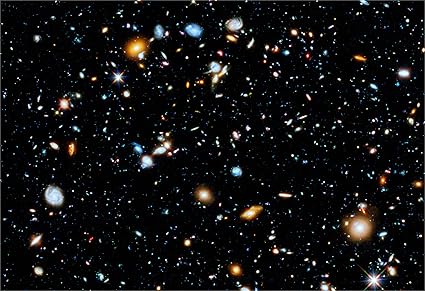
Image result for hubble ultra deep field image
Psalm 8:3-4 "When I consider Your heavens, the work of Your fingers, the moon and the stars, which You have ordained; 4 What is man that You take thought of him, and the son of man that You care for him?"
Introduction: We live in a huge universe

The universe is defined as all physically connected, space-time reality. Current estimates give the size of the visible universe to be 92 billion light years in diameter. When I speak of the "visible" universe, I refer to the farthest point we can see in comparison to the region of space lying beyond such points that are expanding faster than the speed of light. Since nothing travels faster the the speed of light in space (670 million m.p.h or 186,000 miles per second), observations since 1998 confirm that the expansion of the universe is accelerating relative to our position. If one can picture a circle as representing our visual horizon of what we can see as "the visible universe", then to capture the whole universe, one only needs to draw a much larger circle around the first circle to get the idea of what were talking about. 

Image result for circle within a circle

In 2016, astronomers published a new estimate of the number of galaxies to be roughly 2 trillion, with each containing an average of 100 billion stars (giving us a rough number of stars as 2 followed by 23 zeros ). As we mentioned earlier, our universe is expanding at an ever faster rate. Astronomers from Cornell University calculate that the rate at which the universe is expanding, given its age, coupled with the maximum distance we can see (a 46 billion light-year radius in all directions, with one-light year equaling nearly six-trillion miles), yields a universe that is in upwards of 250 times larger than what we can view (see link here: https://arxiv.org/abs/1101.5476)! In other words, what astronomers are able to observe through even the most powerful telescopes represents a potential of less than .5% of the whole universe! 

What David was reflecting upon in Psalm 8 introduces us to what is called the "teleological argument" for God's existence

Whenever David was reflecting on his view of the heavens in Psalm 8, how many stars would he had observed? According to the July 2015 issue of "Sky & Telescope", we get the following answer:

"If you tabulate all stars visible down to magnitude 6.5, thought to be the faintest stars still visible to the unaided eye, the entire sky contains some 9,000 stars. Since you can only see half the sky at any time, that means there are as many as 4,500 stars visible in your sky tonight."

Image result for night sky

As David scanned the skies, he began to write under the inspiration of the Holy Spirit the unparalleled words of Psalm 8. David inferred a certain order and purpose to all that was above him and around him. In another Psalm, Psalm 139, David utilizes a similar tactic by reflecting on the design and purpose he saw within himself. David is an early example of demonstrating the reality of God's creative power from observations in creation. 

Such an argument that attempts to infer God's existence from the apparent design and order of nature is what is called a "teleological" argument (from two words, "telos" meaning "order" and "ology" meaning "study of"). 

The Biblical precedent for natural theology and teleological arguments for God's existence

Whenever one infers anything about God's existence from nature or human nature independent of appeals to Divine written revelation, such an exercise is called "natural theology". Such arguments for God's existence, also termed "theistic arguments", attempt to demonstrate that, belief in God is not only a matter of faith, but also counts as grounds for rational thought. As already mentioned, one type of argument in natural theology looks at repeated patterns in nature and features pointing to design (such as specified complexity, or, a pattern that is unlikely to have been formed by chance). 

Such patterns and features are the stuff of teleological arguments for God's existence (again, so-called because the Greek word "telos" refers to "purpose"). The Old Testament prophet Isaiah records a Divine challenge by God to the idol-worshipers of his day by crafting a teleological method of detecting Divine activity in history and prophecy in Isaiah 41:21-23 - 


“Present your case,” the Lord says. Bring forward your strong arguments,” The King of Jacob says. 22 Let them bring forth and declare to us what is going to take place; as for the former events, declare what they were, that we may consider them and know their  outcome. Or announce to us what is coming; 23 Declare the things that are going to come afterward, that we may know that you are gods; Indeed, do good or evil, that we may anxiously look about us and fear together."


Isaiah's "test" shows how arguments rooted in pattern and purpose (i.e. teleological arguments) can provide discernment when testing truth claims from other religions and validating the claims of Biblical faith. 

The Apostle Paul indicates the plausibility of the project of natural theology by what he writes in Romans 1:18-20 


"For the wrath of God is revealed from heaven against all ungodliness and unrighteousness of men who suppress the truth in unrighteousness, 19 because that which is known about God is evident within them; for God made it evident to them. 20 For since the creation of the world His invisible attributes, His eternal power and divine nature, have been clearly seen, being understood through what has been made, so that they are without excuse."
The "orderliness" and "design" features of the universe supply the contents for a typical "teleological" argument for God's existence. The Apostle Paul articulated another version of this sort of argument to a group of Greek philosophers in Acts 17:26 - 

"and He made from one man every nation of mankind to live on all the face of the earth, having determined their appointed times and the boundaries of their habitation." 

Closing thoughts

The Biblical authors David, Isaiah and Paul give precedents for the appropriateness of using natural theology and teleological arguments in pointing the way to the God of the Bible. Authors outside the Bible confirm this notion of God's general revelation, and humanity's ability to know about His existence, by how various pagan authors worked out their own versions of the teleological argument (such as the Greek philosopher Plato in his work called "Laws"). The teleological argument has had a rich and, at times, contentious history with those who opposed it. In the next post, we will explore some of the history of this very important argument for God's existence.

Wednesday, March 13, 2019

Reflecting on Divine omniscience and prayer from Psalm 139

Image result for God of the Bible
Psalm 139:1-6 "O Lord, You have searched me and known me. 2 You know when I sit down and when I rise up; You understand my thought from afar. 3 You scrutinize my path and my lying down, And are intimately acquainted with all my ways. 4 Even before there is a word on my tongue,
Behold, O Lord, You know it all. 5 You have enclosed me behind and before,
And laid Your hand upon me. 6 Such knowledge is too wonderful for me;
It is too high, I cannot attain to it."

Introduction:

Today's post wants to explore the life-applicable realities of a precious attribute of God revealed in the Bible - Divine omniscience. What is entailed in the Biblical concept of God's knowledge? In Psalm 139, David introduces us to God by first noting this particular property of God's essence. God's knowledge, as seen in these verses, covers at least four areas that we find mentioned in the Bible. The areas I'll mention below summarize the essentials of this vital truth about God. Along the course of today's post, I'll mention how the particulars of omniscience give confidence in prayer.

1. The first has to do with God's direct knowledge of all things. 

For God, there is no such thing as "knowledge by comparison". God knows all things directly. David writes in Psalm 139:1 "O Lord, You have searched me and known me." We as human beings perceive things by way of our senses. Our minds take in the information of our senses and translates them into sounds, pictures and memories. Psalm 147:4 says for instance of God's knowledge of the stars: "He counts the number of the stars; He gives names to all of them." Astronomers estimate that there are roughly 2 trillion galaxies in our observable universe. Each galaxy, in turn, contains an average of 100 billion stars. God knows the location, chemical composition and destination of each star in one thought. 

Undoubtedly, God possess direct knowledge of Himself. James Pettigrew Boice writes in his Abstract of Systematic Theology: 

"The knowledge of God, therefore, not being acquired, cannot be increased. Time does not add to it. Succession of events does not bring it before God. All the objects of his knowledge are to him eternally present and known."

On a most practical level, God's omniscience includes the prayers of His people. God doesn't need prayer to achieve His purposes. Instead, God has designed His purposes to include prayer. Prayer is often short-circuited by a limited view of God. We often times think God has very limited knowledge or no knowledge at all. If only we would consider that God has already known, how greatly our prayer-lives could soar above those troubles of life.

2. Secondly, God not only knows all things directly, God also possesses knowledge of all things with respect to their location in time. 

The Baptist Faith and Message 2000 notes: 

"God is all powerful and all knowing; and His perfect knowledge extends to all things, past, present, and future, including the future decisions of His free creatures." 

God knew when the fall would occur, knew when Christ would be crucified and where everyone would be at that moment (Acts 2:23-24). God's relationship to time is as a Being that perceives every point of space along the line of time - from beginning to end. To illustrate, whenever we watch a parade, our perspective of the parade on the ground-level is limited. However,  people watching the parade in the upper-stories of a building can see the parade from beginning to end. Two vantage points of the parade are valid, however, the ground-level view of the parade is contained within the upper-level view. Such an analogy may help grasp what we've said and will say regarding God's omniscience and humanity's ability to choose.

Biblical terms such as "foreordination", "predestination", "election" and "decree" are all used in scripture to describe God's omniscience at work with respect to time (Job 42:2; Ecclesiastes 3:14; Daniel 4:35; Romans 8:29; Ephesians 1:11). Such Biblical teachings ought not to scare us into thinking that God operates our world by fatalism or that we're all a bunch of puppets operated by invisible strings. 

Divine omniscience, in ways we cannot comprehend, makes possible the ability people have to make genuine decisions. God knows what decisions I would make tomorrow without my natural ability to choose being violated. The Psalmist speaks of God knowing when he rises and sits, as well as God knowing what would arise on his tongue before He spoke it. Bible prophecy proceeds on this notion of God's omniscience. 

Amazingly, God's omniscience does not violate human decisions. No person can explain "how" divine omniscience and human responsibility co-exist. Instead, scripture only reveals "that" God's all-knowing governance (omniscience) and daily decisions function together with no contradiction. 

Think of the Lord Jesus Christ in how He possesses, without contradiction, both a truly Divine will and truly human will. The Biblical teaching describes God's relationship to time as His ultimate will and the human will operating without conflict (see Acts 2:23-24; Acts 4:27-28). Prayer is an island of the believer's dependence on God surrounded by the ocean of His omniscient ability to know and answer such prayers.  

3. In addition to God knowing all things directly and all points in past, present and future, God thirdly knows the essence of all things. 

To illustrate what we've said thus far, God knows, say, an object like a baseball. God knows the trajectory that baseball will take once it is hit. In this third point, God also knows the behaviors of every atom making up the baseball. God also knows what direction the baseball would take if placed in different circumstances (called middle-knowledge). God knows the essence of what makes up all things. Boice again notes on this point: 

"His knowledge is not limited to the manifestations and operations of spiritual beings, but extends to their essences, and includes not only what they are, but also those tendencies which indicate what they may be." 

Charles Hodge in his Systematic Theology echoes this idea of God knowing the essence of all things by including scriptural citations: 

"God, therefore, does and can know in the ordinary and proper sense of that word. He is an ever present eye, to which all things are perfectly revealed. “All things,” says the Apostle, “are naked and opened unto the eyes of Him with whom we have to do.” (Heb. 4:13.) “The darkness and the light are both alike” to Him. (Ps. 139:12.) “He that planted the ear, shall he not hear? He that formed the eye, shall he not see?” (Ps. 94:9.)"

To once more apply these ideas to prayer, when Christians pray, they're asking for God to affect circumstances that are not yet a reality or bring about situations that are different than those of the current moment. The essence of circumstances and the people praying to Him about those situations are known clearly and comprehensively by God.

4. God knows the best means to accomplish His best ends. 

So we see that God's omniscience includes the fact He has direct knowledge of all things in space, second, He possess knowledge of all things in all times and then thirdly, God possesses knowledge of the essence of all things. Now lets consider a fourth area in our reflection on God's omniscience from Psalm 139:1-6, namely: that God knows the best means to which to accomplish His greatest ends (i.e wisdom). In Psalm 139:5, David indicates God has enclosed him in from behind and that His hand is upon Him. 

The preservation of the saint of God in their salvation is a feature of that aspect of God's omniscience we call His "wisdom". God knows how to preserve His people, and has promised as much (John 10:27-28; 1 Peter 1:3-5). The eternal columns of Christian salvation, sunk deep into the cross and God's omniscience, is a marvel to say the least. These features of God's knowledge cause the Psalmist to exclaim in Psalm 139:6  "Such knowledge is too wonderful for me;It is too high, I cannot attain to it."

Closing thoughts

May we praise God for these wonderful aspects of His omniscience. In today's post we noted four qualities of God's ability to know all things. We also looked at how Divine omniscience can grant greater confidence in prayer. 

1. God possesses direct knowledge of all things. 

2. God possesses knowledge of all things with respect to their location in time. 

3. God knows the essence of all things. 

4. God knows the best means to accomplish His best ends. 


Monday, March 11, 2019

How Christians understand the Divine being of God

Image result for trinity
Acts 17:24-26 "The God who made the world and all things in it, since He is Lord of heaven and earth, does not dwell in temples made with hands; 25 nor is He served by human hands, as though He needed anything, since He Himself gives to all people life and breath and all things; 26 and He made from one man every nation of mankind to live on all the face of the earth, having determined their appointed times and the boundaries of their habitation."

Introduction:

Today's post will expound a Christian understanding of God's Divine essence or being. The thoughts below represent a portion of a talk I'll be presenting at a local community college that features a panel composed of other participants from other religions. Although the talk is far from comprehensive, it is hoped that what is described below brings glory to God and expounds clearly what Biblical Christianity has to say about God. As a final note: in the course of the post, I'll mention areas of difference that Christianity's concept of God has with other major religions (i.e. Judaism, Islam and Hinduism).

How do Christians understand the Divine being of God? He is P.U.R.E

God is the focus of the 66 books of the Bible (which contains 39 Old Testament books and 27 New Testament books). A person can know God but never hope to comprehend Him. As a Christian, I am committed to the view of God called "Christian theism", which contends that God is the greatest conceivable being, of which no greater can be conceived, and that this God is decisively revealed by Jesus. 

I'll explain the Christian understanding of God's divine being with the acrostic P.U.R.E. to aid in clarity on this subject. 

1. First, God is Personal. 

When I talk about God's divine being, the letter "p" designates that God is personal. The most frequently mentioned title or name of God in the Old Testament (5766 times) is that of Jehovah (also pronounced "Yahweh"), which translated means: "I am Who I am". A name tells us about the character of the one who bears it. God's most intimate name, "Jehovah", was revealed to people (like Moses) to express how the Biblical God is non-dependent on anything for His existence and personally invested in the affairs of His people who trust in Him by faith. 

The Hebrew Old Testament also used another designation to clue us in on God as personal, namely "Father", found nearly ten times with reference to His covenant with the Jewish nation. 
When we come to the New Testament, the Old Testament designation "Father" is shown personal by Jesus and His followers over 100 times. 

The New Testament clues us in on further revelation of God as Personal by telling us something about Jesus Himself. The Old Testament hints at God having some-sort of plurality of personhood expressing His being (Psalm 2:7; Proverbs 30:4). Jesus, as a true man, was not just a man. The writers of the New Testament used the phrase: "Jesus is LORD". The implicit plurality of personhood as expressing Divine being in the Old Testament is made explicit by Jesus' life, death and resurrection. This second Person, the Son, came to reveal who God is to us by also becoming man for us. The Apostle Paul writes in 1 Corinthians 8:6

"yet for us there is but one God, the Father, from whom are all things and we exist for Him; and one Lord, Jesus Christ, by whom are all things, and we exist through Him."

As we study further how personal God is, we discover in the second verse of the Bible, Genesis 1:2, that God is also identified as yet another Divine Person, the Holy Spirit. Jesus spoke of the Holy Spirit in John 14:17

"I will send you another comforter and he shall not only abide with you but be in you." 

The biblical revelation of Deity as One "what" (God), that is three "Whos" (Father, Son and Holy Spirit), is what Christians call "The Trinity". The revelation of God as "Trinity" is unique to Christianity, and thus denied by religions such as Judaism, Islam and Hinduism. 

2. Unity. 

So we have seen already that God is personal. Now let's note secondly that God is a unity. Christians confess that God is one in being (i.e. "monotheism"). For example, we confess together with Judaism its central text, the Great Shema, as found in Deuteronomy 6:4-5

“Hear, O Israel! The Lord is our God, the Lord is one! 5 You shall love the Lord your God with all your heart and with all your soul and with all your might." 

Jesus identified this text in answer to a question about what constitutes the greatest command in Matthew 22:37. 

When Christians talk about Divine monotheism, they affirm oneness of being that is expressed in a three-fold personhood. Some may think that this is a contradictory idea.  However, for something to be a logical contradiction, we have to have two completely different ideas coexisting in the same relationship and in the same way (such as a "married bachelor" or "square circle"). We don't see that with the Christian understanding of God. God is one "what" (i.e. God) and three "whos" (Father, Son and Spirit). Thus, the Trinity escapes from the charge of being a logical contradiction. 

3. Redeemer. 

As we continue in the Christian explanation of God's being, we have considered how God is personal as Father, Son and Spirit and unified in being. We now turn to the letter "r" of our acrostic in identifying God as "Redeemer". The idea of redemption, when applied to God, speaks of how He went to great lengths to purchase salvation and have it applied to anyone who will respond to Him in faith. Isaiah 43:11 states: “I, even I, am the Lord, and there is no savior besides Me." The New Testament states in John 3:16 - "For God so loved the world that he gave his one and only Son, that whoever believes on him will not perish but have everlasting life". Islam and Hinduism may contain rituals and moral imperatives, however, with respect to their concepts of deity, there is no developed idea of deity being a redeemer. 

4. Eternity. 

We have so far considered that God is personal, unified in being, and the Redeemer. Our final letter "e" represents God as eternal. When we say that God is eternal, we are talking about how He is timeless with respect to the world and unlimited in His life and attributes. There was a point in which the world did not exist. In contrast, God has always existed without beginning. Some of the qualities or attributes that Christians employ in describing God's eternity are He being all-knowing, or omniscient; all-powerful or omnipotent; everywhere present or omnipresent and all-good or omni-benevolent. There are many other such traits that Christians use to highlight the Biblical teaching of God's eternity. 

Christians assert the need for God's eternity by seeing all of life and its responsibilities and relationships in light of Him. I echo the words of C.S. Lewis - "I believe in Christianity as I believe that the sun has risen: not only because I see it, but because by it I see everything else." 

Closing thoughts

In today's post we briefly considered how Christians understand the Divine being of God. God is p.u.r.e, that is:

1. Personal
2. Unity
3. Redeemer
4. Eternal

The above four points rely upon the Biblical revelation of God as a Trinity of Persons sharing in the same, undivided, Divine essence (i.e. deity). The doctrine of the Trinity leads us to the profound personal expression of God by way of the Father, Son and Holy Spirit. The Christian asserts that God is one God - hence the second point of God being unified with respect to His deity. The third point of redeemer captures God's chief role in how He relates to His creation. As redeemer, the Second Person of the Trinity came into history as God with us (i.e. "Immanuel", see Matthew 1:23) to experience and partake in true humanity as man for us (i.e. what is called "incarnation", 1 Timothy 2:5). The incarnation of the Redeemer meant the Son could live, die rise and ascend has the historical Jesus who also is the Christ of Christian faith. All true Christians look forward to Jesus' second coming, at which He will resolve history's evils and usher in His Kingdom. Lastly, we spoke of God as "eternal", referencing those attributes which are proper to deity: omniscience, omnipotence, omnipresence and so forth. Divine eternity speaks of that quality of life unique to God which is independent of creation and which makes Him worthy of worship. 

Wednesday, February 27, 2019

Life applications from Revelation's teaching on the future tribulation period

Image result for book of revelation
Revelation 6:1 "Then I saw when the Lamb broke one of the seven seals, and I heard one of the four living creatures saying as with a voice of thunder, “Come.”
Introduction:

The Apocalypse of John (also known as "the Book of Revelation"), details the Person and work of the Lord Jesus Christ with respect to present realities and future events. We explored in the last post what we can expect to take place as we move forward in history. We noted in particular an event called "the rapture of the church" and distinguished it from its closely related larger event: "the second coming of Jesus". Readers may click on the following link to review the last post here:

http://www.growingchristianresources.com/2019/02/grasping-future-events-of-rapture-and.html 

In that last post, mention was made of another future time period that, per this author's understanding of eschatology or "doctrine of last things", occurs in between "the rapture of the church" and "the second coming of Jesus", namely, "the tribulation period". One could define the tribulation period as follows:

"The tribulation describes a time, yet future, in which God will pour out wrath to judge the nations, defeat Satan's kingdom and prepare Israel for the arrival the Lord Jesus Christ."

In past posts on this site, I have written more detailed posts on the subject of the tribulation period, which the reader can click on here:


also, readers may click on another post-link concerning Jesus and Paul's teaching on the tribulation here:


How can a Christian find any encouragement for godly living or any relevance from the doctrine of the tribulation period. As noted in the last post, those believers who hold to a "pre-tribulation" view of the relationship of the rapture to the tribulation, assert the church's absence during that future cataclysmic event. Revelation 6-19 contains the most detailed description of this future seven-year period, expressed in a series of cyclical descriptions that retell the sequence of predicted events. How can Christians apply such texts to their lives to bring about godliness and encouragement today? Below are some thoughts on how one may apply the teaching of the tribulation period as it is expressed in the Book of Revelation.

Drawing applications from Revelation's teaching on the Tribulation

1. God's plan for dealing with the problem of evil. 

Revelation 6-19 is undoubtedly the fullest treatment we know of regarding the Tribulation period. The whole period is future, representing God's prophetic clock for executing final judgment on this world and, as seen in Paul's writings, the destruction of evil forces as personified by Anti-Christ. Revelation 6-19 unfolds a repetition of this time period in four prophetic visions that function as transparency slides on top of one another to complete a very detailed picture of the tribulation period. With respect to how God will deal with the problem of evil, we can note the first three of these visionary sequences....

a. Vision #1 - Revelation 6-11. 

The tribulation will be Jesus Christ's theater through which He will conquer the evils of the world. This particular depiction of the tribulation period is important because God, in His Ultimate Will, has ordained that time to deal with the world in justice. Acts 17:30-31 states:

Therefore having overlooked the times of ignorance, God is now declaring to men that all people everywhere should repent, 31 because He has fixed a day in which He will judge the world in righteousness through a Man whom He has appointed, having furnished proof to all men by raising Him from the dead.”

b. Visionary sequence #2 - Revelation 12-14

Revelation 12 is the introduction to John's next revelatory sequence of the events of the tribulation. The tribulation will be Christ's way of preparing Israel to meet Him. In Revelation 12-14, Satan and his man, Anti-Christ, will conspire against Israel by leading a rebellion of unbelieving nations during the tribulation period. Like a set of transparency slides, Revelation 12-14 fits on top of the same time frame portrayed in Revelation 6-11.

c. Visionary sequence #3 - Revelation 15-19  

The tribulation (especially the final 3 1/2 years or Great Tribulation) will be the time in which Jesus brings an end to Anti-Christ and the system of evil which will had gripped the future world.  This fully functioning future world system, described in Revelation as: "Babylon the Great", will function in the tribulation as the religious, economic and political web spun out by Satan, the Anti-Christ and the False Prophet of Revelation 12-14. After the half-way point of the tribulation period, the world system will begin to grow hostile toward the Anti-Christ and his regime. A final war, (known as "Armegeddon"), will feature all the forces of evil arrayed against Jesus during His second coming at the end of that period. Like a transparency slide once again, Revelation 15-19:10 fits over the previous visions of Revelation 6-11 & 12-14, completing for us the most detailed treatment of the tribulation period in the Bible.

2. God's promises are true

We have observed how God will deal resolutely with the problem of evil and suffering which plagues the greatest minds and hearts in this current age. So what guarantee do Christians have in the "nasty-now-and-now" that God will keep His promises? One only has to look at how He will bring to pass His promises to Israel. 

In an Old Testament prophecy about the tribulation period, Ezekiel 20:38, we find the following promise:

"and I will purge from you the rebels and those who transgress against Me; I will bring them out of the land where they sojourn, but they will not enter the land of Israel. Thus you will know that I am the Lord." 

During the tribulation period, judgment of the earth will occur while God prepares and purifies Israel to anticipate her Messiah - Jesus Christ - right before the end of the tribulation. The Apostle Paul in the New Testament affirms this promise of Israel's restoration as a proof for the assurance of God's promises to Christians in Romans 11:25-26 - 

"For I do not want you, brethren, to be uninformed of this mystery—so that you will not be wise in your own estimation—that a partial hardening has happened to Israel until the fullness of the Gentiles has come in; 26 and so all Israel will be saved; just as it is written,
“The Deliverer will come from Zion,
He will remove ungodliness from Jacob.”
 
The Great Tribulation will be a time in which the evils of man and the Anti-Christ's regime is brought to a close, with Christ's return marking the end of the tribulation -i.e "the day of the Lord". The church will be with Jesus in the marriage supper of the Lamb, protected from wrath and return with her Lord who Himself will fight and defeat the armies of the world in the battle of Armegeddon. We can therefore trust God's plans and promises. Now let's consider one final application for understanding the doctrine of the tribulation as found in Revelation 6-19....

3. God's powerful motivation to do missions

Revelation chapters 7 and 14 feature a group of Jewish evangelists called "144,000" who will share the Gospel with all the nations. In Revelation 7, we find multitudes of people getting converted during the tribulation. The consequence of converting to Christ will lead to their deaths for Jesus. Both chapters have statements that tie present motivation for sharing the Gospel to what will be that innumerable throng of people getting converted out of the nations. Revelation 7:10b records: "Salvation to our God who sits on the throne, and to the Lamb". Revelation 14:13 records an even more remarkable statement that has clear application to the church now and to the future tribulation martyrs: 

"And I heard a voice from heaven, saying, “Write, ‘Blessed are the dead who die in the Lord from now on!’” “Yes,” says the Spirit, “so that they may rest from their labors, for their deeds follow with them.”  

For those who evidence no concern about the pending tribulation period or spiritual matters in general, this truth can expose their false profession. The motivation to carry the Gospel to as many people as possible is reinforced by what the world can expect when it comes to the final moments of world history. We may wonder why God delays such events as He urges us to have an awareness about them. We know that God delays the return of Jesus to grant people everywhere the time and space to repent and turn to Him in faith (2 Peter 3:9). We also are told by Jesus Himself that the course of history is regulated by the amount of people that get to hear the Gospel in every nation (see Matthew 24:14).  

Closing thoughts

Today's post aimed to provide life-application of the Biblical doctrine of the tribulation period to current Christian living. We focused in particular on Revelation 6-19, since the Apostle John provides for us the most detailed treatment of the subject. We reached the following three applications:

1. The tribulation period reminds us that God has a plan for defeating evil and suffering.

2. The tribulation period reminds us that God's promises are true.

3. The tribulation period reminds us that God has provided a powerful motivator for sharing the Gospel.