Translate

Wednesday, September 6, 2017

God's Grace Shining Through The Darkness - Romans 11:1-6

Image result for halogen headlights

Romans 11:1-6 "I say then, God has not rejected His people, has He? May it never be! For I too am an Israelite, a descendant of Abraham, of the tribe of Benjamin. 2 God has not rejected His people whom He foreknew. Or do you not know what the Scripture says in the passage about Elijah, how he pleads with God against Israel? 3 “Lord, they have killed Your prophets, they have torn down Your altars, and I alone am left, and they are seeking my life.” 4 But what is the divine response to him? “I have kept for Myself seven thousand men who have not bowed the knee to Baal.” 5 In the same way then, there has also come to be at the present time a remnant according to God’s gracious choice. 6 But if it is by grace, it is no longer on the basis of works, otherwise grace is no longer grace."

Introduction:

I'll never forget the first time I saw a car with the new sort of halogen headlights that are common place today. The light was blinding, and targeted. The particular night in which I was driving was dark, rainy and foggy. Despite the darkness, those halogen headlights cut through the darkness, the rain and the fog. 

The Gospel of Jesus Christ is often likened unto light shining in the darkness (see 2 Corinthians 4:1-6). The Gospel's ability to cut through spiritual darkness and to reach the human heart is all do to its source in the Light of the World - The Lord Jesus Christ (John 1:9-13). As we read Paul's words about the nation of Israel and his burden for their salvation, he references an episode in their history involving the prophet Elijah. 

Elijah's ministry is recorded in 1 Kings 17-2 Kings 2. Elijah ministered in a time in Israel's history where spiritual darkness abounded in the court, the temple and the home lives of the people. In perhaps the greatest mountain top experience of Elijah's ministry - his defeat of the prophets of Baal atop Mount Carmel in 1 Kings 18:20-46) - we see Elijah's moments of despair as a flees in the aftermath of that public confrontation. Fleeing for his life from the threats of Queen Jezebel, 1 Kings 19 portrays Elijah fleeing some 100 miles to Mount Horeb. 

Elijah had lost all hope. The darkness he fought for so long had pressed into his soul - threatening to capsize his faith. He requested of God to take his life in 1 Kings 19:4, only to have an angel minister to him with food (19:5). Once more the angel would come in 1 Kings 19:6-8, urging Elijah to eat - since the journey was too great for him. 

Elijah arrives at Mount Horeb. As a prophet, Elijah was called to speak for God. In desperation, Elijah needed to hear from God - and He did. Elijah's complaint in 1 Kings 19:14 concerned his alleged isolation: 

"Then he said, “I have been very zealous for the Lord, the God of hosts; for the sons of Israel have forsaken Your covenant, torn down Your altars and killed Your prophets with the sword. And I alone am left; and they seek my life, to take it away.”

God then responds in 1 Kings 19:15-18 with a new assignment for Elijah and the words we find quoted by the Apostle Paul:

"The Lord said to him, “Go, return on your way to the wilderness of Damascus, and when you have arrived, you shall anoint Hazael king over Aram; 16 and Jehu the son of Nimshi you shall anoint king over Israel; and Elisha the son of Shaphat of Abel-meholah you shall anoint as prophet in your place. 17 It shall come about, the one who escapes from the sword of Hazael, Jehu shall put to death, and the one who escapes from the sword of Jehu, Elisha shall put to death. 18 Yet I will leave 7,000 in Israel, all the knees that have not bowed to Baal and every mouth that has not kissed him.”

Notice how God's grace cuts through the darkness in the verses above:

1. We see first and foremost the calling grace of God - summoning Elijah back to his senses, reminding him of who he is and Whose he is, in 1 Kings 19:16. God's grace never excludes the will of man. 

2. Next we find the grace of God's prophetic word in 19:17. Who would have the last word in Israel as to how things were going to go? Not Jezebel! Not those in power! Such people can only act to the degree God permits them to act. Furthermore, God even makes mention of what will be Elijah's successor. The prophetic power of God's Word will continue unabated. 

3. Then thirdly we see the grace of election in 1 Kings 19:18. God had set aside 7,000 - a remnant - or as Paul describes it in Romans 11:5-6 "In the same way then, there has also come to be at the present time a remnant according to God’s gracious choice. 6 But if it is by grace, it is no longer on the basis of works, otherwise grace is no longer grace." 

On this third point, the Baptist Faith & Message describes God's gracious choice as follows:

"Election is the gracious purpose of God, according to which He regenerates, justifies, sanctifies, and glorifies sinners. It is consistent with the free agency of man, and comprehends all the means in connection with the end. It is the glorious display of God's sovereign goodness, and is infinitely wise, holy, and unchangeable. It excludes boasting and promotes humility."

So we see then God's grace, in all its refracted colors, shining through the dreary days of Elijah and igniting hope in the Apostle Paul. The Gospel shines forth its light into every alley way - urging all men, without exception, to believe, repent and be saved. God's initiative and calling shines forth to draw sinners to a saving knowledge of the truth. God's graces of His calling, His Word and gracious choice are a three-braided rope of grace, never bypassing but beckoning the human will to respond to such amazing grace.

God is ever reaching out through the darkness to those who are spiritually blind, spiritually deaf and who are at odds with Him. God's work of salvation is His work and thankfully, no matter how dark it may get - the Gospel's candle dispels the darkness. As the Gospel shines through the darkness, to the heart open to truth - a free decision issues forth (John 3:11-12; Romans 10:8-10; Ephesians 2:8-9). Paul's point is that His hope for the salvation of His fellow Israelites rests with God (Jonah 2:9). He urges. He pleads for them to believe, repent and be saved. So it is with all that are brought into contact with the Gospel. Would it be that they respond to God's grace shining in the darkness.

Monday, September 4, 2017

Why It Is Important To Know That God Is Not Done With Israel

Image result for israel
Picture from operationworld.org
Romans 11:1a "I say then, God has not rejected His people, has He? May it never be!"

Introduction: Lumber Full Of Knots

My father had been a carpenter by trade all his life. When I was growing up, he had decided to put on a new roof for the house. He ordered a truckload of lumber from the local lumber yard. When the lumber had been dropped off and my dad signed the release papers, the load of lumber was his. Little did he know that many of the boards in that load were full of knots, twisted and warped. The lumber had sat out in the rain for many months at the lumber yard. What was my dad to do? The lumber was his - knots and all.

My dad had decided to got forward with the roof. He grabbed his circular saw, a new rip blade and his chalk-line. He then went to that big stack and picked out the boards he needed for the project. I remember my father taking his blue chalk line, with me holding the other end, and him taking it and "snapping it", resulting in a blue line marking out a straight mark on the board. My dad made all those boards straight. He cut through knots and all to make that load of lumber fit for his use. 

God's plan in bringing about His redemptive purposes through Israel

Do you realize when God chose to manifest His plan of salvation in history - the plan had been decided before time began (2 Timothy 1:9; Titus 1:2). The Father and the Son and decided upon the plan, with the Son making the effort to come into history by way of the virgin birth and incarnating Himself as the man Jesus of Nazareth. God had also decided that in the millennia leading up to His Son's arrival, He would hand select one man (Abraham) to be the patriarch of ultimately one nation (Israel). 

The nation of Israel was God's people redeemed and paid for for the sake of bringing about what would be a people of God and ultimately the humanity of His Son. The problem with Israel was she was full of knots and twists. As a smaller picture of the much larger portrait of all humanity - Israel stood no chance, on its own, of being used by God. All of us can be so described as full of knots, twists and warpings in and through out humanity. Apart of Jesus Christ and apart from the touch of the gracious hand of Almighty God - every human being on this planet is unfit to be in God's presence. God's object lesson of grace - Israel - really is a lesson to all who would be redeemed by grace through faith.

So, God made a covenant with Israel (Exodus 12-15). He revealed His law and tabernacle to her (Exodus 20-40); raised up prophets and kings like David to lead and guide her and pleaded with her to not forsake Him (see Hosea 2). Israel's bent to walk away from God led to two historic exiles in Assyria (Isaiah 39) and Babylon (see the Book of Daniel). 

Israel, particularly the Southern Kingdom called "Judah", was set apart by God to continue on His program with His people. Judah went into exile into Babylon for some 70 years. Upon her return back to the land, men like Ezra and Nehemiah and the latter prophets Haggai, Zechariah and Malachi all urged the people to stay faithful to God. Israel was cured of her idolatry. Four centuries would pass between the closing out of the Old Testament and the arrival of Jesus Christ in Matthew's Gospel.

When one follows the saga of Jesus' life, death and resurrection - the Jewish people were instrumental in the crucifixion of Jesus. Jesus presented Himself to the nation as her King, her Messiah. In passages like Matthew 23 we find Jesus weeping over Jerusalem. Alas she had missed her opportunity. The Kingdom and its King would had been within her grasp if only she had yielded allegiance to Him. Acts 2:22-24 summarizes what we have discussed up to this point:

“Men of Israel, listen to these words: Jesus the Nazarene, a man attested to you by God with miracles and wonders and signs which God performed through Him in your midst, just as you yourselves know— 23 this Man, delivered over by the predetermined plan and foreknowledge of God, you nailed to a cross by the hands of godless men and put Him to death. 24 But God raised Him up again, putting an end to the agony of death, since it was impossible for Him to be held in its power."

The Big Question Needing To Be Answered About Israel In The New Testament

So did Israel jeopardize her place and role in God's redemptive purposes? As more and more Gentiles were being brought into the fold, the question ever loomed on the horizon. As the early church changed from being predominately Jewish to more Gentile - the question came to be, as so represented by the Apostle Paul in Romans 11:1 - "I say then, God has not rejected His people, has He?" The late W.A Criswell, long-time pastor at First Baptist Dallas, notes on this verse:

"But the Jew has a question to ask.  In the Book of Romans, there are questions asked all through the book. The Jew has a question to ask.  The question the Jew asks is this: “If God deals with the Gentiles according to a covenant of grace, then what about us, the children of Abraham? [Romans 9:1-5].  What about the promises to the fathers, and what about the covenant that God made with Abraham, Isaac, and Jacob, and what about the covenant that God made with David? [Romans 9:4].  And what about the promises of the prophecies?  Has God cast away the Jewish people? [Romans 11:1].  Does He not deal with us anymore as a nation, as a race, and as a people? [Romans 11:1]  What about the promises to the nation?  And what about the covenants?” [Romans 9:4]. Has God cast away the Jewish nation? Does the Jewish nation and does the Jewish people have no longer any future?"

Criswell then continues on, bringing in the relevance of this question to the Christian...

"Because God is dealing with us in this dispensation, this age under grace, through the faith in Christ Jesus, is, therefore, He through with the Jew and with the Jewish nation? [Romans 11:1]. And that is the exact question that Paul raises as he begins the first verse of the eleventh chapter of Romans, “I say then, hath God cast away His people?” [Romans 11:1].  Is God done with the Jew?  Is God through with the children of Abraham?  Hath God cast away His people?"

God is not done with Israel, and this is why...

Paul's answer to his own question on whether God is done with Israel is in the short, terse, negative: "may it never be!" God's continuing program with Israel, and its relevance to the Great commission among the nations and the church is the purpose of Romans 11. God is not done with Israel. Below we close out today's post, discover why God is not done with Israel:

a. Israel is still God's chosen people, who have been temporarily set aside (Romans 10:18-11:10).

b. God has ordained unbelieving Israel's setting aside in order to save believing Gentiles and Jews. If God had abandoned Israel, then all other peoples in every tribe, nation and tongue would had remained outside the fold of God's redemptive purposes (Romans  11:11-24).

c. God has ordained that once the full number of Gentiles (and believing Jews) are gathered in this age (this age includes the church age, rapture of church age saints, tribulation and inclusion of tribulation martyrs at Christ's return at the end of the Tribulation), Israel will then be saved at Christ's return (Zech 12:10-11; Revelation 1:7; 7; 14; Romans 11:25-32). This point is so important, since the same God that keeps His promises to Israel is the same God that keeps His promises to those who have by grace trusted in Jesus.


d. In short then, once Christ returns with His raptured saints at the end of the tribulation, Israel will be given the grace to believe on Him, and thus she will shine forth the glory of her Messiah in His Kingdom, enjoying His glory with the glorified church who is seated with Him on thrones in the Millennial Kingdom (Revelation 20:1-6). God's promises are sure and steadfast! 


Friday, September 1, 2017

What is God Like?

Image result for the cross
Acts 17:24-27 "The God who made the world and all things in it, since He is Lord of heaven and earth, does not dwell in temples made with hands; 25 nor is He served by human hands, as though He needed anything, since He Himself gives to all people life and breath and all things; 26 and He made from one man every nation of mankind to live on all the face of the earth, having determined their appointed times and the boundaries of their habitation, 27 that they would seek God, if perhaps they might grope for Him and find Him, though He is not far from each one of us."

Introduction:

What is God like? Who is God? Why is God's nature and identity important to you? The first of these questions will be the focus of our post today. Such questions occupy an area of theological study we call "theology proper". Theology proper focuses particularly on the highest, the first and the greatest subject of theological inquiry - God Himself. Theology proper is the first main area of a larger discipline of theological study that is associated with God's special revelation of Himself in the Bible ("Systematic Theology"). 

One other type of theology, natural theology, is a human attempt to infer what God is like from observations of the natural world, the sciences and philosophical reflection. Oftentimes, whatever observations that are gleaned from either systematic theology or natural theology end up being factored into tracing out one's understanding of theology proper. 

The late author A.W. Tozer once noted that whatever a person thinks about God at a given moment uncovers what is most important thing about or to that person. A person's understanding about God will shape what they believe about the remainder of life and how they will live their lives. 

What is God like?

Dr. Norman Geisler has aided the Christian in many ways by his numerous theological and apologetical insights. Many other writers have benefited from Geisler's charting-out of seven major worldviews that are based upon seven different conceptions of God's nature or what God is like, as seen below:

 Image result for seven major worldviews

When we speak about what defines ultimate reality or where does the "buck-stop" when we arrive at the ultimate explanatory reference point for everything, this is where the question "what God is like?" becomes very important. 

Atheism will tell us there is no God, or that such a being as God is an irrational concept. Atheists such as the late Carl Sagan would quip that the universe is "all there is, all there was and all that ever will be". Thus, physical time and space is the ultimate reality - on the atheistic worldview. 

Image result for universe

Yet, both scientific inquiry and philosophical investigation confirm that the universe began to exist at a point in the finite past. Moreover, the above opening Biblical passage in Acts 17 clearly tells us "The God who made the world" is the Ultimate Cause of all things. The physical universe could not had caused itself, nor existed eternally, nor had been caused by a bigger material cause. Such notions result in the notion of something creating itself out of nothing or an infinite chain of causes and effects - both of which contradict reason, science and no doubt the Bible. The cause of the universe had to be immaterial, intelligent and eternally existing before the universe began to exist. Hence, atheism most certainly fails, since God is not even factored into its worldview.

So what about the second major worldview, polytheism, which asserts many gods, many deities, as defining God? Such representative religions as Hinduism and Mormonism subscribe to polytheism. Polytheism exists in one of two flavors: the finite variety and infinite variety. Finite varieties of polytheism express their various deities as being like mostly divine supermen and superwomen, sharing the power and carrying on their individual purposes upon the arena of human life. The other variety of polytheism has the various deities less well defined. 

The problem with polytheism is the conflict of wills and incoherence that plagues it. Again, when we consider the ultimate cause and origin of the universe, One Mind, One will and thus One God makes much more sense than a multitude of wills (compare 1 Corinthians 8:6). One only need to review the ancient forms of polytheistic thought from Greece, Rome, Babylonia, Assyria and Egypt. All those systems suffered from incoherence and ultimately collapsed in on themselves. 

So in having reviewed atheism and polytheism, we come to the next set of worldviews that limit the nature of God in one degree or another. Panentheism locates God within the world and identifies Him with it. Just as a human being is a soul with a physical body, the analogy carries forth in panentheism with God being the soul and the universe His body. The next worldview is what is termed "finite godism". Limits are placed upon God's knowledge of the future or His power. A modern example of "finite godism" is "open-theism", which suggests that God runs the world by taking risks, since He cannot know for certain what decisions we will make. 

Do the worldviews of "panentheism" or "finite-godism" square with the Bible, philosophical reflection or scientific inquiry? To answer this from strictly the Biblical evidence, we find again and again that God is omniscient (Psalm 139; Isaiah 41:21ff), omnipotent (Psalm 145; 1 Timothy 6:16), omnipresent (Psalm 139), eternal (Psalm 90), all-good (Psalm 136), immaterial (John 4:24), One in being (Deut 6:4-6). None of the above worldviews fit the mold traced out by the Bible. In short order, we've evaluated and found wanting atheism, polytheism, pantheism, panentheism and finite godism as properly answering the question: what is God like? So then, what can be said of the remaining worldviews?

Pantheism identifies God with the world, meaning that in every tree, rock, plant and us is God, and all of creation is God. The popular movie franchise "Star Wars" mimic pantheism by positing "the force". Deism portrays God as setting everything in motion and then letting creation to its own devices. The last worldview, "theism", states God is beyond the universe (transcendent) and interacts within it (immanent). So what can we note about these three remaining worldviews? 

Pantheism's weakness is that it tries to have an infinite Deity that is impersonal. The God of the Bible is unquestionable personal - possessing intellect, emotion and will. In the Bible, God is loving, merciful and concerned about the salvation of human beings (2 Peter 3:9) and in directing the affairs of governments, our world and all that is in it (Romans 11:33-36). 

When considering the observations we glean from philosophical reflection and observations of the natural world (i.e natural theology), in order for a finite effect like the universe to derive from an infinite, transcendent cause - that cause had to possess a mind and a will to execute His choice to bring the universe into being. Thus, panetheism most certainly cannot be the right answer to the question: "what is God like?" 

Deism gets somewhat closer to the truth. In Deism, one has an all-powerful, all-knowing Deity that is the cause of the universe and yet - this deity has taken His hands off to let the universe be governed by natural laws. Deism's deity is not the Savior of the scripture. Although we've not mentioned it in today's post, the Bible's central event: the incarnation of the Son of God as the man Jesus of Nazareth - who lived, died, raised from the dead and ascended - tells us that God Himself came into our world to do something about this mess we call sin. Deism's conception of deity allows no incarnation, no cross and no resurrection. Deism has by-and-large fallen into great disfavor due to the fact it is ineffective in dealing with other questions like the problem of evil and suffering, salvation and final judgment. Furthermore, the Bible does not conceive of God as not being involved with His creation.

So we then arrive at the seventh worldview - theism. Theism gives us One God, with all the eternal attributes, that is intelligent, transcendent or beyond the universe and also capable of directly impacting every point within time and space. The Baptist Faith and Message 2000 states:

"There is one and only one living and true God. He is an intelligent, spiritual, and personal Being, the Creator, Redeemer, Preserver, and Ruler of the universe. God is infinite in holiness and all other perfections. God is all powerful and all knowing; and His perfect knowledge extends to all things, past, present, and future, including the future decisions of His free creatures. To Him we owe the highest love, reverence, and obedience." 

Closing thoughts:

Today we explored the question: what God is like? We considered seven worldviews: atheism, polytheism, panentheism, pantheism, finite godism, deism and theism. We saw various weaknesses in the first six, concluding that only theism (and if we had more time, Christian theism) best answers the question. By chiefly considering what the Bible has to say about God, as well as considerations of natural theology, the conclusion was drawn that God is, His His nature and attributes, all knowing, all-powerful, everywhere present, all-good, immaterial, One in being, possessing all wisdom and deeply involved in the affairs of our world. 

Thursday, August 31, 2017

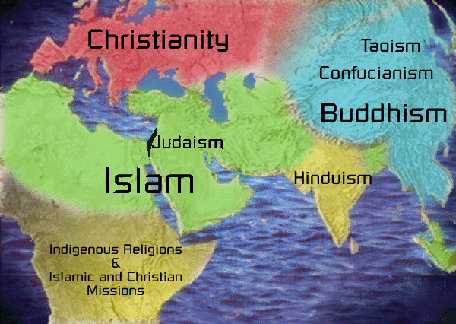
Shadows Of The Truth - Hinduism And Buddhism Compared To Biblical Christianity

Image result for eastern religions
Acts 17:22-23 "So Paul stood in the midst of the Areopagus and said, “Men of Athens, I observe that you are very religious in all respects. 23 For while I was passing through and examining the objects of your worship, I also found an altar with this inscription, ‘TO AN UNKNOWN GOD.’ Therefore what you worship in ignorance, this I proclaim to you."

Introduction:

On August 21st, 2017, many people throughout the United States watched a solar eclipse. The wonder of the moon passing between our earth and the sun captured imagination and scientific curiosity. Where we live, relative to our location on the earth, the moon blocked out about 80% of the sun (due to being in what is called the "penumbra" of the moon's shadow). 

Image result for solar eclipse

A strange and faint shadow clung to the outside surroundings. For a brief moment, the day-time sky was dominated by a faint shadow. 

Whenever the Apostle Paul enters Athens Greece, he entered into the cultural and intellectual center of what had by that point represented the former glories of Greece. Rome was in power and the ancient Greek philosophies of the Stoics, Epicureans and others dominated the city. The intellectuals of the day did not realize they were dwelling in the shadows. They thought they had true light. 

The torch of reason burned on the mixed fuel of philosophical thought and paganism. God's general revelation of Himself, known to all people, was intermixed in with what had by that point become the warping of the truth. Paul came to bring forth the true light of the Gospel as so centered around the death and resurrection of Jesus.

All religions, philosophies and ideologies are striving to grab hold of a particular principle or truth that is a shadowy counterpart to the real sets of truths that is Christianity. All religions are a mixture of God's general revelation, man-made ideas, superstition and elements of spiritual darkness. As we can see in the opening text above, Paul indicates that his audience had an altar dedicated to "The Unknown God", quite literally in the Greek "Agnostos", from whence we derive the English word "Agnostic" to describe those who assert that one cannot know whether we can know anything about God. 

In today's post I wants us to consider to Eastern religions and their respective central projects: Hinduism and Buddhism. As will be seen, each of these strive to grab hold of a principle that is but a shadow of the reality proclaimed by Biblical Christianity.

Hinduism's Main Project And Shadow - Union With Whatever Is Divine. Christianity's Guarantee and Reality - Union With God Through Jesus Christ

C.V. Matthew, a specialist in the belief system of Hinduism, writes in his book: "The Saffron Mission. A Historical Analysis Of Modern Hindu And Missionary Practices" (Cambridge Press. 1999):

"Roughly 8 “sects” of Hinduism. Hinduism portrays itself as an all-inclusive, tolerant, multi-path system to the Ultimate Religion. All Hindus view themselves as the society of the living God. They desire immersion in all of life’s activities while trying to gain, on their view, good karma in this life. For the Hindu, union with what they deem “Universal Soul”. Hinduism is as much about the Indian culture, language and way of life as the rituals." 

It needs to be understood that in this post, we are painting with a very broad brush. Nevertheless, to get to the root of Hinduism's main goal, one could say that all the rituals, the 330 million deities, the various sects, the various holy books (Vedas, Upanishads and the like) are all aimed at one thing: escaping the cycle of birth/rebirth and to find union with the Divine principle they call "Brahma". 

In Hinduism, people are endlessly born, dying and being reborn as different life forms. Evil and sin are illusions or “maya”. The goal of Hinduism is to come to a union with the impersonal “all” or “Brahma”, thus getting past the illusion of good and evil. Depending upon how morally one lives in this life and how much ritual one participates in will, in the Hindu mind, determine whether one has "good Karma" or "bad Karma". Karma is a Hindu word referring to "works or deeds" and is essentially a debt-based system of works salvation. 

Apologist and author Ravi Zacharias notes about Hinduism: “For the Hindu, karma-the moral law of cause-and-effect-is a life-defining concept. Life carries its moral bills, and they are paid in the cyclical pattern of rebirth until all dues are paid in full. Hinduism here conveys an inherited sense of wrong, which is lived out in the next life, in vegetable, animal, or human form. This doctrine is nonnegotiable in Hindu philosophy.”

Sanasara is likened to a wheel of sorts, wherein a person keeps literally going around in circles. "Sanasara" (sometimes spelt: “samsara”) and its related concept "karma" portray a person trying to live good enough in this life to have a better spot in the next. The goal of Hinduism is to escape "Sanasara" and to achieve "Moksha" or union with the Universal Soul.


The Bible paints a different picture. There was a literal Adam and Eve and a serpent named Satan who came to tempt them. Passages such as Romans 5:12 summarize for us the events of the fall, namely that through one man, sin entered into the world, and through sin came death upon us all. In contrast to Hinduism, evil and sin are not illusory. Instead, they’re realities that intruded into the perfect creation made by God (See Genesis 3:7-21; 1 Kings 8:46; Rom. 5:11-21) 

In Biblical Christianity, we find that God has provided Himself in the Person of the Son taking unto Himself a truly human nature in His incarnation as Jesus of Nazareth. Jesus Christ is the One way through which all by faith can have union with God through Him (see John 14:6; 2 Peter 1:3-4). This union is a relational union. 

Unlike Hinduism, the follower of Jesus Christ does not go out of existence or meld their human nature into God's Divine nature. Instead, the Christian comes to participate in and with Christ, Who is Himself united to the Christian by way of His human nature while at the same time ever united to the Father and the Holy Spirit by way of His Divine nature. Only Christianity guarantees reconciliation, relationship and thus true reunion with God in Christ.

Buddhism's Central Project And Shadow: Refuge From Distress And Pain. Christianity's Promise And Guarantee: Redemption And Forgiveness Caused By Sin And Pain

Jacky Sach, a practicing Zen Buddhist, writes in her book: "Essential Buddhism - Everything You Need To Understand About This Ancient Tradition" (F+W Publications, 2006), concerning the central aim of Buddhism:

"Our minds can be our worst enemies. When we desire something our egos can come out in full force and feel threatened at the idea of not getting what we want. We can become irritable, selfish, and stressed. Whether our desire is for a new home, a new job, a larger piece of pie, or peace of mind, the threat of not achieving our desired objective can turn us into unruly and unpleasant individuals. Trying to turn over our desires, to find a place in life where we are content just to be, filled with compassion and love for our fellow humans and our surroundings, is absolutely heaven on earth."

Siddharta Gautama, the founder of Buddhism, was born to an affluent family around the time of 566 b.c. When he came to be aware of the world outside his palatial home, Gautama witnessed suffering, pain and hardship. He saw the injustice of suffering and concluded that the problem lied within each person by way of their desires. By a process of a seven-year journey of introspection, Gautama became renamed as "Buddha" or "the enlightened one". His claim was that by becoming detached from one's desires and discovering that ultimate reality is nothing, one can achieve "Nirvana" or a semblance of heaven here on earth.

The problem with Buddha's teaching was that he was teaching a half-truth. Surely the issues of humanity's problems are found within man, but the way he described it and the solution he proposed was way different than from what we see in Biblical Christianity. Buddha attempted to achieve his project apart from any belief in any deity, let alone the true and living God. 

In the end, Buddhism is a system of practice and belief that tries to reform and purify humanity without God. By detachment from everything, including desire, the Buddhist claims their own brand of salvation.

Biblical Christianity proclaims the truth of how sin and evil are real (Genesis 3:7-15; 1 Kings 8:46; Romans 3:23; 5:11-21) and how Jesus Christ came to destroy the works of the Devil (1 John 3:8), redeem sinners who believe by grace (John 3:16; Eph 2:8-9) and to make all who follow Him by faith into new people (2 Cor. 5:17). In Christianity, rescue from sin involves not detachment but reattachment to the God who made me and redeemed me (2 Corinthians 5:15-21). 

Reality is not nothing but something that God will one day transform into a New Heavens and New Earth, wherein righteousness will dwell (2 Peter 3:13). Heaven is a real place, not a state of mind (John 14:1-3; Philippians 3:20-21). Hell is a real place that can be avoid in Christ by faith but will be occupied by those who persist in their rejection of God and Christ and die in their sins (Luke 16; John 3:36). Only in Jesus Christ is true forgiveness, freedom and redemption found (John 8:12, 36; Ephesians 1:7). 

Closing thoughts

Today we considered shadows of truth that are found in two world religions: Hinduism and Buddhism. We also noted that despite their best efforts, all religions outside Christianity fail to arrive at the central purposes of their respective projects. In Jesus Christ alone is found true union with God by faith and true redemption and forgiveness that is caused by sin. As we consider the imitations and comparison to the genuine article, we can come to better appreciate all that God offers in Jesus Christ through the Old and New Testaments. 

Tuesday, August 29, 2017

Defining Total Success - Romans 10:15-17

Image result for hurricane warnings
Romans 10:15-17 "How will they preach unless they are sent? Just as it is written, “How beautiful are the feet of those who bring good news of good things!” 16 However, they did not all heed the good news; for Isaiah says, “Lord, who has believed our report?” 17 So faith comes from hearing, and hearing by the word of Christ."

Introduction:

Our family lived in Florida for a number of years. I can recall the year when we experienced three hurricanes. It was astonishing to see how many people would vacate a given area to escape the path of the storms. What was even more amazing was to see the resolve some had in choosing to ignore such warnings. I can recall one video that showed a man sitting on top of the roof of his home while it was floating in the aftermath of a particular hurricane. We shake our heads at such things, and yet, when it comes to heeding God's Word, we sometimes choose not to respond. 

Just as no one could blame the weatherman nor law enforcement for the choices of some to ignore their repeated warnings - so too must it be said of those who plea with unsaved loved ones and friends to believe the Gospel. Today we want to consider what counts as success in the task of evangelism.

Who fails when the Gospel is delivered?

Paul is dealing with the irrationality that characterizes the response of unbelief to the Gospel. In Romans 10:15, we find Paul appealing back to a practice in ancient cities that involved messengers bringing news from a battle-line or from another city. 

Watchmen would be situated along the walls of a given city. Whenever they spied a runner with a message on the horizon, they would signal the inhabitants and city official to gather at the city-gate to receive the messenger. Once the messenger arrived, the major concern was whether or not such a person had good news. Whenever the news was favorable, the saying would go: "How beautiful are the feet of those who bring good news!"

However, there are some people who might not had agreed with such estimations. Maybe, for example, they were secretly hoping for a different outcome to the battle or, maybe they were not on the side of the officials. No one can blame the messenger, nor the contents of his message for rendering the response of rejection. It is always a matter of the listener's heart - since, after all, that is the heart of the matter. 

What succeeds in the task of evangelism?

Thankfully, Paul writes in Romans 10:17 "So faith comes from hearing, and hearing by the word of Christ." These words assure those delivering the Gospel that success is not measured by the response of the listener, but rather by the obedience of the messenger. 

Isaiah 55:6-10 gives a fuller treatment of these thoughts. Note the appeal given by those bringing the good news to unbelievers in Isaiah 55:6-7 "Seek the Lord while He may be found; Call upon Him while He is near. 7 Let the wicked forsake his way and the unrighteous man his thoughts; and let him return to the Lord, and He will have compassion on him, and to our God, For He will abundantly pardon."

We then find the messenger answering anticipate objections, reminding the listener that the appeal of the message comes from God and not man in Isaiah 55:8-9 “For My thoughts are not your thoughts, Nor are your ways My ways,” declares the Lord. 9 “For as the heavens are higher than the earth, So are My ways higher than your ways And My thoughts than your thoughts." Truly God's grace is needed for the grasping and reception of the message (hence the point of Romans 10:17).

Then we come to the part of Isaiah's exposition that states why no evangelistic appeal is ever a failure. The delivery of God's Word will result in one of two things: conviction leading to repentance or condemnation of the person's sin which will result in their digging in of the proverbial heels (compare John 16:8-11). God's Word never renders anyone neutral. Isaiah 55:10-11 states - “For as the rain and the snow come down from heaven,
And do not return there without watering the earth and making it bear and sprout, and furnishing seed to the sower and bread to the eater; 11 So will My word be which goes forth from My mouth; It will not return to Me empty, Without accomplishing what I desire, And without succeeding in the matter for which I sent it."

Closing thoughts:

Therefore we find that God's Word is always working. Delivering the message of the Gospel spells success for the messenger. God's work in His Word never fails, since He facilitates the well-meant offer of salvation to sinners by the Holy Spirit's active work of convicting sinners. The ball of responsibility is always in the court of the one receiving or rejecting the message. Would it be that we not cease nor give up on those around us. Would it be that we ever place our confidence in Christ and the power of the Spirit working through the Gospel. 

Monday, August 28, 2017

Interpreting Jesus' Parables And Using Them To Understand Other Parts Of The Bible

Image result for parables
Matthew 13:10 And the disciples came and said to Him, “Why do You speak to them in parables?”

Introduction:

In today's post we aim to introduce the reader to the parables of Jesus and some practical tips to studying and applying them.  Not only do Jesus' parables connect readers and listeners to important spiritual truths, but at times, Jesus' parables can shed light on harder-to-understand portions of the Bible. We will begin this post by first defining a parable, and then walk our way through various examples on how to interpret and apply the parables of Jesus by using one of His more well-known parables: "the parable of the soils"

1. What is a parable?

The most fundamental meaning of the term "parable" as to do with taking a known idea, principle, experience or story and placing it alongside a spiritual truth in order to shed light on that spiritual concept. The simple diagram below illustrates what is literally meant by the term "parable":
----------------------spiritual truth--------------------

____common experience, story, illustration__

The term "parable" comes from two Greek terms: "para" meaning "alongside" and "ballo" meaning "to throw, cast".  When combined together, the term describes someone like Jesus taking a known thing and "casting it up alongside" and otherwise unknown spiritual truth that needs illuminated to the listener. 

Some Bible teachers estimate that in upwards of 30% of Jesus' teaching was in the form of parables.1  We discover over 50 parables of all different forms told by Jesus in the pages of the four Gospels. By studying them we can glean important insights into areas such as salvation, practical everyday Christian life, the Kingdom, the supernatural realm, bringing glory to God and relating to other people.

2. How do we understand the parables?   
As we come to the parable of the soils in Matthew 13:1-23, Jesus gives us the key to understanding His parables. As a matter of fact the parallel passage in Mark 4:13 actually has Jesus saying: "And He said to them, 'Do you not understand this parable? How will you understand all the parables?" We will first of all look at the simple method for interpreting Jesus' parables as gleaned from Matthew 13:1-23 and other passages.

a. Observe the setting of the parable.
In Jesus' parable of the Sower the setting features a sower or a farmer, seed and different types of soils.  Consulting a good Bible Dictionary or a good Study Bible with study notes can enable the reader to begin understanding the imagery of many of Jesus' parables. Resources such as J. Dwight Pentecost's "The Parables of Jesus" notes: Since wheat was a staple of the diet in Palestine, the procedure of raising wheat would had been very familiar to the Lord's hearers. In preparation for sowing the seed, the ground was cleared of all old growth. This caused the entire field to look the same. The sower had no idea of what roots or rocks lay beneath the surface soil."

Pentecost then compares this ancient method of farming to today:

"The soil was not plowed as is done today, but rather the seed was broadcast by the sower on the surface of the soil. The seed was then scratched into the soil with a primitive wooden plow. The sowing was done before the early rains that caused the seed to germinate. The sower waited through the growing period for the coming of the latter rains that brought the grain to full fruition and thus provided a bountiful harvest."

Such background information will ensure the reader that they are getting to the intended meaning meant by Jesus and a better understanding of what He is communicating.

b. Find the key point of the parable.
Parables by and large are designed to communicate one main idea, principle or truth, however there will be those parables that are composed of multiple parts, requiring each part to be interpreted.  Jesus' parable of the soils is told by Jesus in Matthew 13:1-9, with His own interpretation of it given in 13:18-23. Clearly there is more than one part to the parable, however there is at the same time one overall theme, namely the different patterns we see in how people hear and understand the Word of God (compare Matthew 6:23). 

Bible scholar Simon J. Kistemaker reminds us: Althought it is generally true that a parable teaches only one basic lesson, this rule should not be pressed too far. Some of Jesus' parables are complex in composition. Later he writes: Moreover, in Jesus' parables it is not the beginning of the story but the end that is important."3

c. Cross reference other scriptures to see how the parable connects you to other parts of the Bible.
Jesus' telling of this parable of the soils in Matthew 13 ought to be compared to His telling of it in Mark 4:3-8 and Luke 8:5-8. Such cross comparison can enable the reader to understand the nuances of Jesus' parables. 

Over time the parables can provide a window in which to see the broader unity of the Word of God. In seeing the bigger picture of God's truth, we can then come back to the parable itself and have an even better understanding.

Take for instance Paul's discussion in Romans 10:16-21 of how the majority of people hearing the Gospel end up not heeding it. There are certainly excuses typically raised by people for not believing the Gospel, which Paul dismisses due to all men being without excuse (see Romans 1:18-21; 10:18:21). Why is it that people so often either reject the gospel or seem to believe but then later on fall away? Jesus parable of the soils can aid in shedding further light on the interpretation of Romans 10:16-21. 

The first three soils in Jesus' parable refer mainly to hypocrites or "make-believers" that seem genuine but do not possess true saving faith. Only the fourth soil in Jesus' parable speaks of one who have "heard the word in an honest and good heart" (Luke 8:15). The first three types of people in Jesus' parable and those in Paul's exposition are like those described in Hebrews 4:2 "For indeed we have had good news preached to us, just as they also; but the word they heard did not profit them, because it was not united by faith in those who heard." 

d. Live out the main point or teaching(s) of the parable
It is obvious that the reason why parables begin in the realm of the known and proceed to the unknown is to get the listener to bring spiritual truths to bear in everyday life. As James notes in James 2:26 "For just as the body without the spirit is dead, so also faith without works is dead." In studying the parables, the reader or listener or preacher is able to cloth spiritual and oftentimes abstract principles in the garments of everyday life. Ordinary life is where God would have us to live out extraordinary lives for His glory.

Endnotes:
1. Simon Kistemaker. The Parables - Understanding the Stories that Jesus Told. Baker. 2002. Page 10 

2. J. Dwight Pentecost.  The Parables of Jesus.  1982. Kregel. Page 46.

3. Simon Kistemaker. The Parables - Understanding the Stories that Jesus Told. Baker. 2002. Page 11

Thursday, August 24, 2017

The Holy Spirit's Work In The Lives Of Non-Christians And Christians

Image result for the Holy Spirit's work
John 16:8-11 "And He, when He comes, will convict the world concerning sin and righteousness and judgment; 9 concerning sin, because they do not believe in Me; 10 and concerning righteousness, because I go to the Father and you no longer see Me; 11 and concerning judgment, because the ruler of this world has been judged." 

John 16:12-13 “I have many more things to say to you, but you cannot bear them now. 13 But when He, the Spirit of truth, comes, He will guide you into all the truth; for He will not speak on His own initiative, but whatever He hears, He will speak; and He will disclose to you what is to come.

Introduction:

The opening passage for today's post has been put into two distinct sections that highlight the Holy Spirit's work in the lives of unbelievers (John 16:8-11) and believers (John 16:12-13). As a quick note on the latter of these, although Jesus' instructions are primarily toward the apostles, by extension, the Spirit's work described by Jesus can include all Christians (see for instance 1 Corinthians 2:10-13; 1 John 2:20,27). 

The Divine Person of the Holy Spirit and His workings among and in people

Today's post features the Holy Spirit's work among non-Christians and Christians. Whether people realize it or not, God in the Person of the Holy Spirit is ever working to bring the glory of God to people. The Divine Person of the Holy Spirit is the Member of the Trinity that works as the chief agent in affecting conversion in sinners and ongoing change in the lives of Christians. As a Divine Person, the Holy Spirit is truly God - thus making what He does among people a work of God and entailment of the other two Members of the Trinity (the Father and the Son). 

The Holy Spirit works as the Ambassador of the Trinity, bringing to unbelievers the power and Person of the Son for them to place their trust. Unbelievers need His works of conviction and soulish illumination to enable them to either perceive the message of general revelation that leaves them without excuse or to quicken them to the special revelation of the Gospel that leads to true saving faith. 

Christians need the Spirit's working from the inception of regeneration all the way through to the end before their leaving this world. By the Person and work of the Holy Spirit, each Christian is reminded that they are an adopted son or daughter of the Heavenly Father (see Romans 8:14-16; Galatians 4:4-6) and have Jesus as their elder brother according to the flesh (see Hebrews 2:14-17). Below is an unfolding of these general observations in further, specific applications as it regards the Holy Spirit's workings among non-Christians and Christians.

The Holy Spirit's work among non-Christians

First, sinful man must have the Spirit’s work of convincing Him that Jesus is worthy of worship. The problem is that sinful man has no desire to worship this great God. The Holy Spirit’s task in regenerating lost sinners in saving faith is to remove the heart of rebellion against God and replace it with a heart that desires God. Romans 8:5-6 tells us – “For those who are according to the flesh set their minds on the things of the flesh, but those who are according to the Spirit, the things of the Spirit. 6 For the mind set on the flesh is death, but the mind set on the Spirit is life and peace.” 

The preacher may come to you with polished words and the song leader may be angelic in their voice and musical ability. Yet, lest the preacher’s message be accompanied by the Holy Spirit’s conviction and lest the song service be charged with the Holy Spirit's anointing power, all will fall on deaf ears. The anointing refers to the Holy Spirit's ministry in delivering whatever is necessary to break away the dependence upon self and to receive empowerment as a result of dependence upon God. As mentioned, The Holy Spirit acts as the Ambassador of the Trinity. He brings the desire to worship God to unbelieving man, convicting him of sin, righteousness and judgment and making known to Him the things of God (John 16:8-12).

The Holy Spirit's work among Christians 

Then in terms of the Holy Spirit's working in the Christian life, the New Testament details the work of the Holy Spirit in the Christian life from its inception as seen in the following ministries He performs:

i. New Birth/regeneration.
James 1:18 "In the exercise of His will He brought us forth by the word of truth, so that we would be a kind of first fruits among His creatures."

ii. Filling of the Holy Spirit.
Ephesians 5:18 "And do not get drunk with wine, for that is dissipation, but be filled with the Spirit."

iii. Leading/prompting of the Spirit
1 Corinthians 10:13 "No temptation has overtaken you but such as is common to man; and God is faithful, who will not allow you to be tempted beyond what you are able, but with the temptation will provide the way of escape also, so that you will be able to endure it." Philippians 3:15 "Let us therefore, as many as are perfect, have this attitude; and if in anything you have a different attitude, God will reveal that also to you."

iv. Union with Christ by the Spirit
1 Corinthians 12:13 "For by one Spirit we were all baptized into one body, whether Jews or Greeks, whether slaves or free, and we were all made to drink of one Spirit." (1)

v. Anointing/power/illuminating ministry of the Holy Spirit
1 John 2:20 "But you have an anointing from the Holy One, and you all know."


1 John 2:27 "As for you, the anointing which you received from Him abides in you, and you have no need for anyone to teach you; but as His anointing teaches you about all things, and is true and is not a lie, and just as it has taught you, you abide in Him."

Closing thoughts:

As we close out today's post, we have toured the work of the Holy Spirit in the lives of unbelievers and Christians. May all of us be ever receptive to His work in our lives. 

Endnote:
(1) This particular point is not water baptism, which follows and signifies the reality of this work of the Spirit already having occurred in conversion. Water baptism is a God-ordained picture that re-enacts and illuminates the new believer to the truth of what happened to them at salvation.  People don't get water baptized to get saved and spirit baptized, rather they are water baptized following their salvation. 

Water baptism logically connects the new Christian back to the reality of their prior spirit baptism, however it does not impart the salvation which it pictures or points.  In the death, burial, resurrection sequence of believer's baptism by immersion, the Christian acts out in sign form the Spirit's uniting of them to Jesus Christ which occurred in His spiritual baptism or uniting of them to Christ at prior saving faith.  

Wednesday, August 23, 2017

How The Word of God Works In Regeneration And Sanctification

Image result for The Word of God
Romans 10:17 "So faith comes from hearing, and hearing by the word of Christ."

Introduction:

The beginning of the Christian life starts with regeneration or the new birth (John 3:1-5; Titus 3:4-6; 1 Peter 1:23; James 1:18). The continuation of the Christian life following regeneration in saving faith is what the Bible terms "sanctification" (1 Corinthians 1:30; 6:19-20; 1 Thessalonians 4:3). Both graces require the same ingredients for each to begin and carry forth: the Holy Spirit, an open heart of faith and the Word of God. 

One could say that the Holy Spirit is the Agent responsible in initiating the miracle of regeneration and regulating (with a cooperating believer) the ongoing work of sanctification. Certainly without a heart open to truth in light of the Spirit's working, there can be no salvation to be worked forth by Him. In like manner, unless a believer has a heart open to growing further in the things of God, sanctification by the Spirit in cooperation with that saint won't be forthcoming. 

So what about the words of the Bible? What does scripture have to say about itself with respect to its role in regeneration and sanctification? 

The Word of God In Regeneration

First, let's consider the work of regeneration wrought forth by the Holy Spirit in the human heart. We find the following scriptures testifying to the role of God's word in salvation:

Luke 16:31 "But he said to him, ‘If they do not listen to Moses and the Prophets, they will not be persuaded even if someone rises from the dead.’ ”

1 Corinthians 1:18 "For the word of the cross is foolishness to those who are perishing, but to us who are being saved it is the power of God."

1 Thessalonians 2:13 "For this reason we also constantly thank God that when you received the word of God which you heard from us, you accepted it not as the word of men, but for what it really is, the word of God, which also performs its work in you who believe."

2 Thessalonians 2:14 "It was for this He called you through our gospel, that you may gain the glory of our Lord Jesus Christ."

James 1:18 "In the exercise of His will He brought us forth by the word of truth, so that we would be a kind of first fruits among His creatures."

1 Peter 1:23-25  "for you have been born again not of seed which is perishable but imperishable, that is, through the living and enduring word of God. 24   For, “ALL FLESH IS LIKE GRASS, AND ALL ITS GLORY LIKE THE   FLOWER OF GRASS. THE GRASS WITHERS, AND THE FLOWER FALLS OFF, 25 BUT THE WORD OF THE LORD ENDURES FOREVER.” And this is the word which was preached to you."

It is a remarkable thing to think about when we talk about the preaching or teaching of a book resulting somehow in a change of heart. It surely cannot be attributed to the skill or personality of the preacher whenever a soul makes a decision for Jesus Christ. What is there about the Bible that makes it different from any other book in the world? 

I recall once talking at length with a Muslim man about the Quran. My question to that man was whether or not the reading aloud of the Quranic text could make a convert to Islam. He looked at me rather puzzled and said: "no, not really". The Muslim's religion knows nothing of converting power coursing through the words of its religious tome.

The Bible is different. All of the verses I mentioned above reveal that the reading aloud, preaching, teaching or explanation of the words of the Bible bring about the conversion of the soul. Even seeing the precious text of the Bible and reading it to oneself can result in a heart open to truth in general to saying yes to Jesus in a specific act of faith. The miracle of regeneration in the soul is wrought by God's miracle book: the Bible.  

The Word of God in Sanctification

1 Corinthians 2:10-13 For to us God revealed them through the Spirit; for the Spirit searches all things, even the depths of God. 11 For who among men knows the thoughts of a man except the spirit of the man which is in him? Even so the thoughts of God no one knows except the Spirit of God. 12 Now we have received, not the spirit of the world, but the Spirit who is from God, so that we may know the things freely given to us by God, 13 which things we also speak, not in words taught by human wisdom, but in those taught by the Spirit, combining spiritual thoughts with spiritual words."

Colossians 1:4-6  "since we heard of your faith in Christ Jesus and the love which you have for all the saints;           5 because of the hope laid up for you in heaven, of which you previously heard in the word of truth, the gospel 6     which has come to you, just as in all the world also it is constantly bearing fruit and increasing, even as it has been doing in you also since the day you heard of it and understood the grace of God in truth."

2 Thessalonians 2:13 "But we must always thank God for you, brothers loved by the Lord, because from the beginning  God has chosen  you for salvation through sanctification  by the Spirit and through belief in the truth."

Hebrews 4:12 "For the word of God is living and active and sharper than any two-edged sword, and piercing as far as the division of soul and spirit, of both joints and marrow, and able to judge the thoughts and intentions of the heart."

1 Peter 2:2 "Like newborn infants, desire the pure spiritual milk, so that you may grow by it for your salvation."

In the five verses I just listed, we discover that the same Bible that the Spirit uses in bringing about regeneration in saving faith is the chief instrument through which the Christian exercises himself or herself in sanctification. It wasn't too long ago that I was listening to a lecture by a prominent atheist professor of religion at a well-known university. If I were to mention this professor's name, some may recognize him by his many books in which he criticizes the Bible and Christianity. 

This professor explained in his lecture how he begins each semester of his university course on religion. He does an informal poll of the class (many from the so-called Bible belt of the United States). He will ask them: "how many believe the Bible to be the Word of God?" The forest of hands in the room testify to the majority view of the class. The next question he will asks pertains to a currently popular movie or book and he asks the students again how many have seen the movie or read the book. Again, many hands shoot up in the room. The third question raised by the professor concerns how many in the class have read the Bible through from beginning to end, at least once. By that point, only two or three raise their hands. 

The professor at this point then tells the class that for a book they believe to be authored by God Himself, one would think that everyone in the class would had read that book. Think about it, an atheist professor, no friend to the Bible nor Christianity, sees the folly of neglecting the Book of God. Yet, so few Christians ignore the Bible to their peril. The Bible is the primary means used by the Spirit in shaping and molding the willing Christian in becoming more Christ-like in their sanctification. Truly God's Word which can change the heart and keep the saint must be kept as priority in its reading by any Christian desiring to change from one level to the next in their sanctification. 

Closing thoughts

Today we explored how the Word of God works in regeneration and sanctification. Unless God's Word is part of the Gospel equation, no one will believe and be saved. Unless God's Word is intertwined in Christian sanctification, the Christian commitment of the child of God will stagnate and grow sterile. The Bible is God's living Word. It breathes life into the heart dead to God and breathes life into the heart wanting and needing to grow in God. Would we all cherish and take more seriously that precious book called "The Bible", "The Word of God".