Translate

Thursday, September 21, 2017

The Significance Of Ordination In The Life Of A Pastor And God's People

Image result for ordination of a pastor
Numbers 8:9-10 "So you shall present the Levites before the tent of meeting. You shall also assemble the whole congregation of the sons of Israel, 10 and present the Levites before the Lord; and the sons of Israel shall lay their hands on the Levites."

2 Timothy 1:6 "For this reason I remind you to kindle afresh the gift of God which is in you through the laying on of my hands."

Introduction:

I can recall the day I was ordained to the Gospel ministry. The process leading up to that ordination had involved years of training in both Bible College and Seminary. For 25 years God has had me preaching His word. Nearly a decade passed before the time came for my ordination. But even more important than the formal training and preaching opportunities themselves were the character qualities God needed to work out in my life. There were some wonderful men God placed in my path to teach me valuable lessons on friendship, loyalty, leadership and doctrinal conviction. There were various jobs and positions that taught the much needed lesson of servanthood and a willingness to do whatever task, no matter how menial. All of these lessons prepared me for the day I would get ordained. 

So why do churches ordain men for the ministry? Is this rite a recent development in church history? or are their Biblical patterns that inform the necessity for ordained men and the ordination process itself? 

Ordination is a very special time in the life of a church and a man of God. To ordain means "to set apart" for God's service. Normally a group of other ordained ministers and Deacons will come together to form what is called an ordination council. The council's job is to examine a man who has expressed their conviction of God's call to ministry. There are usually a series of questions asked - ranging from the doctrinal to the pastoral to the personal. 

The candidate for ordination is then asked to give testimony of his salvation and what he understands concerning his own call to the Gospel ministry. Such an examination by other ordained men is designed to either confirm that man's call and to attest such a calling to the church or to screen out those men who may not quite be ready. 

Biblical passages that deal with ordination and setting apart those who minister God's word

Ordination is truly a remarkable event. In a sense it is where God calls a man from among the called people of God to issue forth the call of the Gospel from the word of God. Ordination is not a recent phenomenon in the church's life. The following scriptures testify to this ancient roots of this pattern of recognizing God-called men.

To begin, the opening passages in today's post feature the setting apart of the Levites for service in the tabernacle (Numbers 8:9-10) and Paul's reference to young Timothy's "setting apart" and having received the "laying on of hands" in 2 Timothy 1:6. Once the Levites were set apart, Numbers 8:22 then records - "Then after that the Levites went in to perform their service in the tent of meeting before Aaron and before his sons; just as the Lord had commanded Moses concerning the Levites, so they did to them."

Priests were regularly ordained or "set apart" as a mark of God's calling and choosing of them for the task of temple service. We see ordination occurring in the life of Joshua, Moses' successor, in Numbers 27:18-19 "So the Lord said to Moses, “Take Joshua the son of Nun, a man in whom is the Spirit, and lay your hand on him; 19 and have him stand before Eleazar the priest and before all the congregation, and commission him in their sight." The significance of "laying on of hands" is found repeatedly on most of the biblical passages dealing with this subject of ordination. Whenever one laid there hands on another for setting apart unto God's service, there was an idea of "conferral of authority". Numbers 27:20-21 spells out this formal meaning of "laying on of hands": "You shall put some of your authority on him, in order that all the congregation of the sons of Israel may obey him. 21 Moreover, he shall stand before Eleazar the priest, who shall inquire for him by the judgment of the Urim before the Lord. At his command they shall go out and at his command they shall come in, both he and the sons of Israel with him, even all the congregation.”

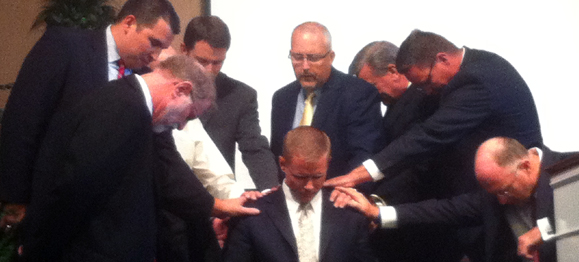
I can recall in my ordination service where the pastor and deacons each took turns laying their hands upon me, praying over me and asking God's blessing upon the future of God's ministry through me. My brother-in-law, a pastor himself, had driven several hours to participate in this public event. Ordination's quality as a public event lends to its significance in the church's life. For Old Testament Israel, men like Joshua were to lead them. Joshua's ordination, which we saw a moment ago, has its significance explained in Deuteronomy 34:9 "Now Joshua the son of Nun was filled with the spirit of wisdom, for Moses had laid his hands on him; and the sons of Israel listened to him and did as the Lord had commanded Moses."

When we come to the New Testament, we see the principles of ordination, already established in ancient Israel, continuing their way in the New Testament church. Whenever Paul and Barnabas were getting ready to launch out into their first missionary work, we read in Acts 13:3 "Then, when they had fasted and prayed and laid their hands on them, they sent them away." The most specific information we have about ordination in the New Testament is found in Paul's two letters to young Pastor Timothy. In 1 Timothy 4:14 we read: "Do not neglect the spiritual gift within you, which was bestowed on you through prophetic utterance with the laying on of hands by the presbytery." And then again 2 Timothy 1:6 "For this reason I remind you to kindle afresh the gift of God which is in you through the laying on of my hands."

Applications:

We could certainly bring in further passages from both Old and New Testaments to bring home the significance of ordination in the life of a pastor and God's people who take seriously the public ministry of the Word of God. For brevity's sake, I will list those other passages for the reader's review (1 Kings 19:15-18; 2 Kings 2:9, 15; 8:8; 2 Kings 9:1-10; 1 Timothy 4:14; 5:22; 2 Timothy 1:6; Hebrews 6:2). As we close out this post today, what lessons can we draw from our brief consideration of the above texts? We can briefly note three such lessons...

1. God affirms his calling on a man through his word to the heart of that individual. God then follows up with a confirmation of that calling through the process of ordination and the acclamation of God's people.

2. In most of the examples we considered above, the men who were ordained were younger men. Ordination is significant because it can be used of God to alert the young men in the congregation of God's dealings with them as to whether or not He is calling them to serve Him.

3. The congregation's participation and observation of the ordination service reinforces and reminds them of the importance of the ministry of the word of God. The man who is ordained will hopefully have many years of fruitful preaching and leading of God's people. In so far as that man is ordained to lead the people, the people have the responsibility to follow and pray for that man.

Wednesday, September 20, 2017

Why Preaching Matters In A Difficult Age - 2 Timothy 3:1-13

Image result for plowing discs
2 Timothy 3:1-5  "But realize this, that in the last days difficult times will come. 2 For men will be lovers of self, lovers of money, boastful, arrogant, revilers, disobedient to parents, ungrateful, unholy, 3 unloving, irreconcilable, malicious gossips, without self-control, brutal, haters of good, 4 treacherous, reckless, conceited, lovers of pleasure rather than lovers of God, 5 holding to a form of godliness, although they have denied its power; Avoid such men as these."

Introduction:

I remember growing up in South Central Pennsylvania between two farms. In the early mornings one could hear the tractors pulling plows and turning up the hardened soil of fallow ground. I would sometimes watch those tractors and observe how the plowing disks on those plows glistened in the sunlight. Rocks and roots would be tossed to the sides by those plows. The rows were straight and deep, ready for the seeds to be sown for that year's harvest. Farmers had to be sure their plows were ready, since the difficult soil required a ready and sharp set of plowing disks to do the job. 

In our age, as well as ages past, the climate has never been favorable to preaching. Nevertheless, no age has ever passed that did not need it. The Apostle Paul is warning a young pastor of difficult times. The urgency of the hour is for young Timothy to preach the Word. Like a plowing disk, Timothy - and really all preachers of the Bible - are called to plow through difficult, fallow soil. The purpose of preaching is to sow the seed of God's Word. Such farming imagery is used throughout God's Word (Matthew 13:38; 1 Corinthians 3:9) to describe the context of the preacher's task. No doubt, Jesus warned of difficult times coming on our world while encouraging believers of His unsurpassed victory and guarantee of the success of God's purposes (John 16:33)

In today's post, I want to make the case that despite whatever difficult times within which we find ourselves, preaching matters. Our text is 2 Timothy 3:1-13. Note the following reasons why preaching matters in these present difficult times...

1. Preaching compels people to deny self. 2 Timothy 3:1-2


The words of the Bible are the preacher's source and tools. The Holy Spirit and God's word function together through the preaching task to change lives. Jesus told his audiences that if anyone wants to be his disciple or follower, they must die to self, take up the cross daily and follow Him (Luke 9:23-24; 14:25-33). Jesus' call to self denial occurred in the context of his preaching. Preaching is God's designated vehicle for compelling the conscience and breaking the unrepentant will. 

Teaching is important in convincing minds. However, preaching is needed to compel the conscience. Paul knew that in these last days, there would be a generation full of people full of themselves. 2 Timothy 3:2a notes: "For men will be lovers of self, lovers of money....". But notice also why present difficulties require preaching....

2. Preaching can bring lasting peace to unruly hearts. 2 Timothy 3:2b-3


Notice what Paul states next about the nature of the times in which he lived and our own in 2 Timothy 3:2b-3 -

"boastful, arrogant, revilers, disobedient to parents, ungrateful, unholy, 3 unloving, irreconcilable, malicious gossips, without self-control, brutal, haters of good."

Good gospel music, praise choruses, hymns and vocalists are appropriately linked to the ministry of the word. Both types of worship function as a team of horses to draw the chariot of God's glory into the central spot of the church's life. Music, when done in the right heart and with the Spirit's anointing - can prepare hearts and bring with it peace for that moment. However, lasting peace beyond the church service has been reserved for the ministry of the word. Isaiah 50:4 states - "The Lord God has given Me the tongue of disciples, That I may know how to sustain the weary one with a word. He awakens Me morning by morning, He awakens My ear to listen as a disciple." 

The music of praise and worship might very well set the table of the mind and the emotions. However, worship of God through the preaching of the Word places nourishment for the heart and will to grasp. What is needed in our day and age is lasting peace, God's peace. Paul's description of this present age is that of unruliness. Our culture is a roiling sea of chatter, arguing, division, strife and self-assertiveness. 

Just as the voice of Christ ranged over the sea of Galilee to make its waves to stand still, so is needed the voice of Christ through His word explained and applied to calm the unruly hearts of people. We need a fresh word from God today, which is why preaching is required to cut through the clamor. 

So we need preaching in these difficult days since it is how God compels people to deny self and bring lasting peace to unruly hearts. Notice a third reason why preaching matters today....

3. Preaching can uproot religious hypocrisy. 2 Timothy 3:5-10

In the next set of verses, Paul describes, especially in 2 Timothy 3:5, of how these present days will include people that have a form of godliness but deny its power. Many pretenders populate so much of Christendom. We have those that espouse prosperity theology and those who promote the sort of Christianity that doesn't require the ministry of the local church. The other day for instance, I saw a book entitled: "how to be a Christian without going to church". I thought the book was a satire until I read and discovered the person was quite serious! 

Biblically-sound, Christ-centered, Spirit- empowered proclamation of God's Word is designed to make clear the true and the not-so-true. Paul makes an interesting reference to Moses' day in 2 Timothy 3:8-9 "Just as Jannes and Jambres opposed Moses, so these men also oppose the truth, men of depraved mind, rejected in regard to the faith. 9 But they will not make further progress; for their folly will be obvious to all, just as Jannes’s and Jambres’s folly was also." Exodus 7:10-12 records the incident in question - "So Moses and Aaron came to Pharaoh, and thus they did just as the Lord had commanded; and Aaron threw his staff down before Pharaoh and his servants, and it became a serpent. 11 Then Pharaoh also called for the wise men and the sorcerers, and they also, the magicians of Egypt, did the same with their secret arts. 12 For each one threw down his staff and they turned into serpents. But Aaron’s staff swallowed up their staffs."

Moses' verbalizing the command of God to Aaron to throw down his staff gives a picture of the verbal ministry of the word in opposition to the charlatanry of the magicians. Their smoke and mirrors were no match for God's power through the spoken word. The end result in this narrative is that Aaron's rod in serpent form swallowed up the tricks of the pretenders. The hypocrisy of the Pharaoh's court - touting their pretended facades of spiritual power - were unmasked. 

So we have seen that preaching matters in today's world, since God has assigned it the role of compelling people to deny self, bringing lasting peace to unruly hearts and uprooting religious hypocrisy. But notice the last point as to why preaching matters today....

4. Preaching urges God's people to uphold godly living. 2 Tim. 3:10-14


Paul says plainly in 2 Timothy 3:12 "Indeed, all who desire to live godly in Christ Jesus will be persecuted." This desire is to be fueled by exposure to Biblical preaching. 1 Timothy 4:16 states - "Pay close attention to yourself and to your teaching; persevere in these things, for as you do this you will ensure salvation both for yourself and for those who hear you." Or again, Hebrews 13:7-9 "Remember those who led you, who spoke the word of God to you; and considering the result of their conduct, imitate their faith. 8 Jesus Christ is the same yesterday and today and forever. 9 Do not be carried away by varied and strange teachings; for it is good for the heart to be strengthened by grace, not by foods, through which those who were so occupied were not benefited." The pastor and the preaching of the Word have been so prescribed by God to form a godly people living in the midst of a godless world. Note Ephesians 4:11-12  "And He gave some as apostles, and some as prophets, and some as evangelists, and some as pastors and teachers, 12 for the equipping of the saints for the work of service, to the building up of the body of Christ." Note as well Philippians 2:15-16 "so that you will prove yourselves to be blameless and innocent, children of God above reproach in the midst of a crooked and perverse generation, among whom you appear as lights in the world, 16 holding fast the word of life, so that in the day of Christ I will have reason to glory because I did not run in vain nor toil in vain."

Closing thoughts

Today we have considered four reasons why preaching matters in a difficult age such as our own:

1. Preaching compels
people to deny self. 2 Timothy 3:1-2

2. Preaching can bring lasting peace to unruly hearts. 2 Timothy 3:2b-3

3. Preaching can uproot religious hypocrisy. 2 Timothy 3:4-10

4. Preaching urges God's people to uphold godly living. 2 Timothy 3:10-14

Tuesday, September 19, 2017

These Difficult Times Need God-Called Preachers To Preach The Word

Image result for preaching
2 Timothy 3:1 "But realize this, that in the last days difficult times will come." 

Introduction:

Whenever a naturally gifted athlete enters onto a playing field or a track, he or she shines brightly when the greatest odds are stacked against them. No one takes notice whenever the playing field is easy. However, whenever other factors and players enter into the fray, the athlete's natural talents, or what we could even term a sense of "calling" - is tested. 

Whenever it comes to the call to preach God's Word, the man of God chosen by God to preach His word may not be what others would had chose. If anything, the presence of "difficult times" or "perilous times" characterize each generation in which God's people find themselves. Despite the presence of difficult circumstances, God-called men shine forth the glory of God in Christ. In today's post, I want us to look at why perilous times, such as our own, still requires Biblical preaching.

In perilous times, many will resist preaching

The sooner a young man called into the ministry realizes the difficulty of his task, the better inclined He will be to lean on God. God knows what hurdles need overcome as the preacher gives himself to the task of proclaiming God's Word. Notice what we read in 1 Corinthians 1:18-23 -

"For the word of the cross is foolishness to those who are perishing, but to us who are being saved it is the power of God. 19 For it is written, “I will destroy the wisdom of the wise, And the cleverness of the clever I will set aside.”
20 Where is the wise man? Where is the scribe? Where is the debater of this age? Has not God made foolish the wisdom of the world? 21 For since in the wisdom of God the world through its wisdom did not come to know God, God was well-pleased through the foolishness of the message preached to save those who believe. 22 For indeed Jews ask for signs and Greeks search for wisdom; 23 but we preach Christ crucified, to Jews a stumbling block and to Gentiles foolishness."


Preaching by design is not man kind's preference. One only need to look at the drift of so many modern churches to see how often they try to replace preaching with substitutes. Whenever a church replaces the pulpit with something else as the primary vehicle for communicating God's presence and power: whether music, drama, entertainment, sacraments, rituals, traditions, programs or personalities - a departure from God's prescribed method for changing lives has just begun. 

It is not that all those other things are necessarily bad in and of themselves. If anything, each one of the just listed components found in various churches have varying degrees of value to the overall life of the church. However, they are secondary in nature when compared to God's prescribed vehicle for the voice of His word - preaching. Some of the above mentioned components of church life may complement or supplement the ministry of the pulpit, yet, they must never be replacements for the preaching event. 

In days such as this, people in the church and the culture will resist preaching. 2 Timothy 3:2-6 gives a diagnosis and prediction of each successive generation down to our own:

"For men will be lovers of self, lovers of money, boastful, arrogant, revilers, disobedient to parents, ungrateful, unholy, 3 unloving, irreconcilable, malicious gossips, without self-control, brutal, haters of good, 4 treacherous, reckless, conceited, lovers of pleasure rather than lovers of God, 5 holding to a form of godliness, although they have denied its power; Avoid such men as these. 6 For among them are those who enter into households and captivate weak women weighed down with sins, led on by various impulses, 7 always learning and never able to come to the knowledge of the truth."

Clearly the times predicted in the above text will be perilous, difficult and down right dangerous. In doing a brief word study on that word translated "difficult" (NASB) or "perilous" (KJV), we find out exactly what kind of age we find ourselves: "words difficult to bear and which penetrate deeply". In short, less and less will want to hear true Biblical preaching because they know that deep down, God's Word and its exposition peel back the layers of the heart that mask hidden sin and excuses.

So then why would God still prescribe a method of communicating His will and intent in the Bible, knowing full well that people prefer anything else but preaching? Why make it seemingly next to impossible for God-called men to bring forth God's word in such a hostile environment? Why preach at all in this present crisis? One reason: so that God alone can be credited as to why anyone would trust in Christ as their Savior and Lord or why any Christian would find themselves growing in the faith.

Present crisis requires preaching

Despite these perilous times in which we find ourselves, strong Christianity can only come about whenever there is sound, consistent Biblical preaching. After expounding further about what kind of present crisis was occurring in Paul's day, as well as our own, we discover these words in 2 Timothy 3:12-15 

"Indeed, all who desire to live godly in Christ Jesus will be persecuted. 13 But evil men and impostors will proceed from bad to worse, deceiving and being deceived. 14 You, however, continue in the things you have learned and become convinced of, knowing from whom you have learned them, 15 and that from childhood you have known the sacred writings which are able to give you the wisdom that leads to salvation through faith which is in Christ Jesus."

No matter how hostile the culture becomes to the gospel and no matter how apathetic churches become to preaching: God-called men are required in this present moral, spiritual and intellectual crisis. Paul reminds his young pastor/reader Timothy of how Moses had to deal with opposition against the fake magicians in the courts of Pharaoh (see Exodus 7:11; 2 Timothy 3:8). Jesus preached through Galilee, Samaria and Judea among hostility, mockery and pretenders. Whenever one reads the book of Acts, it is clear that the more the church was persecuted, the bolder the preaching became and the further advanced the Gospel message went into the far corners of the then known world. Why? The past and present crises required Biblical preaching.

Preachers, keep on preaching no matter what

Think of how God has called great preachers in times of great difficulty. Whenever New England Christianity was dying on the vine in the 17th century, Jonathan Edwards was called of God to preach - sparking forth the first great awakening. Or how about the rapid social and moral revolutions that have rocked the United States in the 20th and 21st centuries? God raised up preachers such as Billy Graham, Jim Cymbala, W.A Criswell, Adrian Rogers, D. James Kennedy, Steven J. Lawson, John MacArthur, Charles Stanley and others, as well as innumerable pastors across Bible believing pulpits across the world. 

The Lord has so designed and so commanded that preaching be done in this present crisis. As we close out today's post, Paul's words in 1 Timothy 4:13-16 ought to be a word to preachers everywhere to stay true to their calling and task to preach His word, not matter what:

"Until I come, give attention to the public reading of Scripture, to exhortation and teaching. 14 Do not neglect the spiritual gift within you, which was bestowed on you through prophetic utterance with the laying on of hands by the presbytery. 15 Take pains with these things; be absorbed in them, so that your progress will be evident to all. 16 Pay close attention to yourself and to your teaching; persevere in these things, for as you do this you will ensure salvation both for yourself and for those who hear you."

Monday, September 18, 2017

Some Thoughts About Approaching The Task Of Preaching - 2 Timothy 4:1-2

Image result for the pulpit
2 Timothy 4:1-2 "I solemnly charge you in the presence of God and of Christ Jesus, who is to judge the living and the dead, and by His appearing and His kingdom: 2 preach the word; be ready in season and out of season; reprove, rebuke, exhort, with great patience and instruction."

Introduction:

This coming Sunday I'll be preaching an ordination service for our newly ordained worship pastor. Every time I see a man yield to God's call on his life, I'm taken back to various scriptures and memories of my early days. Those tender times in which God was dealing with me both thrilled and frightened me all at once. True preaching is a "thrilling desperation". When I say preaching is a thrill - I mean the task itself is a quest to hear what God is saying through His Word. 

Exploring the depths of each word of the Old and New Testaments, consulting word studies, reading commentaries, praying over the sermon notes and coming to new insights mark the thrilling side of the preacher's call. There is of course that fear part of the preaching task. Lest the Holy Spirit take my meager sermon and transform it into a message that will change lives and change me, I have nothing to say. The preacher leans on His Bible and on the Holy Spirit to carry the message from his lips to the people's hearts. 

I thought I would share today some thoughts on approaching the preaching task, since I myself am getting ready for what will be a special Sunday. Even if you are not a preacher, we all as Christians have a responsibility to know Jesus and make Him known to others. 

Some important terms used in preaching

To begin, what is meant by the word "sermon?" According to Merriam Webster's Dictionary, a sermon is a: “speech or conversation that links together words, thoughts and ideas” and comes from a Latin word meaning ”to link together”. When I was learning how to preach in Bible College, one of the finest preaching professors, Dr. Lloyd Perry, taught me about both the science and the art of preaching.  The field of study that one enters into when learning how to preach is what is called "homiletics". Dr. Perry taught the following definition of preaching throughout his many books and courses: 

“Homiletics is the science of sermon construction. Preaching is the art of sermon presentation. The sermon is the product of preparation for presentation.”

The aim of a good sermon

Preaching is all at once an art, a science and a Spirit driven event. As you preach a sermon or hear a sermon preached, a good sermon will engage the mind, the heart and bring about change.  In going off of Dr. Perry's above definition, we could say that as an art - preaching captivates the the imagination.  As a preacher develops and grows, his "artistry" or "sermon delivery" should improve over time.  Certainly too, a good preacher will also aim at the mind, which would cover more of the science or technical side of things. 

Whenever you hear a sermon, can you trace the preacher's conclusions and remarks from the logic of the text? Does the preacher's sermon make sense or does it at least have a discernible flow? Can you follow what is being preached? Has the preacher adequately unpacked what is in the Biblical text? Has the preacher explained what the Biblical author is communicating? Questions such as these are covered in the "science" part of sermon preparation or "homiletics". 

Good sermons aim at the imagination and the mind. However, unless the bulls eye of the preacher's aim is the heart and the conscience, the sermon will do nothing more than inform or entertain. There must needs be conviction, exhortation and expectation for change in both the preacher and the person in the pew. 

Unless the Holy Spirit attends the preacher's preaching, all will be in vain

With a good sermon being a combination of artistry in motion and the scientific part of homiletics, unless the Holy Spirit attends the preaching - all the best intentions in the world will be in vain.  The most polished and honed sermons can fall flat if the preacher relies more on himself than the Holy Spirit. The chiefest of all attitudes when approaching the pulpit is humility.  One old preaching rule of thumb applies well: 

"if you go into the pulpit with your head low, then you will come out with your head high.  However if you go behind the sacred desk of God with your head high, you will come out with your head hanging low". 

The preacher must ever be in a state of reliance on the Holy Spirit, since the Bible He is preaching from is the Spirit's words and the power that he utilizes to preach the sermon derives from the Spirit indwelling his converted human heart. These are some thoughts to think about when approaching the task of preaching God's Word. 

Wednesday, September 13, 2017

When Life Get's Tough: Remember God - Psalm 77

Image result for forget me nots
Psalm 77:1-6 "My voice rises to God, and I will cry aloud; My voice rises to God, and He will hear me. 2 In the day of my trouble I sought the Lord; In the night my hand was stretched out without weariness; My soul refused to be comforted. 3 When I remember God, then I am disturbed; When I sigh, then my spirit grows faint. Selah. 4 You have held my eyelids open; I am so troubled that I cannot speak. 5 I have considered the days of old, The years of long ago. 6 I will remember my song in the night; I will meditate with my heart, And my spirit ponders."

Introduction: 


Have you ever lost a set of keys or a wallet? What is the one bit of advice people always say to do: retrace your steps. I recall a set of keys that had every conceivable key you could imagine. Included in the set of keys was the only key we had to a vehicle. For two days I searched everywhere without success. On the third morning I went out to check on a snow blower that I knew we were going to be using later that day. Wouldn't you know it, the keys were hanging on the snow blower! They had been there the whole time, I just couldn't see them. I realized that I had them with me the last time I used the machine.

Asaph was the man in the Bible who often found himself asking God questions. I like Asaph because of his honesty. In the dozen psalms credited to his authorship, we find Asaph expressing a deep faith in God because He often found himself experiencing deep troubles in life. He sought God and at times got frustrated. Asaph always found a way to work through his valleys, the dry seasons and those places where it seemed God was absent. In Psalm 77, we find Asaph pouring out his heart.


Summary of today's post:

Remembrance is the path we cut to get back onto continuing in the walk of faith. When the three “d’s” hit, (discouragement, disillusionment, doubt), it is tempting to think God has forgotten us. Only when we take time to remember what God has done will we be ready to see what He is doing right now. Just like Asaph, we can learn how to see better the hand of God in the present moment whenever we reflect on how His hand has been on our lives in times past.

What should I include in my remembrance of God?

1. Remember the songs of faith. Ps 77:1-6

Music is the paintbrush for the soul. Once you have heard a tune - especially a catchy one - its hard to forget. Good Christian hymns or praise songs have the ability to leave their imprint upon you. Hearing a familiar song or humming the tune to oneself can evoke memories of places, scents, people and emotions. 

Hearing a hymn brings back scene of childhood in which I recall sensing God's call on my life in salvation, to make a major decision or to change direction in my life. Asaph speaks of a "song in the night" which was his own. Though he was not hearing the voice of God at that time - He nonetheless had the songs of praise to go by in reminding him of those times He did hear God speak to him.

2. Remember God’s promises (His word). Ps 77:7-10

Asaph is a man that asks penetrating questions to God: "will the Lord reject forever?" (77:7) or "has his promise come to an end forever?" (77:8). A Christian who rarely visits their Bible will find themselves questioning God's character at every turn. The ability to wrestle successfully with doubt is directly proportional to how much time we spend in not only getting into the Bible, but also getting the Bible into us.

3. Remember God’s past works. Ps 77:11-15

Wintertime can leave the impression that no growth is taking place in the trees. After all, there are no leaves, no fruit and no spring-time birds singing in the boughs. But do you know, below the ground those roots are seeking after water? Sometimes in those dry seasons of faith, one must remember what God has done in order to appreciate the deeper work He is doing at the moment. We all love Spring and the other seasons due to the pretty leaves, singing birds and shades of the seasons. 

But do you know? if the roots of that tree do not have the chance to go deeper - the other seasons will deplete them. The winds of spring can topple the tree. The heat of summer can shrivel up the leaves. The impending coldness of Fall causes the leaves to plunge to the ground. All the while, the tree's roots have remained deep in the ground to get whatever water and nutrients they can from the soil. 

So it is in remembering God's works. The roots of faith have a chance to go deeper and to survive the ravages of either internal doubt or the harsh climate of a cynical age.

4. Remember your salvation experience. Ps 77:16-20

Do you have a story to tell of how you were brought to saving faith in Jesus Christ? Even if you don't recall a date or time - there ought to be a sense in which you have two memories: life before Christ and life being lived in Christ by faith. One's conversion to Christ represents base camp for the person climbing the mountain of faith. 

It can get down-right difficult when we have to face sheer-rock walls of frustration or find our lungs aching to breath as we have thinner and thinner air in the higher elevations of the walk of faith. Thankfully, the Christian is not alone. The Christian has the compass of the Bible and a climbing partner called the Holy Spirit. 

Hebrews 6:18 tells us of how Christ Himself is literally like "an anchor for faith", which in our analogy would mean that Christ is already at the top of the mountain, tugging on the rope of faith. When I recall "who I am" and "Whose I am", I find that in so many ways - I'll summit that mountain quicker than I think. Salvation includes the experience of Christian growth in sanctification. The journey of faith is just as vital as the destination.

Closing thoughts:

Thus, the four reasons above provide explaining why it is so important to remember God, as disclosed here in Psalm 77.

Tuesday, September 12, 2017

A Quick Overview Of The New Testament Book Of Philippians

Image result for letter to the Philippians
Philippians 3:1 "Finally, my brethren, rejoice in the Lord. To write the same things again is no trouble to me, and it is a safeguard for you."

Introduction to Philippians

Today's post is about considering the overall significance of Paul's letter to the church at Philippi. Commentator Paul S. Rees has this to say about Paul's letter to the Philippians: 

"Paul, while in prison (probably in Rome, possibly at Ephesus, improbably at Caesarea) writes a letter of thanks, love, and solicitude to the Christians in Philippi. They have sent him a gift by Epaphroditus their messenger; and they will soon receive, at Epaphroditus' hand, this epistle of cheerful, almost blitheful gratitude." 

Reese later notes: 

"These believers were the first fruits of the apostle in Europe. Bringing the Gospel to them had been a costly venture. Acts 16:12-40 tells the story. It was at Philippi, which proudly flew the flag of a Roman free city, that Paul and Silas had been flogged half to death. It was here that they had been brutally jailed." 1

Upon my own reading of Acts 16:12-40, we see that section of Acts begin with the conversion of Lydia the purple trader and end with the conversion and story of Cornelius the Jailer. It is in Acts 16:31 that we read one of the clearest explanations of the Gospel: "believe on the Lord Jesus Christ and you will be saved." 

A quick look at a map of the ancient Mediterranean world will enable the reader to see Philippi in relationship to the other lands of the Bible and the travels of the Apostle Paul.

Dr. Woodrow Kroll, longtime host of the radio program "Back to the Bible", writes the following about Philippi: 

"Philippi was just a minor village in Thrace until about 356 b.c when Philip II of Macedon, the father of Alexander the Great, conquered and rebuilt it, enlarging and fortifying the city, giving it his name ("Philip's City"). Years later Philippi became a major city in Macedonia and a Roman Colony. It was situated on the Ignatian Way, the Roman road that linked the Adriatic and Ignatian Seas." 

It would be in the time of Paul's first imprisonment at Rome, recorded in Acts 28, that Paul would had composed Philippians along with three other letters: Ephesians, Colossians and Philemon.  

The key verse of Philippians

As quoted at the beginning of today's post, Philippians 3:1 appears to be the key verse to unlocking the main theme of the letter - joy. Paul states in that verse: "Finally, my brethren, rejoice in the Lord. To write the same things again is no trouble to me, and it is a safeguard for you."  The NASB does a great job of rendering the Greek of this text, in that it shows how Paul's is writing of the same things or "same types of things" he had written previously and was prepared to write again - namely the theme of Christian joy. 

The great commentator R.C.H Lenski writes: 

"Joy is the music that runs through this epistle, the sunshine that spreads over all of it. The whole epistle radiates joy and happiness."3 

Normally in a New Testament epistle or letter, the first half is dedicated to doctrinal instruction (which would be Philippians 1-2), whereas the second part (Philippians 3-4) deals with practical application. Such an observation must not be held to rigidly, since rich doctrine and life-practical application weaves together quite often in either half.

Grand Themes in the Book of Philippians

With the grand theme being: "The Book of Christian Joy", we discover upon reading through Philippians, other important themes. For sake of convenience I will simply lay out each theme and the verse references that are found in Philippians.

1. Joy 1:4,25; 2:2,17-18; 4:1

2. Rejoicing 1:18,26 ; 2:16-18, 28; 3:1,3; 4:4, 10

3. Confidence/confirmation 1:6,7,14,25; 3:3,4

4. Mind/thought-life  1:27,2:2,3,5; 3:15,16,19; 4:2

5. In Christ 1:1,13,14,26; 2:1,5,3:3,14; 4:7,21

6. In the Lord  2:24,24; 3:1; 4:1-2

7. The Gospel 1:5,7; 1:27

8. Work of God Philippians 1:6; 2:12-13, 14-18

9. Call of God/Will of God  2:12-13,14-18; 3:12-14; 4:13

10. Christian life  1:21-22; 2:12-13; 3:14; 4:13

Another major theme is that of revival. Philippi was among Paul's healthier churches to which he wrote. Throughout the letter we find Paul urging the church to abound in the the things of God (1:9-11; 2:12-13). At one point, Paul makes reference to the church having "revived" or "renewed" interest in what he is experiencing during his imprisonment on account of the Gospel (4:10). Undoubtedly true revival ought to result in greater joy in God. All these various themes are expressions of the golden thread running through Philippians - namely that of joy. 

Quick outline of the Book of Philippians

Having considered some introductory matters, as well as the key verse and major themes of this "Book of Christian Joy", we will close out today's post by considering a suggested outline.  It is hope the reader can take this and use it for their own spiritual enrichment or as a resource to teach or preach to others.

Outline of Philippians
Key Verse: Philippians 3:1
Key Theme: The Book of Christian Joy

Christian Joy's confidence - Philippians 1
Wherever there is joy, there is confidence.  Christian joy supplies confidence in:
a. Living 1:1-6; 21-26
b. Suffering 1:18-19
c. The Gospel 1:12, 27-30

Christian Joy's thought-life - Philippians 2
Christian joy's thought-life is cultivated in the following ways:
a. Formed by Christ's humility 2:1-5
b. Flourishes under Christ-centered doctrine 2:6-11
c. Functions to live for Christ 2:12-30
    i. Living for Christ stated 2:12-18
   ii. Living for Christ exemplified 2:19-30

Christian Joy's goal - Philippians 3
The goal of Christian joy is to rejoice in Jesus by...
a. Rejoicing in what Jesus did 3:1-7
b. Rejoicing in what Jesus will do 3:8-11
c. Rejoicing in what Jesus is doing 3:12-21

Christian Joy's necessity - Philippians 4
Christian joy is needed in the following areas....
a. Relationships 4:1-3
b. Prayer 4:4-9
c. Contentment 4:10-14
d. Possessions 4:15-23


Endnotes:


1. Paul S. Reese. Proclaiming the New Testament volume 4 - The Epistles to Philippians, Colossians and Philemon. Page 15.

2. Woodrow Kroll. Places in the Bible. Countryman. Nashville, TN. 2005. 224-225. 

3. R.C.H Lenski. Interpretation of Saint Paul's Epistles to the Galatians, Ephesians, Philippians. Wartburg Press. Page 691. 

Saturday, September 9, 2017

P2 God's Unchanging Promises And Unthwartable Purposes - Romans 11

Image result for basketball
Romans 11:1a "I say then, God has not rejected His people, has He? May it never be!"
Introduction:

Have you ever been frustrated? I have. I remember when I was growing up of having the desire to play on the high school basketball team. The first summer I had signed up for try-outs, I had high expectations. I took to heart everything the coach told us to do. I practiced every drill and even slept with the basketball! When the school year started, I was ready. It didn't take along though for me to figure out my key position on the team - bench warmer! As game after game came and went, my initial expectation turned into frustration. I knew that the reality of the situation versus my expectations were far from looking like one another. In other words, my plans and purposes were thwarted. 

Unlike many of our plans and purposes, God's purposes cannot be thwarted. Job 42:2 states about God and His purposes: “I know that You can do all things, And that no purpose of Yours can be thwarted." The prophet Jeremiah expresses this same idea in Jeremiah 32:17 "Ah Lord God! Behold, You have made the heavens and the earth by Your great power and by Your outstretched arm! Nothing is too difficult for You." Jesus too affirms how God's purposes are unthwartable in Mark 10:27 "Looking at them, Jesus said, “With people it is impossible, but not with God; for all things are possible with God.”

When it comes to assessing God's character and commitment in keeping His promises, we only need to look at the nation of Israel and of course the Lord Jesus Christ. Paul's logic in Romans 11 is that since God has committed Himself to saving the nation of Israel, then the believer in Jesus Christ can rest assured that God will keep His promises to them. 


In yesterday's post, we began considering God's unchanging promises. Today we will consider a second major component of Paul's argument in Romans 11:1-15, namely God's unthwartable purposes. We will show that those who trust in Jesus can rely upon God to complete what He began, since He has pledged Himself to His chosen people – the nation of Israel. Like God’s unchanging promises, His unthwartable purposes are cause for confidence in Him. Whether talking about the past, present or future – we can trust God to come through every time.

God’s Unthwartable Purposes. Romans 11:11-15

As Paul continues to write about the prospect of God restoring Israel, the question is: has God abandoned her? The answer to this question has already been dealt with in the last post: may it never be! But now Paul deals with a second sort of concern: is there any chance that Israel will be saved and restored? The answer to this question is undoubtedly yes. Note Romans 11:11-12  "I say then, they did not stumble so as to fall, did they? May it never be! But by their transgression salvation has come to the Gentiles, to make them jealous. 12 Now if their transgression is riches for the world and their failure is riches for the Gentiles, how much more will their fulfillment be!" Paul is laying out two unthwartable purposes in these verses, both of which demonstrate that God's purposes cannot be frustrated. Let's note the first one...


a). Bring salvation to the Gentiles.     11:11-13,25

Romans 11:25 plainly states - "For I do not want you, brethren, to be uninformed of this mystery—so that you will not be wise in your own estimation—that a partial hardening has happened to Israel until the fullness of the Gentiles has come in."  God is the great Missionary. Throughout the Old Testament we see glimpses and hints of God's redemptive purposes reaching beyond the borders of Israel. Important non-Jewish people like Ruth in the book of Ruth, Job (an Edomite by lineage) and Agur in Proverbs 30 demonstrate God's redemptive purposes including all kinds of people from every nation. 

By the days of Jesus, the glimpses of Divine desire for Gentile salvation turned into full-fledged reality. In Jesus' ministry, people that flocked to hear Him were coming not only from the Jews, but the Gentiles. As one follows the thirty year history recorded of the early church in the Book of Acts, Christianity became more and more composed of Gentiles. 

Sometimes when I think of God's desire to save people from every nation, I like to consider what I call the "four 11's" in the Bible. Genesis 11 records the lineage of Abraham from Noah's son Shem following the scattering of the nations from the Tower of Babel. Genesis 11 follows Genesis 10, which records God's setting up of the so-called "Table of Nations". Clearly God's desire to save the Gentiles began before the call of Abraham. The second "11" that details God's program for Gentile salvation is Daniel 11. This highly detailed prophecy deals with how God is going to ultimately bring an end to the sin and wickedness perpetuating on planet earth. God's purposes for the nations not only entail calling forth sinners to saving faith but also exercising judgment upon those who refused His well-meant offer of salvation. The third "11" is found in John 11:51-52, where the High Priest Caiaphas unwittingly prophesies of Jesus' pending death as being on behalf of not only the Jews, but also the Gentiles. Then of course we come to Romans 11, the fourth "11", which outlines God's express desire to save the Gentiles. 

Perhaps some readers of today's post have unsaved loved ones and friends. You have been praying for their salvation - and yet, nothing has seemingly changed. Don't give up! God's purposes cannot be thwarted. This grand picture of His program to save all sorts of people from every nation applies on the individual level. To those whose hearts are open to truth and who are called by the Holy Spirit to respond to the Gospel - such persons will be saved (see John 16:8-12; Acts 4:12; Romans 10:8-10). As Jesus notes in Matthew 19:26 "And looking at them Jesus said to them, “With people this is impossible, but with God all things are possible.” 

b). Bring salvation to the Jews.     11:14-15,26-27,29

As Paul lays out this grand plan of God to save sinners from the Gentile nations and the Jews, He shows how God has arranged each group into an intriguing relationship. We know on the one hand that the salvation revealed by God was first give by God to the Jewish nation (see John 4:22; Romans 9:1-5). And yet on the other hand, God is using the influx of Gentile converts to stir up envy in the hearts of the Jewish people He desires to see saved. This remarkable point is spelled out plainly in Romans 11:11  "I say then, they did not stumble so as to fall, did they? May it never be! But by their transgression salvation has come to the Gentiles, to make them jealous." 

The ultimate outcome? Note Romans 11:25-27 

"For I do not want you, brethren, to be uninformed of this mystery—so that you will not be wise in your own estimation—that a partial hardening has happened to Israel until the fullness of the Gentiles has come in; 26 and so all Israel will be saved; just as it is written, “The Deliverer will come from Zion, He will remove ungodliness from Jacob.” 27 “This is My covenant with them, When I take away their sins.” 

So in the end, God's will and purposes to save His people (as a nation, not necessarily every single Jewish person, but nevertheless a high proportion - Revelation 7:4-8; 14:1-5) will be realized. God's purposes are unthwartable. As we close out, I love what we read in Romans 11:29 "for the gifts and the calling of God are irrevocable."

Friday, September 8, 2017

P1 God's Unchanging Promises And Unthwartable Purposes - Romans 11:1-15

Image result for God's promises
Romans 11:1-2a "I say then, God has not rejected His people, has He? May it never be! For I too am an Israelite, a descendant of Abraham, of the tribe of Benjamin. 2 God has not rejected His people whom He foreknew."

Introduction:

I will never forget the one teacher I had in elementary school. As I got to know this teacher, I became impressed with how dedicated he was to the overall success of his students. He wanted us all to know how special we were to him. Whenever we got our school pictures, my teacher to them and placed them on stained blocks of wood. As a wood-worker on the side, our teacher then shellacked the blocks and portraits to permanently protect them. When my parents saw what he had done for the whole class, my dad wrote him a thank you letter, expressing his gratitude. That teacher made an impression on me because I knew he was consistent in how he treated and regarded people both inside and outside his family.

When it comes to assessing God's character and commitment in keeping His promises, we only need to look at the nation of Israel and of course the Lord Jesus Christ. Paul's logic in Romans 11 is that since God has committed Himself to saving the nation of Israel, then the believer in Jesus Christ can rest assured that God will keep His promises to them. 

In today's post, we want to begin considering God's unchanging promises and unthwartable purposes. We will show that those who trust in Jesus can rely upon God to complete what He began, since He has pledged Himself to His chosen people – the nation of Israel. God’s unchanging promises and unthwartable purposes are cause for confidence in Him. Whether talking about the past, present or future – we can trust God to come through every time. In this post we will consider why it is that God's promises are unchanging

God’s Unchanging Promises. Romans 11:1-10

When I think of God's character, the fact of His unchanging promises comes to mind. Just like the nation of Israel in the Old Testament, God's promises are the cornerstone of His plans and purposes for the New Testament church. The Apostle Peter writes in 2 Peter 1:3-4 "seeing that His divine power has granted to us everything pertaining to life and godliness, through the true knowledge of Him who called us by His own glory and excellence. 4 For by these He has granted to us His precious and magnificent promises, so that by them you may become partakers of the divine nature, having escaped the corruption that is in the world by lust."

Now when we turn to Paul's remarks about God's commitment to save His chosen people, the Jews, we find certain principles that explain why His promises are trustworthy and unchanging. 

a). Undefeated Word of God. Romans 11:1-4

When you read the history of the nation of Israel, it all begins with Abraham in passages such as Genesis 12:4. God pledged His covenant with Abraham. It would be some 400 years later that God would speak to another Jewish man, Moses, concerning His people's enslavement under the lash of Pharaoh. In Exodus 3:8-9 we are reminded that God heard their cry, and thus sent Moses to be their deliverer. Or how about this passage in Joshua 21:45 "Not one of the good promises which the Lord had made to the house of Israel failed; all came to pass." Or again, 1 Kings 8:56 “Blessed be the Lord, who has given rest to His people Israel, according to all that He promised; not one word has failed of all His good promise, which He promised through Moses His servant. 

On and on we could go, but the point is that God's unchanging promises are possible due to His undefeated Word. Hebrews 6:18 states: "so that by two unchangeable things in which it is impossible for God to lie, we who have taken refuge would have strong encouragement to take hold of the hope set before us." So we have seen God's undefeated Word as explaining why God's promises are unchanging, but notice what else Paul writes in Romans 11:5-6.... 

b). Unbreakable grace. 11:5-6

Where would we be without God's grace. Whenever the Christian feels like God has forgotten them, they only need to look to two historic things: Jesus Christ's empty tomb and the nation of Israel. Psalm 16:11 is quoted by the Apostle Peter in Acts 2 to remind his listeners that God did not abandon Christ to "see decay". The resurrection of Jesus Christ demonstrated that all He did and all He is were true. But what about Israel? Has God still kept His commitment to her, and can I trust Him to do the same for me?

Look at Is 49:15-16 “Can a woman forget her nursing child
and have no compassion on the son of her womb? Even these may forget, but I will not forget you. 16 “Behold, I have inscribed you on the palms of My hands.” Jesus makes a similar type of promises to His New Testament apostles and ultimately to all Christian in John 10:28-29 "and I give eternal life to them, and they will never perish; and no one will snatch them out of My hand. 29 My Father, who has given them to Me, is greater than all; and no one is able to snatch them out of the Father’s hand. Your walls are continually before Me." We know God's promises are trustworthy and unchanging because of His undefeated Word and His unbreakable grace. Paul says as much in Romans 11:5-6. But now notice a third truth we find Paul referring to in Romans 11:1-10...
   
c). Unquestionable fairness.     11:7-10

God is not only loving and gracious, but He is also just. Oftentimes people struggle with the concept of God's hardening of people's hearts in the Bible (such as Pharaoh). However, whenever we keep two distinctions in mind, we find God is never unjust, but just. The first concept to keep in mind is that of personal hardening of the heart. This involves a person repeatedly resisting God and His efforts to win them to Himself. Whenever a person resists God's gracious overtures, they harden their own heart. 

Personal hardening leads to a second important distinction - namely judicial hardening. In Romans 11:7-10, God is giving the people what they wanted - life without Him. The remnant according to God’s choice gets grace and the resistant not wanting God get what they want and thus have justice. Genesis 18:25 states clearly God's just and fair ways of dealing with people: "Far be it from You to do such a thing, to slay the righteous with the wicked, so that the righteous and the wicked are treated alike. Far be it from You! Shall not the Judge of all the earth deal justly?”

God deals with human beings in a form of non-justice called mercy and justice. If God only dealt in accords to His justice, none of us would have hope. There would be no cross. Nevertheless, because people are free moral agents, if they so choose to persist in resisting God, He will dispense His justice. One thing is for sure: God will either mete out non-justice (mercy) to those who by grace through faith believe on His Son or justice to those who resist Him, but God will never be guilty of injustice. So whenever we consider God's undefeated Word, unbreakable grace and unquestionable fairness, we have before us three reasons as to why His promises are unchanging. These thoughts point back to God's unchanging character. In the next post we will consider God's unthwartable purposes.