Translate

Showing posts with label Book of Daniel. Show all posts

Wednesday, November 8, 2017

How God Grants Strength For The Journey - Daniel 10


Image result for daniel in prayer
Daniel 10:1-3 "In the third year of Cyrus king of Persia a message was revealed to Daniel, who was named Belteshazzar; and the message was true and one of great conflict, but he understood the message and had an understanding of the vision. 2 In those days, I, Daniel, had been mourning for three entire weeks. 3 I did not eat any tasty food, nor did meat or wine enter my mouth, nor did I use any ointment at all until the entire three weeks were completed."

Introduction:

The book of Daniel is equally strong in its emphasis upon prophetic events, giving examples of godly piety and prayer. Daniel, the chief protagonist and prophetic author, was a man vested with prophetic gifting. Throughout the 70 years Daniel would spend in Babylon, we find him not only interpreting dreams and seeing visions - but also growing in prayer. In today's post we want to consider a very important lesson learnt upon one's knees in prayer - strength. 

Dr. Charles Stanley has noted that when we fight whatever battle on our knees, only then can we march forward on our feet. Strength is the lesson we find Daniel learning in his time of prayer to God in Daniel 10. What is the nature of the strength available to anyone in prayer? What ways can strength be delivered when God’s people seek Him in prayer? Let’s explore the answers together in today's post.

1. Presence of the Lord Jesus Christ. Daniel 10:1-9

In the opening verses of Daniel 10, we find Daniel brought in contact with a mysterious figure. The description of this figure in terms of his raiment and other characteristics matches very closely with the description of Jesus in Revelation 1:13-16. Scholars such as the late John Walvoord and H.A Ironside have suggested this is none other than a pre-incarnate appearance of the Son of God. The presence of Christ headlines Daniel 10. The prophet is in need of strengthening. 

When we turn to the New Testament, we find Christ promising to strengthen His church and its preachers. Matthew 28:20 records the promise Jesus made to his apostles and ultimately to the church: "and I will be with you always, even to the end of the age." In 2 Timothy 4:1-2a, Paul delivers the urgent command to young pastor Timothy: "I solemnly charge you in the presence of God and of Christ Jesus, who is to judge the living and the dead, and by His appearing and His kingdom: 2 preach the word." Christ's presence among and in His people and with His preachers provides strength. As Daniel would experience ministry from the presence of the pre-incarnate Son, he would have just enough strength to interact with a second visitor - an angelic emissary sent from God.  

2. Provisions of grace from God. Daniel 10:10-17 

When we consider this second interaction of Daniel in Daniel 10, we find this mysterious figure to be an angel. Angels are among the provisions of grace given by God to strengthen His people. Passages such as Psalm 91:11 and Hebrews 1:14 promise reinforcements from Heaven at key low points in our lives. The angelic messenger to Daniel details the battle waged during Daniel's three-week fasting and prayer session. How often do you and I ponder the spiritual battle waging while we pray? Daniel experienced a delay. What would had resulted if he had stopped at week two, one or on the first day? Prayer is an exercise of the soul desperate for God.

Angels of course are not the only provisions of grace. If for anything, angelic aid is a secondary provision, with several others leading the Divine gallery of provisions. Let the reader be reminded of what such provisions are:

a). Holy Spirit. John 14:16-17

b). Mercies. Lamentations 3:21-25 "This I recall to my mind, Therefore I have hope. 22 The Lord’s lovingkindnesses indeed never cease, For His compassions never fail. 23 They are new every morning; Great is Your faithfulness. 24 “The Lord is my portion,” says my soul, “Therefore I have hope in Him.” 25 The Lord is good to those who wait for Him, To the person who seeks Him."

c). Ordinances, such as the Lord's Table, 1 Corinthians 11:23ff. 

God mediates His strengthening grace through such energies that He disposes for the care of His people. By the symbols of the Lord's supper, the Person of the Spirit and those precious mercies - God's people are renewed. We as the sheep of His pasture are frail, weak and unable to perform His will apart from His will. We need His strength. We need the Person of Christ and the wonderful provisions of grace.

3. Power of God’s words. Daniel 10:18-21

The angel says the following to Daniel in Daniel 10:19 "He said, “O man of high esteem, do not be afraid. Peace be with you; take courage and be courageous!” Now as soon as he spoke to me, I received strength and said, “May my lord speak, for you have strengthened me.” This angel was delivering a message from God to Daniel. We find too the angels at Christ's empty tomb telling the women that "He is not here, for He has risen". 

God's words, whether delivered by angelic or human agents, deliver strength. The quality of scripture to provide spiritual strength to those open to it is attested throughout its pages (2 Timothy 3:16-17; Hebrews 4:12; James 1:17-18). Romans 15:4 notes - "For whatever was written in earlier times was written for our instruction, so that through perseverance and the encouragement of the Scriptures we might have hope."

We all need strength for the journey. Thanks be to God for the strength we find in prayer to God. God strengthens His people in turn by the presence of Jesus, His provisions of grace and the power of His words. 

Wednesday, October 25, 2017

Principles For Waiting On God

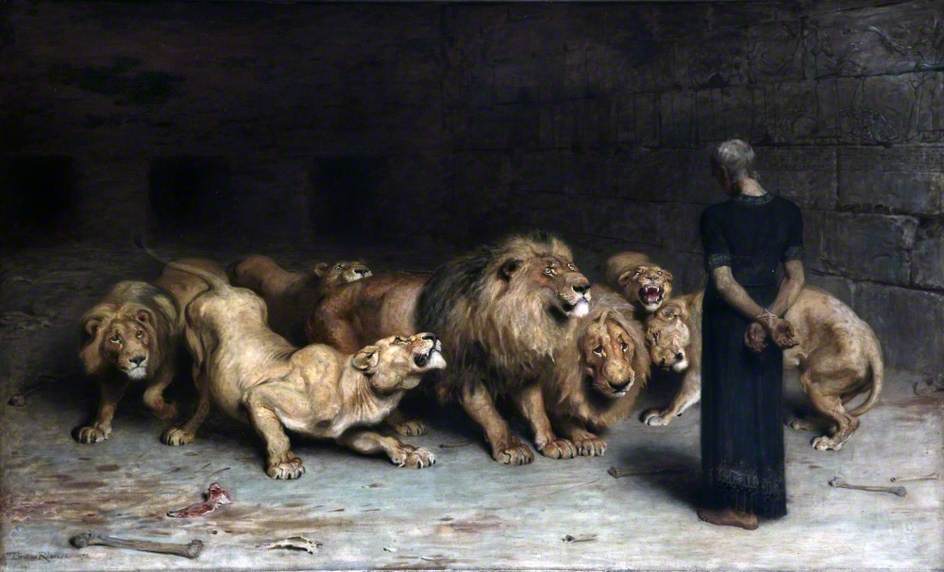
Image result for daniel and the lions den
Daniel 6:4 "Then the commissioners and satraps began trying to find a ground of accusation against Daniel in regard to government affairs; but they could find no ground of accusation or evidence of corruption, inasmuch as he was faithful, and no negligence or corruption was to be found in him."

Introduction 

Have you already experienced frustration this week? What happens when you and I are suddenly faced with a stressful situation? What is our knee-jerk response? The realm of our responses to life's difficulties tells us how much we are trusting God. What tends to be the default response of you and me. Panic? We try-to-fix-it? Run-to-others? Isn’t it interesting that we often try everything first before praying about our situation? 

One of the major themes of walking with God is that of learning to wait on Him. Isaiah 40:31 states - "Yet those who wait for the Lord will gain new strength; They will mount up with wings like eagles, they will run and not get tired, they will walk and not become weary." When we read the account of Daniel and the lion's den, we see the remarkable resolve of Daniel to wait on God. In today's post we aim to glean some principles of what it means to wait on God. What does waiting on God look like? Let's note some principles.

Remain faithful to God. Daniel 6:4 

Charles Stanley one time noted that the only kind of the faith that is reliable faith is tested faith. Whenever we come to Daniel 6, we find Daniel in his mid-eighties. For seventy years he occupied Babylon. Daniel's career as God's prophet began when he was but fifteen. Whenever King Nebuchadnezzar and his forces took the Jews away into Babylon, Daniel was among them. Daniel was tempted with a different food, culture and religion. Despite the Babylonian's best attempts, Daniel never abandoned his faith in God. 

It was then after nearly seventy years that the Babylonians were taken over by the Persians. The kingdom changed hands, yet Daniel's faith never wavered. Though the thrones of men change, God's Sovereign rule never changes.  Through seven decades of living in not one, but two pagan cultures - Daniel remained faithful. 

I find this to be the purpose of times of waiting on God. When I'm under a deadline or am caught between a rock and a hard place - it is in those moments I find myself seeking God. At the time I may not completely understand the presence of trials in my life. The only thing I can say is that in the aftermath of having to wait on God, I find the resolve to remain faithful ever strengthened.  

Retain focus on God. Daniel 6:10

Whenever you and I have to wait on God, what is the one thing we find to be the case - sharpening of focus. When all our activities come to a stop - we are brought to a point of decision. Either I will get better or bitter. Either I will focus on the seeming lack of resources, funds or forward movement in my life or I will focus on God. Whenever we are in a holding pattern, we will focus on something. 

Think about Daniel. There he was, a man in his mid-eighties. He had been praying three times a day for seven decades. The word comes to him that unless he gives into the demands of the king - his life will be on the line. What does he do? He goes to God in prayer. He does not alter his routine. Daniel had cultivated such a focus on God that nothing could stop him - no matter what. Waiting on God teaches us to retain our focus on God.  

Restrain yourself in God.  Daniel 6:11-20

Do you know one of the most remarkable features of this account of Daniel and the lion's den? It is what is missing after we read of Daniel going to God in prayer. From the time Daniel is taken away and thrown into the lion's den until the next day when the king yells down to see whether or not he is still alive - we find no words issuing from Daniel's lips. A man called by God to deal in the words of God was silent. Daniel restrained himself by not complaining, by not panicking nor accosting his opponents. It was not easy. How do we make sense of this?  

I find here a foreshadowing of the Lord Jesus Christ. Daniel remained silent - like a sheep led to slaughter. Isaiah 53:7 predicts what would be Jesus' journey to the cross - "He was oppressed and He was afflicted, Yet He did not open His mouth; Like a lamb that is led to slaughter, And like a sheep that is silent before its shearers, So He did not open His mouth." Peter quotes this same text in Acts 8:32-33. Daniel is foreshadowing a Christ-like attitude. 

Whenever you and I are placed in a holding pattern - are we inclined to hold our tongues or guard ourselves from cursing God, the circumstances or exercising ourselves in self-abasement? We are told to "have this same attitude which was found in Christ Jesus (Philippians 2:1-4). Daniel models here incredible restraint. He knew who was truly in charge - God.  

Regain strength because of God.  Daniel 6:25-28 

You and I oftentimes think if we could get out of our holding pattern - we could surely be stronger. However, it could be the case that God is having us to wait so that we can be strengthened for whatever He has us to do next. Furthermore, our life may very well be evidence to others of God's greatness in our lives - even if we cannot readily see it. Cyrus the king was moved by Daniel's courageous faith. We read his response and Daniel's outcome in Daniel 6:26-28 

26 "I make a decree that in all the dominion of my kingdom men are to fear and tremble before the God of Daniel; For He is the living God and enduring forever, And His kingdom is one which will not be destroyed, And His dominion will be forever. 27 “He delivers and rescues and performs signs and wonders in heaven and on earth,
Who has also delivered Daniel from the power of the lions.” 28 So this Daniel enjoyed success in the reign of Darius and in the reign of Cyrus the Persian.

Daniel enjoyed success. What is success? Certainly Daniel retained a place of honor in the king's court. Undoubtedly Daniel was finally in peace and safety. As wonderful as those things can be - they are but circumstantial in nature. Daniel's success in the truest sense did not lay in his occupying fine positions nor wearing fine clothing but in faithfulness. The test was passed. Daniel had waited on his God. Hebrews 11:33 notes - "who by faith conquered kingdoms, performed acts of righteousness, obtained promises, shut the mouths of lions."

These principles gives us a good picture of the importance of waiting on God. 

Wednesday, September 16, 2015

God's Sovereignty, Providence and the Eternal Glory of Jesus Christ

Daniel 2:20-21 “Let the name of God be blessed forever and ever, For wisdom and power belong to Him. 21 “It is He who changes the times and the epochs; He removes kings and establishes kings; He gives wisdom to wise men And knowledge to men of understanding." 

Introduction:
In the above two verses we see two key concepts: God's Sovereignty or right to reign in 2:20 and then God's Providence or ruling reign in 2:21. As the Lord prophesies through Jeremiah, we discover that not only was Jeremiah a prophet to the Southern Kingdom of Judah, but to the nations. God's Providential and Sovereign control over nations and history is uncontested in these chapters. The Ammonites were the descendants of the vile union between Lot and one of his daughters in Genesis 19:38 and had caused much trouble for Israel in her history. Clearly God was going to judge them, as well as the Edomites, the descendants of Esau, Jacob's brother, for their failure to help Israel at key points in her journeys. The prophecy of Jeremiah and the older book of Obadiah share this judgment against Edom. 

As other nations are mentioned, we come to the Elamites, whom God will use in the Book of Daniel to take over the Babylonians, the empire that he pronounces judgment upon in Jeremiah 50. Jeremiah's prophecy against Babylon is remarkable not only because of its accuracy of prediction, but also in Revelation 16-19 we see the predicted the fall of another Babylonian-like empire prior to Christ's return. 

History's repeated patterns are one of the many ways we see God's Providence at work. Concerning His program for the nations, all of His efforts are focused upon Israel, His chosen people whom He promises to save and restore upon His return and Millennial reign. (Zechariah 12:10; Romans 11:25-26; Revelation 19-20) 

The Sovereign and Providential control of the Father as Almighty God is shared by the Son in equal measure. According to Hebrews 5:1-6, the Person of the Son is the "only Begotten" of the Father, meaning He shares the same qualities and One eternal nature with the Father. Touching His Deity, Jesus Christ is the Son of the Father. Then in Hebrews 5:7-10 we see a second truth about the Son, namely that He came to take on a human nature through which He learned obedience and achieved our salvation, being deemed the Mediator or Priest according to the order of Melchizedek. Third and finally, Hebrews 5:11-14 tells the reader that understanding Christ's Undiminished Deity and real humanity may be hard but necessary for spiritual maturity. As God, the Lord Jesus Christ is the Eternal source of salvation and as man, He is able to administer such salvation to all who by faith truth in Him.   

Monday, July 20, 2015

Daniel - Faith at work in a foreign land


Daniel 1:8-9 "But Daniel made up his mind that he would not defile himself with the king’s choice food or with the wine which he drank; so he sought permission from the commander of the officials that he might not defile himself. 9 Now God granted Daniel favor and compassion in the sight of the commander of the officials."

Introduction:
I wanted to begin today's post with a quotation from 1 Peter 2:9-12 "But you are a chosen race, a royal priesthood, a holy nation, a people for God’s own possession, so that you may proclaim the excellencies of Him who has called you out of darkness into His marvelous light;10 for you once were not a people, but now you are the people of God; you had not received mercy, but now you have received mercy. 11 Beloved, I urge you as aliens and strangers to abstain from fleshly lusts which wage war against the soul. 12 Keep your behavior excellent among the Gentiles, so that in the thing in which they slander you as evildoers, they may because of your good deeds, as they observe them,glorify God in the day of visitation." 

Peter's point is to remind the Christian of the fact that they are "strangers" and "pilgrims" passing through this world. Such a theme is not unique to Peter, since his statements - under Divine inspiration of the Holy Spirit - are taken directly from what Moses wrote in Exodus 19 and other Old Testament passages. Hebrews 11 takes this theme of "strangers and pilgrims" and shows how patriarchs such as Abraham, men such as Joseph and then prophets such as Daniel exhibited this mindset as they journeyed by faith to "the city whose builder and maker is God" (John 14:1-3; Hebrews 11:10-16). Today's post features one of these figures, Daniel, and how he demonstrated faith at work in a foreign land. 

The longer I walk with Jesus, the more estranged I feel from this world's system and the more I pine to get to that Heavenly home. Daniel illustrates in real life what Peter and other Biblical writers wrote frequently about - namely faith at work in the foreign land of this age.

Daniel - Faith at work in a foreign land
As you begin to read the Book of Daniel, you read a book that is partly historical, partly prophetic and also devotional. These three themes weave their way through Daniel's book 
like a three braided rope. In Daniel 1:1-2:18 we see Daniel as a 15 year-old lad, along with his friends, taken away into exile in Babylon, some 800 miles from their Jewish homeland. We could say that is these verses, we see the devotional theme of Daniel exercising faith in a foreign land (along with his three friends) modeled under the following headings in Daniel 1-2: 

1. True faith rejects worldliness. Daniel 1:1-21
As Daniel and his friends were brought into Babylon, they were already endowed by God with character, blamelessness, wisdom and insight from God (Daniel 1:4). Although these young men were in their teens, they operated in a level of faith beyond their years. Unless we have been captured by the glory of God and the endless beauty of the Lord Jesus Christ, we won't begin the fight to reject the world nor persist in such an endeavor. Daniel and his friends were given opportunities to live at ease in the royal courts of Babylon, imbibing in feasting and drinking and changing their language from their native Hebrew to Babylonian Aramaic. 

Despite the pressure placed upon them to conform, Daniel 1:8 is perhaps the tipping point in the chapter: "But Daniel made up his mind". Following that resolve, we see God injecting Daniel and his friends with further favor and compassion from the Babylonians (1:9) and knowledge (1:17).  Daniel was already walking in grace. He had held position and went through process in his current level of grace. The level of faith he had was his measure of light to go by - all provided by God. By having passed the test of Nebuchadnezzars' offers of the easy life, God granted Daniel and his friends the greater measure of faith and grace they would need to handle the tests of success as well as the trials of the furnace (Daniel 3) and the much later lion's den (Daniel 6). 

2. True faith relies upon the word of God (2:1-20). 
Intermingled in this devotional theme is the prophetic dream of Nebuchadnezzar. God gives Daniel wisdom as he and his friends seek God in prayer over the dream's interpretation. We see in Daniel 2:19-23 the following comforts of God's Sovereignty: 

a. God reigns (2:19-21)
b. God reveals (2:22) 
c. God relates (2:23).

As Daniel then stands before the King to give the interpretation of the grand colossus or statue of Nebuchadnezzar's dream. We discover the prophetic history and destiny of history from Daniel's day to the end: 

a. The enormous Kingdom of Babylon is the head of gold(2:36-38)

b. Empire kingdoms of Persia, Greece and Rome, represented by the colossus' chest, belly and legs (2:39-40)

c. An evil kingdom, the kingdom of the future anti-Christ, represented by the feet and toes (2:41-43) 

d. The Eternal Kingdom of Jesus Christ represented as a stone smashing the statue. Daniel 2:44-45.

Nebuchadnezzar's statue or colossus represents the system of unbelief and Satanically inspired, man-made rebellion called "the world". Daniel's faith thrives in a foreign land because of his reliance upon the Word of God. Those prophetic visions gave Daniel the needed perspective on the fleeting duration of this world and the enduring Sovereignty of God. 

3. True faith revolves around Jesus Christ.
Daniel 1:21 has this note - "And Daniel continued until the first year of Cyrus the king." This short statement refers to the total time Daniel would be in Babylon - at least 70 years. So did Daniel's faith hold out for the 70 years that elapsed from his arrival in Daniel 1-2 until we come to the scene of the Lion's Den in Daniel 6? In Daniel 6, a new King, a new Empire and many of Daniel's enemies had died off. New opponents had arisen who hated Daniel just as much, if not moreso than the old enemies. These new villains tricked King Darius into signing an edict that would result in the Lion's Den for anyone refusing to worship the king. Though Daniel knew of the edict, his faith did not waver. In Daniel 6:10 we read - "Now when Daniel knew that the document was signed, he entered his house (now in his roof chamber he had windows open toward Jerusalem); and he continued kneeling on his knees three times a day, praying and giving thanks before his God, as he had been doing previously."

How many of us would continue persevering in faith, knowing full-well that "documents had been signed" that could end our lives? Daniel's faith was not looking at the situation around him brought about by a king in Persia but rather towards the city of the Great King. Daniel orientated his life around God's precious promises which pointed Him towards the Lord Jesus Christ. Now some may wonder how we get to Jesus from Daniel 6? Consider the logic of Hebrews 11:33 for just a moment - "who by faith conquered kingdoms, performed acts ofrighteousness, obtained promises, shut the mouths of lions." Within that same sequence of verses in Hebrews 11, we note how Moses had chosen the reproaches of Christ over the comforts of sin for a season (Hebrews 11:25-26). Much like Moses, Daniel feared not the wrath of a king, but rather chose to set his eyes of faith upon Him who is unseen (compare Hebrews 11:27 to Hebrews 11:33). The unseen One whom Daniel looked to was none other than the Lord Jesus Christ. The logic of Hebrews 11 is at work in Daniel 6. Although Daniel may not had possessed the 20/20 perspective afforded to us by Hebrews 11, the resolve and direction of His faith is as accurate in terms of what His trust is anchored to (Hebrews 6:18-20). As 21st century Christians we are reminded in Hebrews 12:1-3 "Therefore, since we have so great a cloud of witnesses surrounding us, let us also lay aside every encumbrance and the sin which so easily entangles us, and let usrun with endurance the race that is set before us, 2 fixing our eyes on Jesus, the author and perfecter of faith, who for the joy set before Him endured the cross,despising the shame, and has sat down at the right hand of the throne of God. 3 For consider Him who has endured such hostility by sinners against Himself, so that you will not grow weary and lose heart."

Closing thoughts
Today we considered how Christian faith can work and flourish in the foreign land of this present age. The prophet Daniel was our example. We discovered three necessary truths regarding faith at work in a foreign land:

1. True faith rejects worldliness. 
Daniel 1

2. True faith relies upon the Bible. Daniel 2

3. True faith revolves around Jesus Christ. Daniel 6

Sunday, March 29, 2015

How Daniel's prophecy included Palm Sunday


Daniel 9:23-24 "At the beginning of your supplications the command was issued, and I have come to tell you, for you are highly esteemed; so give heed to the message and gain understanding of the vision. 24 “Seventy weeks have been decreed for your people and your holy city, to finish the transgression, to make an end of sin, to make atonement for iniquity, to bring in everlasting righteousness, to seal up vision and prophecy and to anoint the most holy place."

Introduction
In today's post I want to give the reader a summary of one of, if not the most amazing prophecy in all the Bible - Daniel 9:23-27.1 It struck me that since today is Palm Sunday, Jesus' riding into Jerusalem on a Donkey was a matter of significant prophetic fulfillment. As we go through Daniel's prophecy, the reader will see how God orchestrated all of history to bring about Jesus' journey to the cross, and how He will orchestrate history to bring about Jesus' second coming.  

A quick fly over of Daniel's seventy weeks - 3 main divisions
The prophet Daniel, writing some 600 or so years before Jesus' coming, speaks of God's Divine time table for Israel, prophecy and this world.  The prophecy of Daniel 9:23-27, often termed "Daniel's seventy weeks", is regarded by many scholars to be the most amazing prophecy of God's Word.1  Daniel's prophecy reveals a 490 year period of time that constitutes God's Divine dealings with Israel in particular and the world in general.  In all three particular divisions can be briefly noted about this prophecy:

1. Division #1 49 years (seven sevens) in Daniel 9:25.  We know from secular history begins from Artaxerxes decree to rebuild Jerusalem on March 14, 445 b.c until its completion in 396 b.c.  That first leg of the prophecy also roughly marks the end of the Old Testament era of Divine revelation, especially in Malachi.

2. Division #2 434 years (sixty two sevens) in Daniel 9:25.  Again from a combination of predictive prophecy and secular historians we see Daniel speaking of the period of time extending between the testaments - the so-called "silent years". The "silent years" are called such because of God not revealing any new revelation nor inspiring any Bible books during that time.  When the books of Malachi and Esther were finished, the Old Testament Canon closed.  In this period of time (396 b.c to Jesus' days), four world empires arose and fell as predicted also by Daniel in his prophecies: Babylon-->Persia-->Greece-->Rome. 

Whenever you add the 49 years (from 445 b.c-396 b.c) and 434 years (396 b.c. - 32 A.D) together, you arrive at a total of 483 years. Remarkably, Daniel's prophecy begins at the decree to rebuild Jerusalem in March 14, 445 b.c to Jesus' riding into Jerusalem on April 6, 32 A.D. Daniel 9:26 then predicts what is most likely the crucifixion of Jesus Christ on that same week! - "Then after the sixty-two weeks the Messiah will be cut off and have nothing....". This particular part of the prophecy of Jesus riding into Jerusalem on a Donkey was predicted in more detail in passages such as Zechariah 9:9. Christians today celebrate what is called "Palm Sunday" to commemorate this event of Jesus presenting Himself as King. 

3. Division #3 The final "week" or seven years, i.e Daniel's seventieth week in Daniel 9:26b-27. This third division of Daniel's prophecy, thought the shortest portion in God's prophetic time clock, yet receives the most focus in the prophecies of scripture.  

A more specific look at division #3 of the prophecy - Daniel's final 70th week or final seven years
As you look closer at the final "week" (seven years) of Daniel's prophecy, some details emerge.  First of all, Daniel 9:26b gives a general statement about the final seven years of history - "and the people of the prince who is to come will destroy the city and the sanctuary. And its end will come with a flood; even to the end there will be war; desolations are determined."  In this general statement of Daniel's seventieth week in 9:26b we see six elements:

1.  The people = The followers of the "prince"

2.  The prince = He is coming and is different from the Messiah who was cut off - namely Jesus Christ.

3.  The city = Jerusalem, the central city of the prophecy

4.  The sanctuary = A temple that will exist in Jerusalem in this final seven year period.  Most likely some sort of Jewish Temple built in the Tribulation period

5.  Its end = the prophecy has an end point in mind, corresponding to the conclusion of God's prophetic 490 year period set for Israel in relationship to His judgment of the world

6.  War = A final war will be waged with accompanying desolations or Divine judgments near the end of this seven year period of Daniel's seventieth week.   

A very detailed look at the last half of the seventieth week of Daniel
Daniel 9:27 states - 27 "And he will make a firm covenant with the many for one week, but in the middle of the week he will put a stop to sacrifice and grain offering; and on the wing of abominations will come one who makes desolate, even until a complete destruction, one that is decreed, is poured out on the one who makes desolate.” If we take the last three and one half years as the main focus of Daniel 9:27, we can note four elements of what is now a very detailed view of Daniel's seventieth week (seven years) and its latter half (3 1/2 years):

1. he - The Prince who comes and the same one spoken of in Daniel 9:26.

2. "firm covenant with the many for one week". The prince makes a peace covenant with the many, that is the Jews specifically and the world in general.  The covenant is promised by the prince to last the entirety of the seven years spoken of by Daniel, however....

3. "middle of the week he will put a stop to sacrifice". Evidently there will be sacrifices occurring at this temple during this seven year period, however this prince will suddenly interrupt the ceremonies and break covenant with the people at the 3 1/2 year mark.

4. "will come one who makes desolate, even until a complete destruction, one that is decreed". The true character of this prince, called elsewhere in scripture "false Christ" (Matthew 24:15, Mark 13:22); "the son of perdition" (2 Thessalonians 2); "anti-Christ" (1 John 2:18-19); "the beast" (Revelation 13-14), will blaspheme God and lead the whole world astray.  2 Thessalonians 2 summarizes the desolation spoken of here in Daniel, namely the true Christ, the Son of God, will destroy Anti-Christ, the prince, by the breath of His mouth. 

Conclusions and applications
We have aimed to summarize what is perhaps the most amazing prophecy in the Bible - Daniel 9:23-27.  First we noted its three main divisions which when added all together equal a 490 year period of time decreed by God for the Jewish people. Secondly, we noted how the prophecy focuses more closely on the third division, a final seven year period that has yet to occur and will include God's judgment on the world prior to the second coming of Jesus Christ. Thirdly we saw that the prophecy focuses even further on a figure called the Anti Christ who will make a covenant with the Jews for seven years, only to break that covenant mid-way and garner the wrath of God.  Fourthly, we saw a few of the New Testament passages that utilize Daniel 9:23-27 in identifying this future archenemy of God's people and the Lord Jesus Christ.  

The application of Daniel 9:23-27 is seen in two ways: first in how the passage describes the coming future judgment of God on this world, and how unbelievers need to believe and repent now. Secondly we see how accurate the scriptures are in their predictions and thirdly e see that God will keep His promises to His people the Jews, which of course means He will keep His promises to His people the church.   

Endnotes:
1. A very helpful chart to follow Daniel's prophecy can be found at  http://www.middletownbiblechurch.org/oldtesta/oldtes10.htm

2. A most recent example of this continuing trend is the current sermon series being preached by Dr. Robert Jeffress of 1st Baptist Dallas entitled: "The Perfect Ending", wherein He comments on Daniel 9:23-27. 

Monday, December 2, 2013

The theme of endurance & healthy faith in Daniel & 3 John


Daniel 12:13 "But as for you, go your way to the end; then you will enter into rest and rise again for your allotted portion at the end of the age.”

3 John 11 "Beloved, do not imitate what is evil, but what is good. The one who does good is of God; the one who does evil has not seen God."

Some thoughts on the book of Daniel in general and Daniel 11-12 in particular
As we close out our time in the Book of Daniel today, we need to make a general observation about the book and then say something specific about Daniel 11-12. First, the Book of Daniel functions as a padlock, meaning that at the end God through an angel tells Daniel that the vision is sealed and must wait and appointed time. When read in concert with the Book of Revelation, the message and contents of the book open up, being that Revelation functions as a perfect key to unlock Daniel. 

With regards to some specific observations about Daniel 11-12, we are seeing the most detailed prophecy of God's Word. 

1. Daniel 11:1-2 begins by predicting four Persian Kings that would follow Darius that history defines as being from Cambyses (529-522 b.c) all the way to Xerxes I who ruled Persia in the days of Queen Esther in 480 b.c. Remember Daniel was writing this portion of his prophecy in along 515 b.c. 

2. As you do down through Daniel 11:3-45, prediction is made concerning the Greek Empire that would be led by Alexander the Great in 333 A.D and that would divide into four parts given to each of his generals following his death. Those four divided kingdoms in their detail and description of leadership are remarkably detailed and completely accurate as they lead you to an evil king in Daniel 11:29-35. 

This evil King would be known in history as Antiochus Epiphanes who ransacked the temple in Jerusalem in 168 b.c but was overturned by a group of Jews called the Maccabees. The Jewish holiday known as Hanukkah commemorates that event. God through Daniel then uses the predicted events of history as patterns for what will be a prediction of the Anti-Christ in Daniel 11:36-45. 

3. When will the Anti-Christ arise? Daniel 12 gives the timing of his rise, as well as God's faithfulness to preserve the Jewish remnant who will had believed upon Jesus the Messiah in the event of His second coming. 

4. Daniel 12 closes with reference to the resurrection of the righteous at the beginning of His earthly reign and then that of the wicked dead which, in comparison to other scriptures, will occur at the end of Christ's millennial or 1,000 year reign in Revelation 20. 

How the Book of Daniel aims to encourage the believer in the present to endure with prophecies of things to come
Daniel's book closes with an encouragement, much like his intent at the beginning of Daniel 11. The encouragement is for Daniel and those of like precious faith to endure to the end. 

The Book of 3 John is all about cultivating a healthy Christian faith that will endure to the end
When you turn to 3 John, the theme has to do with having a healthy Christian faith. 

1. We see the encouragement to healthy Christian faith (3 John 1-8)

2. We see warnings about unhealthy faith (3 John 9-10) 

3. Then we see a final section on the importance of having a good testimony (3 John 11-15). 

Conclusion
As Daniel and John's writing teach us, through the grace of God and His word, we can endure to the end and have this promise that He Who begins a good work in us will bring it unto completion unto the day of Christ.

Sunday, December 1, 2013

The Christian walk of faith in Daniel 9-10 & 2 John


Daniel 9:24-27 24 “Seventy weeks have been decreed for your people and your holy city, tofinish the transgression, to make an end of sin, to make atonement for iniquity, to bring in everlasting righteousness, to seal up vision andprophecy and to anoint the most holy place. 25 So you are to know and discern that from the issuing of a decree to restore and rebuild Jerusalem until Messiah the Prince there will be seven weeks and sixty-two weeks; it will be built again, with plaza and moat, even in times of distress. 26 Then after the sixty-two weeks the Messiah will be cut off and have nothing, and the people of the prince who is to come will destroy the city and the sanctuary. And its end will come with a flood; even to the end there will be war; desolations are determined. 27 And he will make a firm covenant with the many for one week, but in the middle of the week he will put a stop to sacrifice and grain offering; and on the wing of abominations will come one who makes desolate, even until a complete destruction, one that is decreed, is poured out on the one who makes desolate.”

How a major Bible prophecy strengthened Daniel in His walk with the Lord
Daniel 9 is perhaps the most incredible chapter in the book of Daniel, being that it contains the most amazing and sweeping prophecy in the Bible: Daniel 9:23-27 is the golden gateway to the remainder of Daniel's prophecies that will speak of history up until Christ's return. For seventy years Daniel had been living in Babylon, as was by now in his mid-eighties by the time he composed Daniel 9. 

The chapter begins with him reading the words of the inspired book of Jeremiah. Having read the promises of the captivity lasting for seventy years in Jeremiah 29:10-14, Daniel's eyes and faith must have widened, for in his way of reckoning, only two to three years would remain until God's discipline of the Jews was finished. The prayer that flows from Daniel's heart in Daniel 9:1-22, as well as the strengthening ministry of angel Gabriel makes this chapter gleam even more. 

Daniel 9:23-27 predicts a 490 year period of time prescribed for the Jews by God that will begin as soon as they return and re-construction of their then damaged temple begins. We know from reading the historical books of Ezra and Nehemiah that such a project was undertaken. Daniel's prophecy also predicts the rebuilding of the city of Jerusalem, again an event that was completed in 396 b.c right after the closing of the Old Testament canon. Then the third major event predicted at the end of Daniel deals with the coming and crucifixion of Jesus, which in the timing of Daniel 9:23-27 was to occur 483 years after the decree to build the temple in Jerusalem had been made. From that decree to rebuild on March 14, 445 b.c until Jesus rode into Jerusalem on a donkey to present Himself as Israel's King in April 6, 33 A.D is exactly the 483 years that Daniel predicted. 

The remaining seven years of Daniel's "seventy weeks" has yet to occur in a period of unprecedented judgment on this world called "The Tribulation Period". Daniel 10 teaches the believer about the comfort of Bible prophecy in how we see the Person of Christ (10:1-9); Provisions of grace (10:10-17) and the Promises of scripture (10:18-21). 

What 2 John has to explain about the Christian walk
The Book of 2 John is all about explaining the Christian walk in regards to: The power of the Christian walk (2 John 1-6) and defense of the Christian walk (2 John 7-13). Knowing about the important truths of the Christian walk will aid any Christian in dealing with the great triumphs and often difficult circumstances that attend the Christian life. 

How the Books of Daniel and 2 John can be used together to better understand the Christian walk of faith
Remarkably, when you read Daniel and John's writings together, you are seeing two men who had been walking with God for about the same period of time (Daniel 70 years, John 60 or so years) and who were about the same physical age when they wrote their books (Daniel 85; John at least 85 at the time of 2 John). May you and I walk with the Lord and realize that it is always worth it!

Saturday, November 30, 2013

The theme of overcoming and God's prophetic clock in Daniel & 1 John


Daniel 7:13-14 “I kept looking in the night visions,And behold, with the clouds of heaven
One like a Son of Man was coming, and He came up to the Ancient of Days and was presented before Him. 14 “And to Him was given dominion, Glory and a kingdom, that all the peoples, nations and men of every language Might serve Him. His dominion is an everlasting dominion Which will not pass away;
And His kingdom is one Which will not be destroyed."

Introduction & review:
A couple of days ago we had been studying our way through the Book of Daniel in conjunction with the epistles of John.  As we prepare to enter back into the Book of Daniel today, I remind the reader of our last time in Daniel, which the reader can review at: http://pastormahlon.blogspot.com/2013/11/gods-hand-and-spiritual-discernment-in.html

God's prophetic clock revealed in Daniel 7-8
Today we continue on in our study of Daniel and John's epistles once again.  May the Lord richly bless you as you read this series of blogs and glean from both Daniel's book and the Apostle John's books. 

Daniel 7-8 is a remarkable section in Daniel for a couple of reasons. For one thing Daniel 7-8 was composed some ten years before the events of Daniel 5-6, meaning that even with the Book of Daniel itself there is detailed fulfilled prophecy of near events. Undoubtedly when Daniel composed the Book of Daniel, the Holy Spirit had him arrange the visions in a certain topical arrangement. The crown jewel included in these visions of Daniel 7-8 is found in the above opening verse in today's post - Daniel 7:13-14.  Daniel sees in visions the Pre-incarnate Christ in heaven approaching the throne of the Father, sharing in equal glory and power.  

A second feature of these two chapters is that Daniel is switching to God's prophetic dealings with the Jewish nation. We know that the focus is shifting from the Gentiles to the Jewish people once again due to the fact that Daniel 1 was written in the language of the Jews (Hebrew), Daniel 2-7 was written in a Gentile language (Aramaic) with Daniel 8-12 switching back to the language of the Jews once again. 

So what? Why are the facts above important for you to know dear reader? Here is why: Daniel 7-8 is a unit that gives you God's prophetic clock for history through two sets of lenses: His dealings with the world system of the Gentiles (Daniel 7) and His dealings with the Jewish nation (Daniel 8) will regulate how He deals with the world from Daniel's day up until Christ's return. 

The theme of overcoming in Daniel & 1 John
Daniel 7-8 deals with details, visions and prophecies about two general eras: the time from Daniel's day up until the days of Christ's first coming and then the final seven year period (the Great Tribulation) that will lead up to Christ's Second coming. To go beyond those general descriptions would exceed the purposes of today's blog. However we can say this: that whether through the Gentile lens of Daniel 7 or through the Jewish Lens of Daniel 8, the Kingdom of the Lord Jesus Christ will crush the regimes of men and rebellion of Satan's man - the Anti-Christ. The faith of the Christian is reinforced by and rooted in the Author and Finisher of faith - Jesus Christ. (Hebrews 12:1-2)

The truths we see in Daniel are the similar truths we see in the book of 1 John.  The Apostle John writes his final words of the book of 1 John. What will overcome the allure of this world - our faith. John lays out at the close of 1 John 5 the Christian's three confidences for overcoming this world: namely the confidence of scripture (1 John 5:13); the confidence of prayer (1 John 5:14-15) and our confidence in Christ's our salvation (1 John 5:16-21).