Numbers 8:9-10 "So you shall present the Levites before the tent of meeting. You shall also assemble the whole congregation of the sons of Israel, 10 and present the Levites before the Lord; and the sons of Israel shall lay their hands on the Levites."
2 Timothy 1:6 "For this reason I remind you to kindle afresh the gift of God which is in you through the laying on of my hands."
Introduction:
I can recall the day I was ordained to the Gospel ministry. The process leading up to that ordination had involved years of training in both Bible College and Seminary. For 25 years God has had me preaching His word. Nearly a decade passed before the time came for my ordination. But even more important than the formal training and preaching opportunities themselves were the character qualities God needed to work out in my life. There were some wonderful men God placed in my path to teach me valuable lessons on friendship, loyalty, leadership and doctrinal conviction. There were various jobs and positions that taught the much needed lesson of servanthood and a willingness to do whatever task, no matter how menial. All of these lessons prepared me for the day I would get ordained.
So why do churches ordain men for the ministry? Is this rite a recent development in church history? or are their Biblical patterns that inform the necessity for ordained men and the ordination process itself?
Ordination is a very special time in the life of a church and a man of God. To ordain means "to set apart" for God's service. Normally a group of other ordained ministers and Deacons will come together to form what is called an ordination council. The council's job is to examine a man who has expressed their conviction of God's call to ministry. There are usually a series of questions asked - ranging from the doctrinal to the pastoral to the personal.
The candidate for ordination is then asked to give testimony of his salvation and what he understands concerning his own call to the Gospel ministry. Such an examination by other ordained men is designed to either confirm that man's call and to attest such a calling to the church or to screen out those men who may not quite be ready.
Biblical passages that deal with ordination and setting apart those who minister God's word
Ordination is truly a remarkable event. In a sense it is where God calls a man from among the called people of God to issue forth the call of the Gospel from the word of God. Ordination is not a recent phenomenon in the church's life. The following scriptures testify to this ancient roots of this pattern of recognizing God-called men.
To begin, the opening passages in today's post feature the setting apart of the Levites for service in the tabernacle (Numbers 8:9-10) and Paul's reference to young Timothy's "setting apart" and having received the "laying on of hands" in 2 Timothy 1:6. Once the Levites were set apart, Numbers 8:22 then records - "Then after that the Levites went in to perform their service in the tent of meeting before Aaron and before his sons; just as the Lord had commanded Moses concerning the Levites, so they did to them."
Priests were regularly ordained or "set apart" as a mark of God's calling and choosing of them for the task of temple service. We see ordination occurring in the life of Joshua, Moses' successor, in Numbers 27:18-19 "So the Lord said to Moses, “Take Joshua the son of Nun, a man in whom is the Spirit, and lay your hand on him; 19 and have him stand before Eleazar the priest and before all the congregation, and commission him in their sight." The significance of "laying on of hands" is found repeatedly on most of the biblical passages dealing with this subject of ordination. Whenever one laid there hands on another for setting apart unto God's service, there was an idea of "conferral of authority". Numbers 27:20-21 spells out this formal meaning of "laying on of hands": "You shall put some of your authority on him, in order that all the congregation of the sons of Israel may obey him. 21 Moreover, he shall stand before Eleazar the priest, who shall inquire for him by the judgment of the Urim before the Lord. At his command they shall go out and at his command they shall come in, both he and the sons of Israel with him, even all the congregation.”
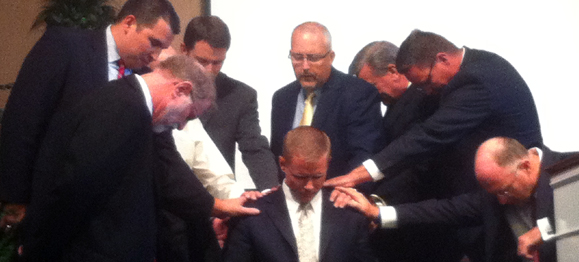
I can recall in my ordination service where the pastor and deacons each took turns laying their hands upon me, praying over me and asking God's blessing upon the future of God's ministry through me. My brother-in-law, a pastor himself, had driven several hours to participate in this public event. Ordination's quality as a public event lends to its significance in the church's life. For Old Testament Israel, men like Joshua were to lead them. Joshua's ordination, which we saw a moment ago, has its significance explained in Deuteronomy 34:9 "Now Joshua the son of Nun was filled with the spirit of wisdom, for Moses had laid his hands on him; and the sons of Israel listened to him and did as the Lord had commanded Moses."
When we come to the New Testament, we see the principles of ordination, already established in ancient Israel, continuing their way in the New Testament church. Whenever Paul and Barnabas were getting ready to launch out into their first missionary work, we read in Acts 13:3 "Then, when they had fasted and prayed and laid their hands on them, they sent them away." The most specific information we have about ordination in the New Testament is found in Paul's two letters to young Pastor Timothy. In 1 Timothy 4:14 we read: "Do not neglect the spiritual gift within you, which was bestowed on you through prophetic utterance with the laying on of hands by the presbytery." And then again 2 Timothy 1:6 "For this reason I remind you to kindle afresh the gift of God which is in you through the laying on of my hands."
Applications:
We could certainly bring in further passages from both Old and New Testaments to bring home the significance of ordination in the life of a pastor and God's people who take seriously the public ministry of the Word of God. For brevity's sake, I will list those other passages for the reader's review (1 Kings 19:15-18; 2 Kings 2:9, 15; 8:8; 2 Kings 9:1-10; 1 Timothy 4:14; 5:22; 2 Timothy 1:6; Hebrews 6:2). As we close out this post today, what lessons can we draw from our brief consideration of the above texts? We can briefly note three such lessons...
1. God affirms his calling on a man through his word to the heart of that individual. God then follows up with a confirmation of that calling through the process of ordination and the acclamation of God's people.
2. In most of the examples we considered above, the men who were ordained were younger men. Ordination is significant because it can be used of God to alert the young men in the congregation of God's dealings with them as to whether or not He is calling them to serve Him.
3. The congregation's participation and observation of the ordination service reinforces and reminds them of the importance of the ministry of the word of God. The man who is ordained will hopefully have many years of fruitful preaching and leading of God's people. In so far as that man is ordained to lead the people, the people have the responsibility to follow and pray for that man.