Translate

Showing posts with label Eschatology. Show all posts

Wednesday, April 8, 2026

Post #30 1700 Years of the Nicene Creed - the phrase "whose kingdom shall have no end" - interpreting the millennium and its relevance to the Nicene Creed

Introduction:

    In the last post in this series here Growing Christian Resources: Post #29 1700 Years of the Nicene Creed - the phrase "whose kingdom shall have no end" and evaluating millennial views, I spent time overviewing the major interpretive options for the millennium in Revelation 20. Our whole point was to interact with the Nicene Creed's affirmation "whose kingdom shall have no end". 

    In today's post I intend to wrap up this part of our study of the Nicene Creed by noting key hermeneutical or interpretive assumptions that govern where and why people conclude premillennialism, amillennialism, or postmillennialism. I will then make some final remarks on the relevance of this whole discussion to the Nicene Creed's statement about Christ's never ending kingdom. 

What interpretive issues in Revelation 20 govern the millennial discussion?

1. Is Revelation 20:1-10 recapping current history from Christ's resurrection to 2nd coming or is it following from His 2nd coming in Revelation 19:11-21?

2. Is the reference to "First Resurrection" speaking of salvation or of a future resurrection of the righteous at Christ's return?

3. Is Revelation 20:1-10 detailing more than one resurrection or is there only one general resurrection of both righteous and the wicked at the end of history? Many will include discussion of 20:11-15 in answering this question.

4. Is the Kingdom of Jesus Christ only spiritual and present, spiritual and earthly with an already/not yet component or entirely earthly in the future?

5. Is the number "1,000" a literal reference to a future 1,000 year reign of Jesus or is it a symbolic round number referring to His current reign in Heaven over the earth or a little bit of both?

Why does the millennial discussion have relevance to the Nicene Creed's statement "who kingdom shall have no end"?

    As I noted at the beginning of this post, the Nicene Creed does not tilt either way in the direction of any of the above millennial views. The Nicene Creed's main purpose is to summarize key affirmations of the Christian faith that Christians in all places and at all times may confess in a worship service. 

    The millennial discussion is relevant because of how it has us refocus our attention on the second coming of Jesus Christ and the manifestation of Himself, His Kingdom, and the end of the age. Furthermore, the millennial conversation draws our attention to how Christ will bring about what will be the perpetuation of His Kingdom into eternity long after this age and its kingdoms have passed off the scene. 

    Even how the first four or five centuries of church history construed these things reveals a lack of pure consensus. Yes, Chiliasm or Classical Premillennialism was the majority report in the beginning, however, a minority of church fathers held to some type of allegorized view of the millennium or in some cases, a half-way point between chiliasm and the allegorized view. 

    For the church fathers, the emphasis was on the resurrection of the body and the anticipation of Christ's "at-any-moment" return (which by the way is a hallmark detail of modern pretribulation, premillennial thought).  

    The eternal kingdom of Christ far exceeds the systematic expressions of eschatology found in the early church or even in the four main positions I outlined above. The Nicene Creed's standard, generalized expression of eschatological expectation keeps us focused on Christ's physical, bodily return and the unending nature of His Kingdom. In other words: keeping the main thing is the main thing. 

Closing thoughts and what's next

     As we've been at this series on the Nicene Creed, we journeyed through the detailed confessions of the deity and personhood of God the Father, the deity and humanity of the Son and His atoning work, resurrection, ascension, and soon return. In our next post we will begin to explore the Nicene Creed's statements on the Person and Work of the Holy Spirit. Stay tuned!

Wednesday, March 25, 2026

Post #29 1700 Years of the Nicene Creed - the phrase "whose kingdom shall have no end" and evaluating millennial views


Introduction:

    In the last post of this series on the Nicene Creed, we looked at the Nicene Creed's confession of Jesus coming in glory here Growing Christian Resources: Post #28 1700 Years of the Nicene Creed - "and He shall come again, with glory". I closed out that last post by noting how the Kingdom of God is the domain of the reign of the Son of God. What divides theologians concerns the issue of the millennial kingdom that it referred to throughout Scripture.

    I pondered some on the debate over the nature of Christ's reign as it relates to the doctrine of the millennium. Is the revelation of the glory of the King mainly in Heaven now with a final manifestation meant to then resurrect the saints, judge unbelievers, and usher in the New Heavens and New Earth (the broad outline of so-called "amillennialism" and "post-millennialism")? 

    Or will the glory of God through Christ, through His Kingdom, involve an earthly physical stage of a 1,000 years duration, beginning with the resurrection of the just and concluding with the resurrection of the unjust, final judgment, and New Heavens and Earth?

    For those who want to appeal to the Nicene Creed to support pre-, a-, or post-millennialism, the Creed itself will not lend proof for either school of thought. Suffice to say though the whole debate over the millennium must reckon with which view most clearly shows Christ revealing the glory of His deity in such a way to flood the whole earth and cosmos, as well as to show He is the decisive revelation of God. 

    In today's post I wanted to revisit where I ended in the last post and evaluate the four leading millennial viewpoints against the next statement in the Nicene Creed: "who kingdom shall have no end". What we will do is briefly define what the main schools of thought are on the millennium, how such a discussion is relevant to this phrase in the Nicene Creed, and then offer some final reflections.

Four views of the millennial reign of Christ

    To keep this post at a minimal length, I will confine our survey of the millennial views to the Biblical text of Revelation 20, which tends to be the main hotbed of contention among the four schools. 

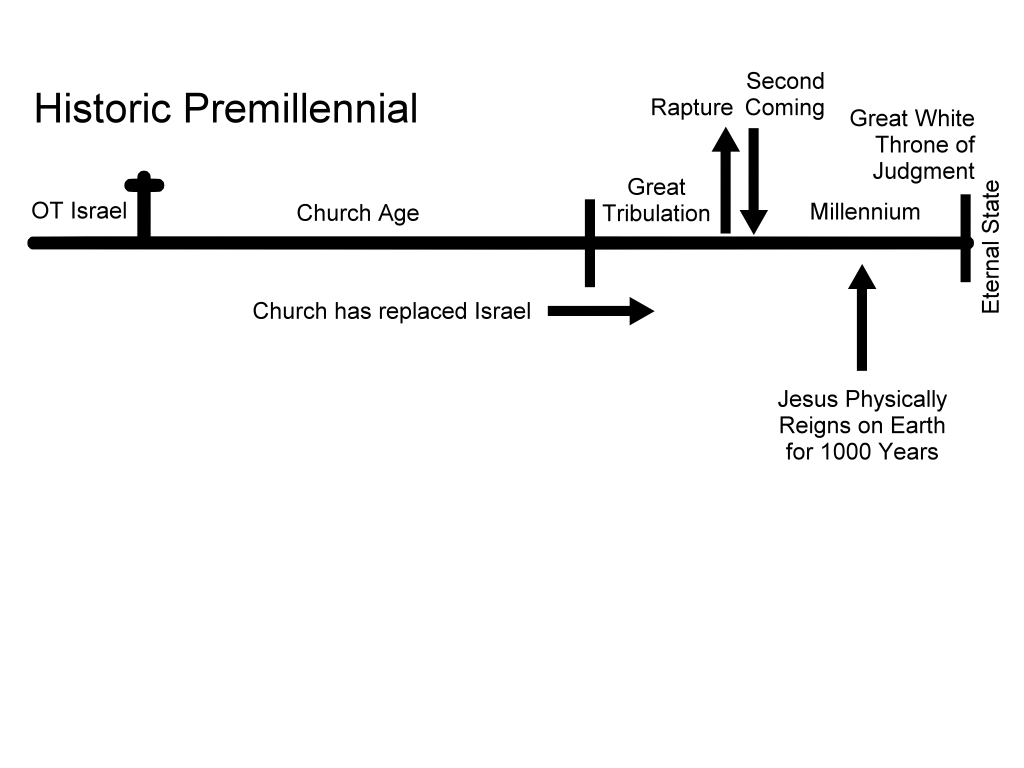
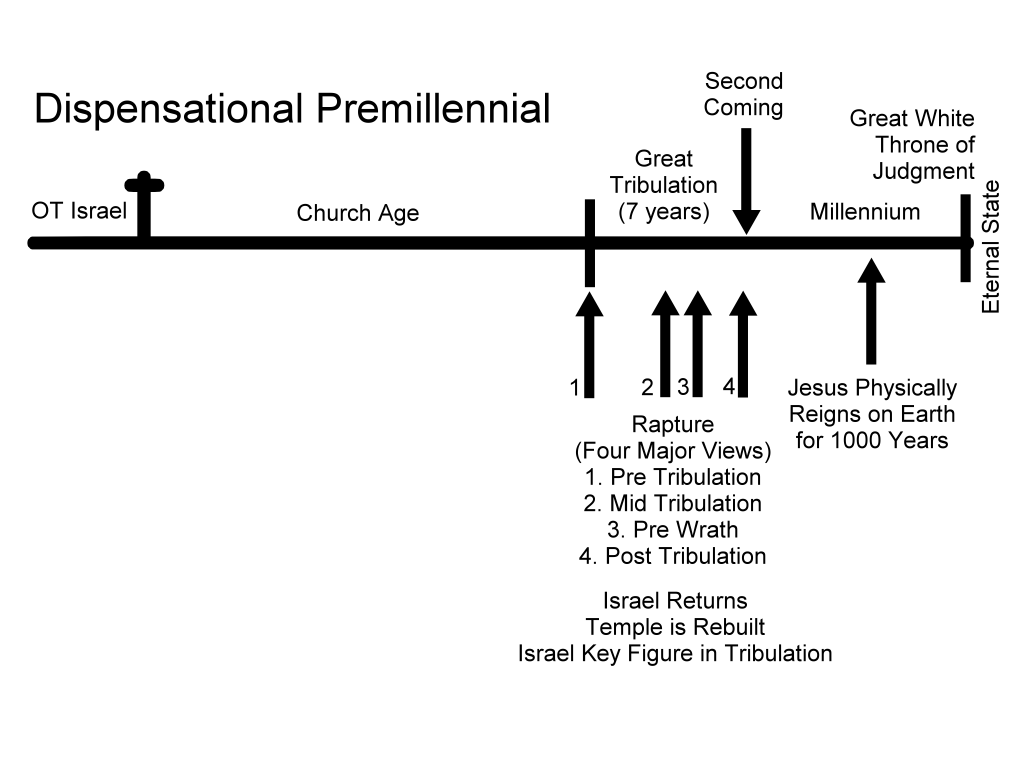
1. Premillennialism - Those who hold to this teach that when Christ returns, He will set up a literal earthly kingdom for 1,000 years, followed by a brief loosing of Satan to deceive the nations, the Great white throne judgment and then the bringing in of the "New Heavens and New Earth". The reason for the name "premillennialism" is due to the prefix "pre" referring to "before" and "millennium" being "1,000 years". Two variations exist within the Premillennial interpretation which for now we will just list their names. These two variations could also count as two of the four millennial views, since each of them have vast amounts of literature associated with them, as well as leading commentators and interpreters. 

a. Classical Premillennialism 

    Sometimes called "Post-Tribulational Premillennialism", this version of premillennialism is so-called because of its claim to be the oldest eschatological view on the millennium, hence "classical premillennialism". Early interpreters such as Irenaeus of Lyons (180 A.D.) and Papias (mid-second century) championed this position, known in their day as "chiliasm". The most notable proponent of this position in recent times was the late George Eldon Ladd.

b. Dispensational Premillennialism.

    Sometimes called "Pre-tribulational Premillennialism", this position is represented by those in the early church who anticipate the soon return of Christ at anytime for His church. Medieval theologians such a Jehoiakim Fiore, and more recently by John Nelson Darby, twentieth century dispensationalism (men such as John Walvoord and J. Dwight Pentecost), and progressive dispensationalists today (such as Darrell Bock) have advocated this view. 

2. Amillennialism.


   This position teaches that Christ began His reign at His ascension into Heaven and is ruling and reigning over a spiritual kingdom right now. Early forerunners of this position didn't so much express themselves as "Amillennial" as they did their opposition of the classical premillennialism noted above - i.e. "chiliasm". One of the earliest forerunners to this view was Cyprian of Carthage, who wrote in chapter 27 of his book "On The Unity of the Church" in the mid-3rd century:

"The Lord’s coming will be sudden; let Him find us vigilant, not distracted by the world’s deceit. If we hold fast to His precepts, the devil will not overcome us. Awake, therefore, and reign with Christ, for only those who watch shall receive the crown."

     Being that it denies a literal 1,000 year reign of Christ, the term "A-millennialism" is used (a=no and millennium = 1,000 years).  History (according to this view) will continue in its downward spiral and at the end Christ will return, judging the world and Satan, and bring about the new heavens and new earth. Cyprian of Carthage was an early forerunner, with Augustine of Hippo (4th-5th century) being the first to truly systematize it into a workable eschatological model. Modern theologians such as Sam Storms and Jay Adams are among more noteworthy defenders of it. 

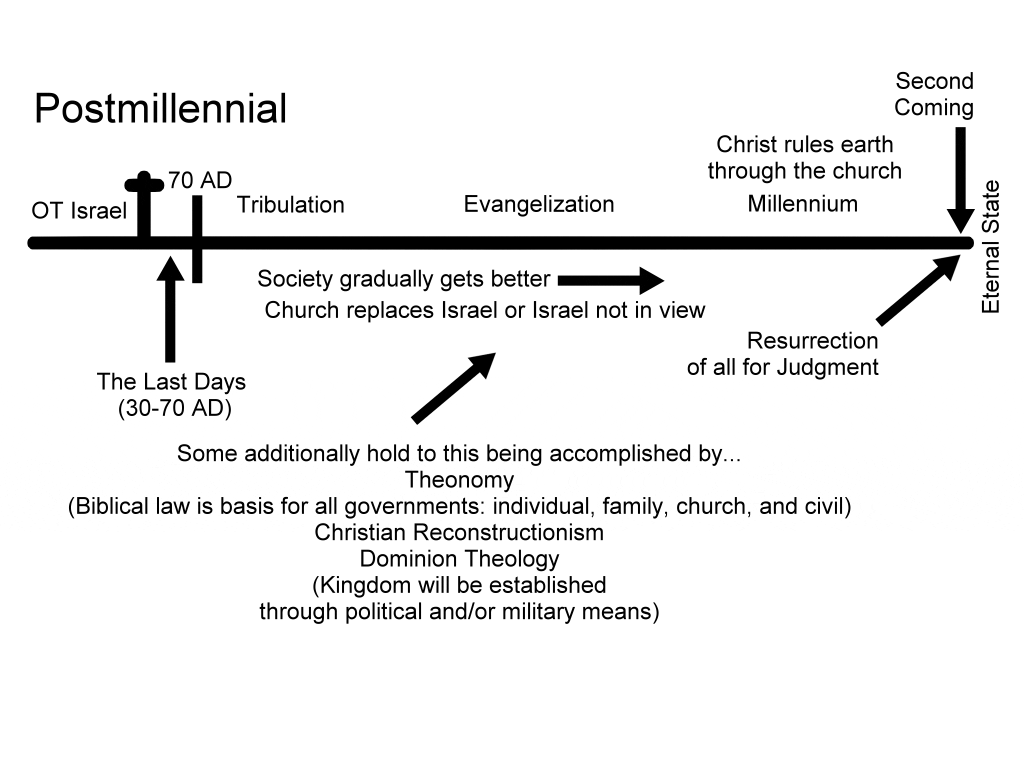
3. Post Millennialism 

    This position teaches that Christianity will continue to increase until the whole world is taken over by the gospel.  Though not every individual will be saved, yet post-millennialists contend that every nation will eventually see many of their people saved.  It generally teaches that the church will continue to evangelize until so many people are converted that Christ will then return at the end of the future golden age or "millennium" )post = "end" millennium= 1,000 years).  

    Post-millennialists take passages such as Psalm 2 and missionary passages such as Matthew 28:18-20 to refer to the triumph of the gospel over unbelief. Admittedly, if there was one view I wish I believed, it would be this one (due to its optimistic outlook on the triumph of the Gospel). Older theologians such as Jonathan Edwards and more recent ones such as the late R.C. Sproul and Greg Bahnsen have ably expressed its tenets. represent this viewpoint. 

    As for myself, I tend to land in the pre-tribulational, premillennial camp. Readers may explore this blogsite, where I have written posts in the past delving into far more detail on the above positions just outlined, as well as my own understanding.

    In the next post I'll continue on to deal with the interpretive issues involved in the discussion about the millennium and the relevance of this discussion to how we understand the Nicene Creed's "whose kingdom shall have no end".


Wednesday, February 25, 2026

Post #28 1700 Years of the Nicene Creed - "and He shall come again, with glory"


Introduction:

    It has been a while since I posted in my series on the Nicene Creed. A busy ministry schedule and other series floating around in my mind have precluded me from working any further into the Nicene Creed. With that said, in the last post we noted the important of "theological triage", that is, prioritizing doctrines of Scripture by their relative weight or emphasis in the Bible in comparison to other truths here Growing Christian Resources: Post #27 1700 Years of the Nicene Creed - The Nicene Creed's Confession Of Last Things (Eschatology) and a word on theological triage

    One reason we are studying the Nicene Creed is because earlier generations of the church saw the need to give agreed-upon summaries of what was essential for Christians everywhere and at all times to confess with regards to their faith. Creeds are not meant to be exhaustive in their treatment of Bible doctrine. Other theological treatises such as confessions or doctrinal statements operate to give more detailed listings of doctrines. Even then, there is still a sense in which there is a consistency among all orthodox creeds, confessions, and doctrinal statements when it comes to what counts as first tiered theological commitments. 

    In today's post we continue on with our study of the Nicene Creed by noting what it has to say about Christ's second coming. I'll likely be posting installments at a slower pace, since we are also currently studying the doctrine of sanctification in this blogsite. Onto the Nicene Creed!

"And He shall come again."

    The Nicene Creed affirms the second coming of the Son. When Jesus ascended into Heaven forty days after His resurrection, He gave final instructions to His disciples. In Acts 1:9-11, we read what then is said next by angels who appear to the disciples as Jesus ascends:

"And after He had said these things, He was lifted up while they were looking on, and a cloud received Him out of their sight. 10 And as they were gazing intently into the sky while He was going, behold, two men in white clothing stood beside them. 11 They also said, 'Men of Galilee, why do you stand looking into the sky? This Jesus, who has been taken up from you into heaven, will come in just the same way as you have watched Him go into heaven.'”

    The point made here by the angels to the disciples is that the return of Jesus will be a physical and bodily return. This of course isn't the only passage in the Bible that asserts the second coming, but it is among the clearer passages that affirm the bodily return of our Lord (see also Acts. 1:11; 3:19–21; 1 Corinthians 4:5; 11:26; 15:23). If one takes what the Nicene Creed is saying here in context of its overall confession of the incarnation, this point emerges all the more. 

    The Second Coming of Jesus Christ is the most focused upon subject in all of Biblical prophecy or Eschatology. The late Bible scholar John Walvoord notes:

"It (the second coming) constitutes the most tremendous intervention of divine power in the entire course of human history. On every hand one discovers that the Scripture dealing with the second coming is the key to the prophetic future." (Biblio Theca Sacra 114:454, April 1957, page 97). 

    Roughly one out of every four verses in the Bible refer to Biblical eschatology. In the realm of such references, the physical bodily return of our Lord dominates the Biblical vision of the future or last things. Jesus Himself spoke often of what would be His second coming (Matthew 16:27; 25:29-31; 26:64; Mark 8:38; Luke 9:26; 22:69). Let me give one example of a pair of references from the Old and New Testaments concerning our Lord's soon return to earth.
    
    The prophet Isaiah prophesied of the future coming of Yahweh to earth in Isaiah 25:6-9 "The Lord of hosts will prepare a lavish banquet for all peoples on this mountain; a banquet of aged wine, choice pieces with marrow,
And refined, aged wine. 7 And on this mountain He will swallow up the covering which is over all peoples, even the veil which is stretched over all nations. 8 He will swallow up death for all time, and the Lord God will wipe tears away from all faces, and He will remove the reproach of His people from all the earth; For the Lord has spoken.
9 And it will be said in that day,
'Behold, this is our God for whom we have waited that He might save us.
This is the Lord for whom we have waited; Let us rejoice and be glad in His salvation.”
    
    In Isaiah's prophecy we certainly see the visible, physicality of this return to earth. The coming Kingdom will be manifested in a physical way, altering the very earth itself. One feature associated with the Lord's return is mention of a great banquet, a common theme in passages that speaks of God manifesting Himself to His covenant people in the context of His redemption of them (see Exodus 24 or our Lord's institution of the Lord's Supper in Luke 22). 
    
      The Apostle John records a strikingly similar description of the coming of Jesus Christ with His bride, the Church, first Revelation 19:7-9 "Let us rejoice and be glad and give the glory to Him, for the marriage of the Lamb has come and His bride has made herself ready.” 8 It was given to her to clothe herself in fine linen, bright and clean; for the fine linen is the righteous acts of the saints. 9 Then he said to me, 'Write, ‘Blessed are those who are invited to the marriage supper of the Lamb.’” And he said to me, 'These are true words of God.” 

    The same author then records the very vision of the coming of Jesus Christ, Yahweh in the flesh, in Revelation 19:11-14 "And I saw heaven opened, and behold, a white horse, and He who sat on it is called Faithful and True, and in righteousness He judges and wages war. 12 His eyes are a flame of fire, and on His head are many diadems; and He has a name written on Him which no one knows except Himself. 13 He is clothed with a robe dipped in blood, and His name is called The Word of God. 14 And the armies which are in heaven, clothed in fine linen, white and clean, were following Him on white horses."
    
    This pair of references are but a small slice of numerous examples of texts that emphasize the physical, visible return of our Lord who is God and man to earth, just as affirmed in the Nicene Creed (see for instance Zechariah 14 and Matthew 24:15-31; Joel 2:28-32; Daniel 9:23-27; and 2 Thessalonians 2:7-8 and many, many others). 

"With glory"

    Three senses of the term "glory" are worth mentioning as revealed in the Bible. The first sense is "incarnate glory". The reason why the Nicene Creed adds this little phrase "with glory" is to emphasize the point I made earlier, namely the second coming of our Lord will not be invisible, but visible; not a spiritual non-physical return, but a return featuring Him in his post-resurrected, ascended, incarnate glory as God in the flesh. This is the first observation to note of what is meant by "glory", namely the incarnated glory of Christ returning to earth. 

    What is the glory of God? God's glory is that excellency of God whereby He makes visible, clear, and revelatory His otherwise unapproachable, invisible nature and attributes. As Christ returns, He will manifest the glory of deity through His glorified humanity due to His coming for His people. The second coming of Jesus Christ is promised to the Christian to be one which they will see with their own eyes (Job 19:25-28; 1 Peter 1:8; 1 John 3:2-3; Revelation 1:7-8). 

    Baptist Theologian J.P. Boice notes of the glory in which Christ will appear at His second coming:

"It will be an appearance with power and glory; “for the Lord himself shall descend from heaven, with a shout, with the voice of the archangel, and with the trump of God,” (1 Thess. 4:16); “in the glory of his Father,” (Matt. 16:27); and “in his glory, and all the angels with him,” (Matt. 25:31); fulfilling to believers their expectation of “the appearing of the glory of our great God and Saviour Jesus Christ.” Tit. 2:13" (J.P. Boice, Abstract of Systematic Theology, 40.3). 

    The second sense concerning how Christ will return "with glory" is that He will have the accompaniment of the angelic hosts of heaven itself. Jesus earlier on in His public ministry made this statement in Mark 8:38 "For whoever is ashamed of Me and My words in this adulterous and sinful generation, the Son of Man will also be ashamed of him when He comes in the glory of His Father with the holy angels." Theologian A.A. Hodge notes this of Christ's second coming in glory in His "Outlines of Theology":

"The coming itself, its manner and
purpose are alike defined. He is to be attended with the hosts of
heaven, in power and great glory." 

    Then the final sense of the term "glory" has to do with how Jesus Christ will manifest His full deity with which He shares with the Father and the Holy Spirit in the realm of the coming Kingdom itself. The Kingdom of God is the domain of the reign of the Son of God. What divides theologians concerns the issue of the millennial kingdom that it referred to throughout Scripture. Is the revelation of the glory of the King mainly in Heaven now with a final manifestation meant to then resurrect the saints, judge unbelievers, and usher in the New Heavens and New Earth (the broad outline of so-called "amillennialism" and "post-millennialism")? Or will the glory of God through Christ through His Kingdom involve an earthly physical stage of a 1,000 years duration, beginning with the resurrection of the just and concluding with the resurrection of the unjust, final judgment, and New Heavens and Earth? The Nicene Creed doesn't dive into those specifics, nor will I in this post. Suffice to say though, the whole debate over the millennium must reckon with which view most clearly shows Christ revealing the glory of His deity in such a way to flood the whole earth and cosmos, as well as to show He is the decisive revelation of God. 

Tuesday, February 3, 2026

Post #27 1700 Years of the Nicene Creed - The Nicene Creed's Confession Of Last Things (Eschatology) and a word on theological triage

Introduction:

    In our study of the Niceno-Constantinopolitan Creed of 381 A.D., we have explored the Creed's confession of God the Father and God the Son. As we are coming down the homestretch of what the Nicene Creed has to say about God the Son, we come to that section that deals with summarizing the Biblical teaching on "eschatology" or the study of last things.

Theological triage. 

    In an emergency room, doctors and nurses are able to know who to treat and who is to remain in the waiting room by a process known as "triage". A person with a broken arm, though serious, is not regarded as severe as another in cardiac arrest. Determining which is which is the whole point of triage. 

    In the study of Bible doctrine and theology, theologians undergo a similar approach to "theological triage", noting what the Bible states as of first, second, and of third importance, as well as viewing historic creeds like the Nicene Creed. Readers may refer to an excellent article on theological triage by Al Mohler here A Call for Theological Triage and Christian Maturity - AlbertMohler.com 

    Let me mention one more important point before we go forward. This author affirms the historic and Biblical doctrine of "Scripture Alone" (sola scriptura). Whenever Jesus for example was dealing with His opponents, He would always distinguish between "it is written" (quoting from the Old Testament at the time) and "you've heard it said" (the traditions of the Pharisees). Jesus was a proponent of sola Scriptura, affirming that all other secondary forms of authority are decided by the primary and only infallible, inerrant source of the faith - Scripture. Sola Scriptura does not exclude consultation of such secondary authorities like creeds, commentaries, and church leaders (otherwise we would have to call it "solo-scriptura"). 

    We ought to know what the church-at-large has historically taught so as to check our own doctrinal positions to ensure doctrinal fidelity. What sola Scriptura reminds us of is that those secondary reference markers are to be checked against the only source which God has revealed through the Prophets and Apostle - the Bible. Even as we move forward in our study of the Nicene Creed, we mustn't think it is the same level of authority as the Scripture (for the Creed is only a summary, an outline of what Christians confess). If the reader wants more details on where I stand on the place and purpose of creeds and confession in Christian practice, then please review my first post in this series here  http://www.growingchristianresources.com/2025/05/post-1-1700-years-of-nicene-creed-what.html  

The Nicene Creed's confession of eschatology or "last things".

    If we use the approach of "theological triage" introduced above, we can begin to grasp what the Nicene Creed has to confess regarding eschatology. Eschatology (more popularly known by some as "Bible Prophecy") covers the following subjects typically discussed today: the state of the soul after death, Heaven, Hell, Christ's physical, bodily second coming, resurrection of the soul and body, the final judgment, and the New Heavens and New Earth. Most would consider these "first-tier" subjects or those dogmas that are confessed by Christians everywhere and at all times. 

    There are other topics that are discussed among Christians that though important, do tend to not be as central as the above subjects. There are what we would call "second-tier" areas, such as whether or not Christ will have a millennial reign on earth and whether or not Israel is to be restored. Sometimes a second-tier issue can become emotionally charged enough or touch upon a current issue in the culture that makes it hover between first and second-tier status (the whole matter of Israel's current status has become a hot-button topic in recent years, for example).  

    Then there are then so-called "third-tier" topics that are intramural discussions among Christian denominations and churches, such as whether or not there will be a future tribulation period, whether or not there is a rapture, the timing of the rapture relative to the tribulation, identity of the Anti-Christ, and whether or not world events are setting up future end-times scenarios. 

    As the reader can note, some of the first grouping of topics on eschatology are those covered not only in the historic Christian creeds (Apostle's Creed, Nicene Creed, Athanasian Creed), but also historic confessions (such as the 2nd London Baptist Confession 1689, Westminster Confession of Faith, Augsburg Confession) and more recent ones (Baptist Faith and Message 2000 for example). The second and third groupings, as I said, tend to be discussed among denominations and larger segments of Christianity. 

    I bring this out to remind the reader that although all doctrine is important, yet not all doctrine is of equal weight and bearing on the totality of Christian conviction. For instance, if I deny the physical, bodily return of Jesus Christ, I may need to question the genuineness of my Christian confession. However, if I differ with someone else on the timing of the rapture or even on whether or not there is to be a future millennial reign of Christ on earth, Christian faith and practice will remain intact. This is why studying the historic Creed of Christianity is valuable, since we're reminded by such summaries what is central, secondary, and tertiary in the realm of Christian doctrine, judging all of course by the final court of appeal - The Bible.    

    When you look at the Nicene Creed's summary of eschatology, its "short list" of what it considers primary-tier or first-order doctrines central to the Christian faith, you find the following.

1. Christ's physical, bodily second coming = "and He shall come again, with glory."

2. Final judgment = "to judge the quick and the dead."

3. Christ's eternal Kingdom = "whose kingdom shall have no end."

    Those three clauses give us the first group of statements by the Creed on eschatology. They occur as the concluding statements in the overall confession of the Son's deity, humanity, substitutionary atonement, resurrection, and ascension. 

    We then come to the final sentences of the Nicene Creed, which give us further statements on eschatology:

1. The resurrection of the body = "and we look for the resurrection of the dead

2. New Heavens and New Earth = "and the life of the world to come. Amen"

    It is of interest to note that the first grouping of eschatology occurs at the end of the confession on Christology, whereas the second grouping comes after statements made about the church and baptism. 

Why theological triage is relevant to our confession of eschatology in the Nicene Creed

    We must remember that the Nicene Creed is a confession recited by Christians who meet together for Sunday worship. Their identities and understanding of where they're heading is wrapped up in the Person of Jesus Christ, who reveals the Father, who won their salvation, and who is coming again. 

    Typical debates in eschatology today about Premillennialism, Amillennialism, and Postmillennialism won't be settled by appealing to the Nicene Creed, since such matters are of second-tier status, not first-tier central Christian affirmations. As for third-tier level discussions such as the timing of the rapture (an intramural discussion among certain strands of premillennial believers), the Nicene Creed will not be the place to go. Why?

    The point of creeds is not to exhaust all the Bible has to say on such matters as eschatology, but rather to provide a summary of the most salient points of the faith "once for all delivered to the saints". In the realm of theological triage, the creeds give us "first tier" concerns. 

    When we look at confessions of faith like those mentioned above, they will get more detailed, bringing into view the second-tier as well as first tier commitments. Then of course we have doctrinal statements relevant to denominations or churches that may even spell out their teaching on third-tier matters, since such subjects are of importance in those immediate contexts of Christians. 

Closing thoughts:

    As a final note, whether one is a Premillennialist (which I am), or Postmillennialist, or Amillennialist, the importance of such tried-and-true summaries like the Nicene Creed is I can confess what the Creed says about Christ's second coming along with those dear brothers and sisters who espouse different schools of eschatological thinking. Creeds help us to see the Christian faith from the 30,000 foot level, especially in this era of history where so many attacks are daily leveled against Christians. May we prayerfully and thoughtfully consider these thoughts as we move forward in this study. 

Wednesday, March 22, 2023

A Study Of Paul's Teaching About The Rapture & Tribulation Period In 1 & 2 Thessalonians


Introduction:

  In our last post, here, http://www.growingchristianresources.com/2023/03/a-study-of-jesus-teachings-about.html,  we explored what Jesus had to teach on the tribulation period in His sermon on the Mount of Olives in Matthew 24, Mark 13, and Luke 21. We focused upon how His teaching advanced our understanding of the Bible's overall teaching on the tribulation at the end of this age. We also made some remarks on why the rapture of the church does not appear in Jesus' Sermon on the Mount, while commenting that He does introduce the rapture in His later institution of the Lord's Supper in John 14:1-3.

    As noted in a previous post, scholar Dr. Tim LaHaye has counted nearly fifty Old Testament passages and fifteen New Testament texts that refer to the Tribulation period. I recall reading of how other than Paul's letters to the Thessalonians, we see no other mention of the Tribulation period in the New Testament Epistles. This is very telling. 

    As the late John Walvoord once noted in a conference on the rapture and tribulation, the absence of mention of the tribulation period in the Epistles (save 1 and 2 Thessalonians of course) gives another argument for placing the rapture prior to the Tribulation period. 

    Thus what follows concerns Paul's teaching on the Tribulation in 1 and 2 Thessalonians. As will be discovered, the only reason He mentions this event is to contrast it with the rapture and to serve warning to those who may not yet be believers in the Lord Jesus Christ.   

Paul's teaching on the Rapture & Tribulation period. 

    Jesus significantly advances our understanding of the Bible's overall teaching on the tribulation period. Whenever we come to the writings of the Apostle Paul, we find there are two main passages in his writings the deal with the Tribulation Period (1 Thessalonians 5:1-11 and 2 Thessalonians 2:1-12). In both passages, Paul discusses the tribulation period in light of the rapture of the church. 

    Unlike what we saw in Jesus' teaching on the tribulation, Paul treats the tribulation period in its relationship to the rapture of the church. We discover that the tribulation will follow the rapture. Paul's extensive knowledge of the Old Testament, as well as His careful distinctions about the church in the rapture, informs how He presents this subject of the triublation. The first of these passages, 1 Thessalonians 5:1-11, is worth outlining to see how it treats the Tribulation period:

I. The swiftness of God's wrath at the end of the tribulation will be avoided by believers 1 Thessalonians 5:1-3

    The Apostle Paul undoubtedly is using this phrase "day of the Lord" in 1 Thessalonians 5:1-3

"Now as to the times and the epochs, brethren, you have no need of anything to be written to you. 2 For you yourselves know full well that the day of the Lord will come just like a thief in the night. 3 While they are saying, “Peace and safety!” then destruction will come upon them suddenly like labor pains upon a woman with child, and they will not escape."

    In our last post, we briefly looked at the usage and appearance of the phrase "The day of the Lord". This term, as it describes the final outpouring of God's wrath on the earth, is spoken of in Old Testament passages such as Isaiah 2:12; Isaiah 10:3; Isaiah 13:9; Isaiah 34:2; Isaiah 34:8; Isaiah 61:2; Ezekiel 30:3; Amos 5:18; Zephaniah 1:7. 

    To grasp the nature of the Day of the Lord as revealed in Scripture, as well as to understand why the church won't have to endure it, gives us a strong argument for the rapture occuring before the tribulation period.

    The beginning of the Day of the Lord will begin at the same time as the rapture or shortly before it. As we saw in my recent posts on the rapture, the Lord's gathering of His church to Himself will occur with no preceding signs - meaning it will be "imminent" or will occur at anytime. The Day of the Lord (i.e. covering The Tribulation period, 2nd coming of Jesus to earth, His thousand year reign, see especially Joel 2-3) will begin in the same manner - suddenly and imminently. 

    Paul emphasizes this point of  "imminency" in 1 Thessalonians 5:1 (see the citation of 1 Thessalonians 5:1-3 above). Furthermore, in noting the timeframe of the Day of the Lord, I would argue that the "Day of the Lord" will cover the entire seven-year tribulation period, and not just a portion of it. 

II. The severity of wrath of the Great Tribulation (final 3 1/2 years) will be avoided by Christians in the church right now. 1 Thessalonians 5:4-9

    So we have seen that the "Day of the Lord", which will include the entire Tribulation period, will come swiftly, at anytime. The Apostle Paul appears to be working backwards from the end of the seven-year tribulation period to its mid-point. Whenever you compare Paul's presentation of the tribulation period to that of Jesus' in Matthew 24-25, you discover that this section of 1 Thessalonians 5:4-9 corresponds to Matthew 24:21-41. In terms of what we noted earlier, Jesus refers to the last 3 1/2 years of the Tribulation period as "The Great Tribulation". 

    So the question is: would Paul's readers (and us) have to worry about the severity of wrath in that final half of the future tribulation? Paul's answer is "no". Now with that said, Paul uses the truth of the coming tribulation to tell his readers to be on the "alert" and "on their guard". Like any church, the church at Thessalonica had a mixture of "true believers" and "make-believers". 

    For those people who think they are "o.k" with God and thus can live in ease, it is those people who need to be the most alarmed. Paul's words in 1 Thessalonians 5, connected with his continuing discussion of the rapture from 1 Thessalonians 4:13-18, gives people a warning and a chance to escape the coming wrath by trusting in Christ as Savior, Lord, and Treasure (see 1 Thessalonians 5:9). Like Jesus before him, the Apostle Paul is referencing the coming Tribulation period, in terms of its severity, to warn unbelievers of what is coming.  

III. Solid encouragement to live for Jesus right now - 2 Thessalonians 2

    So, we have seen how the tribulation period or "Day of the Lord" will begin swiftly, without preceding signs, in lines with the rapture of the church. We then looked at the severity of this future era as a warning to unbelievers about the need to trust in Christ in this current age of grace. But now, Paul is going to pivot to some final words of encouragement. 

    In 1 Thessalonians 5:1-11 we saw Paul begin with the end of the Tribulation (the day of the Lord) and work his way back through the second half of the Tribulation period (called by Jesus the Great Tribulation) to underscore the swiftness and severity of judgment. We have seen as well that Paul offers strong encouragement that believer's will not have to experience such wrath and that they are to strive all they can for Jesus now. But what about Paul's teaching in 2 Thessalonians 2:1-8? 

    2 Thessalonians speaks of the coming of Jesus Christ and our being gathered to Him. The doctrine of the rapture is mentioned in 2:1-2, which states:

"Now we request you, brethren, with regard to the coming of our Lord Jesus Christ and our gathering together to Him, 2 that you not be quickly shaken from your composure or be disturbed either by a spirit or a message or a letter as if from us, to the effect that the day of the Lord has come."
  
    Paul refers to that doctrine to comfort his readers in the face of rumors circulating that perhaps the Thessalonians had missed the rapture; or that the day of the Lord had come; or that they were somehow going to have to endure God's wrath after-all. From 2:2-12 we get an overview of the whole Tribulation period:

1. 2 Thessalonians 2:2-4 The increasing level of apostasy going on right now up until the Anti-Christ is first revealed at the beginning of the Tribulation.

2. 2 Thessalonians 2:5-11 The Spirit of God will remove His restraining influence and check on man's evil, and the Anti-Christ will have full liberty to increasingly and gradually exercise full dominion over this planet. One purpose of this period will be to judge unbelieving man's sin. A second main purpose for this period will be to prepare Israel for her coming Messiah at the end of this period. However, we gain a clear third purpose: destruction of Satan's man - the Anti-Christ.

    The encouragement Paul gives to his readers is that because of Jesus' catching away of His Church just before the "Day of the Lord" or Tribulation period, the Christian will not have to endure all that will transpire in that seven period of time. 

Endnotes:

1. To say there will be seasons of trial or tribulations throughout the history of Christ's church or the individual lives of God's people cannot be disputed. In fact suffering and trials of all sorts is to be the norm for anyone wanting to be Godly in Christ Jesus. (Acts 14:22; 2 Timothy 3:12) However the testimony of scripture bears out the fact that the Tribulation period (the whole seven year period of time spoken of in Daniel and elsewhere) is unique in terms of its intensity and character and thus merits its own unique study and understanding.

2. The Book of Zephaniah is perhaps the fullest treatment on this phrase in the Old Testament, being that the entire book is dedicated specifically to describing it. Will this day encompass the entire Tribulation period? Or is this a phrase meant to describe the tail end of the Tribulation period? Zephaniah 1:1-3:11 describes how God will wage war against the nations who have assembled against Him, followed by the promised restoration of Israel and the redeemed in Zephaniah 3:12-20. When we tie in the Old Testament teaching on the tribulation and Jesus' instructions about it, we find out that "the Day of the Lord" will encompass the entire tribulation period. Paul's usage of this phrase contains this built-in assumption, which leads me to conclude the church will not be present in the tribulation period.
 

Saturday, March 18, 2023

A Study Of Jesus Teachings About The Tribulation Period In Matthew, Mark, and Luke.


Introduction & Review

    Today's post will focus upon Jesus' teaching on the tribulation period in His final public sermon. To understand what is meant by "The Tribulation Period", let me review briefly from our last post. In our last post we concluded the following regarding the Old Testament's teaching about the Tribulation period:

1. The Tribulation period will be an unprecedented time of human history, occurring at the end of this age. 

Daniel 12:1 

“Now at that time Michael, the great prince who stands guard over the sons of your people, will arise. And there will be a time of distress such as never occurred since there was a nation until that time; and at that time your people, everyone who is found written in the book, will be rescued."

    The tribulation period is so-called due to how God will pour out what is called His "eschatological wrath" (that is, "His final expression of judgment") upon this world's unbelieving system and inhabitants. It is called by other names ("Day of the Lord" - Zephaniah 1:15;  "Daniel's seventieth week" - Daniel 9:23-27; and "time of Jacob's trouble" - Jeremiah 30:7. just to name a few).

2. The Tribulation period's purpose, in addition to God's judging of this world, is prepare Israel to meet her Messiah (see Zechariah 12 and 14, as well as Romans 11:25 and Revelation 14). 

    We can also note, especially from Revelation 7, that many people will get converted to Christ in the Tribulation period as a result of the efforts of the 144,000 Jewish evangelists preaching the Gospel.

3. The Tribulation period's duration will be seven years. 

    This length of time is drawn from the final seven year period or "final week" of Daniel's seventy weeks prophecy in Daniel 9:23-27. In Daniel 9:26b-27, we discover that the final seven year period is sub-divided into two equal halves of 31/2 years each. 

    Jesus refers to this prophecy, noting in Matthew 24:21 that the latter half is called "The Great Tribulation", due to the increased intensity and frequency of God's outpouring of wrath. The first half is not focused upon near as much as the latter half in other prophetic passages (especially in Revelation 13-18, which details the events of that final 31/2 year period). 

4. A tyrannical ruler will attempt to blaspheme God and lead the whole world astray in outright rebellion again God. 

    This ruler is called by many names in prophetic Scripture (the son of perdition, anti-Christ, the beast). His regieme will be known as "Babylon the Great", and is detailed in Revelation 15-18. 

5. Christ's rapture of the church will precede this event. 

    The rapture and His second coming constitute part one and part two of His overall return, with the tribulation ooccuring in between both. His return to earth to rescue Israel will close out this period of time. We do not find mention of the rapture in the Old Testament, due to it being an event revealed by Jesus, then His Apostles, for the church and this current period of time for which the church eagerly awaits the return of her Lord (see Philippians 3:20-21 for example).
    Readers may review the last post by clicking here:http://www.growingchristianresources.com/2023/03/a-study-of-old-testaments-predictions.html.

    As we continue on in our Biblical overview of the Tribulation period, we enter now into the New Testament with the aim once again to understand what the Bible has to say about this subject. In today's post, we shall review Jesus' teaching on the tribulation period.

Jesus' teaching on the Tribulation period

   Jesus is recorded saying the following about the tribulation period in Matthew 24:21-22

"For then there will be a great tribulation, such as has not occurred since the beginning of the world until now, nor ever will. 22 Unless those days had been cut short, no life would have been saved; but for the sake of the elect those days will be cut short."

     The above citation is taken from Jesus' final public teaching on the Mount of Olives - called by scholars "The Olivet Discourse". To understand why Jesus focuses attention on the tribulation, we first need to note the setting of Jesus' sermon.

The setting of Jesus' sermon on the mount gives insight into His remarks on the tribulation period. 

    The history of the Mount of Olives gives insight into understanding why Jesus would devote so much time to expounding upon the tribulation period. 
    
    This particular mountain is spoken of in Ezekiel's vision of the glory of God departing from the Temple in Jerusalem and resting over "the mountain to the East" in Ezekiel 9-10. 

    The setting of Jesus' sermon tells us that His sermon is detailing how God will deal with Jerusalem in history and prophecy. Zechariah 14, another significant prophetic passage that highlights this famous mountain, will feature the Lord Jesus returning to earth at the end of the tribulation period to restore Israel unto Himself before beginning His earthly reign. Such Biblical background aids us in seeing the significance of Jesus' remarks on the Divine plan for Jerusalem, the future tribulation period, and His second coming. 

How Jesus' teaching is presented in Matthew, Mark, and Luke.

    The three versions of this teaching, found in Matthew 24:1-31; Mark 13:1-27 & Luke 21:5-28, are the passages we look to to understand Jesus' teaching on the Tribulation period and His Second coming back to earth. 
    
    In the citation from Matthew 24:21-22, we find Jesus alluding back to Daniel 12:1ff. This allusion signals to us that Jesus is not only referring to the pending destruction of Jerusalem and its temple 40 years future to Jesus' words, but also The Tribulation period at the end of this age. 

    Matthew and Mark's accounts appear to emphasize Jesus' predictions a near event future to them (destruction of Jerusalem in 70 A.D) and the Tribulation period at the end of this age. 

    Luke's account does the same as Matthew and Mark, with the additional phrase of the "times of the Gentiles" referring to the Gentile occupancy in Jerusalem that began in the days of King Nebuchadnezzar, and which will cease at the end of the future Tribulation.

Some specific observations about the tribulation period from Jesus' teaching in His sermon on the Mount of Olives.

    There is much more that could be said about Jesus' teaching, but we can note a few points about the Tribulation from these texts:

A. Jesus utilizes Daniel's prophecies throughout His sermon, meaning that He uses similar language to describe a future seven year period, divided into two equal 3 1/2 year periods, with the latter being the most severe (see Daniel 9:23-27 and Daniel 12:1-3).

B. Jesus refers to the whole period as "The Tribulation Period" (Matthew 24:29; Mark 13:24) and the latter half as "The Great Tribulation" (Matthew 24:21). Jesus uses phrases from Daniel 9:23-27 and Daniel 12 to describe this period as being unprecedented.

C. In all three passages there is reference made to a fairly near event future to Jesus' time as well as the far future tribulation period. The near future event of the destruction of Jerusalem in 70 A.D acts as a template to preview what will be the final seven year tribulation period spoken of in Daniel. 

    In Daniel's prophecies we see this same phenomena of "double-fulfillment", wherein he speaks of a fairly near set of events 250 years from his day (which is the attack of Jerusalem and its temple by Antiochus Epiphanes in 168-165 b.c.) and of course the far future event of the tribulation period at the end of this age.

D. Jesus' continuity with Daniel's prophecies gives us a bridge between the Old and New Testament teachings on the Tribulation period. Every passage that follows throughout the New Testament on the Tribulation period does so from Jesus' sermon interpreting the extensive Old Testament treatment on the subject.

A quick note about the absence of the rapture in Jesus' teaching on the tribulation period

   A final remark needs made about the rapture, or the lack of mention thereof.  So, why no mention of the rapture of the church in Matthew 24-25, Mark 13, or Luke 21? As we labored to show already, Jesus' is laying out God's final dealings with the Jews both in the near prophetic sense (destruction of Jerusalem in 70 A.D.) and far prophetic sense (Daniel's 70th week or tribulation period). 

    In the chronology of Jesus' teaching, once he completes His Olivet Discourse, it is then where He and his disciples go to the upper room to begin the celebration of the Passover (see Matthew 26:1; Mark 14:1; Luke 22:1; John 13:1). 

    Since Jesus is instituting the Lord's Table in the context of the Passover Celebration, and since His Lord's Table is a new Covenant meal for the pending coming Church age (which would begin in Acts 2), it makes sense that Jesus would make reference to the rapture of the church in John 14. 

Closing thoughts:

    Today we surveyed Jesus' teaching on the Tribulation Period in His sermon on the Mount of Olives. The takeaways for this study are as follows. First, God's pledge to bring His chosen people, Israel, to faith in her Messiah, as well as His promises to their forebears Abraham, Isaac, and Jacob, require the Tribulation period. The primary purpose of this period is to prepare Israel for the coming of her Messiah at the end of this age. God's promises to His people Israel says something to those who are His people in the Church - that God never breaks His promises. Then lastly, drawing attention to this period of time places urgency on evangelization of neighbors and friends as to how they can avoid the coming wrath of God upon the earth. 


Thursday, March 16, 2023

A Study Of The Old Testament's Predictions Of The Coming Tribulation Period


Introduction:

    In today's post we are going to begin looking at one of the two major events which will follow the rapture of the church. Readers may consult my last two posts on the rapture of the church here http://www.growingchristianresources.com/2023/03/introducing-christs-return-for-his.html and here http://www.growingchristianresources.com/2023/03/the-major-bible-passages-on-rapture-of.html. 

Two major events that will follow the rapture of the church.

    The one event will involve the rewarding of Christians for how they lived their lives for Jesus while here on this earth. This event, called "The Judgment Seat of Christ" or "The Judgment Seat of God"  (see 1 Corinthians 3:10-15; 2 Corinthians 5:10; Romans 14:10) will occur in Heaven when all Christians, deceased and living, will be caught away by Jesus and given glorified, physically transofrmed bodies. The judgment seat of Christ will not be about whether someone has trusted in Christ as Savior (this of course is a pre-requisite in becoming a Christian). Rather, the issue at stake will be that of faithfulness to the Lord. This "Judgment of believers" or "Judgment Seat of Christ" will represent a heavenly theatre of God's activity following the rapture and will last the duration of the final seven years of world history.

    The second event, the Tribulation period, which we could refer to as an "earthly theatre", will feature God's Divine wrath poured out upon this world. This event will be contemporary with the rewarding of the saints spoken of in the above paragraph. Unlike the Judgment Seat of Christ, the focus of the Tribulation will not be the Church, since the Church will had been raptured prior to the Tribulation. Instead, Israel's preparation for her Messiah will be one of three foci (with the two other foci being Divine judgment of Evil and mass conversion of people to Christ from the nations) - see Zechariah 12:10; 2 Thessalonians 2:8-12; Revelation 7:9). 

    The Tribulation period is the focus of today's post. In particular, we want to understand how the Old Testament introduces and progressively reveals this important teaching of Bible prophecy. Author Tim Lahaye notes the following about the importance of gaining familiarity with the Tribulation period:

"In His masterful Olivet Discourse, our Lord warned that this world has yet to see a time of "great tribulation", such as was not since the beginning of the world to this time, no, nor ever shall be (Matthew 24:21). And those who take the Bible literally find it signficant that the Tribulation period is given more space in Scripture than any other comparable event, There is more space allocated to the Tribulation than the 1,000-year Millennial Kingdom, heaven, hell, or any subject except salvation and the promise of Christ's second coming. It is mentioned at least 49 times by the Hebrew prophets and at least 15 times in the New Testament." (Tim Lahaye and Thomas Ice, Charting the End Times, page 56). 

    Even though I won't cover all 49 Old Testament texts on the tribulation period, what follows is a survey of nine of the more major passages to give us a sense of the Old Testament's progressive revelation on the subject. This is important to know, since Jesus and the Apostles refer often to the tribulation period in the New Testament. 

How the Old Testament progressively tells us of the future Tribulation period.

1. Deuteronomy 4:26-31 - The First Mention of the Tribulation Period.

   Note what Moses writes in Deuteronomy 4:30-31 

"When you are in distress and all these things have come upon you, in the latter days you will return to the Lord your God and listen to His voice. 31 For the Lord your God is a compassionate God; He will not fail you nor destroy you nor forget the covenant with your fathers which He swore to them."

    The above text stands as perhaps the first mention in the Bible of a period of time that Jesus calls "the tribulation" (Mark 13:19). God lays out the prophetic history of Israel through the Old Testament and human history (4:26-28) with reference to her going through a time of great difficulty and deliverance by her Lord in 4:29-31. At this early stage in the Bible's revelation of this subject, Israel's whole history and the tribulation period are treated as one, seamless history.

2. Isaiah 13:6-18 - The day of the Lord is associated with the Tribulation

    The heart of this passage is expressed in Isaiah 13:9-11a 

"Behold, the day of the Lord is coming,Cruel, with fury and burning anger, To make the land a desolation; And He will exterminate its sinners from it. 10 For the stars of heaven and their constellations will not flash forth their light; The sun will be dark when it rises and the moon will not shed its light. 11 Thus I will punish the world for its evil and the wicked for their iniquity." 

    Twice in this passage we find reference to what is called "the day of the Lord".  We are not told the duration of this "day" in the passage, only its character and purpose.  We often see the phrase "Day of the Lord" used in two respects. It can refer to a specific judgment of God, as in the case of God's use of the Babylonians in destroying the city of Jerusalem (see Lamentations 2:22-23). Such "Days of God"or "Days of the Lord" are spoken of throughout the Old Testament, and speak of God's temporal judgment on a nation. 

    The second sense we see usage of the term "Day of the Lord" has to do with what we call God's "eschatological wrath", that is, His wrath poured out upon the earth for the entire duration of the tribulation period or what will be the Great White Throne Judgment spoken of in Revelation 20.  

3. Isaiah 17:4-11 Israel will be prepared to meet her Lord

    Isaiah 17:7 notes "In that day man will have regard for his Maker and his eyes will look to the Holy One of Israel."

4. Jeremiah 30:4-11 The Tribulation is termed "The time of Jacob's distress or trouble"

    It is in this passage that we gain further evidence of God turning His attention back to Israel. During the Tribulation period God will prepare Israel to meet her Messiah through a process of chastening, purification, purging and protection. This is what we read in Jeremiah 30:7-9

‘Alas! for that day is great, There is none like it; And it is the time of Jacob’s distress, But he will be saved from it. 8 ‘It shall come about on that day,’ declares the Lord of hosts, ‘that I will break his yoke from off their neck and will tear off their bonds; and strangers will no longer make them their slaves. 9 But they shall serve the Lord their God and David their king, whom I will raise up for them."

5. Ezekiel 20:33-38 The tribulation period will purify Israel to enter into the Lord's Kingdom

Ezekiel 20:38 states - 

"and I will purge from you the rebels and those who transgress against Me; I will bring them out of the land where they sojourn, but they will not enter the land of Israel. Thus you will know that I am the Lord." 

    Thus far in our study of the Tribulation period, we have discovered that the judgment of the earth will occur and that the preparation of Israel for her Messiah will be the specific focus. As we follow the theological breadcrumbs concerning the Tribulation period, we are getting a sense of its purpose in the plan of God. 

6. Daniel 9:26b-27 The duration and details of the Tribulation period

    When we turn to the prophet Daniel, we come upon Daniel 9:23-27, wherein we read of the so-called 'seventieth week of Daniel", yet another descriptor of the tribulation period. Daniel 9:26b-27 tells us the following about the Tribulation period:

"and the people of the prince who is to come will destroy the city and the sanctuary. And its end will come with a flood; even to the end there will be war; desolations are determined. 27 And he will make a firm covenant with the many for one week, but in the middle of the week he will put a stop to sacrifice and grain offering; and on the wing of abominations will come one who makes desolate, even until a complete destruction, one that is decreed, is poured out on the one who makes desolate.”

    It is in this passage that we first gain access to the time frame of this period - seven years.  Daniel's prophecy also unfolds another chronological feature: that this seven year period will be at the end of a 490 year period of time prescribed for Israel by God with regards to His program for her (hence the term "Daniel's seventieth week").  The final "seven" in the prophecy will be divided into two parts of 3 1/2 years each, featuring a tyrannical ruler called "the prince", who especially in the latter half of this period will unmask his true intentions.

7. Daniel 12 reveals details about the latter 3 1/2 years of the tribulation, called "The Great Tribulation"

    We appeal again to Daniel's prophecy, this time in Daniel 12:1 

“Now at that time Michael, the great prince who stands guard over the sons of your people, will arise. And there will be a time of distress such as never occurred since there was a nation until that time; and at that time your people, everyone who is found written in the book, will be rescued." 

    Jesus refers to this text in His final public sermon - the Olivet Discourse - in Matthew 24:15 and Mark 13:14. We can note the importance of Daniel 12 by what Jesus says about it in Mark 13:14 

“But when you see the abomination of desolation standing where it should not be (let the reader understand), then those who are in Judea must flee to the mountains."

    In so far as Jesus makes predictions of what was then the coming destruction of Jerusalem in 70 A.D., yet the international and global scale of the scene in Daniel 12:1 tells us that Jesus is using the destruction of Jerusalem in 70 A.D as a template for understanding what will take place in the tribulation period. As you read on down through Daniel 12, you discover the specific time frame of this vision to occur in the future and in the same latter 3 1/2 year period that Daniel spoke of in Daniel 9:23-27.  Daniel's prophecies in 9:23-27 and chapter 12 form the foundation of Jesus' teachings on the tribulation period in His Olivet discourses of Matthew 24, Mark 13 and Luke 21. 

8. Amos 5:18-20 reveals the character and fearsome time that will be the Tribulation period.

    Amos'prophecy about the Tribulation period uses the phrase "Day of the Lord" to define this period. In one of the most descriptive passages, Amos gives us a taste of what this future period will be like:

"Alas, you who are longing for the day of the Lord, For what purpose will the day of the Lord be to you? It will be darkness and not light; 19 As when a man flees from a lion And a bear meets him,
Or goes home, leans his hand against the wall And a snake bites him. 20 Will not the day of the Lord be darkness instead of light, Even gloom with no brightness in it?"

9. Zechariah 14:1-4 The end of the Tribulation period witnesses the return of the Messiah to the earth. 

Zechariah 14:4 reads - "In that day His feet will stand on the Mount of Olives, which is in front of Jerusalem on the east; and the Mount of Olives will be split in its middle from east to west by a very large valley, so that half of the mountain will move toward the north and the other half toward the south."

    This final look at the teaching of the tribulation period in the Old Testament reveals that this future era will close with Jesus coming back to earth to rescue the Jews from the Anti-Christ and warring nations. 

Conclusions

    In this fly-over of the Bible's teaching of the Tribulation period, we have attempted to look at the major Old Testament Prophecies that speak specifically about it. We have concluded the following:

1. It will be an unprecedented time of human history, occurring at the end of this age. Being that the Old Testament predicts its uniqueness, the likelihood of it referring to a general pattern of tribulation that covers the church age or some other broad period of history is pretty slim.

2. The Tribulation period's primary purposes include judging the world and preparing Israel to meet her Messiah

3. The Tribulation period's duration will be seven years. The first half is hardly mentioned, with the overwhelming focus on the events of the latter 3 1/2 years that Jesus calls later on "The Great Tribulation" in light of Daniel's prophecies.

4. A Tyrannical ruler, called "Anti-Christ", will attempt to blaspheme God and lead the whole world astray in outright rebellion again God. 

5. Christ's rapture of the church will precede this event. His return to earth to rescue Israel will close out this period of time. The rapture and His second coming constitute part one and part two of His overall return, with the tribulation nested in between both. 


Sunday, March 12, 2023

The Major Bible Passages On The Rapture Of The Church


Introduction:

    In the last post, I introduced what is known as "the doctrine of the rapture", or what is sometimes called "The Lord's return for His Church". For readers interested in the last post, simply click on the following link here http://www.growingchristianresources.com/2023/03/introducing-christs-return-for-his.html.

    In today's post I want to lay out the major passages in the New Testament that touch upon this doctrine. At this point I'm not going to expound on where the rapture fits in relationship to other future events. Such considerations have their place and importance. Instead, it is vital that we first have all the Biblical data, considered in each passage's context.

    The overwhelming themes of the New Testament's teaching on the rapture of the church is three-fold: comfort, hope, and expectation. On several occasions we find the theme of comfort in passages that teach about the rapture of the church (see for instance 1 Thessalonians 4:18). We can also reference the theme of hope, that is, hope in the Lord Jesus Christ for those who are living day by day in light of His soon return (see Titus 2:13 for example). Then thirdly, the theme of expectation resonates through the texts below, since the rapture is an "imminent" future event, that is, it could happen at any time with no preceeding signs heralding its arrival (see 1 Corinthians 15:51-52).

    The passages below are culled from studies, various Bible teachers, and books I've read over the years. It is hoped that in assembling these texts, fruitful study on this vital truth can be done by those so interested.

Main Testament passages that refer to the rapture of the church.

1. John 14:1-3 - “Do not let your heart be troubled; believe in God, believe also in Me. 2 In My Father’s house are many dwelling places; if it were not so, I would have told you; for I go to prepare a place for you. 3 If I go and prepare a place for you, I will come again and receive you to Myself, that where I am, there you may be also."

2. 1 Corinthians 1:7-9 "so that you are not lacking in any gift, awaiting eagerly the revelation of our Lord Jesus Christ, 8 who will also confirm you to the end, blameless in the day of our Lord Jesus Christ. 9 God is faithful, through whom you were called into fellowship with His Son, Jesus Christ our Lord."

3. 1 Corinthians 15:51-58 "Behold, I tell you a mystery; we will not all sleep, but we will all be changed, 52 in a moment, in the twinkling of an eye, at the last trumpet; for the trumpet will sound, and the dead will be raised imperishable, and we will be changed. 53 For this perishable must put on the imperishable, and this mortal must put on immortality. 54 But when this perishable will have put on the imperishable, and this mortal will have put on immortality, then will come about the saying that is written, “Death is swallowed up in victory. 55 O death, where is your victory? O death, where is your sting?” 56 The sting of death is sin, and the power of sin is the law; 57 but thanks be to God, who gives us the victory through our Lord Jesus Christ. 58 Therefore, my beloved brethren, be steadfast, immovable, always abounding in the work of the Lord, knowing that your toil is not in vain in the Lord."

4. Philippians 1:6 "For I am confident of this very thing, that He who began a good work in you will perfect it until the day of Christ Jesus."

5. Philippians 1:10 "so that you may approve the things that are excellent, in order to be sincere and blameless until the day of Christ."

6. Philippians 2:16 "holding fast the word of life, so that in the day of Christ I will have reason to glory because I did not run in vain nor toil in vain."

7. Philippians 3:20 "For our citizenship is in heaven, from which also we eagerly wait for a Savior, the Lord Jesus Christ."

8. Colossians 3:4 "For our citizenship is in heaven, from which also we eagerly wait for a Savior, the Lord Jesus Christ".

9. 1 Thessalonians 1:9-10 "For they themselves report about us what kind of a reception we had with you, and how you turned to God from idols to serve a living and true God, 10 and to wait for His Son from heaven, whom He raised from the dead, that is Jesus, who rescues us from the wrath to come."

10. 1 Thessalonians 4:13-18 "But we do not want you to be uninformed, brethren, about those who are asleep, so that you will not grieve as do the rest who have no hope. 14 For if we believe that Jesus died and rose again, even so God will bring with Him those who have fallen asleep in Jesus. 15 For this we say to you by the word of the Lord, that we who are alive and remain until the coming of the Lord, will not precede those who have fallen asleep. 16 For the Lord Himself will descend from heaven with a shout, with the voice of the archangel and with the trumpet of God, and the dead in Christ will rise first. 17 Then we who are alive and remain will be caught up together with them in the clouds to meet the Lord in the air, and so we shall always be with the Lord. 18 Therefore comfort one another with these words."

11. 1 Thessalonians 5:1-9 "Now as to the times and the epochs, brethren, you have no need of anything to be written to you. 2 For you yourselves know full well that the day of the Lord will come just like a thief in the night. 3 While they are saying, “Peace and safety!” then destruction will come upon them suddenly like labor pains upon a woman with child, and they will not escape. 4 But you, brethren, are not in darkness, that the day would overtake you like a thief; 5 for you are all sons of light and sons of day. We are not of night nor of darkness; 6 so then let us not sleep as others do, but let us be alert and sober. 7 For those who sleep do their sleeping at night, and those who get drunk get drunk at night. 8 But since we are of the day, let us be sober, having put on the breastplate of faith and love, and as a helmet, the hope of salvation. 9 For God has not destined us for wrath, but for obtaining salvation through our Lord Jesus Christ".

12. 2 Thessalonians 2:1-7 "Now we request you, brethren, with regard to the coming of our Lord Jesus Christ and our gathering together to Him, 2 that you not be quickly shaken from your composure or be disturbed either by a spirit or a message or a letter as if from us, to the effect that the day of the Lord has come. 3 Let no one in any way deceive you, for it will not come unless the apostasy comes first, and the man of lawlessness is revealed, the son of destruction, 4 who opposes and exalts himself above every so-called god or object of worship, so that he takes his seat in the temple of God, displaying himself as being God. 5 Do you not remember that while I was still with you, I was telling you these things? 6 And you know what restrains him now, so that in his time he will be revealed. 7 For the mystery of lawlessness is already at work; only he who now restrains will do so until he is taken out of the way."

13. 1 Timothy 6:14 "that you keep the commandment without stain or reproach until the appearing of our Lord Jesus Christ".

14. Titus 2:13 "looking for the blessed hope and the appearing of the glory of our great God and Savior, Christ Jesus".

15. Hebrews 10:37 "For yet in a very little while, He who is coming will come, and will not delay."

16. James 5:8 "For yet in a very little while, He who is coming will come, and will not delay."

17. 1 John 2:28-3:3 "Now, little children, abide in Him, so that when He appears, we may have confidence and not shrink away from Him in shame at His coming. 29 If you know that He is righteous, you know that everyone also who practices righteousness is born of Him. 3:1 See how great a love the Father has bestowed on us, that we would be called children of God; and such we are. For this reason the world does not know us, because it did not know Him. 2 Beloved, now we are children of God, and it has not appeared as yet what we will be. We know that when He appears, we will be like Him, because we will see Him just as He is. 3 And everyone who has this hope fixed on Him purifies himself, just as He is pure."

18. (Possible passage about the rapture) Revelation 3:10 "Because you have kept the word of My perseverance, I also will keep you from the hour of testing, that hour which is about to come upon the whole world, to test those who dwell on the earth."

Passages that can illustrate what the rapture is like.

1. Genesis 5:24 "Enoch walked with God; and he was not, for God took him."

2. 2 Kings 2:9-12 "When they had crossed over, Elijah said to Elisha, “Ask what I shall do for you before I am taken from you.” And Elisha said, “Please, let a double portion of your spirit be upon me.” 10 He said, “You have asked a hard thing. Nevertheless, if you see me when I am taken from you, it shall be so for you; but if not, it shall not be so.” 11 As they were going along and talking, behold, there appeared a chariot of fire and horses of fire which separated the two of them. And Elijah went up by a whirlwind to heaven. 12 Elisha saw it and cried out, “My father, my father, the chariots of Israel and its horsemen!” And he saw Elijah no more. Then he took hold of his own clothes and tore them in two pieces."

3. Acts 1:11 "They also said, “Men of Galilee, why do you stand looking into the sky? This Jesus, who has been taken up from you into heaven, will come in just the same way as you have watched Him go into heaven.”

4. Acts 8:39 "When they came up out of the water, the Spirit of the Lord snatched Philip away; and the eunuch no longer saw him, but went on his way rejoicing."

5. Revelation 12:5 "And she gave birth to a son, a male child, who is to rule all the nations with a rod of iron; and her child was caught up to God and to His throne."