Translate

Showing posts with label Top Bible Prophecies. Show all posts

Sunday, November 10, 2013

Daniel's seventy weeks in summary


Daniel 9:23-24 "At the beginning of your supplications the command was issued, and I have come to tell you, for you are highly esteemed; so give heed to the message and gain understanding of the vision. 24 “Seventy weeks have been decreed for your people and your holy city, to finish the transgression, to make an end of sin, to make atonement for iniquity, to bring in everlasting righteousness, to seal up vision and prophecy and to anoint the most holy place."

Introduction
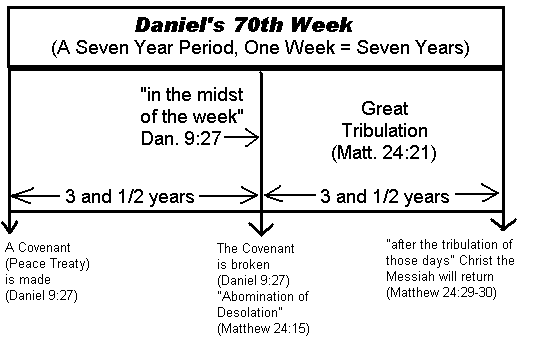
In today's post I want to give the reader a summary of one of, if not the most amazing prophecy in all the Bible - Daniel 9:23-27. I encourage the reader to use the chart above to help visualize what will be an unfolding of this significant passage of scripture.1

A quick fly over of Daniel's seventy weeks - 3 main divisions
The prophet Daniel, writing some 600 or so years before Jesus' coming, speaks of God's Divine time table for Israel, prophecy and this world.  The prophecy of Daniel 9:23-27, often termed "Daniel's seventy weeks", is regarded by many scholars to be the most amazing prophecy of God's Word.1  Daniel's prophecy reveals a 490 year period of time that constitutes God's Divine dealings with Israel in particular and the world in general.  In all three particular divisions can be briefly noted about this prophecy:

1. Division #1 49 years (seven sevens) in Daniel 9:25.  We know from secular history begins from Artaxerxes decree to rebuild Jerusalem on March 14, 445 b.c until its completion in 396 b.c.  That first leg of the prophecy also roughly marks the end of the Old Testament era of Divine revelation, especially in Malachi.

2. Division #2 434 years (sixty two sevens) in Daniel 9:25.  Again from a combination of predictive prophecy and secular historians we see Daniel speaking of the period of time extending between the testaments - the so-called "silent years". The "silent years" are called such because of God not revealing any new revelation nor inspiring any Bible books during that time.  When the books of Malachi and Esther were finished, the Old Testament Canon closed.  In this period of time (396 b.c to Jesus' days), four world empires arose and fell as predicted also by Daniel in his prophecies: Babylon-->Persia-->Greece-->Rome. 

Whenever you add the 49 years (from 445 b.c-396 b.c) and 434 years (396 b.c. - 32 A.D) together, you arrive at a total of 483 years. Remarkably, Daniel's prophecy begins at the decree to rebuild Jerusalem in March 14, 445 b.c to Jesus' riding into Jerusalem on April 6, 32 A.D. Daniel 9:26 then predicts what is most likely the crucifixion of Jesus Christ on that same week! - "Then after the sixty-two weeks the Messiah will be cut off and have nothing...."

3. Division #3 The final "week" or seven years, i.e Daniel's seventieth week in Daniel 9:26b-27. This third division of Daniel's prophecy, thought the shortest portion in God's prophetic time clock, yet receives the most focus in the prophecies of scripture.  

A more specific look at division #3 of the prophecy - Daniel's final 70th week or final seven years
As you look closer at the final "week" (seven years) of Daniel's prophecy, some details emerge.  First of all, Daniel 9:26b gives a general statement about the final seven years of history - "and the people of the prince who is to come will destroy the city and the sanctuary. And its end will come with a flood; even to the end there will be war; desolations are determined."  In this general statement of Daniel's seventieth week in 9:26b we see six elements:

1.  The people = The followers of the "prince"

2.  The prince = He is coming and is different from the Messiah who was cut off - namely Jesus Christ.

3.  The city = Jerusalem, the central city of the prophecy

4.  The sanctuary = A temple that will exist in Jerusalem in this final seven year period.  Most likely some sort of Jewish Temple built in the Tribulation period

5.  Its end = the prophecy has an end point in mind, corresponding to the conclusion of God's prophetic 490 year period set for Israel in relationship to His judgment of the world

6.  War = A final war will be waged with accompanying desolations or Divine judgments near the end of this seven year period of Daniel's seventieth week.   

A very detailed look at the last half of the seventieth week of Daniel
Daniel 9:27 states - 27 "And he will make a firm covenant with the many for one week, but in the middle of the week he will put a stop to sacrifice and grain offering; and on the wing of abominations will come one who makes desolate, even until a complete destruction, one that is decreed, is poured out on the one who makes desolate.” If we take the last three and one half years as the main focus of Daniel 9:27, we can note four elements of what is now a very detailed view of Daniel's seventieth week (seven years) and its latter half (3 1/2 years):

1. he - The Prince who comes and the same one spoken of in Daniel 9:26.

2. "firm covenant with the many for one week". The prince makes a peace covenant with the many, that is the Jews specifically and the world in general.  The covenant is promised by the prince to last the entirety of the seven years spoken of by Daniel, however....

3. "middle of the week he will put a stop to sacrifice". Evidently there will be sacrifices occurring at this temple during this seven year period, however this prince will suddenly interrupt the ceremonies and break covenant with the people at the 3 1/2 year mark.

4. "will come one who makes desolate, even until a complete destruction, one that is decreed". The true character of this prince, called elsewhere in scripture "false Christ" (Matthew 24:15, Mark 13:22); "the son of perdition" (2 Thessalonians 2); "anti-Christ" (1 John 2:18-19); "the beast" (Revelation 13-14), will blaspheme God and lead the whole world astray.  2 Thessalonians 2 summarizes the desolation spoken of here in Daniel, namely the true Christ, the Son of God, will destroy Anti-Christ, the prince, by the breath of His mouth. 

Conclusions and applications
We have aimed to summarize what is perhaps the most amazing prophecy in the Bible - Daniel 9:23-27.  First we noted its three main divisions which when added all together equal a 490 year period of time decreed by God for the Jewish people. Secondly, we noted how the prophecy focuses more closely on the third division, a final seven year period that has yet to occur and will include God's judgment on the world prior to the second coming of Jesus Christ. Thirdly we saw that the prophecy focuses even further on a figure called the Anti Christ who will make a covenant with the Jews for seven years, only to break that covenant mid-way and garner the wrath of God.  Fourthly, we saw a few of the New Testament passages that utilize Daniel 9:23-27 in identifying this future archenemy of God's people and the Lord Jesus Christ.  

The application of Daniel 9:23-27 is seen in two ways: first in how the passage describes the coming future judgment of God on this world, and how unbelievers need to believe and repent now. Secondly we see how accurate the scriptures are in their predictions and thirdly e see that God will keep His promises to His people the Jews, which of course means He will keep His promises to His people the church.   

Endnotes:
1. You can find the chart at http://www.middletownbiblechurch.org/oldtesta/oldtes10.htm

2. A most recent example of this continuing trend is the current sermon series being preached by Dr. Robert Jeffress of 1st Baptist Dallas entitled: "The Perfect Ending", wherein He comments on Daniel 9:23-27. 

Thursday, June 27, 2013

Summarizing Top Bible Prophecies


Revelation 19:10 "Then I fell at his feet to worship him. But he said to me, “Do not do that; I am a fellow servant of yours and your brethren who hold the testimony of Jesus; worship God. For the testimony of Jesus is the spirit of prophecy.”

Over a period of time we have looked at key texts that unfold key themes and purposes of God's prophetic program in scripture.  We have termed such scriptures: "Top Bible Prophecies".  A Top Bible prophecy is characterized by its scope of coverage of time and the future, its depiction of God's glory, the number of other scriptures connected to it and the clarity we gain about the Christian identity.  Today I want to tie all of the top Bible prophecies together by attempting to offer a summary explanation of each with a concluding section on the five purposes of prophecy that we gain from these texts.  

Briefly Summarizing Top Bible Prophecies

1. Genesis 3:15 The Seed Promise
We began considering the first mention of the Gospel in the Bible, as well as the first example of predictive prophecy: Genesis 3:15.  The most important word in the text is the word "seed", a term that points ultimately to God's plan of salvation as seen in other texts such as God's words to Noah in Genesis 6:9.  The next top Bible Prophecy, Genesis 12:1-7, also includes this word "seed" and exhibits God's clarifying of His plan of salvation to being also His promise.

2. Genesis 12:1-7 God's Covenant with Abraham
From Genesis 3:15 to 12:1 is roughly 2,000 years period of time and 20 generations of humanity stretching from Adam to Noah and then from Noah's Son Shem to Abram.  God called Abram out of Ur of the Chaldees and began to reveal to him the Promise of salvation.  Not only would God bring forth a specific "seed" from Abram, but God also promised at least two other promises: a land for Abram's descendants and blessing upon every tribe and nation of the earth due to the Promise.  This three-fold cord of land, seed and blessing would weave its way throughout the rest of scripture and through the next two top Bible Prophecies: Deuteronomy 30 and 2 Samuel 7:8-16.

3. Deuteronomy 30 The Promised Land
470 years after God first spoke to Abraham in Ur of the Chaldees, we find Moses and the second generation of Israelites which he led encamped on the plains of Moab East of the Jordon.  God's word to Abraham of a land promise back in Genesis 12:7 would eventually become fulfilled partially whenever the Israelites would nearly conquer the land of Canaan under Joshua's leadership in the Book of Joshua.  Despite living in the land and at times having possession of the land in large portions, historically Israel never had full-possession of the promised land.  If we take Deuteronomy 30 seriously, we can only conclude that the prophecy spoken has a future fulfillment at Christ's return.  

4. 2 Samuel 7:8-16 A shepherd and The King
From the days of Moses in Deuteronomy 30 until David's day in 2 Samuel 7 we cover over 400 years of time.  The "land" portion of Abraham's covenant back in Genesis 12:7 was spelled out in Deuteronomy 30, which meant the need to spell out further the promise of a "seed".  God's Covenant with David in 2 Samuel 7:8-16 serves to amplify the "seed" promise, unfolding the truths of a royal bloodline extending from David to a second truth, the Ultimate descendant being none other than Jesus Christ.  A shepherd David was called to be King and would be used by virtue of his bloodline to be the means by which the Great Shepherd would arrive into this world.  That same Great Shepherd would give His life and raise from the dead and ascend into heaven.  That same Descendant of David, the Lord Jesus Christ, will return to take up His physical throne in Jerusalem to begin the physical part of His 1,000 year reign over His people and the earth.  

5. Psalm 110 
Psalm 110 is termed a "top Bible prophecy" by virtue of the fact it is the most quoted Old Testament scripture in the New Testament.  Psalm 110 explains how God's Covenant with David would lead Christ, and how God's Covenant with David was not just with David as it was with His own Son in eternity.  Often God will replay Eternal events and truths that He worked out within Himself by way of historic covenants.

6. Isaiah 53
As much as top Bible Prophecies cover the glories of the future surrounding Christ's second coming and conquering reign, some top Bible Prophecies also predict the sufferings of His first coming.   This prophecy tells of not only details leading up to Christs death, but it even details his death by crucifixion, a form of torture that would be invented over 300 years after Isaiah's writing and perfected by Jesus' day.

7. Jeremiah 31:31-33 The New Covenant
By reading Jeremiah's prediction of the New Covenant in concert with Hebrews 8:7-13, we come to discover the power God was going to provide for the faith-walk in a spiritual sense for believers in this age and for Israel physically in the age to come.  The New Covenant promises and prophecies serve to amplify the "blessing" portion of God's covenant with Abraham way back in Genesis 12:1-7.  For this blogger, it would appear that Genesis 12:1-7 is the theological and spiritual center of Old Testament revelation and all of the major themes leading up to the New Testament.  In a sense then, the New Covenant is a "re-echoing" of God's Covenant with Abraham that would be fulfilled and made available by Jesus Christ to all Jew and Gentiles who would by grace through faith believe on Him.  

8. Daniel 9:24-27 The Bible's greatest prophecy
The final "top Bible prophecy" of this series is the most far reaching in that it covers three main truths about God's Sovereignty, Christ's cross and Christ's second coming.  God's calendar for history is the nation of Israel as it pertains to the first and second comings of Christ. Through Daniel God predicted a 490 year prescribed period of time for the nation of Israel and really the world at large.  The first 49 of those years would cover the rebuilding of Jerusalem from the exile to the end of the Old Testament.  The second block of  434 years would stretch from the days of Malachi to the death of Christ.  Since the death, burial, resurrection and ascension of Jesus Christ, God's calendar for Israel has been put on hold in order to give room for Gentiles to be called and drawn to saving faith. (Romans 11:1-24) Such an action by God has not revoked any of His plans to restore Israel, since their remains one final 7 year period for Israel to be fulfilled.  That final seven year period called by Jesus and others "The Tribulation", will be used by God to purify Israel, call sinners to salvation and to prepare the earth for wrath before His return.  Daniel closes as a closed book or a padlock of sorts, with the Book of Revelation functioning as the key.  It is in Revelation 6-19 we find the full unfolding of Daniel's 70th week or last seven year period of time.  Thankfully, the Lord Jesus Christ will have the final word.  

Five Purposes of Prophecy gained from these texts
1. To clarify God's present and future purposes
Genesis 3:15 begins with a general statement about "the seed of the woman", with Genesis 12:7 and the New Testament clarifying by prophecy that the "Seed" would initially be Israel and ultimately Jesus Christ.  Prophecy throughout the Bible progressively clarifies in sharper and sharper detail God's present and future purposes.

2. To correct sin.  Prophecy was confrontational in that it aimed to correct sin.  Daniel was praying and confessing the sins of his nation and God revealed in Daniel 9:24-27 about the prescribed time God was going to use to bring the nation of Israel to repentance at the appearing of her Messiah.  Prophecy performs this corrective function by warning of future wrath and giving insight into the human heart. 

3. To comfort the saints.  The New Covenant of Jeremiah 31:31-34 and Hebrews 8:7-13 brings great comfort to the saints.  Prophecy demonstrates that the Christian life will succeed because of God's doing and grace. (Philippians 1:6) Prophecies such as the New Covenant ensure that all true believers in this present age and for Israel at Christ's appearing will endure and have power to live for Him.  

4. To Predict the future. Prophecy certainly addresses current situations but it also predicts of things to come.  All of the Top Bible Prophecies are marked by predictions of things near to the author as well as events that have yet to take place.  

5. To point to Jesus Christ.  Every single one of the top Bible Prophecies we looked at pointed in some fashion to Jesus Christ.  The first four purposes of Bible prophecies serve this final purpose: point to Jesus.  Revelation 19:10 reminds us that the testimony of Jesus Christ is the Spirit of prophecy.  Jesus Himself reminded His disciples in Luke 24:44 that the Law, the Prophets and the Psalms point to Him.  This entire study has aimed to point the reader to the soon return of Jesus Christ.  May you be blessed dear reader and be made more hungry for the study of His word and the hastening of His Soon return.  

Wednesday, June 19, 2013

Top Bible Prophecy #8 - Daniel 9:24-27


Daniel 9:23 At the beginning of your supplications the command was issued, and I have come to tell you, for you are highly esteemed; so give heed to the message and gain understanding of the vision.


The setting for today's top Bible Prophecy - Daniel 9:24-27
The prophet Daniel in Daniel 9:1-2 had been reading a series of verses from the prophet Jeremiah in Jeremiah 29:10-14
“For thus says the Lord, ‘When seventy years have been completed for Babylon, I will visit you and fulfill My good word to you, to bring you back to this place. 11 For I know the plans that I have for you,’ declares the Lord, ‘plans for welfare and not for calamity to give you a future and a hope.12 Then you will call upon Me and come and pray to Me, and I will listen to you. 13 You will seek Me and find Me when you search for Me with all your heart. 14 I will be found by you,’ declares the Lord, ‘and I will restore your fortunes and will gather you from all the nations and from all the places where I have driven you,’ declares the Lord, ‘and I will bring you back to the place from where I sent you into exile."

Upon reading and reflecting on that text written over 70 years prior, Daniel decides to seek the Lord in prayer and to await God's response in Daniel 9:3-19.  In Daniel 9:20-23 the angel Gabriel comes to a weary Daniel to encourage him and instruct him about God's future plans for Israel and His redemptive purposes to the end of history.  Daniel had already been in Babylon for 70 years, and knew the time was about done.  However what he needed to know from God was: "what now?" We read these words in Daniel 9:23 "At the beginning of your supplications the command was issued, and I have come to tell you, for you are highly esteemed; so give heed to the message and gain understanding of the vision."

With that word of encouragement, Daniel is given in 80 words the most far reaching prophecy in Daniel 9:24-27.  It is to these four verses I direct the reader's attention to consider the Top Bible Prophecy of Daniel 9:24-27.

Top Bible Prophecy - Daniel 9:24-27
Many prophecies exist throughout scripture, some of which we have covered in previous studies.  In this current periodic study we are entitling "Top Bible Prophecies", we have looked at those prophecies which predict and shape the events of scripture and history. 1 Many of those prophecies cover vast stretches of time and others are known for their heights of revelation about Jesus Christ.  Daniel 9:24-27 accomplishes both.  Below is a summary of the passage and the three great truths that show why it can be termed a Top Bible Prophecy:

1. Sovereignty of God                  9:24-25
The prophecy begins by stating in Daniel 9:24 - "Seventy weeks have been decreed for your people and your holy city."  To understand how the Jews reckoned time, we know from passages such as Genesis 29:27-28, a "week" was a way of measuring a period of seven years or what is called a "heptad". Being that the Jewish calendar was based on the phases of the moon, each year was 360 days in length.  Hence 490 years are spoken of here in Daniel 9:24 that correspond to a period of time divinely prescribed by God.  

God's Sovereignty is His comprehensive rule over people, times and events. (Genesis 50:20; Psalm 90:1-2; Daniel 2:44; Romans 11:36)   Before God reveals the specifics of this time frame, He first of all lists six Divine purposes for the remainder of his dealings with his people Israel -
1. To finish transgression
2. To make an end of sin
3. To make atonement for iniquity.  

Those first three purposes would be accomplished in Christ's first coming to die on the cross and raise from the dead.  God is Sovereign enough to orchestrate all of time in order to send His Son to accomplish salvation once and for all. (Galatians 4:4)  Daniel then lists three more Divine purposes that relate to Christ's future second coming:
4. To bring in everlasting righteousness
5. To seal up vision and prophecy
6. To anoint the most holy

These last three Divine purposes are like the first three, they must necessarily come to pass.  All six have relationship to Israel, to history and to Christ.  God is Sovereign enough to bring them about. (Acts 2:23-24; Romans 11:25-26; Philippians 3:20-21)  Thus the first reason why Daniel 9:23-27 is a Top Bible Prophecy.  But notice the second truth taught...

2. Savior's Cross                          9:25-26a
From the Sovereignty of God we see his remaining explanation of the prescribed 70 weeks (490 years) that would lead up to the crucifixion of our Lord.  Recall the observation we made about how the Jews reckon time? In these two verses God revealed through this angel two divisions of this prescribed period, with the third being dealt with later in 9:26b-27.  In Daniel 9:25 we read - "So you are to know and discern that from the issuing of a decree to restore and rebuild Jerusalem until Messiah the Prince there will be seven weeks and sixty-two weeks; it will be built again, with plaza and moat, even in times of distress."  

The first divided section deals with "seven weeks" or "49 years".  The decree to rebuild and restore Jerusalem is recorded in Nehemiah 2 and occurred on March 14, 445 b.c.  Whenever you count 49 years from that date, you arrive at 396 b.c, the exact year the city was done and also whenever Malachi the prophet finished his prophecy.  

The second divided section of 62 sevens or 434 years is reckoned from the completion of the city in 396 b.c to the crucifixion week of our Lord in 33 A.D.  Daniel 9:26a states - "Then after the sixty-two weeks the Messiah will be cut off and have nothing, and the people of the prince who is to come will destroy the city and the sanctuary."  Now whenever you do a little math and combine these two divisions together (49 years plus 434 years = 483 years) and multiply 483 years times 360 days, you arrive at a figure of 173,880 days.  If we take the decree to rebuild and restore Jerusalem (March 14, 445 b.c) and count 173,880 days, we would arrive at April 6, 33 A.D, the day in which Jesus rode into Jerusalem on his triumphal entry!  That very week would be when our Lord was to be crucified or "cut off" as predicted by Daniel.  

So we see the truths of God's Sovereignty, leading to the Savior's cross which in turn brings us to the third major truth found in this top Bible prophecy, namely...

3. Surrounding events leading to Christ's return 9:26b-27
Daniel's prophecy jumps from the cross to the future wherein history will be coming to its intended end before Christ's return.  The third and final division of the seventy weeks is classified as "one week" or a seven year period wherein this "prince" will make a covenant with Israel.  In the middle of this seven year period, the prince (elsewhere called "Anti-Christ, Son of Perdition and other names) will break his treaty and thus revealing his true colors.  Thus "Anti-Christ" is the subject of these verses, with his rebellion and blasphemy being the primary predicted events.  This final seven year period or "week" spoken of in Daniel is referred to by other names throughout the Bible.2

This focus of Daniel's 70th week is designed to show the stage upon which the second coming of Christ will take place.  The "complete destruction" upon the one "who makes desolate" (Anti-Christ), though not explicitly stated here in Daniel 9:24-27, is shown in other texts to be accomplished by one Person, the soon coming King of Kings and Lord of Lords.  2 Thessalonians 2:8 illustrates - "Then that lawless one will be revealed whom the Lord will slay with the breath of His mouth and bring to an end by the appearance of His coming." 

Conclusion
Praise be to God for the top Bible prophecy of Daniel 9:24-27 that reveals the Sovereignty of God, the Savior's Cross and the Surrounding events of Christ's second coming.  

Endnotes:_____________________

1. Other top prophecies that have been studied previously are: Genesis 3:15; 12:1-7; Deuteronomy 30; 2 Samuel 7:8-16; Psalm 110; Isaiah 53 and Jeremiah 31:31-34.  The reader is encouraged to type in "Top Bible Prophecy" in the search engine on this blog site to view the previous entries in this study.
  
2.  Note the names given for Daniel's "seventieth week" throughout scripture:
1. Day of Israel's Calamity. Deuteronomy 32:35
2. Jacob's trouble or troubled time. Jeremiah 30:7; Daniel 12:1
3. Day of Wrath. Zephaniah 1:15
4. When you arrive in the New Testament, Daniel 9:26b-27 constitutes the backdrop for Jesus' teaching on the times leading up to His second coming in Matthew 24:15 and Mark 13:14.    
5. Day of the Lord. 1 Thessalonian 5:2
6. The Tribulation and Great Tribulation, Matthew 24:21,29
7. Judgment leading to Christ's return. Revelation 6-19 


Friday, June 14, 2013

Top Bible Prophecy #7 The New Covenant


Jeremiah 31:31-34 Behold, days are coming,” declares the Lord, “when I will make a new covenant with the house of Israel and with the house of Judah, 32 not like the covenant which I made with their fathers in the day I took them by the hand to bring them out of the land of Egypt, My covenant which they broke, although I was a husband to them,” declares the Lord. 33 “But this is the covenant which I will make with the house of Israel after those days,” declares the Lord, “I will put My law within them and on their heart I will write it; and I will be their God, and they shall be My people. 34 They will not teach again, each man his neighbor and each man his brother, saying, ‘Know the Lord,’ for they will all know Me, from the least of them to the greatest of them,” declares the Lord, “for I will forgive their iniquity, and their sin I will remember no more.”

Previous Top Bible Prophecies and today's Top Bible Prophecy

We have been viewing what I term "Top Bible Prophecies" periodically throughout the past few months.  This series is designed to acquaint the reader with scriptures that deal with major themes of God's prophetic program.  I have included both the blog date entries and top prophecies we have looked at in the listing below:
1. Genesis 3:15 The Seed Promise 4/12

2. Genesis 12 God's Covenant with Abraham 4/18 and 4/19

3. Deuteronomy 30 The Promised Land 5/1

4. 2 Samuel 7:8-16 A Shepherd and a King 5/2

5. Psalm 110 5/24 and 5/25

6. Isaiah 53 The Lamb of God 5/29a

If the reader desires to view the entire series, just type in "Top Bible Prophecies" in the search browser on this blog site, and all six of the posts should appear in their chronological sequence.     

In continuing on with our study, we come to what will be the foundational passage of both the future of Israel and our current New Testaments: Jeremiah 31:31-34.  In this passage (as well as several others scattered throughout the Old Testament Prophets), mention is made to what the Bible calls "The New Covenant".  Thankfully there is ample scripture in the New Testament that explains what is meant by this term and prophecy and why it is important for Christian understanding today.

Hebrews 8-10 is the divine commentary on Jeremiah 31:31-34 serves to explain the similarities and differences of the Old and New Covenants
Whenever you turn to Hebrews 8, you are treated to a Divine commentary on the meaning and significance of the New Covenant articulated in Jeremiah 31 and other Old Testament passages.  In Hebrews 8:1-5 we see a summary section of Hebrews 1-7 that explains the author's purpose in presenting the superiority of Jesus Christ as the believer's Eternal High Priest.  After the summary of Hebrews 8:1-5, we see these words in 8:6 - "But now He has obtained a more excellent ministry, by as much as He is also the mediator of a better covenant, which has been enacted on better promises."  Those three underlined words serve to give the reader an outline of the remainder of Hebrews 8:7-10:25 in explaining the similarities and differences between what is called the "first" or Old Covenant and the "second" or New Covenant:

1. The New Covenant exceeds the Old due to a better ministry.  8:7-9:10

2. The New Covenant exceeds the Old due to a better Mediator. 9:11-10:18

3. The New Covenant exceeds the Old due to better promises. 10:19-25

The main point of the discussion about the Old and New Covenants
The conversation about the Old and New Covenants can be described as having to do with the ability to live the Godly life being commanded by God to His people.  The "Old Covenant" was given to the descendants of Abraham under Moses' administration in Exodus 19:5-24:8 as a temporary system for the people of Israel to use in their lives following their Exodus and salvation.  Though God revealed righteous principles to live by to His people, there was never any power promised through the Mosaic covenant revealed at Sinai.  Although the people stated their confidence in Exodus 19:8 "all that the Lord has spoken, we will do!", yet it was clear that the Old Covenant could not produce the needed power for Godly living.  Only after 40 days of time had passed, we find the people bowing themselves to a golden calf while Moses is on top of Mt. Sinai in Exodus 32.   

Like Noah, like Abraham and all the Genesis patriarchs, the nation of Israel was still saved by grace alone through faith alone - a truth that is spelled out in Exodus 19:1-4.  However as God began to reveal the Law of God from 19:4 onward, it was designed not to impart righteousness, but demand it.  The design of the Old Covenant was to show the people their continual need for God's grace. God knew when He had revealed the Law that there was going to need to be a New Covenant.  The Old Covenant parallels in function the original covenant of works given to Adam and Eve in the Garden that was broken by their disobedience.  Just as they needed God's second provision of the graceful covenant of Genesis 3:15-21, Israel would need a New Covenant due to their breakage of the Covenant at Sinai.   

Comparing the Old and New Covenants as seen in Hebrews 8:7-13: Power for Godly Living
As I noted earlier, the whole discussion about Old versus New Covenant has to do with the need to live the Godly life being demanded of the believer by God. As you read Hebrews 8:7-13, and particularly 8:10-13, you discover the following comparisons between the Old and New Covenant systems:

1. New Power for Living.  Hebrews 8:10a
The Old Covenant demanded godliness, but only the New Covenant can give the power to live the Godly life.

2. New Way of Knowing (God).  Hebrews 8:10b-11
In the Old Covenant God was unapproachable, however in the New Covenant God is relational.  In the Old Covenant the people could only know about God from a distance, in contrast the New Covenant the people can know God.

3. New Forgiveness of sins. Hebrews 8:12
In the Old Covenant system sin is shown as sin, whereas in the New Covenant sin is forgiven.

4. New Change of life.  Hebrews 8:13
The Old Covenant has no ability to bring about the necessary change of heart.  All the Old Covenant could do was demand change and point to the grace of God.  In the New Covenant change is expected, since the power of the Holy Spirit comes to indwell the heart at saving faith and begins the progressive, transforming work of sanctification.  

Final thoughts on the New Covenant Prophecy
We must remember that the original prophecy of the New Covenant in Jeremiah 31:31-34 was given to Israel with the expectation of fulfillment in the future.  The only thing God did not reveal was in what manner he was going to begin the fulfillment.  The New Covenant's point was and is to bridge the promises of God to Abraham to the fulfillment of those promises in Jesus Christ.  Jesus Christ's first coming inaugurated the New Covenant era and promises to be experienced by grace-called believers in this age.  The church's current spiritual foretaste of the New Covenant blessings is based upon the guaranteed completion of it in Israel in the future.  Because of this prophecy, we in this age foretaste New Covenant blessings through the Gospel: power for Godly living, knowing God, forgiveness of sins and change.