Translate

Tuesday, October 3, 2017

Revival Sermon: Revive Us According To Your Spirit - Psalm 51

Image result for revival psalm 51
Psalm 51:10-12 "Create in me a clean heart, O God, And renew a steadfast spirit within me. 11 Do not cast me away from Your presence And do not take Your Holy Spirit from me. 12 Restore to me the joy of Your salvation
And sustain me with a willing spirit."

Introduction:

Today's post will feature another post from guest blogger and a dear pastor friend of mine: Pastor Mark Dooley. Pastor Mark and I have had a wonderful friendship in both life and ministry since 2001. Recently Pastor Mark came and preached a series of revival messages at the church where I pastor. He pastors Leonardtown Baptist Church in Leonardtown, MD. I offer these sermons to the wider readership of this blog and pray that all who read them will be blessed and revived in their faith as I was in getting to hear them.

Sermon: Revive Us According To Your Spirit - Psalm 51, preached at New Hope Baptist Church, Watertown, New York
Monday Night 10/3/17
by Pastor Mark Dooley

A little boy was visiting his grandparents and was given his first slingshot made by his grandfather.  He practiced trying to hit a tin can, but he could never hit it.  As he walked across the yard he saw Grandma’s pet duck.  On an impulse, he took aim and let the stone fly. It hit the duck right in the head, and it instantly fell dead.  The boy panicked and hid the dead duck under a nearby building, only to look up and see his sister, Sally, watching.  She’d seen it all, but she said nothing.
After lunch that day, Grandma said, “Sally, let’s wash the dishes.”  But Sally said, “Johnny told me he wanted to help in the kitchen today.  Didn’t you Johnny?”  And then she whispered to him, “The duck!”  So, Johnny did the dishes.

Later, Grandpa asked if the children wanted to go fishing.  Grandma said, “I’m sorry, but I need Sally to help me make supper.”  Sally smiled and said, “Johnny wants to do it.”  Again, she whispered, “The duck.”  Johnny stayed while Sally went fishing.

After several days of Johnny doing both his chores and Sally’s, finally he couldn’t stand it.  So, he confessed to Grandma that he’d killed the duck.  Numbers 32:23 says, “Be sure your sin will find you out.”  Why is it that we think we can hide sin?  Johnny’s sin had found him out, and so had David’s in the passage we consider tonight.
The background of our text today is David’s sin as recorded in 2 Samuel 11-12.  David had committed adultery with Bathsheba, another man’s wife.  To compound his sin, he tried to cover it up by bringing her husband, Uriah, home from battle.  But when it was clear that Uriah wouldn’t go home to be with his wife, David sent him back to battle with instructions for Joab, his commander, to put Uriah on the front lines and then retreat so he’d be left alone.  The result was that Uriah was killed in battle.  So, David’s sins included adultery, deception, and murder, at the very least.

But David couldn’t get away with his multiple sins any more than Johnny could hide the duck.  In real life, one sin committed that’s not repented of usually leads to another sin and then another sin, and on and on until it makes one a slave to sinning.  That was the case with David.  His slavery to sin ultimately crushed him when Nathan, the prophet, told him the story of the little ewe lamb.  He spoke about a poor man who had only one little lamb and how much he loved that lamb.  There was also a rich man who had many lambs.  A traveler came to the rich man, but instead of taking one of his many lambs to prepare a meal, he took the single lamb of the poor man, killed it and prepared it for the traveler.  David flew into a rage and said that anyone who committed that heinous of a sin should be executed. 

You see, up until this point, David didn’t have the moral stamina nor the courage to confess his own sin.  And at first, he still was in denial of his sins.  But after telling the story of the lamb and David reacting as he did, the prophet looked David square in the eye and said, “You are the man!”  It was then that it became crystal clear to David that the Lord knew what he had done.

To David’s credit, he repents of his sin.  This psalm, Psalm 51, is the record of David's prayer. It was uttered after Nathan confronted him about his sin.  This is one of the most penitential psalms ever written.  In it we see David praying for forgiveness.  We see the pattern of revival and how it comes from the Spirit of God.

Friends, I declare to you tonight that God will revive you by His Spirit just as much as He revived David.  I don’t know what your sin is.  Maybe it’s not quite as drastic as David’s.  But maybe it’s much worse than David’s.  

Regardless of the severity of your sins in your own mind, the reality is that sin separates us from God.  It’s sin that necessitated the death of God’s Son.  We may have trusted Jesus, but that doesn’t make us perfect or immune from sin.  Like David, one who the Bible calls “a man after God’s own heart,” we find ourselves succumbing to the seductiveness of sin’s power.  We need to be revived.  As we look at what David did in response to his sin, we find exactly what we need to do as well.  We see three things we need to ask for and which will be supplied by the Spirit of God.

Before we get to those things, however, let me lay a little more foundation.  We see in the opening verses of the psalm why God provides these things.  It’s because of who He is.  He’s a God of love and compassion.  Notice that the psalm begins with David asking God to “be gracious” to him.  He acknowledges God’s “lovingkindness,” or “unfailing love,” as some translations put it.
David knows he doesn't deserve forgiveness, so he calls on God's character of mercy to remove his sins.  He asks for renewal, purity, and pardon.  He begs God, “…blot out my transgressions.  Wash me thoroughly from my iniquity and cleanse me from my sin.”  

Notice the three phrases used here to describe sin: transgressions, iniquity, and sin.  We could look at the biblical words used and see the various subtleties of what God considers sin, but the important thing to see is that sin is sin.  Individuals have excused sin.  Society has renamed sin.  We call it a neurosis, antisocial behavior, or an alternative lifestyle.  But God calls it sin.  Even many churches today misunderstand sin and treat it as far less significant than it is.  What David did was sin, and what we do today is sin.  It’s because of sin that we need revival.

Furthermore, David recognized that his sin was primarily against God.  Verses 3-4 read, “For I know my transgressions, and my sin is ever before me. Against Thee, Thee only, I have sinned and done what is evil in Thy sight.”  One can only imagine the turmoil, the sleepless nights and troubled days David endured as he continually tried to cover his sins.  Because of his status as king, it seems that no one would challenge him or accuse him of sin … but as he acknowledges in verse 3, it was always before him.

This doesn’t mean that David's sins against Bathsheba and her husband, Uriah, were meaningless or inconsequential.  Rather, this is David’s recognition that ultimately all sin is against the Lord, whom he professed to love.  All sin is ultimately our exhibiting rebellion in the very face of God.  We do sin against people and need to make such sin right when it occurs. But our sin is even more against our heavenly Father.  It’s that breach that must be healed at all costs.  So how does that healing occur?  Notice with me three necessary things.

1. First, we must allow God’s Spirit to purify us (vv. 7-8).  

David’s prayer is to become pure once again in verse 7: "Purify me with hyssop, and I shall be clean; wash me, and I shall be whiter than snow."  When a leper was healed of his leprosy, he would undergo a ritual of purification in which the hyssop plant was used.  When God purifies us, we are made “whiter than snow.”

David had been through a period of spiritual drought and now he longs for the joy that only the Lord can provide. In verse 8 he exclaims, "Make me to hear joy and gladness; let the bones which Thou hast broken rejoice."  We see here that sometimes the struggles we are going through are God’s vehicle to get our attention.  I’m not saying God always causes trouble.  Sometimes He does, I believe.  But God always uses the difficulties of life.  He speaks to us through them to get our attention and redirect our focus away from ourselves and back to Him.  

It was C.S. Lewis who once said, “Pain insists upon being attended to.  God whispers to us in our pleasures, speaks in our consciences, but shouts in our pains.  It is his megaphone to rouse a deaf world.”

Perhaps God is speaking to you through your pain and you just aren’t listening.  Maybe you find yourself without joy.  You’re spiritually dry and you need to be revived.  All of the joy had gone out of David’s life, and only God could restore it.  In this heartfelt prayer, David now longs for this joy in fellowship to be restored to him once more.

Have you lost the "joy" of your salvation?  Have you become somewhat distant from God?  Have you taken God for granted?  How does that occur?  It happens when other things become more important to us than God does.  If scanning your Facebook news feed is more important to you than reading your daily devotion, then you need to be purified.  If you prefer staying up late on Saturday so you can watch movies and then sleep in on Sunday to getting a good night’s rest and being awake and alert for worship, then you need to be purified.  If talking on the phone or via text to a good friend takes priority in your life over talking to God in prayer, then you need to be purified.  In short, you need revival.  And these are only a few of the ways we evidence our great need for revival.  You may not have committed gross sin like David, but still the prophet’s words are true: “You are the man.”  “You are the woman.”

David's sins had affected his whole person: his eyes, mind, ears and bones, heart and spirit, hands, and lips.  Sin can be so pleasurable in the moment and yet so devastating on the body, mind and spirit.  David knew this, so he asked for more than simple purification, as important as that was.  Instead, he wanted his entire being to be restored so he could serve the Lord acceptably.  He wanted the joy of the Lord within him and the face of the Lord smiling upon him.  We must allow God’s Spirit to purify us. Also, we see that 

2. We must allow God’s Spirit to cleanse us (vv. 9-11).  

In these verses, David continues his plea; “Hide Thy face from my sins and blot out all my iniquities. Create in me a clean heart, O God, and renew a steadfast spirit within me. Do not cast me away from Thy presence, and do not take Thy Holy Spirit from me.”  
Verse 10 is the central verse of the psalm and it expresses the heart of David's concern.  Can we be pure again once we've been corrupted? The answer is YES!  It doesn’t matter what you’ve done.  No matter whether your sin isn’t as bad as David’s, or worse than his sin, you can still be cleansed from it when you repent and allow the Spirit of God to cleanse you.  Hebrews 9:14 states, “How much more will the blood of Christ, who through the eternal Spirit offered himself without blemish to God, cleanse your consciences from dead works to serve the living God!”

The key is repentance.  David realized what he had done and how graciously God had responded.  He didn’t want to be caught up in any of these sins again.  So, he repents.  He turns away from his sin and determines not to allow it to continue to reign in his life.  He offers a prayer of a different kind; “Create in me a clean heart, O God, and renew a steadfast spirit within me.”  In other words, help me to start over afresh and anew, Lord.

The verb for "create" is the Hebrew word, bara.  It indicates the bringing into existence of something that didn’t exist before.  We see it used in Genesis 1 in the creation account.  “In the beginning, God CREATED …”.  There are three basic Hebrew words that are used to describe creating: bara, asah, and yatsa.  Commentator John Phillips says of bara, “The word is reserved in Scripture for the distinctive work of God.  Men can “make” things (asah) and “form” things (yatsa), but only God can create (bara).”  

In the case of revival, God creates a new heart that’s been transformed by the power and grace of God.  Only His Spirit can do that.  If we need to experience revival, we need to ask the Spirit of God to cleanse us and create in us that which only He can – a clean heart.  If we aren’t willing to allow Him to clean our life up, then we’re never going to experience revival.

I think of my father-in-law at this point.  He passed into eternity about 10 or 12 years ago.  Maybe 7 or 8 years before he died, he finally trusted Christ, and became a Christian.  I say finally, because it was somewhat of a struggle for him.  For years, my wife and I would witness to him of his need for Jesus, and his response was always something along the lines of, “I’m going to clean my life up and then I’ll come to Jesus.”  We’d both tell him it didn’t work that way, that he was powerless to clean his own life up, and instead how he needed to simply trust Christ the way he was and allow Him to do the cleaning.  Like so many others, for so long, he didn’t realize that he couldn’t make things right with God through his own efforts.  It was only as he released the reins of his life and trusted a sovereign God with the controls of his life that he was truly saved.  

I think the same thing is true of revival.  So often, we know things aren’t right in our lives.  Yet we keep a firm grip on the wheel of our life.  Jesus take the wheel isn’t just a country song that Carrie Underwood sings; it’s a truth that expresses what we all need to do.  If things aren’t right in your life, they’re going to remain not right until you let go and give control to the One who created you to begin with.

Notice how in verse 11, David prays against his great fear: "Do not cast me from Thy presence and do not take Thy Holy Spirit from me."  These are the words of one who has walked with God but who knows that the relationship had been shattered.  For some time, David's cover-up and unforgiven sin had been an impenetrable barrier between himself and God.  Now he hoped, by God's grace, that the barrier would be removed and that he could, once again, be brought into fellowship with the Lord.

I want you to know today that God won’t cast you from His presence.  He won’t remove His Holy Spirit from you.  Your fellowship with Him may have been broken, but the breach isn’t irreparable.  If David could be purified and cleansed, so can you.  You can be restored, which leads us to our final truth today.... 

3. We must allow God’s Spirit to restore us (v. 12).

In verse 12 David says, “Restore to me the joy of Thy salvation and sustain me with a willing spirit.”  A few years ago, an angry man rushed through the Rijks Museum in Amsterdam until he reached Rembrandt's famous painting "Nightwatch."  Then he took out a knife and slashed it repeatedly before he could be stopped.  A short time later, a distraught, hostile man slipped into St. Peter's Cathedral in Rome with a hammer and began to smash Michelangelo's beautiful sculpture “The Pieta.”  Two cherished works of art were severely damaged.  But what did officials do?  Did they throw them out and forget about them?  Absolutely not!  Using the best experts, who worked with the utmost care and precision, they made every effort to restore the treasures.


The enemy of our soul has done more than slash the painting of our life or smash a portion of our life.  What Jesus said about him is recorded in John 10:10a.  It says, “The thief comes only to steal, and kill, and destroy.”  Sadly, I have a front row seat to see that on a daily basis.  

I know a young Christian man who got involved with a married woman and the end result was he had to be excommunicated from his church.  I know another young man who had an emotional affair with a married woman, and although it’s now over, this woman continues to struggle and there is a family in crisis.  I think of a woman I know whose family dynamic has changed such that she now fills her life with many other things except the things of the Lord, and as a result she is now away from the fellowship of the church.  

In all these cases, the individuals involved profess to be believers.  Yet the enemy has worked to steal, kill and destroy.  With great skill and precision, he has done just that.

Folks, I know an expert who, with the utmost care and precision, can restore the treasure of your broken life.  You’re worth far more than Rembrandt’s “Nightwatch” painting.  You’re worth far more than Michelangelo’s “The Pieta.”  You’re worth the death of God’s own Son.  He will restore the joy of your salvation.  He will sustain you with a willing spirit.  But you must turn to Him and look to Him for restoration.  Your restoration will not come from more church involvement.  It will come from a renewed relationship with Jesus.  That renewed relationship with Jesus may well lead to an increased involvement with your church.  In fact, it probably should.  But don’t look to your church, don’t look to your pastor, don’t look to any human to fix what only God can fix.  David didn’t ask the prophet Nathan to fix him.  He turned immediately to God, crying out, “Restore to me the joy of Thy salvation.”  Friends, I tell you confidently that God will do that for you today if you will look to Him.

Conclusion:

Do you remember little Johnny in our opening story?  I left that story after Johnny confessed what he had done to his grandmother.  But I never told you her response.  With tender compassion, she knelt down and said, “I know, Johnny,” as she gave him a hug.  She said, “I was standing at the window and saw the whole thing.  Because I love you, I forgave you.  But I wondered how long you would let Sally make a slave of you.”

Friend, how long will you allow the enemy to make a slave of you?  How long will you let sin reign in your life?  Like David did here, repent and return to the Lord.  For then you will truly know what it means to be revived and restored.

Monday, October 2, 2017

Guest Blogger - Pastor Mark Dooley: Sermon - "Revive Us Again, Psalm 85"

Related image
Psalm 85:6-7 "Will you not revive us again so that your people may rejoice in you? 7 Show us your faithful love, Lord,
and give us your salvation."

Introduction:

Today's post will feature a guest blogger and dear pastor friend of mine: Pastor Mark Dooley. Pastor Mark and I have had a wonderful friendship in both life and ministry since 2001. Recently Pastor Mark came and preached a series of revival messages at the church where I pastor. He pastors Leonardtown Baptist Church in Leonardtown, MD. I offer these sermons to the wider readership of this blog and pray that all who read them will be blessed and revived in their faith as I was in getting to hear them.

Sermon: Revive Us Again - Psalm 85, preached at New Hope Baptist Church, Watertown, New York
by Pastor Mark Dooley

These instructions that Wiersbe refers to are seen, I believe, in these verses.  There are three things the psalmist refers to here.  The first is obedience.  “I will hear what God the Lord will say,” verse 8 says.  Wiersbe says the picture here is of a worship leader or prophet stepping forward and saying something like, ‘It’s time now to be silent before God and listen for His message.’  This is the first step in the path to revival for us as well.  

We need to slow down long enough to be still and listen to what God’s saying to us.What about you?  Do you hear what God is saying to you?  Are you spending time in His word?  Do you have a daily quiet time?  Are you part of a group where you study the Word of God and have accountability with others?  If not, how do you expect to “hear what God the Lord will say”?  

Far too many people seem to think if they sit through a church service as the preacher rambles on while their mind is focused on the events coming up that week, or the relationship they’re trying to pursue, or the financial obligations they have and how they’re going to meet them, that they’ve heard from God.  But really, all they’ve done is sit in a worship service oblivious to what God is doing and saying. 

Listen, can you tell me what Pastor Mahlon preached on last week?  Do you know what the most recent sermon series was about?  What is your Sunday School class studying right now (if you’re even in a class)?  Do you see where I’m going here?  How many us can really say we’re hearing from the Lord?  If we want revival, though, this is where it begins. 

But beyond just hearing, reading, and even studying the Word of God, are we doing the word of God?  James said, “prove yourselves doers of the word, and not merely hearers who delude (yourselves)” (James 1:22).  Folks, we can study the word all day, every day, but if we don’t put it into practice it does no good.  Obedience is key to revival.  The path to revival begins with obeying the Word of God.Next, we see consecration.  “Let them not turn back to folly,” the psalmist says in v. 8b. Really, this is describing the concept of repentance.  To repent means to turn away from.  

I’ve seen many people in my life who supposedly turn away from a sin, but then when the opportunity to engage in that sin comes up again, they go right back to it.  That’s not biblical repentance.  We talked earlier about the time of the judges.  That time period in Israel’s history clearly demonstrated their propensity to “turn back to folly.”  According to the book of Judges, God sent seven different nations to discipline them.  They repented, but their repentance was only for a season, for they’d always lapse back into their foolish ways.  

Revival, however, comes when we are consecrated to the Lord.  We not only repent, but we remain.  We turn away from our sin, and we turn to the ways of God.  We not only begin walking in those ways, but we continue walking in them.  Will you commit today to walking in God’s ways?  If you truly want to be revived, consecration is an indispensable element.

Finally, we see reverence.  “His salvation is near to those who fear Him,” verse 9 says.  Nearly every translation uses the term “fear” here, although the NET Bible translates it, “Certainly his loyal followers will soon experience his deliverance.”  The biblical terminology of fearing God is often misunderstood.  It is often downplayed as respect, but it’s more than that.  Even my use of the term reverence can be misunderstood.

Perhaps this long quote from an article in Christianity Today can shed some light.  The author says, “Unfortunately, many of us presume that the world is the ultimate threat and that God's function is to offset it.  How different this is from the biblical position that God is far scarier than the world …. When we assume that the world is the ultimate threat, we give it unwarranted power, for in truth, the world's threats are temporary.  When we expect God to balance the stress of the world, we reduce him to the world's equal …. As I walk with the Lord, I discover that God poses an ominous threat to my ego, but not to me.  

He rescues me from my delusions,so he may reveal the truth that sets me free.  He casts me down, only to lift me up again.  He sits in judgment of my sin, but forgives me nevertheless.  Fear of the Lord is the beginning of wisdom, but love from the Lord is its completion.”When we come to truly understand who God is, and who we are in relation to God, I believe there will be true reverence.  We’ll be like Isaiah who, in the presence of God, said, “Woe is me, for I am ruined!  Because I am a man of unclean lips, and I live among a people of unclean lips” (Isaiah 6:5).  

Folks, God isn’t the big guy up in the sky, or a grand-father figure who coddles us and gives us goodies.  He’s the Almighty sovereign of the universe.  If we’re going to truly experience revival, we need to understand who He truly is and put Him in proper perspective in our life.  Obedience, consecration, and reverence.  This is the path to revival.Finally, today, let’s consider the power of revival (vv. 9b-13).  

These final verses reveal what we can expect when true revival does occur.  Let me sum this up using three words.  First is glory.  In verse 9b, the psalmist speaks of glory dwelling in our land.  I think immediately of the account in 1 Samuel 4.  The ark of the covenant had been captured by the Philistines.  Israel had carried it into battle treating it somewhat like a good luck charm.  But that day 30,000 men of Israel fell and the ark was taken by away.  The news of the defeat was reported to Eli, the priest.  When he learned that the ark had been captured, he fell backwards off his seat, broke his neck, and died.  About that time, his daughter-in-law, the wife of his son, Phineas, who also died in the battle, gave birth.  She delivered a boy and named him Ichabod, a name which means “the glory is gone,” for as she said in 1 Samuel 4:22, “The glory has departed from Israel, for the ark of God was taken.”Folks, in many ways the glory has gone from our own land.  Just as the Philistines stole the ark, so the culture has largely stolen the witness of the church.  Our witness is largely weak and ineffective.  Indeed, the glory is gone.  But when true revival comes, glory will dwell in the land.  People will know that God is real.  The witness of the church will resound with the glory of the gospel.  That’s the power of revival – it displays the glory of God.Another word that we see here that describes the power of revival is truth.  In verse 10, the psalmist says, “loving kindness and truth have met together.”  Verse 11 says that “truth springs from the earth.”  

That our culture has abandoned the concept of truth is abundantly clear.  Truth has become a relative notion.  For many, truth is whatever works for them.  For many in our postmodern the perspective is that truth lies in our experience, so if my experience differs from yours, then my truth is different than your truth.  Furthermore, they say, what does it matter anyway as long as we get along and love each other?  But that kind of love is a mile wide and an inch deep and it will never stand the test of time.

Josh McDowell tells about a question he asked Amber, a 16-year-old girl in a Christian youth group.  He asked, “Is it wrong to engage in premarital sex?”  Amber said, “Well, I believe it’s wrong for me.”  McDowell pressed asking further, “But do you believe that the Bible teaches that premarital sex is wrong for everyone?”  He said that Amber’s eyes shifted back and forth as she weighed her answer.  Then she said, “Well, I know it’s wrong for me, and I’ve chosen not to have sex until I’m married.  But I don’t think I can judge other people on what they do.”4
McDowell’s conclusion was that Amber had been conditioned to believe that truth is not true for them unless they choose to believe it.  

That’s why over 80% of our kids today claim that “all truth is relative to the individual and his/her circumstances.”  In fact, in two national surveys conducted by Barna Research, people were asked if they believe that there are moral absolutes that are unchanging or that moral truth is relative to the circumstances.  By a 3-to-1 margin, adults said truth is always relative to the person and their situation.  Among teenagers, 83% said moral truth depends on the circumstances.  Only 6% said moral truth is absolute.This is why we need revival, because we’ve largely lost the concept of truth.  Friends, Jesus said “I am the way the TRUTH, and the life” (John 14:6).  His High Priestly prayer that’s recorded in John 17 records Him saying, “Sanctify them in the truth; Thy word is truth.”  I can guarantee you that the world today will seek to relativize every situation.  

But I can further guarantee you that what God’s Word says is absolute truth.  When it conflicts with the culture, you should stand with the Word of God every time because therein is truth.  And the power of revival is that it gives us a restoration of truth.Finally, today, notice with me the word righteousness.  The psalmist says that “Righteousness will go before Him” (verse 13).  The word righteousness has multiple meanings in Scripture.  Obviously, there is the righteousness of Christ that is given to us when we believe. 

The Apostle Paul described this well in 2 Corinthians 5:21 when he said, “He made Him who knew no sin to be sin on our behalf, that we might become the righteousness of God in Him.”  I don’t think this is what the psalmist is referring to here though.The Scripture also uses the term righteousness to describe “right living.”  This is conduct in relation to others, and it’s a word that’s contrasted with wickedness.  We see this contrast often in the book of Proverbs.  For example, Proverbs 11:8 says, “The righteous is delivered from trouble, But the wicked takes his place.”The power of revival is that it produces right living.  We speak to people in ways that are right and honor God.  We are just and above board in all our dealings.  We are helpful and willing to go out of our way for others.  We love others with sacrificial love, putting their needs ahead of our own.  This is what it means to live righteously.  This is what it means to be revived. This is the power of revival.“Wilt Thou not Thyself revive us again?” the psalmist asked.  It’s a pertinent question.  It reminds me of another question asked by Ron Bishop.  Bishop was the president of SCORE International.  SCORE stands for Sharing Christ our Redeemer Enterprises.  Hailing from Tennessee, Bishop, who passed away 3 years ago, was the basketball coach for Tennessee Temple University, and he used athletics as a tool to spread the gospel.  He touched the lives of athletes and coaches such as Andy Pettitte, Mariano Rivera, and John Calipari.  Bishop once asked this question in his prayer letter: “Has anyone seen any signs of revival lately?”  

It’s a fair question.  Have you seen any signs of revival?  Are you even looking for revival?  Too often, I think we’re looking for survival, but not revival.  Revival is the sovereign work of God.  Bishop said that few have experienced revival, but that’s the very thing we should be looking for.  I agree.  “Wilt Thou not Thyself revive us again,” Lord?  Will you look to Him today to be revived?

Thursday, September 28, 2017

Taking A Closer Look At Paul's Analogy Of The Olive Tree In Romans 11:16-24

Image result for olives in Israel
Romans 11:25 "For I do not want you, brethren, to be uninformed of this mystery—so that you will not be wise in your own estimation—that a partial hardening has happened to Israel until the fullness of the Gentiles has come in."

Introduction:

In Romans 11, we find Paul illustrating God's plan of salvation for the nations and Israel by way of an olive tree. Such an analogy is intentional on Paul's part to demonstrate how God intends to save a multitude of people from the nations (i.e gentiles) and a multitude of Jews at Christ's return. In today's post we want to explore some of the background of this analogy to discover how to best interpret Paul's overall argument of Romans 11 with respect to the olive tree.

Olive trees in the Mediterranean world, ancient Israel and the Bible

Such a tree would had been known to anyone in the Mediterranean world (Spain, Italy, Northern Africa) and those who lived in Israel. 

Image result for olive tree in Israel

Baker's Encyclopedia notes the following about the oil produced from olive trees:

"Oil was symbolically associated with joy, festivity, ceremony, honor, light, and health (both spiritual and physical), while its absence spelled sorrow (Joel 1:10), and the withdrawal of all that is good in life."

Olive trees and olives in general came to be used quite frequently in scripture to refer to the nation of Israel. The first mention of anything olive is found in Genesis 8:11 to refer to the olive branch given to Noah by the dove to indicate the lessening of the flood waters of God's wrath on the earth. Olive trees and their fruit have this fundamental meaning of God's favor, redemption and the richness of his promises. 

For sake of space and focus, I won't list the scriptures associated with the following uses, but olive oil extracted from the fruits of such trees was used in: lighting lamps in homes, the temple, anointing of priests, kings and prophets, medicine, bathing oils and incense. Such wide variety of uses made olive trees and their olives vary valuable to both Jews and the surrounding nations. 

The specific meaning of olive trees and olives that is pertinent to our study, has quite a bit of reference in the Old Testament, thus meriting mention of the key texts. We find olive trees or olives to refer specifically to God's chosen people - Israel - and its land in such texts as Judges 9:8-9; 2 Kings 18:32; Ps 52:8; 128:3; Is 24:13; Jeremiah 11:16; Hosea 14:6; Zech 4:11-12. Jesus' final sermon addressing great themes of prophecy, His second coming and Israel occurs in the context of the Mount of Olives (Mt 24:3; Mk 13:3; Lk 19:29,37; 21:37). 

The theological significance of the grafting of branches and the olive tree itself

In Paul's analogy of the olive tree signifying God's plan for the nations and Israel, we find references to the grafting of branches into the olive tree. Paul wastes no time in associating the grafted-in branches as being the gentiles and the original "natural" branches representing the Jews. We read the following in Romans 11:16-21

"If the first piece of dough is holy, the lump is also; and if the root is holy, the branches are too. 17 But if some of the branches were broken off, and you, being a wild olive, were grafted in among them and became partaker with them of the rich root of the olive tree, 18 do not be arrogant toward the branches; but if you are arrogant, remember that it is not you who supports the root, but the root supports you. 19 You will say then, “Branches were broken off so that I might be grafted in.” 20 Quite right, they were broken off for their unbelief, but you stand by your faith. Do not be conceited, but fear; 21 for if God did not spare the natural branches, He will not spare you, either."

So what is the significance of taking branches from a wild olive tree and grafting them into the cultivate olive tree that represents God's plan of salvation for both Jews and the other nations? Easton's Bible Dictionary explains:

"The “olive-tree, wild by nature” (Rom. 11:24), is the shoot or cutting of the good olive-tree which, left ungrafted, grows up to be a “wild olive.” In Rom. 11:17 Paul refers to the practice of grafting shoots of the wild olive into a “good” olive which has become unfruitful."

God desires not only a redeemed people, but a redeemed people that are bearing fruit. Similar analogies of fruit-bearing, plants and God's redemptive purposes are found in such Old Testament passages as Isaiah 5 and Jeremiah 11 and then John 15:2, which states: "Every branch in Me that does not bear fruit, He takes away; and every branch that bears fruit, He prunes it so that it may bear more fruit." The Easton Bible Dictionary continues on by noting:

"By such a process the sap of the good olive, by pervading the branch which is “grafted in,” makes it a good branch, bearing good olives. Thus the Gentiles, being a “wild olive,” but now “graffed in,” yield fruit, but only through the sap of the tree into which they have been grafted. This is a process “contrary to nature” (11:24)."

Thus the original or "natural branches" were not bearing fruit. So by removing them, God wanted to take branches from a wild tree (the nations) and graft them into the healthy root and trunk - which I would propose is Christ Himself (again see similar analogies in John 15). Thomas Robinson's "Studies In Romans - Expository And Homiletical", confirms this observation of the olive tree of Romans 11 being no less than Christ Himself:

"Good Olive Tree. Visible church with all its blessings. Place in Christ's church an inestimable privilege. Yet not sufficient of itself to secure salvation. Outward union with the church brings privilege, not pardon. The only tree in which salvation is certain is the true vine, John xv. 1."

Author Svetlana Khobnya notes in his article on Romans 11, "The Root In Paul's Olive Tree Metaphor (Romans 11:16-24)", volume 64:2 Tyndale Bulletin, pg 265:

"The proposal, that he uses the olive tree and the whole process of its rejuvenation to draw a picture of the restoration of Israel and the addition of the Gentiles into God’s people on the basis of God’s fulfilment of his promises in Christ, coheres with Paul’s overarching theological convictions. On this reading, Christ is the very root of the tree." 

Final Applications

Today we looked more closely at Paul's metaphor of the olive tree in Romans 11. We considered the background of such an imagery and attempted to draw some broad theological conclusions while noting the broader Old Testament backdrop. But what does all of this mean to you and me, dear reader? 

1. First an foremost, unless one is connected to Jesus Christ (the true tree or true vine) by faith, there is no spiritual life to be found nor possessed. 

2. Second, since God has pledged to restore the nation of Israel in the future, this means we can trust God to keep his promises to the believer today. 

3. Thirdly, the seeming impossibility of God's redemptive program in saving Jewish multitudes in the future ought to point to what is the seeming impossibility of anyone getting saved in the nations at this present moment. Clearly salvation is of the Lord and in this present age, the Holy Spirit is calling those persons whom God is drawing and whose hearts are opened to the truth, eliciting a free response to the Gospel. 

4. Lastly, whenever we consider even a little bit the vastness of God's reach in saving sinners - whether present among the nations or future concerning Israel - we ought to break out in praise (see Romans 11:33-36)!

Saturday, September 23, 2017

The Urgent Need For Biblical Preachers - 2 Timothy 4:1-5

Image result for ron dicianni images
2 Timothy 4:1-2 "I solemnly charge you in the presence of God and of Christ Jesus, who is to judge the living and the dead, and by His appearing and His kingdom: 2 preach the word; be ready in season and out of season; reprove, rebuke, exhort, with great patience and instruction."

Introduction:

I have in my office the above picture by artist Ron Dicianni hanging on my wall. When I look at that picture, it captures all that is being expressed in the key text of today's post. Today's post will feature 2 Timothy 4:1-5 in which the Apostle Paul is urging young Timothy to "preach the Word". This text has a special meaning to me, since it was the text which God used in calling me to preach His Word 25 years ago. Today's post is going to deal with the subject: "The Urgent Need For Biblical Preachers". 

1. Divinely Commanded to Preach the Word. 2 Timothy 4:1-2

In 2 Timothy 4:1-2a the Apostle Paul writes: "I solemnly charge you in the presence of God and of Christ Jesus, who is to judge the living and the dead, and by His appearing and His kingdom: 2 preach the word....". Every pulpit and sanctuary in the world has an invisible balcony wherein the King of Kings is in attendance. The heavenly charge to preach the Word requires a Heavenly book with Divine authority. The preacher charged with this task is like the town crier: "Hear ye, hear ye what His Majesty the King has to say."

1 Timothy 5:20-21 reminds us of the preacher's calling, and how we need to exercise caution: "I solemnly charge you in the presence of God and of Christ Jesus and of His chosen angels, to maintain these principles without bias, doing nothing in a spirit of partiality. 22 Do not lay hands upon anyone too hastily and thereby share responsibility for the sins of others; keep yourself free from sin." 

Preaching is not man's idea but God's Divine decreed method of calling sinners to repentance and saints to ongoing pursuit of Godliness. How then can the preacher fulfill the assignment placed upon his frail frame. Woe to preachers who rely only upon stories and opinions of the day - since such preaching will be death to the ears before it is ever life to the heart. A Divine call demands a Divine Book - and that Book is the Bible. The Divine command to preach the Word is the first reason why the Bible is the basis for preaching, but notice secondly....

2. Discernment necessary in preaching the Word. 2 Timothy 4:2

In 2 Timothy 4:2 Paul tells Timothy to preach the Word and to be ready in season and out of season. What is he saying? In effect, he is expressing the need to be ready all the time and more than that, to discern the seasons of the present moment.  The only Book that can shine the appropriate light in otherwise dark places is the Bible. People need a Word from God from the Word of God. 

Preaching is a thrilling desperation. The thrilling aspect is that the preacher gets to represent God and His interests to the people. The desperation of preaching is that lest the Spirit attends the preacher, the sermon will fail and fall to the ground. It was said of the prophet Samuel at the end of 1 Samuel 3 that God ensured that not one of his words would fall to the ground. 

In my 25 years of preaching God's Word, I have learned the necessity of discernment in preaching. A well-worn Bible that is marked from Genesis to Revelation is the sign that the preacher is equipped to bring God's mind to bear on any subject. The scriptures are the only thing that can pierce soul and spirit; joints and marrow, thus discerning the innermost reaches of the heart (Hebrews 4:12). 

Biblical-based preaching must dig deeper before it can ever hope of reaching higher than the preacher's personality. My life experience is but a ladle used by God to dip out the otherwise unsearchable riches and wisdom of God's Word (see Romans 11:33-12:2). The Bible must be the basis for preaching because preaching is Divinely commanded and discernment is needed and thirdly...

3. Dangerous times need Biblical preaching. 2 Timothy 4:3
Paul writes these words in 2 Timothy 4:3-4 which aptly describes our day and age - "For the time will come when they will not endure sound doctrine; but wanting to have their ears tickled, they will accumulate for themselves teachers in accordance to their own desires, 4 and will turn away their ears from the truth and will turn aside to myths." What makes this age of ours so dangerous is how much in mass the church is selling-out in the name of being relevant and popular. I won't name the man nor the subject matter, but one day I was watching a well-known preacher discuss how the church in America must stop relying upon 2,000 year old letter lest she become irrelevant. 

I know this man's message and have read his books and in as much as he had abandoned sound doctrine long ago, to abandon the Bible reveals how he is able to justify many of the positions he holds. 

The need of the age is not for less preaching, but more. However there is only one type of preaching that will effectively shine light through the thick darkness of our time - preaching based upon God's Book - the Bible. I write these words as a preacher who in many ways has only begun to preach. Noah was a preacher of righteousness for centuries. Moses preached for decades. The men who have had a lasting impact on each generation of God's people are men who preached often, consistently, Biblically, dependently upon the Spirit, with passion, with compassion and with urgency from Heaven. We need sermons with more, not less scripture and more, not less Christ. 

I recall years ago hearing a preacher state that the greatest danger faced by Noah in the Ark was not the storms on the outside but the woodpeckers on the inside! In our churches and pulpits is a cancer called Biblical illiteracy and an abandonment of Biblically based, Spirit-led preaching. Dangerous times need the pulpit to be the anchor of the ship, the rudder of the vessel that is not blown around by fads, fashion and fear. Notice one more reason why the Bible needs to be the basis for preaching...

4. Enduring ministries center on Biblical preaching. 2 Timothy 4:5

Notice what Paul writes in 2 Timothy 4:5 "But you, be sober in all things, endure hardship, do the work of an evangelist, fulfill your ministry." Why would any preacher want to base their ministry on untested foundations when the one foundation that has endured millennia of scrutiny and countless attacks has been the Bible? The Bible is an anvil upon which uncounted hammers of doubt, criticism and opposition have bent and broken. 

Anyone who spends any length of time preaching God's Word knows first hand how high of a commodity endurance is to the man of God. Youthful enthusiasm and ambition runs out of fuel rather quickly. Just as soon one adopts the latest fad, it is already obsolete. Yet the Bible never fails!

Closing thoughts:

Today's post was all about answering the question: why the Bible must be the basis for preaching. In this post we discovered four such reasons from 2 Timothy 4:1-5:

1. Divine Command to Preach the Word.2 Timothy 4:1-2 

2. Discernment necessary in preaching the Word. 2 Timothy 4:2

3. Dangerous times need Biblical preaching. 2 Timothy 4:3

4. Enduring ministries center on Biblical preaching. 2 Timothy 4:5

Thursday, September 21, 2017

The Significance Of Ordination In The Life Of A Pastor And God's People

Image result for ordination of a pastor
Numbers 8:9-10 "So you shall present the Levites before the tent of meeting. You shall also assemble the whole congregation of the sons of Israel, 10 and present the Levites before the Lord; and the sons of Israel shall lay their hands on the Levites."

2 Timothy 1:6 "For this reason I remind you to kindle afresh the gift of God which is in you through the laying on of my hands."

Introduction:

I can recall the day I was ordained to the Gospel ministry. The process leading up to that ordination had involved years of training in both Bible College and Seminary. For 25 years God has had me preaching His word. Nearly a decade passed before the time came for my ordination. But even more important than the formal training and preaching opportunities themselves were the character qualities God needed to work out in my life. There were some wonderful men God placed in my path to teach me valuable lessons on friendship, loyalty, leadership and doctrinal conviction. There were various jobs and positions that taught the much needed lesson of servanthood and a willingness to do whatever task, no matter how menial. All of these lessons prepared me for the day I would get ordained. 

So why do churches ordain men for the ministry? Is this rite a recent development in church history? or are their Biblical patterns that inform the necessity for ordained men and the ordination process itself? 

Ordination is a very special time in the life of a church and a man of God. To ordain means "to set apart" for God's service. Normally a group of other ordained ministers and Deacons will come together to form what is called an ordination council. The council's job is to examine a man who has expressed their conviction of God's call to ministry. There are usually a series of questions asked - ranging from the doctrinal to the pastoral to the personal. 

The candidate for ordination is then asked to give testimony of his salvation and what he understands concerning his own call to the Gospel ministry. Such an examination by other ordained men is designed to either confirm that man's call and to attest such a calling to the church or to screen out those men who may not quite be ready. 

Biblical passages that deal with ordination and setting apart those who minister God's word

Ordination is truly a remarkable event. In a sense it is where God calls a man from among the called people of God to issue forth the call of the Gospel from the word of God. Ordination is not a recent phenomenon in the church's life. The following scriptures testify to this ancient roots of this pattern of recognizing God-called men.

To begin, the opening passages in today's post feature the setting apart of the Levites for service in the tabernacle (Numbers 8:9-10) and Paul's reference to young Timothy's "setting apart" and having received the "laying on of hands" in 2 Timothy 1:6. Once the Levites were set apart, Numbers 8:22 then records - "Then after that the Levites went in to perform their service in the tent of meeting before Aaron and before his sons; just as the Lord had commanded Moses concerning the Levites, so they did to them."

Priests were regularly ordained or "set apart" as a mark of God's calling and choosing of them for the task of temple service. We see ordination occurring in the life of Joshua, Moses' successor, in Numbers 27:18-19 "So the Lord said to Moses, “Take Joshua the son of Nun, a man in whom is the Spirit, and lay your hand on him; 19 and have him stand before Eleazar the priest and before all the congregation, and commission him in their sight." The significance of "laying on of hands" is found repeatedly on most of the biblical passages dealing with this subject of ordination. Whenever one laid there hands on another for setting apart unto God's service, there was an idea of "conferral of authority". Numbers 27:20-21 spells out this formal meaning of "laying on of hands": "You shall put some of your authority on him, in order that all the congregation of the sons of Israel may obey him. 21 Moreover, he shall stand before Eleazar the priest, who shall inquire for him by the judgment of the Urim before the Lord. At his command they shall go out and at his command they shall come in, both he and the sons of Israel with him, even all the congregation.”

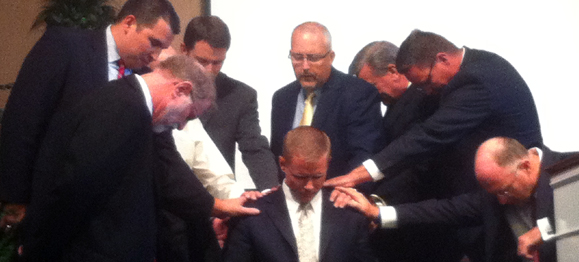
I can recall in my ordination service where the pastor and deacons each took turns laying their hands upon me, praying over me and asking God's blessing upon the future of God's ministry through me. My brother-in-law, a pastor himself, had driven several hours to participate in this public event. Ordination's quality as a public event lends to its significance in the church's life. For Old Testament Israel, men like Joshua were to lead them. Joshua's ordination, which we saw a moment ago, has its significance explained in Deuteronomy 34:9 "Now Joshua the son of Nun was filled with the spirit of wisdom, for Moses had laid his hands on him; and the sons of Israel listened to him and did as the Lord had commanded Moses."

When we come to the New Testament, we see the principles of ordination, already established in ancient Israel, continuing their way in the New Testament church. Whenever Paul and Barnabas were getting ready to launch out into their first missionary work, we read in Acts 13:3 "Then, when they had fasted and prayed and laid their hands on them, they sent them away." The most specific information we have about ordination in the New Testament is found in Paul's two letters to young Pastor Timothy. In 1 Timothy 4:14 we read: "Do not neglect the spiritual gift within you, which was bestowed on you through prophetic utterance with the laying on of hands by the presbytery." And then again 2 Timothy 1:6 "For this reason I remind you to kindle afresh the gift of God which is in you through the laying on of my hands."

Applications:

We could certainly bring in further passages from both Old and New Testaments to bring home the significance of ordination in the life of a pastor and God's people who take seriously the public ministry of the Word of God. For brevity's sake, I will list those other passages for the reader's review (1 Kings 19:15-18; 2 Kings 2:9, 15; 8:8; 2 Kings 9:1-10; 1 Timothy 4:14; 5:22; 2 Timothy 1:6; Hebrews 6:2). As we close out this post today, what lessons can we draw from our brief consideration of the above texts? We can briefly note three such lessons...

1. God affirms his calling on a man through his word to the heart of that individual. God then follows up with a confirmation of that calling through the process of ordination and the acclamation of God's people.

2. In most of the examples we considered above, the men who were ordained were younger men. Ordination is significant because it can be used of God to alert the young men in the congregation of God's dealings with them as to whether or not He is calling them to serve Him.

3. The congregation's participation and observation of the ordination service reinforces and reminds them of the importance of the ministry of the word of God. The man who is ordained will hopefully have many years of fruitful preaching and leading of God's people. In so far as that man is ordained to lead the people, the people have the responsibility to follow and pray for that man.

Wednesday, September 20, 2017

Why Preaching Matters In A Difficult Age - 2 Timothy 3:1-13

Image result for plowing discs
2 Timothy 3:1-5  "But realize this, that in the last days difficult times will come. 2 For men will be lovers of self, lovers of money, boastful, arrogant, revilers, disobedient to parents, ungrateful, unholy, 3 unloving, irreconcilable, malicious gossips, without self-control, brutal, haters of good, 4 treacherous, reckless, conceited, lovers of pleasure rather than lovers of God, 5 holding to a form of godliness, although they have denied its power; Avoid such men as these."

Introduction:

I remember growing up in South Central Pennsylvania between two farms. In the early mornings one could hear the tractors pulling plows and turning up the hardened soil of fallow ground. I would sometimes watch those tractors and observe how the plowing disks on those plows glistened in the sunlight. Rocks and roots would be tossed to the sides by those plows. The rows were straight and deep, ready for the seeds to be sown for that year's harvest. Farmers had to be sure their plows were ready, since the difficult soil required a ready and sharp set of plowing disks to do the job. 

In our age, as well as ages past, the climate has never been favorable to preaching. Nevertheless, no age has ever passed that did not need it. The Apostle Paul is warning a young pastor of difficult times. The urgency of the hour is for young Timothy to preach the Word. Like a plowing disk, Timothy - and really all preachers of the Bible - are called to plow through difficult, fallow soil. The purpose of preaching is to sow the seed of God's Word. Such farming imagery is used throughout God's Word (Matthew 13:38; 1 Corinthians 3:9) to describe the context of the preacher's task. No doubt, Jesus warned of difficult times coming on our world while encouraging believers of His unsurpassed victory and guarantee of the success of God's purposes (John 16:33)

In today's post, I want to make the case that despite whatever difficult times within which we find ourselves, preaching matters. Our text is 2 Timothy 3:1-13. Note the following reasons why preaching matters in these present difficult times...

1. Preaching compels people to deny self. 2 Timothy 3:1-2


The words of the Bible are the preacher's source and tools. The Holy Spirit and God's word function together through the preaching task to change lives. Jesus told his audiences that if anyone wants to be his disciple or follower, they must die to self, take up the cross daily and follow Him (Luke 9:23-24; 14:25-33). Jesus' call to self denial occurred in the context of his preaching. Preaching is God's designated vehicle for compelling the conscience and breaking the unrepentant will. 

Teaching is important in convincing minds. However, preaching is needed to compel the conscience. Paul knew that in these last days, there would be a generation full of people full of themselves. 2 Timothy 3:2a notes: "For men will be lovers of self, lovers of money....". But notice also why present difficulties require preaching....

2. Preaching can bring lasting peace to unruly hearts. 2 Timothy 3:2b-3


Notice what Paul states next about the nature of the times in which he lived and our own in 2 Timothy 3:2b-3 -

"boastful, arrogant, revilers, disobedient to parents, ungrateful, unholy, 3 unloving, irreconcilable, malicious gossips, without self-control, brutal, haters of good."

Good gospel music, praise choruses, hymns and vocalists are appropriately linked to the ministry of the word. Both types of worship function as a team of horses to draw the chariot of God's glory into the central spot of the church's life. Music, when done in the right heart and with the Spirit's anointing - can prepare hearts and bring with it peace for that moment. However, lasting peace beyond the church service has been reserved for the ministry of the word. Isaiah 50:4 states - "The Lord God has given Me the tongue of disciples, That I may know how to sustain the weary one with a word. He awakens Me morning by morning, He awakens My ear to listen as a disciple." 

The music of praise and worship might very well set the table of the mind and the emotions. However, worship of God through the preaching of the Word places nourishment for the heart and will to grasp. What is needed in our day and age is lasting peace, God's peace. Paul's description of this present age is that of unruliness. Our culture is a roiling sea of chatter, arguing, division, strife and self-assertiveness. 

Just as the voice of Christ ranged over the sea of Galilee to make its waves to stand still, so is needed the voice of Christ through His word explained and applied to calm the unruly hearts of people. We need a fresh word from God today, which is why preaching is required to cut through the clamor. 

So we need preaching in these difficult days since it is how God compels people to deny self and bring lasting peace to unruly hearts. Notice a third reason why preaching matters today....

3. Preaching can uproot religious hypocrisy. 2 Timothy 3:5-10

In the next set of verses, Paul describes, especially in 2 Timothy 3:5, of how these present days will include people that have a form of godliness but deny its power. Many pretenders populate so much of Christendom. We have those that espouse prosperity theology and those who promote the sort of Christianity that doesn't require the ministry of the local church. The other day for instance, I saw a book entitled: "how to be a Christian without going to church". I thought the book was a satire until I read and discovered the person was quite serious! 

Biblically-sound, Christ-centered, Spirit- empowered proclamation of God's Word is designed to make clear the true and the not-so-true. Paul makes an interesting reference to Moses' day in 2 Timothy 3:8-9 "Just as Jannes and Jambres opposed Moses, so these men also oppose the truth, men of depraved mind, rejected in regard to the faith. 9 But they will not make further progress; for their folly will be obvious to all, just as Jannes’s and Jambres’s folly was also." Exodus 7:10-12 records the incident in question - "So Moses and Aaron came to Pharaoh, and thus they did just as the Lord had commanded; and Aaron threw his staff down before Pharaoh and his servants, and it became a serpent. 11 Then Pharaoh also called for the wise men and the sorcerers, and they also, the magicians of Egypt, did the same with their secret arts. 12 For each one threw down his staff and they turned into serpents. But Aaron’s staff swallowed up their staffs."

Moses' verbalizing the command of God to Aaron to throw down his staff gives a picture of the verbal ministry of the word in opposition to the charlatanry of the magicians. Their smoke and mirrors were no match for God's power through the spoken word. The end result in this narrative is that Aaron's rod in serpent form swallowed up the tricks of the pretenders. The hypocrisy of the Pharaoh's court - touting their pretended facades of spiritual power - were unmasked. 

So we have seen that preaching matters in today's world, since God has assigned it the role of compelling people to deny self, bringing lasting peace to unruly hearts and uprooting religious hypocrisy. But notice the last point as to why preaching matters today....

4. Preaching urges God's people to uphold godly living. 2 Tim. 3:10-14


Paul says plainly in 2 Timothy 3:12 "Indeed, all who desire to live godly in Christ Jesus will be persecuted." This desire is to be fueled by exposure to Biblical preaching. 1 Timothy 4:16 states - "Pay close attention to yourself and to your teaching; persevere in these things, for as you do this you will ensure salvation both for yourself and for those who hear you." Or again, Hebrews 13:7-9 "Remember those who led you, who spoke the word of God to you; and considering the result of their conduct, imitate their faith. 8 Jesus Christ is the same yesterday and today and forever. 9 Do not be carried away by varied and strange teachings; for it is good for the heart to be strengthened by grace, not by foods, through which those who were so occupied were not benefited." The pastor and the preaching of the Word have been so prescribed by God to form a godly people living in the midst of a godless world. Note Ephesians 4:11-12  "And He gave some as apostles, and some as prophets, and some as evangelists, and some as pastors and teachers, 12 for the equipping of the saints for the work of service, to the building up of the body of Christ." Note as well Philippians 2:15-16 "so that you will prove yourselves to be blameless and innocent, children of God above reproach in the midst of a crooked and perverse generation, among whom you appear as lights in the world, 16 holding fast the word of life, so that in the day of Christ I will have reason to glory because I did not run in vain nor toil in vain."

Closing thoughts

Today we have considered four reasons why preaching matters in a difficult age such as our own:

1. Preaching compels
people to deny self. 2 Timothy 3:1-2

2. Preaching can bring lasting peace to unruly hearts. 2 Timothy 3:2b-3

3. Preaching can uproot religious hypocrisy. 2 Timothy 3:4-10

4. Preaching urges God's people to uphold godly living. 2 Timothy 3:10-14