 Romans 1:16-17 "For I am not ashamed of the gospel, for it is the power of God for salvation to everyone who believes, to the Jew first and also to the Greek. 17 For in it the righteousness of God is revealed from faith to faith; as it is written, “But the righteous man shall live by faith.”
Introduction: The Spark That Lit The Fuse Of The Protestant Reformation
How powerful are the words found in the 66 books that comprise our Bibles? Nothing can turn a soul to God except the Holy Spirit working through the nearly 775,000 words in our Old and New Testaments. I rejoice in hearing conversion stories from people who have by grace through faith trusted in Jesus Christ for their salvation. Whether reflecting upon my own conversion, or reading about other people's conversions, such accounts stir the heart to give praise to God for all He has done through Christ. The 16th century Protestant Reformer Martin Luther's story and conversion is the focus of today's post.
In the 16th century, Europe and the Roman Catholic Church were poised on a knife's-edge. The need for moral and spiritual reform was recognized a century before Martin Luther had come on the scene. The political, religious, moral and economic climate was ripe for reform. God's hand of providence was at work. Martin Luther would be His instrument for reform and reigniting of the Gospel.
Martin Luther was born in 1483 to a copper mining owner and worker. Martin's father, Hans, desired to see Martin get a good education. When young Martin acquired his Bachelor's degree and Master of Arts degree in Law, he began to practice law per his father's wishes. However, when traveling through the woods, a sudden lightening-storm startled Luther, with a near-by lightening strike evoking a rash vow from Luther's lips to serve as a monk. Author James Edward McGoldrick notes of this episode:1
"(H)e encountered a severe lightning storm in which he thought he would perish. In anguish he appealed to St. Anne, the patroness of miners, to intercede with God, and he promised that he would reciprocate by becoming a monk. Much to the dismay of his parents, Martin passed through the gates of the Black Cloister to become a friar. In doing so, he had chosen the lifestyle which his church extolled as the best means to obtain salvation."
Once Luther pledged his life of servitude to St. Anne - the patron saint of miners - he entered into the Augustinian monastery at Erfurt, Germany in July of 1505.
He quickly excelled in all things religious. As time marched on, Luther's incessant desire to quiet his sensitive conscience through religious ritual kept falling short. Luther was as a candle in the dark, with no inner light of his own. The wick that began the Protestant Reformation in Germany on October 31, 1517 would be Luther's nailing to the church door of Wittenburg, Germany his 95 challenges or "theses" against the abuses of the Roman Catholic practice of selling indulgences (that is, "get-out-of-purgatory-free-cards"). However, for October 31, 1517 to become the beginning of the Reformation in Germany, there first needed to be the conversion of the Reformer - Martin Luther. That spark that began in Luther's heart was his so-called "Tower-Experience".
Martin Luther's Testimony Of Conversion - The Needed Spark From God
Thankfully, Luther's life was recorded in detail either by his own recollections or the eye-witness testimonies of friends and foes alike. Apart from Jesus and the Apostle Paul, many scholars have noted that no figure in all of church history has had more written about his life and writings than the mighty Reformer from Germany. Luther's "Tower-Experience" was the process through which he struggled to understand the relationship between God's just role in having the right to punish sin and Luther's own need for forgiveness. Erwin W. Lutzer makes the following observation about Luther's struggle:2
"When Luther began to teach the book of Romans, he trembled at the phrase 'the righteousness of God' (Rom. 1:17). Though he says he was an 'impeccable monk', he stood before God as a sinner troubled in conscience. The righteousness of God struck fear into his heart because he knew that it was because of God's unbendable righteousness that sinner's were cast away from His most holy presence."
He was brought to the breakthrough of the doctrine of "justification by faith" in reading Romans 1:17 and upon reflecting on Augustine's commentary on the same-said verse of scripture. In Luther's own words, we find the following testimony that led him to finally discover peace in his heart and with God, from his so-called "Tower-Experience" in 1513:3
"I greatly longed to understand Paul's epistle to the Romans and nothing stood in the way but that one expression "the righteousness of God," because I took it to mean that righteousness whereby God is just and deals justly in punishing the unjust."
"My situation was that, although an impeccable monk, I stood before God as a sinner troubled in conscience, and I had no confidence that my merit would assuage Him. Therefore I did not love a just angry God, but rather hated and murmured against Him. Yet I clung to the dear Paul and had a great yearning to know what he meant."
"Night and day I pondered until I saw the connection between the righteousness of God and the statement that "the just shall live by faith." Then I grasped that the righteousness of God is that righteousness by which through grace and sheer mercy God justifies us through faith."
Now comes Luther's description of his conversion...
"Thereupon I felt myself to be reborn and to have gone through open doors into paradise. The whole of Scripture took on a new meaning, and whereas before "the righteousness of God" had filled me with hate, now it became to me inexpressibly sweet in greater love. This passage of Paul became to me a gate to heaven...".
As a monk serving in the Augustinian order of the Roman Catholic Church (so-named from the 5th century theologian, Augustine), Luther had consulted Augustine's commentary on Romans while making his epochal discovery about how a person is truly made right with God - by grace alone through faith alone. The final sentences of Augustine's commentary on Romans 1:17 was instrumentally used by God in aiding Luther to connect the dots between God's righteousness and saving faith:4
"We have now the principal point or the main hinge of the first part of this Epistle, — that we are justified by faith through the mercy of God alone. We have not this, indeed as yet distinctly expressed by Paul; but from his own words it will hereafter be made very clear — that the righteousness, which is grounded on faith, depends entirely on the mercy of God."
Clearly, the doctrine of justification by faith alone has its roots reaching back a millennium to Augustine, who in turn derived it from the Apostle Paul in the first century. Justification by faith is that Divine, legal declaration of the sinner's innocence with respect to the law of God. At the moment of conversion or saving faith, I as a sinner am credited with Christ's righteousness. To help convey the meaning of the word "justification", the sinner is regarded by God to be "just-as-if-I-never-sinned" or put positively: "just-as-if-I-always-did-rightly". The doctrine of justification by faith alone is the core of the Gospel. Luther's conversion came as a result of the Holy Spirit's working in his heart through the scriptures to reignite the flame of the Gospel.
Closing thoughts and applications
One thing I find fascinating about Luther's testimony is that we find a man giving credit to the Spirit's work through the scriptures in bringing about his heart-change. The work of salvation is a miracle-work brought about by the Spirit of God through the Word of God operating upon and in the human heart (see Romans 10:8-10; James 1:18; 1 Peter 1:23). What about you dear read today? Have you experience such a saving faith? Have you trusted upon the finished work of Jesus Christ? Luther's explanation of salvation as the "opening of the gates of paradise" cement in the mind's eye a clear understanding of what salvation is all about: namely, reconciling sinners such as myself to a holy righteousness God through faith in Jesus Christ. This month of October celebrates the 501st anniversary of the beginning of the Protestant Reformation, and more importantly, the reigniting of the flame of the Gospel. Were it not for the Holy Spirit's intervention through the scriptures in the heart of a troubled soul named Martin Luther in 1513, the wick of October 31, 1517 might not had been lit. Let us celebrate the Lord Jesus Christ and the Gospel which alone can save the soul which yields in response to His call by faith.
Endnotes:
1. McGoldrick, James Edward. "Introducing Martin Luther". Reformation and Revival. Vol 7, part 4. Fall 1998. Page 20.
2. Lutzer, Erwin W. Rescuing The Gospel: The Story And Significance Of The Reformation. Page 45. Baker Books. 2016.
3. Quotation derived from the website: http://www.reformationtheology.com/2010/05/the_tower_experience_1.php. This well-known testimony of Martin Luther is cited in volumes that contain his main works.
4. St. Augustine's Commentary On Romans. https://www.ccel.org/ccel/calvin/calcom38.v.v.html

Introduction: What Is Meant By A Biblical Worldview?
I just finished reading a marvelous book by author Dr. Jeff Myers entitled: "The Secret Battle Of Ideas About God - Overcoming The Outbreak Of Five Fatal Worldviews", which aids greatly in thinking through current events in 21st century Western culture. So what is a worldview? A worldview is a systematic model that each person constructs in answering life's most important questions. The concern of the book in this review is to equip readers with not just any worldview, but a Biblical one. Dr. Jeff Meyers' mentor, George Barna, is cited in the book with the following definition of what makes for a Biblical worldview:
"(A) means of experiencing, interpreting, and responding to reality in light of a Biblical perspective."
So who is Dr. Jeff Myers? He is President of a worldview training ministry called: "Summit Ministries". The goal of the ministry is to equip people with the tools they need to construct a Biblical way of thinking (i.e., "a Biblical worldview).
The Big Questions That Any Worldview Ought To Address
In his book: "The Secret Battle Of Ideas About God - Overcoming The Outbreak Of Five Fatal Worldviews", Meyers utilizes the metaphor of a virus to describe how bad worldviews can "infect our thinking". Whenever we talk about worldviews, we are looking at how a given set of beliefs address life's most important questions.
So, what are the questions Meyers is interested in seeing answered? The following headings in several chapters of the book summarize the big questions, which he also spells out on page 22 of the book:
1. Chapter 3, "Am I Loved?"
2. Chapter 5, "Why Do I Hurt?"
3. Chapter 7, "Does My Life Have Meaning?
4. Chapter 9, "Why Can't We All Just Get Along?"
5. Chapter 11, "Is There Any Hope For the World?"
6. Chapter 13, "Is God Relevant?"
The Worldviews Covered In "The Secret Battle Of Ideas About God"
As Dr. Jeff Myers deals with the subject of evaluating various worldviews, we find him focusing on five particular religious/philosophical belief systems and their comparison to Biblical Christianity. As a way of getting a handle on what each of the following worldviews espouse (Secularism, Marxism, Post-modernism, New Spirituality and Islam), Meyers suggests a four step process of both defining and preventing infestation by the worldviews just listed:
A. Identify.
On the subject of life's meaning, we find Secularism asserting that life is about control. With respect to Marxism, it defines life's meaning as having to do with redistribution of wealth and bringing change by social revolt. With concern to Post-modernism, the main point of life is that there is no "main point", since truth and moral absolutes are defined by individuals or culture. New-Spirituality (formally known by its older moniker, "The New Age"), states that life is about human consciousness rising to find unity with the universe. Then lastly, Islam's definition of life's meaning has to do with submission to Allah. The Gospel asserts that meaning, value and purpose in life is found in God as decisively revealed in the incarnation of the Son of God as Jesus of Nazareth.
B. Isolate.
Just as a virus needs identified before prescribing treatment, so it is with any worldview that has mixture of truth with harmful error. The next step is then to isolate the worldview and see how it "ticks". As mentioned already, the six big questions (see above) are used to audit each of the five worldviews covered in the book. Just to take one of the questions as an example, ("Is There Any Hope For The World?), the five worldviews answer the question, per Meyers' summary, as follows:
1. Secularism believes, in the words of philosopher Paul Kurtz, who also authored the Humanist Manifesto II, "No deity will save us; we must save ourselves".
2. Marxism suggests we raise taxes and confiscate property until wealth is redistributed. Only then can a future human utopia be realized.
3. Post-modernism declares that: "there is no meaning".
4. New Spirituality asserts that, "when we act as though we're one with the universe, only then can hope be discovered".
5. Islam emphasizes that hope is only discovered through submission to Allah. Dr. Meyers offers two references from the Quran to demonstrate his summation (Quran 16:36; 35:24).
The last remaining two steps in arresting the influence of bad ideas in our minds is to inform and then invest in other people. Meyers certainly does a great job of informing people about how each worldview handles the major questions of life. The investment part deals with how we communicate the Gospel in a winsome way and demonstrate how it alone answers all the big questions of life.
Declarations To Live By
To bring the reader to a better understanding of the Gospel, Dr. Jeff Meyers utilizes what he refers to as "declarations" that set us free from idea viruses:
1. "I am loved". Deep unconditional love exists, and I can have it.
2. "My suffering will be overcome."
3. "I have an incredible calling."
4. "I'm meant for community". This declaration points to the place of the local church and community of believers in Jesus Christ.
5. "There is hope for the world". This of course is found in Christ alone.
Answering The Big Question: "Is God Even Relevant?"
The final chapter of Dr. Meyer's book raises the question: "Is God even relevant?" The particular interest of this final chapter is demonstrating not only why Christianity best addresses the big questions of life over against its rivals, but also why any of the foregoing discussion is relevant to today. Meyers begins with a wonderful quote from C.S. Lewis:
"I believe in Christianity as I believe that the sun has risen; not only because I see it; but because by it I see everything else."
To reinforce the relevance of the Gospel to worldview thinking and practical everyday life, the five affirmations mentioned at the beginning of the book are repeated once more:
A. "I am loved". Meyers refers to the Greek noun "agape", which speaks of self-sacrificial love.
B. "My suffering will be overcome". Meyers mentions the Greek verb used in the New Testament to describe victory, "nikao", from whence is derived the sneaker brand "Nike".
C. "I have an incredible calling." Here Meyers calls to mind the Greek word "kaleo", a verb often used to describe Jesus' calling of His disciples to follow Him.
D. "I'm meant for community". Here Meyers uses the Hebrew Old Testament term "shalom", which speaks of attainment of inner-peace, contentment, relational balance, as a result of living life according to the will of God.
E. "There is hope for the world". In this final affirmation, Meyers references the Greek word "elpis", which is often used to translate the word "hope" in the New Testament.
All in all, Dr. Jeff Meyers' book is a call to focus one's worldview on the Biblical God revealed in Jesus Christ. He approvingly quotes A.W. Tozer:
"What comes into our minds when we think about God is the most important thing about us."
By evaluating the five fatal worldviews of new spirituality, secularism, post-modernism, Islam and Marxism, Jeff Meyers wants to make clear the message of the Gospel. In one of the most memorable quotes of the book, Meyers writes on page 189:
"The Gospel isn't just good news for those who have never heard; its good news for those who love Jesus but wrestle what this means for everyday life."
Closing Thoughts:
I would highly recommend Dr. Jeff Meyer's book: "The Secret Battle Of Ideas About God - Overcoming The Outbreak Of Five Fatal Worldviews" for anyone desiring an introduction on how to communicate, live and defend the Gospel in today's culture.
 Jeremiah 2:13 - “For My people have committed two evils: They have forsaken Me, The fountain of living waters, to hew for themselves cisterns,
Broken cisterns that can hold no water."
Jeremiah 2:13 - “For My people have committed two evils: They have forsaken Me, The fountain of living waters, to hew for themselves cisterns,
Broken cisterns that can hold no water."
Introduction:
Every age features God calling forth certain men to lead efforts toward spiritual and moral reform. Over time, those persons that allege themselves as God's people let the message of the Gospel slip. The prevailing spiritual and moral conditions of a given culture rapidly decline. Although there is always a small remnant or number of people that remain, still, the need for spiritual and moral reform is only realized when God's people grow desperate for it. In today's post, we aim to consider how God uses moral and spiritual reformation to call His people back to fidelity to the Gospel. The goal of this post is to demonstrate how the Protestant Reformation of the 16th century fits the pattern of God's desire to reform and renew His church.
Jeremiah, a Prophet and Reformer from the Old Testament
One of the most beloved passages in God's Word is found in Jeremiah 29:11, wherein Jeremiah writes:
"I know the plans I have for you, says the Lord, plans for welfare and not calamity to give you a future and a hope."
What was the context of this incredible passage? You may have noticed the opening passage of today's post, found in Jeremiah 2:13 -
“For My people have committed two evils: They have forsaken Me, The fountain of living waters, to hew for themselves cisterns, broken cisterns that can hold no water."
God spoke through Jeremiah's mouth and pen to a people who were going into exile some 800 miles away from their homeland. Though they had sinned and though they were being disciplined, God's Word to them was to settle in the land of Babylon. The Jews were to build homes and be a blessing where they were. The tone of Jeremiah's prophecy was that of sorrow. The call of God through Jeremiah was that of repentance and reform. Furthermore, God was not done with them.
Jeremiah was a prophet who preached the need for spiritual and moral reform in his nation. God expressed through Jeremiah both warnings and encouragements to turn back to Him. Sadly, not everyone listened. One major opponent of Jeremiah, Shemaiah, attempted to oppose Jeremiah and sabotage the message of the Lord before Zedekiah and the royal officials. Despite those attempts, the Word of the Lord proved true and Shemaiah was shown to be an impostor. Other critics of Jeremiah's ministry, like Hananiah in Jeremiah 28 and Pashhur in Jeremiah 20, accused Jeremiah of treason and other crimes to undercut his ministry.
No matter what age, there are always the Shemaiahs, Hananiahs and the Pashhurs who are attempting to oppose and overturn the proclamation of God's Word.
The Apostle Paul, an Apostle that Called Forth God's People To Remain Faithful to the Gospel
In the Apostle Paul's day, the need for Godly churches with pastors who would proclaim the truth of God's Word to feed the flock of God was ever growing. Paul's earliest letter, the Epistle to the Galatians, is a scathing rebuke of a church that was letting things slip. Paul writes in Galatians 3:1-5 -
"You foolish Galatians, who has bewitched you, before whose eyes Jesus Christ was publicly portrayed as crucified? 2 This is the only thing I want to find out from you: did you receive the Spirit by the works of the Law, or by hearing with faith? 3 Are you so foolish? Having begun by the Spirit, are you now being perfected by the flesh? 4 Did you suffer so many things in vain—if indeed it was in vain? 5 So then, does He who provides you with the Spirit and works miracles among you, do it by the works of the Law, or by hearing with faith? 6 Even so Abraham believed God, and it was reckoned to him as righteousness."
One of Paul's later writings, his Epistle to Titus, urges a pastor named Titus to establish Godly leadership on the Island of Crete. Titus 1 was written with the intent to give the characteristics of Godly pastoral leadership. Just as Jeremiah in his day stayed faithful to preaching the word of God without apology, Paul wrote Titus at Crete to be faithful and to establish leadership who could combat the lies and false gospels of his day. Whether we are talking about Jeremiah's day or the 1st century world of the Apostle Paul, the call for reform and renewal to the Gospel is Biblical and needed. These two quick examples set the stage for seeing why the sixteenth century Protestant Reformation continued on this Biblical precedent.
Martin Luther, God's Man For Starting Needed Reforms In Sixteenth Century Europe
On October 31, 1517, God used a man by the name of Martin Luther to spark a a movement that was later called by German Princes in 1529: "protestantism" or what we call today "The Protestant Reformation". Luther's initial motives involved "protesting" ecclesiastical abuses performed by various clerics in the Medieval Roman Catholic Church. Luther called for reform.
The Reformation's aim was to bring the Bible and the Gospel back to God's people. For centuries, both were suppressed by man-made traditions. The Bible's unique authority was blurred with the insistence upon the church's traditions standing on equal ground.
The Gospel's central message of faith being necessary and sufficient for receiving the credited righteousness of Jesus Christ (i.e. "justification by faith") was eclipsed by an alternate message of faith's necessity on the one hand, and insufficiency on the other to receive salvation. Justification was expressed by the Roman Catholic Church as "infused" into the sinner by faith plus participation in the Roman Catholic sacramental system.
Martin Luther and other men of God were called:"Reformers" because they believed the Roman Catholic church needed reformed. A particular Latin phrase emerged out of the Protestant Reformation: "reforma semper reformata", meaning "reformed, and always reforming". Practically speaking, any church, no matter it's denominational flag, must reform what it believes and practices by God's word and continue to do so. Every generation of God's people are responsible to practice "reforma semper reformata".
Eventually those who heeded Luther's call to reform were called "Protestants" because they "protested" against the man-made traditions and the works-salvation message of Roman Catholicism. Luther and those like him followed in the line of Paul and Jeremiah, experiencing much opposition as a result of remaining committed to the preaching and teaching of God's Word.
Closing Thoughts And The Continued Need For Spiritual and Moral Reform
In our 21st century world, the call of God on every Christian is to be faithful to the Gospel of justification by faith alone. Just like Jeremiah, Paul and Martin Luther, we are called to proclaim the message that the only way a person can be declared just or right with God (i.e justification) by grace alone through faith alone in Christ alone. By receiving this truth by faith, the Christian will be then equipped to live the Christian faith that abounds in good works for the glory of God - i.e. sanctification. Though there will be opposition, nonetheless, we must trust in the same God who promised Jeremiah long ago that His plan is to give a future and a hope through the scriptures and by faith in Jesus Christ.
 Matthew 7:7 “Ask, and it will be given to you; seek, and you will find; knock, and it will be opened to you."
Introduction:
When my dad was alive, I would find myself asking him questions. To my recollection, I never recall my dad growing impatient with my queries. As a matter of fact, my dad's love language was that of a "time-spent" person. So-called "time-spent" persons enjoy spending time with the people they love. My dad's favorite expression of building relationships with the people he loved was to spend quality time. I knew from an early age that I had his favor. No matter the line of inquiry, questions served as points of entry into fostering closeness. My dad’s wisdom, and my need for it, often prompted the questions.
The Uniqueness of Biblical Prayer
The uniqueness of Christianity's approach to prayer is that it centers around the concept of a Father to a child, and a child to a Father relationship.1 God has designed prayer so that we can draw to Him, and he to us. Often-times, questions are entry points for the Christ-follower to explore a deeper walk or experience with God in their daily life. Asking questions such as "why pray", for example, prompts us to see that God has included prayer in His overall Providential dealings with people and our world. For those in a redemptive relationship with God through Jesus Christ by faith, this Divine design of Biblical prayer portrays God's people as children to a Father. Frances de Sales (1567-1622) writes in his book - “Introduction to the devout life”:
“Prayer opens the understanding to the brightness of divine life, and the will to the warmth of heavenly hope.”
Summarizing Today's Post: Why Raise Questions In Prayer?
How we pray is the most immediate evidence to us about our level of awareness of God. Additionally, how we view prayer and how seriously we take prayer says quite a bit of how we view God in relationship to ourselves. There are those who can fake their way through prayer by making an outward show to people around them or fooling themselves. Yet, when we get real with God, urgency characterizes our prayers. We cry out. We call out. We raise questions. People in the Bible raised questions when they talked to God. Among the questions we can ask God about prayer, the most fundamental one is: "why pray, if God knows?" The answer to this question is two fold: first, we're commanded to pray (1 Thessalonians 5:17) and second, God invites us to have a face to face conversation with Him in prayer. As Corrie Ten Boom once noted:
“The Devil smiles when we make plans. He laughs when we get too busy. But he trembles when we pray-especially when we pray together.”
1. The Appropriateness Of Asking.
Matthew 7:7 was quoted at the beginning of today's post to set the tone for the main topic: "The Big Questions of Prayer." Sometimes people wonder if it is appropriate to ask God questions in prayer. The fear is if we ask God questions, we can run the risk of questioning God's character. There can be of course those questions we ask out of anger, fear or ignorance. However, most questions asked of God in prayer are attempts to clarify what it is He is doing. Luke's version of Jesus' words in Matthew grants an expansive commentary on Matthew 7:7. We find the text in Luke 5:9-13
“So I say to you, ask, and it will be given to you; seek, and you will find; knock, and it will be opened to you. 10 For everyone who asks, receives; and he who seeks, finds; and to him who knocks, it will be opened. 11 Now suppose one of you fathers is asked by his son for a fish; he will not give him a snake instead of a fish, will he? 12 Or if he is asked for an egg, he will not give him a scorpion, will he? 13 If you then, being evil, know how to give good gifts to your children, how much more will your heavenly Father give the Holy Spirit to those who ask Him?”
Remarkably, the "father/son" motif we alluded to earlier is expressed by Jesus in His teaching on prayer. God invites His children to ask questions on account of closer fellowship with Him! Let us be reminded of James' words, the half-brother of Jesus according to the flesh in James 4:2
"You lust and do not have; so you commit murder. You are envious and cannot obtain; so you fight and quarrel. You do not have because you do not ask."
So to not ask God prevents us from receiving answers. More importantly, we miss out on a growing experience with God through a developing prayer-life. Those who regularly pray learn that knowing God is more vital than getting answers. This point, which is so fundamental, is missed so often by all of us who name Jesus as Savior and Lord by faith. So asking God the big questions in prayer is appropriate. So then, what exactly are examples of "big questions" in prayer? For what purposes could God use them in developing Christians as his people?
2. Asking Big Questions, & How God Develops Us
In the 16th century reformer Martin Luther’s book: “A Simple Way to Pray”, we find the following description of the place of prayer in our lives:
“We know that our defense lies in prayer alone. We are too weak to resist the devil and his vassals. Let us hold fast to the weapons of the Christian, they enable us to combat the devil.”
Below are examples of some of the "big-questions" of prayer we may often find ourselves asking. To make this exercise simple, I've laid out the questions per the six interrogatives found in the English language: "who?", "what?", "when?", "where?", "why? and "how?" along with the suggested purpose God may use in the eliciting forth of questions to Him.
1. Who? --> Knowing God.
It is interesting when God turns the tables and asks us the questions in prayer. We find in prayer that we sometimes don't know God as well as we thought. The "who" sort of questions focus our attention on getting to know God better. In Matthew 16:15 we find Jesus raising the following question: "He said to them, 'But who do you say that I am?”'
2. What? --> Conviction.
Abram's relationship with God took a quantum leap in Genesis 15. God shows Abram the stars in the nigh sky to convey the magnitude of His covenant with him. Abram's level of faith goes from operating in probabilities to certainties. Quite literally, the word "believed" in Hebrew refers to having a firm conviction about something. Our English word "Amen" is a transliteration of the Hebrew root "'Amen'" (אֱמִ֖ן). Whenever someone says "amen" in a church service or at the end of prayer, we're saying: "so be it". Jesus often prefaced statements in the Four Gospels with the double affirmation, "truly, truly", of which the Greek text uses the words taken over from the Hebrew: "amen, amen" (ἀμὴν ἀμὴν) or "so be it, so be it". Thus, we see the following assessment of Abram's faith in Genesis 15:6 "Then he believed (i.e. "He amened") in the Lord; and He reckoned it to him as righteousness." It would be this very text that the Apostle Paul would quote in his exposition on the doctrine of justification by faith in Romans 4.
3. When? --> Timing.
Whenever we find ourselves asking God the "when" questions, we're concerned about matters of His will and timing. In two places we find good examples of the disciples and Jesus discussing issues of timing. First, we read in Matthew 24:3 As He was sitting on the Mount of Olives, the disciples came to Him privately, saying, “Tell us, when will these things happen, and what will be the sign of Your coming, and of the end of the age?” Then we read in Acts 1:6 "So when they had come together, they were asking Him, saying, “Lord, is it at this time You are restoring the kingdom to Israel?”
4. Where? --> Provision.
Do we often wonder where finances will come from when paying bills or needing resources to do ministry? God's people are challenged to trust Him for financial, spiritual and emotional provisions. Three passages give us an example of the big "where" type of questions. Psalm 121:1-2 I will lift up my eyes to the mountains; From where shall my help come? 2 My help comes from the Lord, Who made heaven and earth. Also Philippians 4:6-7 "Be anxious for nothing, but in everything by prayer and supplication with thanksgiving, make your requests known unto God. And the peace of God, which surpasses all understanding, will guard your heart and mind in Christ Jesus." One more, Philippians 4:19 "And my God will supply all your needs according to His riches in glory in Christ Jesus."
5. Why? --> Calling.
Have you and I ever asked God the big "why" sort of questions. Gideon asks such questions in the book of Judges. Often we find ourselves second-guessing God's calling on our lives. Note what Gideon says as recorded in Judges 6:13 Then Gideon said to him, “O my lord, if the Lord is with us, why then has all this happened to us? And where are all His miracles which our fathers told us about, saying, ‘Did not the Lord bring us up from Egypt?’ But now the Lord has abandoned us and given us into the hand of Midian.”
6. How? -->Desperation.
The "how" questions emerge when we're desperate. Often we find ourselves caught between "a-rock-and-a-hard-place". David expresses such desperation in the Psalms. First, we read in Psalm 13:1-2 How long, O Lord? Will You forget me forever? How long will You hide Your face from me? 2 How long shall I take counsel in my soul, Having sorrow in my heart all the day? How long will my enemy be exalted over me? The secondly, Psalm 42:5 "Why are you in despair, O my soul? And why have you become disturbed within me? Hope in God, for I shall again praise Him For the help of His presence."
These six questions, or ones like them, are ways in which we find ourselves seeking God. Seeking God leads to growth in God (compare 4:6). So then, we find God includes inquiry as part of the design of prayer for our spiritual development. As we close out this post today, asking the big questions of prayer can only occur in a beneficial way once we're reminded of the assurances of prayer.
3. Assurances of prayer.
Matthew 7:7 not only prompts us to "ask", "seek" and "knock" with respect to our approach to God in prayer, but it also is a springboard into the assurances we find in seeking the Lord. I want to close out this post with two wonderful passages that speak to this matter of the assurance we find with God in prayer. The first text is found in Hebrews 4:16
"Therefore let us draw near with confidence to the throne of grace, so that we may receive mercy and find grace to help in time of need."
The second passage of scripture speaks of how we can know God hears the prayer of the Christ-follower -
1 John 5:14-15 "This is the confidence which we have before Him, that, if we ask anything according to His will, He hears us. 15 And if we know that He hears us in whatever we ask, we know that we have the requests which we have asked from Him."
May we not have timidity when it comes to seeking God through Christ by His Spirit as we draw more closely to Him by way of the big questions of prayer.
Endnote:
1. The spiritual landscape of our planet represents variations of people attempting to connect with their idea of deity. Mankind has all sorts of questions. Unfortunately, there is no other conception of a Personal God like there is in the Biblical revelation of Him. All 4,000 or so religions in our world, to one degree or another, have some form of expression of prayer, albeit man-made versions. Seeking some sort of response from some sort of deity evidences mankind's bearing of God's image (see Genesis 1:26; Romans 1:18-20). Mankind will seek anything else except the God of scripture. Only when the Spirit of God has so prompted sinners by conviction, leading to the new-birth by faith, can people be called true "seekers". Unfortunately, due to the fall of Adam and Eve in the Garden of Eden, mankind's spiritual sensibilities have resulted in warped views of God and self (Romans 5:12-21; Romans 1:21-25). All other religions outside of Biblical Christianity attempt to gain favor with God by way of rituals or rite involving some sort of man-made effort in prayer.
Unlike other religions, the spiritual relationship entered upon by faith in Jesus Christ has God's favor (i.e. grace) front-loaded into the spiritual relationship. In contrast to man-made religion, which has man reaching up to a deity of their own making, Christianity alone has God reaching down to the sinner through Jesus Christ. Biblical prayer is just as unique. Biblical prayer features God, in the Person of the Holy Spirit, initiating prayer through the Christian to then in turn express themselves in inquiry and praise to the Father through the Son (see Romans 8:26-27; Ephesians 2:18).
 Colossians 2:9 "For in Him all the fullness of Deity dwells in bodily form."
Introduction:
In our last post, we considered the following subjects that occupied our reflections upon Christ's appearances in the Old Testament:
1. The Old Testament's overall revelation of the Son of God.
2. We also spent some time considering what light is shed upon the Son's pre-existence and deity by the doctrine of divine simplicity.
3. As we studied these important subjects, we found out how the doctrine of Divine simplicity enables us to talk meaningfully of God's revelation of Himself in our world.
For readers wanting to review the last post, simply click on the following link here:
http://www.growingchristianresources.com/2018/09/part-two-doctrine-of-divine-simplicity.html
The state of the Son in relationship to Old Testament history was that as the Second Person of the Trinity before the incarnation. Anytime the Bible uses titles such as "The Angel of the Lord" or "The Word", such references point to the Son before His incarnation. The title "Son" speaks specifically to His pre-existence in eternity with the Father and Holy Spirit as One God. In today's post, we want to focus attention upon the coming of the Son of God into our world. By exploring the Son's incarnation as Jesus of Nazareth, we will see how this event relates to Him retaining a Divine nature that is described by the doctrine of Divine simplicity.
The Doctrine Of The Incarnation: Expounding On How God the Son Came Into Our World And What Took Place When He Came To Be A Man
Theologian Wayne Grudem has written the following heading to define the incarnation on page 554 of his major work, "Systematic Theology": "deity and humanity in One Person of Christ". When we speak of the "incarnation" or "enmanning" of God the Son as Jesus of Nazareth, we refer to that act in which He, as a Divine Person, came into this world to partake of the additional experience of what it was like to be a man. The event itself entailed two main miracles:
1. The virginal conception and birth through Mary, which explains how He came.
2. The hypostatic union. This miracle involved the joining of a truly human nature unto His Personhood. As the Divine Son of God, He already bore all the properties associated with true deity. The hypostatic union describes "what took place" in the incarnation, namely, He assuming unto Himself a second, truly human nature, with all of its attendant properties.
The Baptist Faith and Message 2000 does a fine job of summarizing what occurred in the incarnation of the Son of God:
"In His incarnation as Jesus Christ He was conceived of the Holy Spirit and born of the virgin Mary. Jesus perfectly revealed and did the will of God, taking upon Himself human nature with its demands and necessities and identifying Himself completely with mankind yet without sin."
Why The Incarnation Of The Son Of God?
The incarnation describes what took place when the Person of the Son of God united true humanity and undiminished deity within Himself as a Divine Person. New Testament texts such as Matthew 1:20-23; Luke 1:35; John 1:1-14; Philippians 2:5-11; Colossians 1:13-16; 2:9; 1 Timothy 3:15-16 and Hebrews 2:11-14 testify to this point. One may ask what would prompt the Divine Person of the Son to so united to His Person a human nature? Moreover, does the doctrine of Divine simplicity have any compatibility to the doctrine of the incarnation?
Three major thinkers in the history of the church aid us in answering this question: Athanasius, Anselm of Canterbury and Thomas Aquinas. I mention these three thinkers due to their consistent adherence to the doctrine of Divine simplicity, which they saw as shedding light on the Bible's teaching about the God of the Bible, and the incarnation. In the quotes below, I will mention how each of these writers answer the question of: "why the incarnation", followed by a reference to what they affirm about the doctrine of Divine simplicity. These references will show the reader how histories greatest Christian thinkers saw no conflict between the Doctrine of Divine Simplicity and The Incarnation.
First, Athansius of the fifth century, explains why the Son became incarnate in his work, "On The Incarnation":
"The Word, then, visited that earth in which He was yet always present ; and saw all these evils. He takes a body of our Nature, and that of a spotless Virgin, in whose womb He makes it His own, wherein to reveal Himself, conquer death, and restore life."
Athanasius expresses his belief in the Divine simplicity of the Divine nature of God, shared by the Triune Persons in his work - "On The Trinity", by the following statement: "nor is the Trinity a blend of creative and created being." As touching the deity of the Son, we can say similar remarks as expressed by Athanasius.
Secondly, the 11th century theologian Anselm wrote a major work on the incarnation entitled: "why God became man", expressing why he thinks Christ became incarnate in terms of achieving God's original purposes in creating humanity, which fell into sin:
"that this purpose could not be carried into effect unless the human race were delivered by their Creator himself?"
As Athanasius did, Anselm too subscribed to the doctrine of Divine simplicity in chapter 12 of his classic work on the doctrine of God: "The Proslogion" - "But, clearly, whatever You are You are through Yourself and not through another."
No other writer affirmed the doctrine of Divine Simplicity more extensively than did Thomas Aquinas. Aquinas, in his massive work: "Summa Theologicae" offers his answer as to why the Son became incarnate in Part 3, Question 1, Article 1, of the same work:
"Hence it belongs to the essence of the highest good to communicate itself in the highest manner to the creature, and this is brought about chiefly by "His so joining created nature to Himself that one Person is made up of these three—the Word, a soul and flesh," as Augustine says (De Trin. xiii). Hence it is manifest that it was fitting that God should become incarnate."
Aquinas devotes a long section near the beginning of "Summa Theologicae to the doctrine of Divine Simplicty. The fact we find him affirming both doctrines in the same work demonstrates how he saw no issue in affirming Divine Simplicity and the incarnation of the Son of God.
Applications And Closing Thoughts For Today
We aimed today to consider the meaning of the incarnation of the Son of God, the reason for it and how the incarnation is compatible with the doctrine of Divine Simplicity. We referenced key New Testament passages and saw how great Christian thinkers handled these issues. So why are these considerations important to us? Let me suggest three pastoral suggestions:
1. If we can come to know the Lord Jesus Christ on a deeper level, ought we not love Him enough to think harder about Him (see 2 Peter 3:18)?
2. We ought to see how magnificent Christ is by virtue of what He came to reveal to us about God and our own humanity. He, as truly God, makes God accessible to us by way of the true humanity which he assumed and still retains for our sake. This ought to bring comfort to the Christian, since Christ, as man, can empathize with us, while as God, He is not caught off guard by what is going on in our lives (see 1 Timothy 2:5; 1 John 2:1-2).
3. By exploring the thoughts of others in Christian history, we can discover the rich faith of which we're a part. We can praise God for how various questions we find ourselves asking today were addressed many centuries ago.

Hebrews 1:1-2 "God, after He spoke long ago to the fathers in the prophets in many portions and in many ways, 2 in these last days has spoken to us in His Son, whom He appointed heir of all things, through whom also He made the world."
Introduction:
In our last post in this series, we considered the doctrines of Divine Simplicity, the Trinity and Christology. For those readers wanting to review "part one", simply click on the following link: http://www.growingchristianresources.com/2018/08/part-one-doctrines-of-divine-simplicity.html.
The purpose for presenting those three doctrines was to lay the groundwork for exploring the compatibility between the doctrine of Divine Simplicity (DDS) and Biblical Christology. The Person, natures (Divine and human) and work of Jesus Christ comprise the main points of what is called "Christology" (i.e. "the study of Christ"). The focus of this particular set of posts is whether or not the Doctrine of Divine Simplicity (i.e. God is not composed of parts, is immaterial and is identical in His existence and essence, with no potentiality in being) is a useful doctrine in shedding light on Christology. We want to start with considering Christ's deity as revealed in the Old Testament. Along the way, we will consider the doctrine of Divine simplicity and how the Bible talks about God in His interactions with people by way of various Old Testament appearances of what is arguably non-other than the Divine Person of the Son.
How The Old Testament Reveals The Second Person of the Godhead and Why Divine Simplicity Is Not Affected

What is meant when we say that Jesus Christ is, "very God and very man" or "Jesus is Lord"? 2 Peter 3:18 commands us to grow in the grace and knowledge of our Lord Jesus Christ. No one can ever exhaust the Person of Jesus Christ. He is all-together lovely.
The equality of the Son with the Father is not just a New Testament truth (even though it is most fully realized in the New Testament). Certain Old Testament patterns of revelation suggest some sort of plurality of Personhood as identifying the One God of Israel. The term "Godhead" speaks to this specific feature of the God of the Bible in which a plurality of persons (we've used the terms "subsistences" or "hypostases" in previous posts to refer to how the Divine Persons bear the properties of Deity or are instances of the Divine nature as revealed in scripture). Whether we speak of the Father, Son or Holy Spirit, all three share in and each bear the appropriate properties that are assigned to Deity (i.e. omniscience, omnipresence, omnipotence, simplicity and all the rest).
This broadly hinted at "plurality of Personhood", as characterizing the One God called "Yahweh" or "Elohim" in the Old Testament, is traced out in quick fashion below. The Old Testament's revelation of God is relevant to our discussion of the deity of the Son hinted at in the Old Testament and expressed in the New Testament.
For starters, there are times where the idea of at least "two divine Persons" are hinted at and even asserted in various Old Testament passages (Psalm 2; Psalm 110; Proverbs 30:4; John 1:1; John 17:3-5; Colossians 1:13-16). The Person of the Son appears throughout the Old Testament record and is even explicitly named as a distinct Personage in passages such as Psalm 2; Psalm 110 and Proverbs 30:4. Under various revelations of Himself to people in what theologians refer to as "Theophanies" or "Christophanies", this second Divine Person is shown as a distinct but nonetheless co-equal identity within the Divine revelation of the God of the Old Testament. Examples of such "Christophanies" include:
1. In many places throughout the Old Testament, we see appearances of the Angel of the Lord with Divine attributes equal to Yahweh (Genesis 16; 22; Exodus 3:2; Numbers 20:16; Judges 2:1-4; 13:20).
2. In other places, we will see "two Yahwehs", one invisible in Heaven and the other appearing in temporary human form to various people (Genesis 18; 19:23; Judges 2). The "visible Yahweh" is portrayed as having the same Divine authority and status as the "invisible Yahweh". Theologian Michael Heiser refers to this Old Testament phenomena as "the two powers of heaven" doctrine, functioning as a precursor to the New Testament's teaching on the unity and equality of the Father and the Son (John 17:1-5; 1 Corinthians 8:6).
3. We also see the Person of the Son appear in disguise as a rock from whence water flows (Numbers 11:4,34; Psalm 106:14; 1 Corinthians 10:6); the burning bush which spoke to Moses (Exodus 3:14); a man that wrestled with Jacob (Genesis 32; Hosea 12:4); the Captain of the Lord of hosts that spoke to Joshua (Joshua 5) and other places.
The Relevance Of Divine Simplicity to The Various Appearance of God the Son in the Old Testament
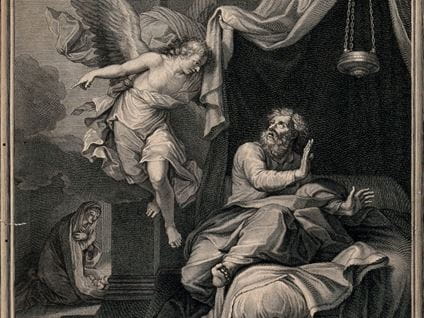
At this point, it is important to ask about what relationship the doctrine of Divine simplicity has to what we see in the Biblical text. The DDS asserts that the Divine nature is "without parts" and thus, immaterial in nature. Whenever the Bible asserts that "God is" something or uses a noun to affirm "what God is" or "how God is" in His essence and existence, we have the smoking gun of the doctrine of Divine simplicity. For example, Psalm 99:5 ends with the short phrase: "Holy is He". Such expressions are what theologians refer to as "predicating of attributes to God", meaning that God is the truest and fullest expression of that attribute. In other words, Yahweh does not merely have an attribute called "holy", rather, He is Holy and Holy is He. God is, by His essence and existence, holiness par excellence. To expounds further on this attribute of holiness, Isaiah 6:3 records the Seraphim crying out the three-fold repetition of "Holy, Holy, Holy". God is , in His existence and essence, this very attribute, and conversely, this very attribute is God. The other attributes of God we find in scripture (i.e. omniscience, mercy, love, goodness., etc.) are described in the same fashion as what we saw with God'a holiness. The doctrine of Divine simplicity teaches us that God is all His attributes, with no attribute being more center stage than another. What this means then is: God as Holy is truly Holy with respect to other attributes with which we understand Him in similar terms (i.e. God is holy loving and lovingly holy; God is holy merciful and lovingly merciful; God is holy omniscient and omnisciently-holy and so forth).
What makes this intriguing, in terms of the Person of the Son, is that Jesus Himself asserts in John 12:41 that what Isaiah saw in Isaiah 6:3 was no less than He Himself! By affirming the deity of the Son, the terminology used by the Old Testament in describing such Old Testament appearances suggest the applicability of Divine Simplicity as expressing what we mean when we say "Jesus is truly God".
How the Bible Talks About God and Its Relevance to Understanding Christ's Deity and Divine Simplicity
 So what about all the various Old Testament appearances in terms of an "embodied Yahweh" and other sorts of appearances that clearly involve Yahweh manifesting Himself in created or creaturely ways? Do these appearances in any way conflict the doctrine of Divine Simplicity? More specifically, does the Son's appearances in various forms and ways in the Old Testament do away with the notion of Him bearing a Divinely Simple nature?
Theologians have understood the Bible's way of speaking of God occurs on a two-level way of speaking. Passages that speak of God as "not changing" or "changing His mind" (Numbers 23:19; Malachi 3:6) and which describe the Son (Hebrews 1:8-13; Hebrews 13:6) use language that speaks of God as He is in His existence and essence (i.e. "being language" or "ontological language"). Such "ontological language" is God telling us what He is like and how He is like as the Divinely Simple Being that is identified as Father, Son and Spirit.
A second type of description used by the Bible for God utilizes analogies and metaphorical descriptions, such as God having "eyes" (2 Chronicles 16:9); "wings" (Malachi 4) ; some sort of embodiment (Daniel 10:6) and even "changing His mind" (Genesis 6:1-6). This second way of talking about God is the way in which God communicates Himself for our understanding. God's use of this second manner of revealing Himself is called "analogical language". An "analogical description" refers to how God reveals an attribute of Himself in a comparative way to something in the created order. Thus for instance, whenever we see God described as "having eyes", this expression points us back to the "being language" or "ontological language" of God as everywhere present or omnipresence.
To handle all the Biblical data correctly, it is important to interpret the analogical language scripture uses to describe God according to the ontological or "being" texts that reveal God as He really is. If the student of scripture fails to consider these observations, heresies such as Mormonism, which teach that God is some sort of Divine humanoid being with physical parts, will result.
I know that today's post has tossed a lot of new terms at some readers that can quickly get us all deep into the weeds. So, to put what I just wrote in another way, a wonderful, proven illustration may help. Older Theologians use the illustration of a parent lisping to an infant in so-called "baby-talk". Why do parents do this? So that the baby is not hindered in interacting with the parent.
As to what occurs in the relationship between the Son and the created order, the experience of change is with respect to how people experienced Him in the Old Testament. The Person of the Son, like the parent in the above illustration, "stoops down" to the level of His people by various ways, whether they be covenants, through objects or in taking on a temporary embodied form (see Hebrews 1:1-2). As author Dr. Sinclair Ferguson once remarked in a sermon,
"Christ's Old Testament appearances functioned as a dress rehearsal for His permanent taking on of a human nature in the incarnation."
As noted already, God, by the Person of the Son, appears as a burning bush, somehow as a rock issuing forth water or as the visible Yahweh for our sake. Even though we know "that" the water from the rock and the burning bush are "Christophanies" or "Theophanies" or appearances of Christ; we still don't comprehend "how" Christ is genuinely revealed to His people in those instances. All we can say is that the pre-incarnate Christ "bent down" in such appearances to communicate to His people while all the while not ceasing to remain Divinely simple as a Divine member of the Godhead.
The Person of the Son, as we have discussed above, is free to interact with our world. Any changes and interaction with such a Divine Person like the Son (also called "the Word" in John 1:1-3,14) are how we experience Him on our side of things. It is not God's nature that undergoes such changes. Instead, we are the ones that experience change in such interactions. In the next post, we will discover how these features of the Old Testament's portrayal of God sets the stage for how we understand the Son's decisive revelation of God in His incarnation as Jesus of Nazareth.
More next time....


