Revelation 12:3-4 "Then another sign appeared in heaven: and behold, a great red dragon having seven heads and ten horns, and on his heads were seven diadems. 4. And his tail swept away a third of the stars of heaven and threw them to the earth. And the dragon stood before the woman who was about to give birth, so that when she gave birth he might devour her child."
Demons, Angels and the war in the heavenlies
John, the human author of the Book of Revelation (along with the Divine Author, God the Holy Spirit), takes us now into "Episode Two" of this grand vision of history leading up to and beyond that first Christmas night. We saw yesterday the significance of Christmas in Revelation and began looking at Revelation 12. As we will see today, in-as-much-as Christ's 1st advent was a historical event - it also was a cosmic one. Jesus came in the virgin's womb through the virgin conception - resulting in His uniting of a truly human nature to His Person. He came to redeem fallen humanity.
However, the Son's incarnation also affected the spiritual realms. It is here that we get a clear view of the origin of the demonic realm, the great fight in the heavenly realms leading up to Christ's birth, and the warfare that will continue until the end of time.
1. The Great Red Dragon. This is none other than Satan himself. We see him appearing as a serpent in Genesis 3:1. His nature as a Dragon, as "that serpent of old", is full and complete, as seen in the repetition of the number seven. According to Old Testament passages such as Isaiah 14 and Ezekiel 28, Satan was not always Satan. He was created as an angel, a chief Angel, perhaps the chief choir director of the angelic hosts. He was "Lucifer", the "enlightened one", who in focusing upon his created beauty became prideful.
2. A third of the stars. According to John, Lucifer rebelled and seduced 1/3 of the angelic host to follow him in a massive revolt in heaven. This revolt might very well had occured either between days 1 and three of the creation days described in Genesis 1, Psalm 104 or perhaps shortly after the completion of the creation described in those same chapters. We know that angels are described as "stars" since we see such description in Job 38:7.
Some of these "fallen ones", these demons, had rebelled so badly as to "lose their former estate" and were chained in the darkest regions until the time of the final judgment. (Jude 6) Others of these fallen angels were permitted by God to roam over the earth and torment people, as seen in the eight or nine occassions where Jesus performed exorcisms in Matthew, Mark Luke and John.
Lucifer Himself is currently "Prince of the power of the air" and "a god of this age". (2 Corinthians 4:1-6). He is roaming to and fro over the earth, along with his demonic hoards, seeing whom he may torment, destroy and blind to the truth of God. (1 Peter 5:8).
3. Stood in front of the woman. John next writes that This Dragon stood in front of the woman, awaiting to devour her child. Clearly Satan, though powerful, is still a creature, being that he did not know when exactly the day nor hour would occur for Jesus to enter into this world. He is behind the persecutions of the Jews throughout the Old Testament. Galatians 4:4 tells us that Jesus was born into this world in the fulness of time. Despite the Old Serpent's best efforts, the Christ-child was born.
4. The One born a king will rule as The King In Revelation 12:5-6, we see a summary statement from the moment of Christ's birth in Bethlehem to when He will return to earth to rule and reign as King. Satan will attempt to destroy Israel in the days leading up to Christ's return. God will have provision for protecting her in the last 3 1/2 years leading up to the second coming of Jesus Christ.
5. Christmas reminds us that God finishes what He begins, He has defeated the enemy
Just as God would accomplish His purpose in the birth of Christ in His first coming, the purpose of God will reign supreme in the Second coming. The outcome of the warfare is sure. Christmas reminds us of the victory of God in Jesus Christ: His birth declared victory; His cross won victory; His resurrection and ascension confirmed victory; His word communicates victory and the soon return will demonstrate to all that He alone is the victorious King of Kings and Lord of Lords.

Welcome to Growing Christian Resources, where you can search over 2,000 resources pertaining to your Christian walk, the explanation and defense of the Christian worldview and links to audio and video resources. Please checkout the New Hope podcast at www.gcrpodcast.wordpress.com and www.newhope-ny.org. For those desiring to dig-deeper into the scriptures, please check out www.biblicalexegete.wordpress.com.
Sunday, December 13, 2015


Saturday, December 12, 2015
How the significance of Jesus' birth is explained in the book of Revelation
Revelation 12:1-2 "A great sign appeared in heaven: a woman clothed with the sun, and the moon under her feet, and on her head a crown of twelve stars; 2 and she was with child; and she cried out, being in labor and in pain to give birth."
How Christmas is spoken of in the Book of Revelation
Where do people typically go in the Bible to read or study the accounts of Christ's birth? When you think of Christmas, your thoughts may turn to the accounts written at the beginning of Matthew and Luke. The Gospels of Matthew and Luke are primary sources from which we understand that first Christmas. Other sources for studying the first advent of Jesus can include the prophecies and promises of Christmas from the Old Testament. But what about the last book of the Bible? The Book of Revelation?
Amazingly we find not only what was going on in the angelic realm the night of Christ's birth, but we also get a front row seat to the whole of human history from creation until Christ's return. In three episodes John relates the vision of what went on in the heavenly realms on the night of Christ's birth (Revelation 12:1-2); followed by a second episode detailing the rebellious career of Satan from creation until Christ's return (Revelation 12:3-6). The third episode is a more detailed revelation that helps the reader fit together the information from the first two episodes. (Revelation 12:7-16).
How much was riding on the night Christ was born
In the opening verse John sees his first vision: a woman clothed with the sun, the moon under her feet and twelve stars. As we survey scripture, we quickly find out that these are various descriptions of the nation of Israel it has existed throughout history. Being uniquely called by God through the bloodlines of Abraham, Isaac and Jacob (Genesis 12; 15; 17; Deuteronomy 7:7-8), Israel above all other nations was chosen to be the recipient of His law and promises. (Romans 9:1-3) The idea of "a woman" is ultimately referring to Mary herself - since the prophecies concerning the virgin birth of the Messiah culminate in her. (Isaiah 7:14)
The twelve stars are in reference to the twelve tribes of Israel. We see twelve stars referring to the twelve patriarchs from whence these twelve tribes would derive in the dream of Joseph about his brothers in Genesis 37. The moon, being a reflector of light, shows us another apsect of Israel - she was to reflect the glory of God to the nations. Clearly God is rehearsing to the readers of John's book that it was through Israel that He would bring forth the Savior.
So with the entire history of man and Israel pivoting upon the birth of the Savior that Christmas night, we see Mary crying out in the pain of labor. As much as Jesus Christ was God in human flesh and in-so-far as his birth was unique in being a virgin birth, the remaining details of the birth remind us that what took place that Christmas night was real. What occurred in the heavenly realms on the night of Christ's birth would reveal just how much this one night would forever change the landscape of both history and eternity.
How Christmas is spoken of in the Book of Revelation
Where do people typically go in the Bible to read or study the accounts of Christ's birth? When you think of Christmas, your thoughts may turn to the accounts written at the beginning of Matthew and Luke. The Gospels of Matthew and Luke are primary sources from which we understand that first Christmas. Other sources for studying the first advent of Jesus can include the prophecies and promises of Christmas from the Old Testament. But what about the last book of the Bible? The Book of Revelation?
Amazingly we find not only what was going on in the angelic realm the night of Christ's birth, but we also get a front row seat to the whole of human history from creation until Christ's return. In three episodes John relates the vision of what went on in the heavenly realms on the night of Christ's birth (Revelation 12:1-2); followed by a second episode detailing the rebellious career of Satan from creation until Christ's return (Revelation 12:3-6). The third episode is a more detailed revelation that helps the reader fit together the information from the first two episodes. (Revelation 12:7-16).
How much was riding on the night Christ was born
In the opening verse John sees his first vision: a woman clothed with the sun, the moon under her feet and twelve stars. As we survey scripture, we quickly find out that these are various descriptions of the nation of Israel it has existed throughout history. Being uniquely called by God through the bloodlines of Abraham, Isaac and Jacob (Genesis 12; 15; 17; Deuteronomy 7:7-8), Israel above all other nations was chosen to be the recipient of His law and promises. (Romans 9:1-3) The idea of "a woman" is ultimately referring to Mary herself - since the prophecies concerning the virgin birth of the Messiah culminate in her. (Isaiah 7:14)
The twelve stars are in reference to the twelve tribes of Israel. We see twelve stars referring to the twelve patriarchs from whence these twelve tribes would derive in the dream of Joseph about his brothers in Genesis 37. The moon, being a reflector of light, shows us another apsect of Israel - she was to reflect the glory of God to the nations. Clearly God is rehearsing to the readers of John's book that it was through Israel that He would bring forth the Savior.
So with the entire history of man and Israel pivoting upon the birth of the Savior that Christmas night, we see Mary crying out in the pain of labor. As much as Jesus Christ was God in human flesh and in-so-far as his birth was unique in being a virgin birth, the remaining details of the birth remind us that what took place that Christmas night was real. What occurred in the heavenly realms on the night of Christ's birth would reveal just how much this one night would forever change the landscape of both history and eternity.
Thursday, December 10, 2015
How the incarnation enables us to speak of Jesus in two ways

Isaiah 9:6-7 "For a child will be born to us, a son will be given to us; And the government will rest on His shoulders; And His name will be called Wonderful Counselor, Mighty God, Eternal Father, Prince of Peace."
Introduction:
Isaiah the prophet wrote these words over 750 years before the events of Christ's birth recorded in Matthew and Luke's Gospel. In this one verse we discover two towering truths about Jesus Christ: first, that He would be born and second, His eternal pre-existence. What may seem at first to be a contradiction is actually central to identifying the person of Jesus Christ. How so? Let's discover!
Jesus was virgin born as a true human being
Anytime we talk about Jesus Christ, we speak of Him in one of two ways. The first was is by speaking of Him as a human being and the second way is to speak of Him as fully-Divine along with the Father and Holy Spirit. Prophecy in the Old Testament and the explanations of what Jesus came to be and do are consistent in this dual-way of talking about Jesus.
Isaiah first of all identifies Jesus the Messiah as One who would take upon Himself true humanity - hence as man, he would have a beginning. In another passage, Isaiah 7:14, we discover that the beginning of Jesus' experience as a human being would start with the virgin birth/conception.
This unusual detail of the virgin/birth conception is a cornerstone of the Christian faith for a couple of reasons. First of all, it was a man who had broken God's law in the garden of Eden, and so a man would have to pay for the damages done by the giving of his life. Unfortunately when God cursed humanity and the earth, all of humanity inherited the sin nature from Adam.
Which leads us to the second important truth about the virgin birth of Jesus - that Jesus would not inherit the sin nature. According to 1 Peter 1:18, the sin nature of Adam is transmitted down through the father's side of the human bloodline. Since Jesus did not have a human father, He could not inherit the sin nature. This is vital, since a sinless Savior is required to represent sinful man before a Holy God.
Thus "Jesus" refers to Jesus Christ as truly man. He would be "a son" given, "born" and having a beginning as it touches his humanity.
Christ is Eternal God
As we noted already, in the Bible we can speak of Jesus in one of two ways: as truly man and then in a second way described by Isaiah wherein the Son is also truly God. When we speak of "Jesus", we speak of His full humanity. When we speak of "Christ" we are referring to Him being fully God. Thus before Jesus Christ became a human being, He had pre-existed from all eternity. Each title given here by Isaiah points us to this truth:
1. As Wonderful, Christ is shown to be beyond human comprehension.
2. As Counselor He is God full of wisdom
3. The Mighty God is referring to His Divine Nature
4. Everlasting Father speaks to Him sharing the same nature as God the Father
5. Prince of Peace speaks to His Deity revealed through His humanity
Jesus Christ as God is equal in importance to Him being the virgin born man. Why? Only as God could the Son provide salvation (Isaiah 43:10-11). Therefore in one verse - Isaiah gives us the entire sweep of the Bible's teaching on the identity of the one who was to be born in Bethlehem. He as One person was truly God and truly man. He who has always been would become born and thus having a beginning. Without this event of the incarnation, salvation and the truth of God's word would had been jeopardized.
Wednesday, December 9, 2015
Christmas and the Four Gospels

Matthew 1:21-22 “She will bear a Son; and you shall call His name Jesus, for He will save His people from their sins.” 22Now all this took place to fulfill what was spoken by the Lord through the prophet."
Introduction:
Yesterday we began considering the whole Bible in light of Christ's first coming, and traced God's redemptive plan from Genesis to Malachi. We ended at the cradle. Today, we will journey from the cradle to the cross as we consider Christmas in the Four Gospels.
Seeing Christ in the Gospels
The cradle of Bethlehem is spoken of in Matthew and Luke's Gospel and the cross of calvary is spoken of in all four Gospels: Matthew, Mark, Luke and John. We come to understand God the Son coming from eternity into time to live a perfect life, die a sinless death and raise to victory over death, hell and the grave.
In Matthew we see Christ our King. He is King as it touches His lineage back to King David in the Old Testament and He is King as it touches His Eternal pre-existence as the Son of God. He is the King who came, taught, healed and was rejected by His own people. The lineage of Christ's royal bloodline and the scene of the wisemen worshipping the two-year old Christ in Matthew 2 begins this grand theme of Jesus is King. As one journey's towards the end of Matthew, there is found the emphasis of Jesus' Kingship with regards to His possession of all power as God-incarnate in Matthew 28:18.
Mark shows us Christ the suffering servant. He came to die and give His life a ransom for many. (Mark 10:45). Though Mark does not gives us the early life of Christ, yet it focuses our attention as to why he was born - to live as the believer's credited righteousness, to die for the forgivness of sins and to rise to provide both.
Luke portrays Christ as the Son of Man, full and complete humanity. He is the Master who calls his disciples to die to themselves and live for Him. Luke the physician points us to the Great Physician Jesus Christ. Luke begins His Gospel with the early life of Christ: His birth, His presentation at the temple and the shepherds. We see 72 names listed in Christ's geneaology - stretching from Adam to Christ.
John, the beloved Disciple pens for us the glory of Christ as God in human flesh. In John's record we see emphasis upon Christ's undiminished Deity and perfect humanity. We see John's fondness for the number seven in telling us His version of Jesus' life: seven signs or miracles and seven times where Jesus identifies Himself as "I am".
What Christmas is all about
Now all four of these Gospels take us through Jesus' life to His cross. The three days following Christ's crucifixion witnesses His resurrection from the dead and then His ascension 40 days thereafter. When you put all four gospels together together, you have a complete picture: the babe in Bethlehem would be the Savior on the cross. The Savior on the cross would rise again, demonstrating Himself to be the God of glory. All Four Gospels work distinctly and together in communicating the glory of the incarnate God - Jesus Christ - invading history. The Kingdom of God has been inaugurated by Jesus following His ascension into Heaven, yet if He had not came in the virgin conception/incarnation, there would had been no cross, no empty tomb nor inauguration of any Kingdom. In as much as we are right to celebrate all that Jesus achieved, let us not forget the way in which He came to affect such salvation - namely, the virgin's womb and the miracle of His incarnation. This is what Christmas is all about.
Tuesday, December 8, 2015
How God used Old Testament history to prepare for Jesus' coming

Luke 24:44 "Now He said to them, 'These are My words which I spoke to you while I was still with you, that all things which are written about Me in the Law of Moses and the Prophets and the Psalms must be fulfilled.'”
Introduction
Preachers of old have often said something to the effect: "even though I may not be able to find Jesus Christ in every verse of the Bible, yet from every verse of the Bible I can get you to Jesus Christ." As Jesus was speaking to his disciples prior to His ascension into heaven, He was pointing back to the Old Testament Scriptures that spoke concerning Himself. As we think about how the Bible focuses so much on what Christ would come to accomplish in His first coming, as well as what He will accomplish in His second coming, I want us to discover how God used Old Testament history to prepare for Jesus' coming.
From Creation through History we see Christ
As we start at Genesis we see Christ the creator. The Gospel of John tells us that without Him nothing was made that was made (John 1:3). Christ is the Origin of all things, Who along with the Father and Holy Spirit, as One God created the Heavens and the earth. In Genesis He is Creator. As you go through the rest of the Old Testament books, we discover Christ pictures or spoken of in the following ways:
In Genesis He is my Creator. In Exodus, my Redeemer. Leviticus, my Perfect sacrifice. In Numbers, He is the God who leads me and in Deuteronomy, the Living God.
From History to the Prophets we see Christ
In Joshua He is the Captain of my Salvation. Ruth tells me He is my Kinsman Redeemer. In Samuel He is my Prophet and in Kings and Chronicles He is my Sovereign God. In Ezra He is my Faithful Scribe and in Nehemiah He rebuilds what the enemy has torn down. In Esther He is the God who is always on time.
In Job He is the the midst of my suffering and in Psalms he is the Song of my salvation. Proverbs tells me His is wisdom and Ecclesiates reveals Him to be the meaning of life. Song of Of Solomon presents Him as my beloved Bridgegroom. Isaiah, the prince of the prophets, shows Him to be Holy God. Jeremiah shows Him to be the one who weeps and Lamenatations, the one who mouurns. Ezekiel shows him to be the Glory of God and Daniel tells me His is the fourth man in the fiery furnace.
Hosea shows Him to be the Faithful spouse and Joel shows me the Holy Spirit whom He would send to help. Amos communicates Him as the Plumbline of Truth and Obadiah reveals Him as Humility against my pride. Jonah reveals Christ as the one who died, buried and rose again, the Great Foreign Missionary coming to seek and save the Lost. Micah tells me there is no God like Him and Nahum reveals His way in the whirl wind and the clouds to be the dust of His feet.
Habakkuk understands Him to answer my prayers and Zephaniah tells me that He rejoices over me with singing and quiets me with His love. Haggai unfolds Him as the treasure of all nations and Zechariah shows the purpose of His first and second comings - to provide salvation and bring forth His glory. Malachi, that great last prophet, tells of the time up to His first coming, and that He will come again as the Sun of Righteousness with Healing in His wings.
From the Prophets to the Cradle we are led to meet Christ
After Malachi, 400 years passes, with heaven closed and no word from God. Israel was awaiting the arrival of their King, their Messiah. Then we come to Matthew and we find out that the long awaited Messiah would be born in Bethlehem's cradle. By the time Christ would die on the cross, over 100 propecies would be fulfilled. The shadow of the cross was never far from the cradle.
Monday, December 7, 2015
The Scarlet Thread of Redemptive History
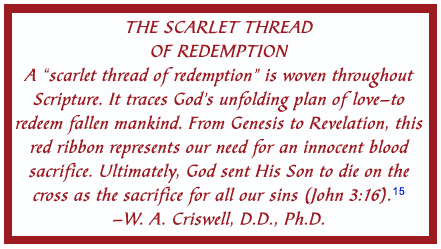
Genesis 38:28 Moreover, it took place while she was giving birth, one put out a hand, and the midwife took and tied a scarlet thread on his hand, saying, “This one came out first.”
The Scarlet Thread
In one of my Bibles I have a red piece of yarn that I call "the scarlet thread". The reason I have this yarn in my Bible is to remind me of the redemptive plan of God that took place in bringing the Savior to the world. Preachers such as the late Dr. W.A Criswell quoted above have for years made reference to the lineage of Christ's humanity as being a scarlet thread of redemption. In several places in the Old Testament we find remarkable events and people that constituted the bloodline that God would use to bring about Christ's humanity.
Mankind is broken before God
In Genesis 38 we meet one of Jacob's sons - Judah. Now Judah was a man who lived by his desires and by the moment. Unlike his father Jacob, we never see Judah exhibit any major quantum leaps in the walk of faith. In this chapter, we see hypocrisy, treachery, lies, immorality, intrigue, injustice and betrayal. Judah's spiritual life was littered with the trash of the sin nature he inherited from his father going all the way back to Adam. (1 Peter 1:18) Judah is a small picture of humanity in need of a Savior. Little did he know that God was going to use his rebellion and unsavory decisions to Sovereignly work forth the bloodline of redemption.
The bloodline issuing from Judah to Christ
God's hand was upon and in history as He was preparing the way for the arrival of His Son on that first Christmas night. When we compare the birth records of Jesus in Matthew and Luke, we discover some remarkable features:
-From Adam to Noah is ten generations
-From Shem, Noah's Son, to Abraham is ten generations
-From Judah, Abraham's great-grandson to King David of Israel is ten generations
-Judah and his wife Tamar here in Genesis 38 appear in Christ's geneaology in Matthew
-King David was of the tribe of Judah, which came from Judah the man here in Genesis 38
-The second major prophecy about Christmas was about Judah in Genesis 49:10
The Scarlet thread of redemption signals the hand of God in salvation
At the end of Genesis 38, after a series of shocking events, Tamar, Judah's daughter-in-law, has twins by Judah. The twisted set of events in this chapter underscore the falleness of man in need of a Savior. As the twins are being born, the first one pops its hand out and the midwife ties on its wrist a scarlet thread. Suddenly it goes back in and the little brother forces his way ahead and becomes the first born! Just like grandfather Jacob - who steals the blessing from his older brother Esau, and just like great-grandfather Isaac whom God chose over the older brother Ishamael, God once again is working to remind man that He is charge.
Only One who is both God and man could fix what man had broken before God
God was not and could not be twarted in bringing about that first Christmas. God came through a broken humanity to redeem all who by grace through faith would believe on Him. (John 1:12-13). A man, Adam, had broken things with God - thus God's justice demanded that man is responsible to fix what was broken. Likewise, God and God alone could provide salvation - however God is too Holy to just right out forgive sinful man. God took upon Himself humanity in order to satisfy both conditions.
That little scarlet thread shows us that God's plan was continuing onward. God was going to accomplish what He set out to do - to bring the Savior into the world.
Sunday, December 6, 2015
The Christian Apologetic Task and its Relevance to Christmas

1 Peter 3:15 "but sanctify Christ as Lord in your hearts, always being ready to make a defense to everyone who asks you to give an account for the hope that is in you, yet with gentleness and reverence."
Introduction:
During these last few days we have been taking the time to suggest ways in which one could argue for the historicity and reality of the birth narratives of Jesus Christ. More specifically - we have aimed to demonstrate the reasonability, reliability and significance of the Son of God becoming incarnated or revealed in true humanity by way of the virgin birth. Such a study has included discussions about the possiblity of miracles, the existence of God and the reality of the Person and work of Jesus Christ. It is hoped that the reader has gleaned some ways in which they can share the Gospel in reference to the miracles of the virgin birth and incarnation.
To know that the incarnation was a real event begs the question: what will you do with Jesus? As we also labored to demonstrate, being that we live in a world where God's direct intervention into history has occured (minimally described by the non-natural events of the beginning of the universe and Jesus' resurrection from the dead), we concluded that there is no reasonable basis for excluding the miraculous from a genuine reading and assessment of the Christmas accounts in Matthew and Luke's Gospels.
As can be seen, such efforts have relevance for communicating the truth of Jesus' remarkable life and resurrection from the dead. Today's post aims briefly to define what we will call "the Christian apologetical task", with some final closing remarks on its relevance to Christmas.
Defining the term "apologetics"
In the opening text of today's post we see the mandate given by the Apostle Peter to defend the Christian's hope. In fact the word translated "defense" is the Greek word "apologia" (a-po-lo-gee-a), from whence we derive the name of the branch of Christian theology called "apologetics". When a Christian engages in apologetics, they are not saying they are "sorry" for being a Christian, rather they are given reasons to skeptical onlookers as to why they are so full of hope in an otherwise hopeless world. Dr. R.C Sproul in a sermon entitled "apologetics" gives this definition of apologetics: "A well reasoned defense of the truth claims of the Christian faith." Any well rounded Christian should not only know "what they believe" but also "why they believe".
Various methods for doing apologetics
With the mandate to defend the faith being clear from scripture and the meaning of apologetics being briefly defined, the next important area has to do with how to go about doing apologetics. Several methods of defending the Christian faith have been proposed through the more than 2,000 year history of the Christian church.
a. Classical Apologetics
Ed Hindson and Ergun Caner of Liberty University of the following description of classical apologetics:"the unbeliever is offered
evidence of the existence of God, and the supposition is that the unbeliever can reasonably ascertain that this hypothesis is rational and cohesive". 1 Hindson and Caner then explain further the second area general covered by classical apologetics, namely: "The classical apologist further argues for the reliability of the special revelation (The Bible) as a reliable and authoritative word from God."2 Author Doug Powell has this to say about the classical method: "The emphasis of classical apologetics is on reason. Christianity's logical soundness and internal coherence is exploited in this method. As a result, tests are developed and proofs are given that demonstrate the truthfulness of Christianity and the irrationality of competing worldviews." Powell later adds: "The classical method is so called because it traces its roots back to the second century and the earliest apologists."3
When defending the Christian faith through the method of classical apologetics, at least two and sometimes three steps are followed in the course of the presentation.
1. First, reasonable arguments are given to show the reasonability of the Christian faith. Such arguments as showing God's existence from observations in the universe and science (i.e the cosmological argument); the existence of objective moral values (i.e the moral argument); how God is necessary for anything to exist (i.e the ontological argument) and then the evidence for design in the universe (also called the telelogical argument).
2. The next phase will usually entail demonstrating the reliability of the Bible from the transmission of its words through the thousands of existing manuscripts to the archaeological evidence supporting the accounts we read in the Bible.
3. Usually the final phase will then be showing how the God of the Bible exists due to the resurrection of Jesus Christ from the dead. Some classical apologists will combine this step and the defense of the scriptures, whereas others may only focus on either one.
b. Presuppositionalist apologetics
Classical apologetics states the the proper starting point for defending the Christian faith is reason to scripture. However other apologists believe that the proper starting point for defending the Christian faith is by pre-supposing God Himself. Christian scholar Norman Geisler notes: Presuppositional apologetics is the apologetical system that defends Christianity from the departure point of certain basic presuppositions. The apologist presupposes the truth of Christianity and then reasons from that point.4 With the presuppositionalist approach, the emphasis is almost opposite, namely you presuppose God's existence and aim to prove why Christianity alone is most reasonable and possess the greatest justification for believing. Douglas Powell notes the following about presuppositionalism: "Thus, presuppositionalists are more concerned with what makes evidence evidential and what makes reason reasonable. Because the God of the Bible is the Creator of all things, we know that He is not just the source of all physical things, but all laws whether they be scientific laws, moral laws or logical laws.5
The presuppositionalist contends that since all human beings have the knowledge about God in their hearts, the purpose of apologetics then is to expose the fallacies of their worldview and get them to admit what they have been supressing. A typical presuppositionalist approach would be that without God, we could not use reason in our discussions, since reason itself requires the existence of God to operate. The existence of objective moral values and the underlying laws of such fields as math and even science require the existence of God. Even though presuppositionalism is the minority method in apologetics today, it can be very effective when dealing with such worldviews as Atheism.
c. Evidential Apologetics
In the evidentialist approach, evidence from the world of the sciences, history and observation functions to provide the necessary ammunition for the Christian apologist. Doug Powell notes: Evidentialism's value as a substantial tool to defend the faith rose in the nineteenth and early twentieth centuries as archaeology in particular developed as a science and turned its attention to the Mediterranean world and the Middle East. The findings of ancient manuscripts contributed immensely to our ability to know the original text of the Bible."6
Hindson and Caner give this insight about the evidentialist approach: "the method is the same: arguing the preponderance of the data."7
In the evidentialists mind, if enough evidence is brought forth to the unbeliever, the unbeliever will be backed into a corner, admitting that their evidence cannot compare to the evidence for the God of the Bible. In using events such as the World-wide flood of Genesis 6-9, evidentialists will appeal to virtually every branch of science to support the historical reality of the flood. In showing the flood to had been a real event, the logical follows then that the Bible is realiable enough to be trusted in other areas and ultimately salvation.
d. Fideism or arguing that the best defense of the Christian faith is the Christian faith itself
Doug Powell observes the following about this fourth major approach: "In sharp contrast to these three methods, fideism rejects reason, evidence, and transcendental arguments as sufficient ways to justify the Christian faith (fide is Latin for faith). Faith and faith alone is the only proper way to understand the truth of Christianity."8 For the fideist, the task of the apologist is to proclaim the truth of the Gospel in the special revelation of the Bible, since the warped human nature necessarily rejects the testimony of God in the general revelation of creation and the conscience. As Hindson and Caner note about this approach: "A fideist, therefore, is one who holds the view that one comes to belief in God on the basis of faith alone, in the absence of or contrary to reason.9 Unlike the other three viewpoints above, the value of evidence and rational arguments is placed in doubt under the method of fideism.
Conclusion
We have explored the meaning of apologetics and four main methods for defending the Christian faith: classical, presuppositionalism, evidentialism and fideism. May you and I dear reader know that not only must the Christian hope be defended, but that there are some marvelous ways in which we can go about presenting Christ to a lost a dying world. These two thoughts especially have bearing on this time of year as we consider the family and friends with which we will have contact - some of which have never trusted in Jesus Christ. Would it be that God uses these series of posts to open the eyes of openly hostile or skeptical loved ones and friends who are cynical towards Biblical truths such as the virgin conception and incarnation of Jesus as God in human flesh. The task to proclaim and defend the faith never ends and the relevance of such efforts has never been so urgent. May those who are Christian readers of these posts have a renewed fervor to share Jesus this season.
Endnotes:
1. Ed Hindson and Ergun Caner. The Popular Encyclopedia of Apologetics. Harvest House Publishers 2008. Page 64.
2. Ed Hindson and Ergun Caner. The Popular Encyclopedia of Apologetics. Harvest House Publishers 2008. Page 65.
3. Doug Powell. Holman Quicksource Guide to Christian Apologetics. Holman Publishers. 2006. Page 356.
4. Norman Geisler, General Editor. Baker Encyclopedia of Christian Apologetics. Baker. 1999. Page 606
5. Doug Powell. Holman Quicksource Guide to Christian Apologetics. Holman Publishers. 2006. Page 360.
6. Doug Powell. Holman Quicksource Guide to Christian Apologetics. Holman Publishers. 2006. Page 359.
7. Ed Hindson and Ergun Caner. The Popular Encyclopedia of Apologetics. Harvest House Publishers 2008. Page 65.
8. Doug Powell. Holman Quicksource Guide to Christian Apologetics. Holman Publishers. 2006. Page 363.
9. Ed Hindson and Ergun Caner. The Popular Encyclopedia of Apologetics. Harvest House Publishers 2008. Page 224.
Subscribe to:
Posts (Atom)