Translate

Thursday, April 13, 2017

What is Maundy Thursday? Exploring Why Today Is Significant For Many Followers Of Jesus

Image result for Maundy Thursday
John 13:1 "Now before the Feast of the Passover, Jesus knowing that His hour had come that He would depart out of this world to the Father, having loved His own who were in the world, He loved them to the end."

Introduction:

For those Christian fellowships that follow closely the Christian calendar, today marks what many call "Maundy Thursday". For many in non-liturgical church fellowships, such holy-days may not hold a lot of significance. The church that I serve at will be celebrating Good Friday tomorrow and of course Easter on Sunday. But what about this day called "Maundy Thursday"? Robert Webber has written a helpful book that explains the meaning of the Christian calendar and its associated days and observances entitled: "Ancient-Future Time". Webber notes the following about "Maundy Thursday":

"The term 'Maundy' derives its meaning from the Latin 'Maundatum Novum', which means "New Commandment". Thus, Maundy Thursday is the day Christ instituted the new commandment of love both by word and symbolic action."

Now before I go on, an important disclaimer needs to be made. In all fairness, it is good to avoid emphasizing form over the substance or truth of the scripture. With that important thought of avoiding the route of becoming legalistic and ritualistic, the other ditch to avoid is having ignorance about what previous generations of Christians have done in their attempts to apply the scriptures and live them out. Scripture is the pattern, the standard and the authority by which any traditions are judged. If we find, on the same token, certain expressions that can immerse one in the Word of God and focus more on Jesus, then we have in effect demonstrated the pattern of sifting our expression of worship through the Words of God in the Bible. This post is an attempt to better understand what can be a beneficial Christian observance whilst not removing Scripture from its rightful spot as the final authority on what we say, think and do.

The Main Points Of Maundy Thursday

So we have at least a definition of what this day commemorates. In searching through various books that feature the various cycles and holy days of the Christian calendar, one finds that Maundy Thursday centers around what Jesus did on the Eve of His crucifixion in the upper room in John 13-17.

In the standard Maundy Thursday celebration, the Pastor or Bishop (or whichever Christian leadership position is part of the given tradition) begins the service through a foot-washing ceremony. For non-liturgical fellowships (the term "liturgy" refers to a certain, prescribed way of expressing the worship of God by the church) that may not follow a formal route or structure, details such a foot-washing, reading of certain scriptures and other activities might seem unusual. 

With that said, what can we say about foot-washing? Though foot-washing is not an official ordinance of the church, nonetheless, can be a powerful symbolic action of communicating the need to serve one another. We read Jesus' closing remarks following the washing of the disciple's feet in John 13:12 "So when He had washed their feet, and taken His garments and reclined at the table again, He said to them, “Do you know what I have done to you?" In think about what Maundy Thursday is all about, Jesus' question certainly is cause for pause: do we really know what He did for us? He came not to be served, but to serve and give His life a ransom for many (Mark 10:45). 

In stooping down to wash the disciple's feet, the Lord Jesus Christ was re-enacting His own "stooping-down" as God in human flesh in the act of His incarnation. Amazingly, as truly God, He already possessed humility as a Divine attribute. The fact God would even choose to create the world was an act of condescension on His part. Christ's incarnation, followed by His earthly life, ministry and death on the cross would carry out the most intense act of humility and condescension of God to us who are in need of Him (see Philippians 2:5-11).

Maundy Thursday not only includes focus upon Christ's service to us in the act of foot washing, but also in the commemoration of the Lord's Supper. In typical fashion, reference will be made to God's institution of the Passover in Exodus 12. When Jesus instituted the Lord's Supper in John 13-17 and in the other Gospel accounts, He was fulfilling the imagery associated with the Lord's table. He prescribed this covenant meal for His church (see 1 Corinthians 11:23-27). Jesus, after all, is the ultimate "Passover Lamb" (see 1 Corinthians 5:7). 

Why Maundy Thursday Can Be Useful For The Christian

As one considers the events of Jesus' final hours with His disciples before His crucifixion, we as His church are, as it were, in the "final hours" before the close of this age. The Lord's supper not only points back to what He achieved on the cross, but also looks forward to His soon return. Maundy Thursday is just as much about reminding Christians of their identification in Christ's second coming as what He did in His first coming. 

Maundy Thursday also takes us into those final moments when Jesus was in the Garden of Gethsemane. I can recall years ago attending what was the only Maundy Thursday service I was ever at and a participant. A pastor friend of mine invited other pastors and the community to take part. Admittedly, he did some of the details differently. Nevertheless, he centered the time around Jesus' moments in the Garden of Gethsemane. At the service, each participant read some scripture, offered prayers and then we took up a collection to be given to a local mission in that town. When the service was done, I came to appreciate all that this particular day meant. 

Jesus wrestled in the Garden with the temptation of by-passing the cross. He of course did not yield to such temptation, but instead aligned His sinless human will with what He and the Father had agreed upon in eternity with respect to the One, unified Divine will. In effect, Gethsemane was a thresh-hold Jesus chose to step over in order to express His unyielding allegiance and desire to do the Father's will. 

Closing Thoughts:

As Maundy Thursday slips into the night hours, may we thank the Lord for what was a willing choice made in His humanity to yield to what had already been a decision made in eternity: to be the Savior of the World.  


Wednesday, April 12, 2017

What Is Arguably The New Testament's Most Potent Chapter - 1 Corinthians 15

Image result for 1 Corinthians 15
1 Corinthians 15:1  "Now I make known to you, brethren, the gospel which I preached to you, which also you received, in which also you stand."

Introduction:

Since we are in Easter-week, I thought it apropos to consider the contents of what could arguably be the New Testament's most-potent chapter: 1 Corinthians 15. Below we will do a fly-over of this chapter to see its significance in understanding Christ's resurrection and why this truth is central to understanding Christianity and the power needed for living for God today.

The Living Gospel shines hope into a troubled church

The letter of 1 Corinthians represents a letter written by the Apostle Paul to a troubled church. After reading through the first 14 chapters of 1 Corinthians, judgment and God's discipline seem imminent.  The thunderclouds of God's Fatherly-discipline hung over this church.  Yet, the rays of mercy and hope shoot through the cloud-tops to break up the gloom in 1 Corinthians 15.  The sunshine of God's Living Gospel pours into the otherwise bleak future for this church.  No chapter in God's word spells out the implications of Christ's resurrection any clearer than 1 Corinthians 15.

The main point of 1 Corinthians 15 - Unfolding the Living Gospel

Every major Bible doctrine, every conceivable means of persuasion is used by the Holy Spirit to convince the reader of the power of the living Gospel in 1 Corinthians 15.  Below is a thumbnail sketch of this remarkable chapter:

1. The Gospel's Living Message. 
1 Corinthians 15:1-11

2. The Gospel's Living Christ.       
1 Corinthians 15:12-20

3. The Gospel's Living Doctrine    
1 Corinthians 15:21-28

4. The Gospel's Living Power       
1 Corinthians 15:29-49

5. The Gospel's Living Encouragements 1 Corinthians 15:50-58

As was noted already, 1 Corinthians 15 is arguably the New Testament's most potent chapter.  Those five major divisions are like the five smooth stones that David had ready His sling to defeat the Goliath of unbelief. It only requires one stone from this mighty brook to topple any giant you might be facing.  The Living Gospel is not only revealed in its power - but in it's robust splendor. 

The Living Gospel is the remedy for every spiritual ailment

The Apostle Paul is like a pharmacist issuing a bottle that, when taken in full measure, heals the heart and revives the Christian. The resurrection power of Jesus Christ is brought to the sinner by the Holy Spirit to bring about a transformed heart in saving faith (see 1 Peter 1:3-5). 

A quick overview of the New Testament will reveal the priority of Christ's resurrection to Christianity:

1. All Four Gospels record the resurrection of Jesus Christ and His post-mortem appearances to His disciples.

2. The Book of Acts, the record of the early church, features roughly 20 sermons preached in the early church. The Apostles Peter and Paul preached all of the sermons in the Book of Acts except one. Among those roughly 20 sermons, we find reference to the resurrection of Jesus Christ to be the central emphasis of their preaching.  Most if not all of Paul's letters, Peter Letters and most of the other New testament books make reference to Christ's resurrection. Dr. Gary Habermas, a premier expert on the historical case for Christ's resurrection, estimates there are roughly 300 verses referencing the resurrection in the New Testament.

3. The Book of Revelation presents the Post-resurrected Christ as ruling and reigning, worthy of all worship. Christ's vindication of His identity as God-incarnate is due to the fact that He has overcome death. Truly, without the resurrection of Jesus Christ, Christian faith itself would be lifeless.  

Closing thoughts:

As we direct our thoughts towards this coming Easter weekend, may we read through 1 Corinthians 15. May this post aid the reader in considering more closely why this chapter in the New Testament is so potent for understanding Christ's resurrection and how there is power available for Godly-living today.

Tuesday, April 11, 2017

WhyThe Post-Resurrection Appearances Of Jesus Are Vital In Understanding Jesus' power To Change Lives Today

Image result for jesus post mortem appearances
Matthew 28:6 "He is not here, for He has risen, just as He said. Come, see the place where He was lying. 7 Go quickly and tell His disciples that He has risen from the dead; and behold, He is going ahead of you into Galilee, there you will see Him; behold, I have told you.”

Introduction:

No other event or Christian doctrine is more proclaimed, more attacked and more crucial than Christ's resurrection from the dead.  To get our footing on how Jesus' resurrection is communicated and how it is typically defended against critics, I will note four key areas of consideration that must be considered when talking about Jesus' resurrection from the dead:

1. His burial
2. The empty tomb
3. Post-resurrection appearances to His followers
4. Changed lives

What top Christian apologists or defenders of the Christian faith say about Jesus' resurrection from the dead

Three of the top Christian Apologists today list the above four areas in their short list of what constitutes the the Biblical narrative of Christ's resurrection from the dead.  I want the reader to note the last element in each of their listings, since the importance of Jesus' post-resurrected appearances will be discussed toward the end of this post.

First, Josh McDowell in his book: "Evidence that Demands a Verdict" lists the following elements of what he calls "the resurrection scene":1

1. Jesus was dead
2. The tomb
3. The burial
4. The stone
5. The seal
6. The guard
7. The disciples
8. The post-resurrection appearances 

The second Christian apologist, Liberty University Professor Dr. Gary Habermas, lists out a very similar short list in the argument he gives for the Resurrection that he calls the "Minimal Facts Argument":2

1. The burial
2. The empty tomb
3. Post resurrection appearances
4. Changed lives (especially of the Apostle Paul).

Dr. Habermas' argument leans heavily on Paul's statements in 1 Corinthians 15:1-10, noting that the material represents early information that takes the reader back to within a year after the crucifixion and resurrection of Jesus. He will tell you that his approach is to take the Gospels and Paul's statements as historically reliable, just as one studying Julias Caesar would take the Roman historian Tacitus to be a reliable source. By considering a "minimal fact" to be supported by multiple sources and affirmed by the majority of New Testament scholars of all stripes (whether liberal, moderate or conservative), Habermas' method demonstrates the historicity of Jesus' resurrection.  

The third Christian Apologist who argues for the historicity and reliability of the resurrection accounts of Jesus Christ is Dr. William Lane Craig. Dr. Craig a world renowned expert and debater who frequently debates critics attacking the Bible.  In his presentations, I have heard Dr. Craig list in a similar fashion the following essential elements to the account of Jesus' resurrection from the dead:

1. The burial
2. The empty tomb
3. The post resurrection appearances
4. The changed lives of the disciples
5. The conversion of the Apostle Paul

The reader can check out Dr. Craig's material at www.reasonablefaith.com.

The one area among these elements that merits further focus and explanation

In past posts over the years we have explored the great resurrection chapter of 1 Corinthians 15 and have aimed to unpack and proclaim all that Paul has to say in his masterful explanation and defense of the resurrection.  Certainly the Gospel accounts have also been the focus of past blogs on this subject, wherein we have talked about the crucifixion, burial and empty tomb.  

In listening to such fine communicators of the Christian faith above like McDowell, Habermas and Craig, as well as reading wonderful books and articles written by able Bible teachers, it has come to my attention that the way in which Jesus' post-resurrection appearances changed lives is worthy of consideration. Exploring how the post-resurrected Jesus radically changed the lives of his disciples in the wake of His resurrection, as well as how He is still changing lives today lends immense credibility to the truth of the resurrection narratives. 

What we observe in the post-resurrection appearances of Jesus

Whenever we consider the four Gospel records, the Book of Acts and 1 Corinthians 15, we find exactly one dozen episodes featuring Christ's post resurrection appearances. Furthermore, we find three common themes among them all:

1. Desperate condition of the people before His appearances

2. Direct encounter with the Risen Christ appearances themselves

3. Dramatic change that resulted from the appearances

Eight individuals or groups stand out in these post-resurrection appearance narratives, what we could call "post-resurrection profiles". 

1. Mary Magdelene
2. Peter
3. Emmaus Road Disciples
4. Thomas
5. The Disciples in general
6. Group of 500 people
7. James, the half brother of Jesus 
8. Paul

In scanning over these eight people or groups, we discover that in each case, their lives before, during and after each post-resurrection appearance leads to the conclusion that Christ indeed not only raised from the dead, but is alive and operating among His people.  Such post-resurrection power is the basis for the salvation and Christian growth of every Christian living today.  

Closing thought

The importance of Jesus' post-resurrection appearances cannot be over-estimated.  Not only is such a truth a vital component in communicating and defending the truth of Jesus' resurrection from the dead, but also is vital in explaining how Jesus is able to change lives today. In closing, this is why we come across such statements as 1 Peter 1:3 "Blessed be the God and Father of our Lord Jesus Christ, who according to His great mercy has caused us to be born again to a living hope through the resurrection of Jesus Christ from the dead." May we think on such truths and live our lives for the living, risen and exalted Jesus Christ!"


Endnotes:
1. Josh McDowell. Evidence that Demands a Verdict - Volume 1. Here's Life Publishers. Page 189.

2. Dr. Habermas' minimal facts presentation can be found at the following link at: https://www.youtube.com/watch?v=ay_Db4RwZ_M

Monday, April 10, 2017

Transformation From Weeping To Rejoicing - A Study In The Life Of Mary Magdalene

Related image
John 20:8-11  "So the other disciple who had first come to the tomb then also entered, and he saw and believed. 9 For as yet they did not understand the Scripture, that He must rise again from the dead. 10 So the disciples went away again to their own homes. 11 But Mary was standing outside the tomb weeping; and so, as she wept, she stooped and looked into the tomb."

Meet the weeping disciple

Have you ever wept? I mean, convulsing, uncontrollable wailing. Inconsolable. Tears flowing like rivers. The sense of despair that overtakes you. Broken words in between gasps of breath. This is the type of sorrow we see Mary Magdalene expressing at the tomb of the Lord Jesus. The tomb is empty. The disciples had already arrived and left. No one is expecting resurrection. All have scattered - save the weeping disciple. Mary's grief hangs like a thick fog. 

A quick study of John's gospel will reveal at least seven places where we find the expressive sorrow of weeping. Of those seven or eight spots, four are found in John 20, all of them referring to Mary. Her weeping is inconsolable. The appearance of angelic emmisaries are of no avail. There is only One who can change this situation. He is not there - at least yet.

The theme of weeping transformed into mourning

Weeping is an interesting phenomena to study in both Old and New Testaments. One of the reasons weeping is so interesting is due to its coupling with its opposite expression - rejoicing. Jewish thought was often fond of jamming together two opposite thoughts to express the whole range of human emotion. Romans 12:15 is a prime example: "Rejoice with those who rejoice, and weep with those who weep." When we come to the coupling of weeping and rejoicing in the Old Testament, here is what we find:

Psalm 30:5 states - "For His anger is but for a moment, His favor is for a lifetime; Weeping may last for the night, But a shout of joy comes in the morning." Or again, Psalm 126:6 "He who goes to and fro weeping, carrying his bag of seed, Shall indeed come again with a shout of joy, bringing his sheaves with him." One more example shows this powerful contrast of weeping and rejoicing, Ecclesiastes 3:4 "A time to weep and a time to laugh; A time to mourn and a time to dance."

The two ideas are used together in communicating the limits of human expression in the sight of God and in relationship with Him. However, what happens when we see God using these same two ideas to reveal His intent to change the one who weeps into one who rejoices? We could cite several examples, however, one that comes immediately to mind is Isaiah 61:1-3. Isaiah writes in Isaiah 61:1-3

"The Spirit of the Lord God is upon me, because the Lord has anointed me To bring good news to the afflicted;
He has sent me to bind up the brokenhearted, To proclaim liberty to captives And freedom to prisoners;
2 To proclaim the favorable year of the Lord And the day of vengeance of our God; To comfort all who mourn,
3 To grant those who mourn in Zion,
Giving them a garland instead of ashes,
The oil of gladness instead of mourning,
The mantle of praise instead of a spirit of fainting. So they will be called oaks of righteousness, The planting of the Lord, that He may be glorified."

Jesus quoted this very passage at the opening of His ministry in Luke 4:18 while teaching at the Synagogue in Nazareth. How would it be that Jesus would fulfill this passage. He indicates that His arrival at the Synagogue began this process. We know that in His 35 miracles and major sermons, Jesus delivered emotional and physical healing. No one who reads the New Testament can debate the incredible spiritual healing that would come as a result of His atoning work on the cross. However, how do we know that all of those aforementioned works would achieve their intended end? One word: resurrection.

Mary's change from the weeping disciple to the rejoicing disciple

As we return to John 20, we see this double theme of weeping and rejoicing epitomized in Mary Magdalene. She is recorded four times weeping in this text (John 20:11 (2x),13, 21). As Jesus begins to speak to her, Mary is at first unchanged. She presumes that Jesus is the gardener. However, Jesus speaks her name: "Mary". Suddenly, the veil of tears is parted. She recognizes the voice of her Master, her Lord, her Rabboni. It is at this juncture we see the change in Mary and these words in John 20:17-18  "Jesus said to her, “Stop clinging to Me, for I have not yet ascended to the Father; but go to My brethren and say to them, ‘I ascend to My Father and your Father, and My God and your God.’” 18 Mary Magdalene came, announcing to the disciples, “I have seen the Lord,” and that He had said these things to her."

What was it exactly that transformed Mary from that of weeping to that of rejoicing? It wasn't the empty tomb - although that piece of evidence is valuable in that it demands an explanation. Nor was it the angels - although they are important in showing that whatever the explanation for the empty tomb. If anything, the presence of angels sets the stage for the only explanation that can make sense of these events: God raised Jesus from the dead!

So what changed Mary? Notice first, she "saw" the Lord. His post-mortem physical appearance to Mary was revelatory, real and life-altering. To "see" the Lord is described in Old Testament terms as "tasting and seeing" (compare Psalm 34:8). These terms are activities of God's grace, power and illuminating efforts in helping Mary to understand the significance of what took place. Grace is what opened her eyes, and her heart. The New Testament throughout ascribes this activity to the Holy Spirit (see 1 Corinthians 2:10-13; Ephesians 1:18-20). 

So we could say then that God's Wonderous grace enabled Mary Magdalene to "see" her Lord. But now notice what else is said about her: "and that He had said these things to her". We see God's Word. God's Word is what transforms her and completes the transformation. The Psalmist prays these words in Psalm 119:28 "My soul weeps because of grief; Strengthen me according to Your word." God's Word brings light (Psalm 119:105) and life (1 Peter 1:23-25). Mary Magdalene was able to change from weeping to rejoicing over her Savior's resurrection due to God's wonderous grace and God's Word. 

Closing thoughts: You and I need God's Wonderous Grace and Word to go from weeping to rejoicing

Life is far from easy. There have been seasons that I could classify as sorrowful. Yet, in those moments, God's wondrous grace has sustained me and His Word has enabled me to punch through the layer of sadness to find strength and joy in Him. Jesus' resurrection power is promised to every Christian by the Person and work of the Holy Spirit (Romans 8:11). As we lean on Him, He continues to minister God's wondrous grace.  The words of the Bible are that second necessary component. Like Mary, we too can come to rejoice in the Lord again after what can be long seasons of weeping. Whenever we have wept, the rejoicing is all the better. All the sweeter. That wonderful resurrection power is ever available. Let's listen for the voice of Jesus as He speaks to us in His Word.   

Sunday, April 9, 2017

Why Palm Sunday Is Important - Reflections From Matthew's Gospel About Palm Sunday

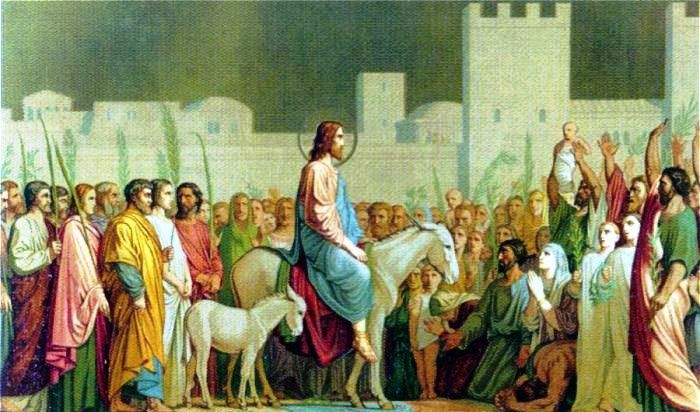
Image result for Jesus palm sunday
Matthew 21:1-3 "When they had approached Jerusalem and had come to Bethphage, at the Mount of Olives, then Jesus sent two disciples, 2 saying to them,“Go into the village opposite you, and immediately you will find a donkey tied there and a colt with her; untie them and bring them to Me. 3 If anyone says anything to you, you shall say, ‘The Lord has need of them,’ and immediately he will send them.”

Introduction:

This weekend will be a time where many Christians the world over will celebrate what has been historically called: "Palm Sunday". I can recall as a child receiving little "palm branches" to take home after a Palm Sunday celebration in Sunday School and at church. We have been viewing Jesus' triumphal entry in Luke 19 these last couple of posts. I felt today it would benefit readers to consider some thoughts about the significance of Palm Sunday from Matthew's portrayal of this same event. Please note the following points...

1. Preparation. Matthew 21:1-3

Jesus was preparing for what would be the week leading up to His crucifixion. In the cycle of Jewish festivals, Passover Week was getting underway. The day in which Jesus rode into Jerusalem on a Donkey was the day the Passover lambs were officially chosen by each Jewish family to begin preparation for what would be their slaughter by Thursday night of that week. 

This particular day was part of the original liturgy of the first Passover week instituted by Yahweh to the people through Moses in Exodus 12:3-6 "Speak to all the congregation of Israel, saying, ‘On the tenth of this month they are each one to take a lamb for themselves, according to their fathers’ households, a lamb for each household. 4 Now if the household is too small for a lamb, then he and his neighbor nearest to his house are to take one according to the number of persons in them; according to what each man should eat, you are to divide the lamb.5 Your lamb shall be an unblemished male a year old; you may take it from the sheep or from the goats. You shall keep it until the fourteenth day of the same month, then the whole assembly of the congregation of Israel is to kill it at twilight."

The lamb would be raised for an entire year and named by the family. When the lamb was "selected", that meant that the lamb was deemed "ready" for the Passover. Jesus came as "the Lamb of God" - i.e as the "Choice Lamb" Who was prepared from before the foundation of the world by the Father (John 1:29; Revelation 5:6). The Son came willingly and is described in passages such as 1 Corinthians 5:7 as the lamb of God. 

2. Prophetic Fulfillment Matthew 21:4-5

Matthew records that when Jesus rode into Jerusalem, that his efforts were not just some random activity. The purpose for Jesus' riding into Jerusalem was to fulfill prophecy. Zechariah 9:9, composed by Divine inspiration some 520 years prior to this event, is quoted by Matthew in Matthew 21:4-5 - "This took place to fulfill what was spoken through the prophet: 5 'Say to the daughter of Zion, ‘Behold your King is coming to you, Gentle, and mounted on a donkey, Even on a colt, the foal of a beast of burden.’” Everything that Jesus did was not random nor accidental - but intentional. He was yielding Himself to His Father's will as He made His way to Calvary.

3. Presentation Matthew 21:6-9

Just as those lambs were formally prepared, they were also presented. When Jesus came riding into Jerusalem on a Donkey, He was presenting Himself as Israel's King. Many people in that scene were asking questions regarding Jesus' identity. One of the aims of Jesus' actions was to send a message to the Jewish leadership and to the people of Israel - "here is your King!".

According to passages like Isaiah 53, He would be not only be the Lamb of God, but also a rejected Savior. This idea once again reminds us that when Jesus had rode through on that first "Palm Sunday", He was fulfilling prophecy. The people who were crying "Hosanna" would within a week's time shout "crucify Him." 

4. Passion Matthew 21:10-11

Matthew 21:10-11 records - "When He had entered Jerusalem, all the city was stirred, saying, “Who is this?” 11 And the crowds were saying, “This is the prophet Jesus, from Nazareth in Galilee.” Once Jesus had rode into Jerusalem, it was His way of officially concluding the public ministry phase of His first coming and entering into what many theologians call His "passion" (from a Latin root passio meaning "suffering"). 

Luke's version includes the following detail of Jesus weeping over Jerusalem following His triumphal entry in Luke 19:41-43  "When He approached Jerusalem, He saw the city and wept over it,42 saying, “If you had known in this day, even you, the things which make for peace! But now they have been hidden from your eyes. 43 For the days will come upon you when your enemies will throw up a barricade against you, and surround you and hem you in on every side,44 and they will level you to the ground and your children within you, and they will not leave in you one stone upon another, because you did not recognize the time of your visitation.” These chilling and heart breaking laments are recorded by Matthew in Matthew 23:37-39.

Jesus' weeping was due to His foresight into what would be the destruction of Jerusalem in 70 A.D. Readers can consult historic works such as Flavius Josephus (a first century Jewish Historian), who records the horrendous details of that sequence of events that were fulfilled as Jesus had predicted. Jesus' emotional anguish over the people rejecting God's plans and purposes through Him would get deeper by the end of the week. 

The emotional anguish would turn into physical agony on the cross and spiritual agony that He would endure in His humanity while at the same time experiencing the anguish of the pains of sin-bearing as the Divine Son. As the God/man, Jesus would passionately face crucifixion. Praise be to God though, the true triumph of the pending "holy week" would not lie ultimately in His riding into Jerusalem, but rather in His death on the the cross and triumphal resurrection three days later outside the Holy City!

Saturday, April 8, 2017

The Sweeping Message Of The Last Seven Sayings Of Jesus From The Cross

Image result for seven sayings of Jesus
Hebrews 12:2-3 "fixing our eyes on Jesus, the author and perfecter of faith, who for the joy set before Him endured the cross, despising the shame, and has sat down at the right hand of the throne of God. 3 For consider Him who has endured such hostility by sinners against Himself, so that you will not grow weary and lose heart."

Introduction: The Seven Sayings of Jesus

    Today's post features the seven statements that Jesus uttered from the cross during His six hours of crucifixion. First, let's consider all seven sayings in their chronological order:

1. “But Jesus was saying, ‘Father, forgive them; for they do not know what they are doing.’ And they cast lots, dividing up His garments among themselves.” Lk 23:34 

2. “And He said to him, “Truly I say to you, today you shall be with Me in Paradise.” Lk 23:43 

3. “When Jesus then saw His mother, and the disciple whom He loved standing nearby, He said to His mother, “Woman, behold, your son!” 27 Then He said to the disciple, “Behold, your mother!” From that hour the disciple took her into his own household.” Jn 19:26-27

4. About the ninth hour Jesus cried out with a loud voice, saying, “Eli, Eli, lama sabachthani?” that is, “My God, My God, why have You forsaken Me?” Mt 27:46. Compare Mk 15:34. 

5. “After this, Jesus, knowing that all things had already been accomplished, to fulfill the Scripture, said, “I am thirsty.” John 19:28 

6. “Therefore when Jesus had received the sour wine, He said, “It is finished!” And He bowed His head and gave up His spirit.” John 19:30 

7. And Jesus, crying out with a loud voice, said, “Father, into Your hands I commit My spirit.” Having said this, He breathed His last.” Luke 23:46 

Considering the whole message of the seven-sayings of Jesus from the cross.

    These "sayings" occupy a total message that is strung together like seven perfect pearls. Writers have noted the pattern and have found meditating upon these sayings a valuable exercise for the Christian's faith and spiritual vitality. The great 19th century Baptist preacher C.H Spurgeon has deemed the seven sayings as follows:

1. The First Word (Forgiveness)
2. The Second Word (Salvation)
3. The Third Word (Affection)
4. The Fourth Word (Anguish)
5. The Fifth Word (Suffering)
6. The Sixth Word (Victory)
7. The Seventh Word (Contentment)

As Spurgeon comments in his book on the seven sayings - "Christ's Words From The Cross": 

"There are many other ways in which these words might be read, and they would be found to be full of instruction. Like the steps of a ladder or the links of a golden chain, there is a mutual dependence and interlinking of each of the cries, so that one leads to another and that to a third. Separately or in connection, our Master's words overflow with instruction to thoughtful minds."

    To give one more example of how various authors have considered these seven sayings of Jesus as a collection, Andrew W. Blackwood notes in his book - "The Voice From The Cross", the following headings for each saying:

1. The Prayer of Forgiveness
2. The Promise Of Life
3. The Word of Kindness
4. The Cry Of Derelection
5. The Call For Help
6. The Shout Of Triumph
7. The Prayer of Trust

Here again, we see the sayings portrayed as a shimmering string of pearls. 

How we can understand these seven sayings in light of considering the major themes of the four Gospels. 

    In look at these sayings and considering what various authors have written about them, one must take into mind the intentions of each of the Gospel authors. Sayings #1, #2 and #7 derive from Luke's Gospel, which aimed to show Jesus as the perfect Son of Man (see Luke 19:10). Sayings #3, #5 and #6 derive from John's Gospel, whose aim is to present Jesus Christ as God in Human flesh or the Perfect Son of God (see John 1:14; 20:30-31). Then there is that middle saying, saying #4, which is found in Matthew and Mark's Gospels. 

    Matthew presents Jesus Christ as the royal King coming to save His people from their sins (Matthew 1:23; 20:28; 28:18-20). Mark presents Jesus as the suffering servant willing to give His life a ransom for many (see Mark 10:45). 
    Such considerations of the Four Gospel writers can aid us in understanding how these seven sayings incorporate a full-orbed view of Jesus Christ as the King, Suffering Servant, Perfect Son of Man and God in human flesh.

Final thoughts and reflections on the seven sayings of Jesus

    When we look at the sayings together, there is undoubtedly a plot-line and symmetry. The plot-line proceeds from Jesus crying out as the propitiatory sacrifice in saying #1 (i.e satisfying or staying God's wrath on sinners) to having full confidence that His offering for sins is fully accepted in saying #7 as the atonement for sins. The others sayings touch upon pieces of human experience (loneliness in saying #3; forsakeness in saying #4 and thirst in saying #5). 

    These particular sayings remind us that Jesus was truly man and was indeed fulfilling the prophetic picture of the suffering Messiah in Isaiah 53. This was no supposed suffering. Rather, this was a genuine suffering by the Person of the Son in true humanity. Sayings #2 and #6 reminds us of Christ's Divine authority. The whole Person of Christ was on the cross. It was His humanity that had the nails and lashes of the whip driven in and brutally applied. In His Deity, the inestimable value of the atonement was paid. The totality of all that Jesus did is carried forth on these seven sayings. 

Friday, April 7, 2017

How Much Of You Does He Have? Considering The Background & Applications Of Palm Sunday - Luke 19:28-48

Related image
Luke 19:28-33 "After He had said these things, He was going on ahead, going up to Jerusalem. 29 When He approached Bethphage and Bethany, near the mount that is called Olivet, He sent two of the disciples, 30 saying, “Go into the village ahead of you; there, as you enter, you will find a colt tied on which no one yet has ever sat; untie it and bring it here. 31 If anyone asks you, ‘Why are you untying it?’ you shall say, ‘The Lord has need of it.’” 32 So those who were sent went away and found it just as He had told them. 33 As they were untying the colt, its owners said to them, “Why are you untying the colt?” 34 They said, “The Lord has need of it.”

Introduction:


In the last post, we considered the various motives and responses to Jesus that one finds in Luke 19. Jesus' triumphal entry into Jerusalem is situated within the wider context of Luke 19. Each of the four Gospels include Jesus' entry into Jerusalem (Matthew 21:1-11, 14-17; Mark 11:1-11; Luke 19:29-44; John 12:12-19). We want to consider Luke's version of the event by focusing on two main areas. We first want to better understand why Jesus chose to ride in on a donkey, since His choice of mount communicates much of what He intended to present to the people. Then secondly, today’s post aims to have you examine your heart to see how much of your life He has. The goal will be to urge us all to give our all to this King Jesus Who so desires a triumphal entry into our lives.

Historical background of Jesus' entry into Jerusalem

The choice of a donkey in preference to a white stallion was intentional on Jesus' part. The donkey and two other details of Jesus' entry merit further examination to discern what exactly what happening on the first Palm Sunday. 

First, Roman generals rode stallions, and thus if Jesus would had ridden into Jerusalem in this manner, it would had attracted the wrong kind of attention - leading to possible pre-mature execution. By the end of the week, Jesus would be executed by the Roman authorities, per God's timing and plan (Acts 2:22-24). The timing of everything was in view. If anything, the choice of a donkey was intended for the Jews gathering to celebrate the Passover.

Jesus desired to communicate His intent of presenting Himself as Israel's King. The best way to do this while obscuring any unwanted attention at the same time would involve appealing to the ancient way in which Israel's kings would ride. 1 Kings 1:38-40 records the coronation of young King Solomon: 

"So Zadok the priest, Nathan the prophet, Benaiah the son of Jehoiada, the Cherethites, and the Pelethites went down and had Solomon ride on King David’s mule, and brought him to Gihon. 39 Zadok the priest then took the horn of oil from the tent and anointed Solomon. Then they blew the trumpet, and all the people said, “Long live King Solomon!” 40 All the people went up after him, and the people were playing on flutes and rejoicing with great joy, so that the earth shook at their noise."

The second detail of Jesus' triumphal entry has to do with the actions of the people spreading their cloaks before Jesus. Just like the donkey, the spreading of cloaks harkens back to the practice associated with Israel's history of it's monarachs. 2 Kings 9:13 records the coronation of King Jehu, another King in Israel's history: "Then they hurried and each man took his garment and placed it under him on the bare steps, and blew the trumpet, saying, “Jehu is king!”

Then thirdly, we find the people picking up branches of various sorts - and more specifically, palm branches - to wave at Jesus as He entered. William Heinrich in the journal "Bible and Spade", volume 14, Spring 2001, page 15, writes in his article: "The Enigma Of The Palm Branch":

"Although presentation of palm branches was mentioned by only one Gospel writer, I suggest their use at the Triumphal Entry was a deliberate act, full of symbolism. The people were proclaiming nationalistic pride and their desire to be free of Roman rule. As Jesus rode by the crowd they shouted “Blessed is the king of Israel.” The message was clear. They were looking for deliverance from Roman tyranny and they tied that hope to Jesus, whose miraculous powers made Him a powerful foe to the Romans. By presenting the palm branches to Him, the people were declaring their loyalty to Him as a victorious general or king might expect."

These three details show us not only Jesus' actions in clearer detail, but also the people's intentions. The people were ready to make Jesus their King - however, their conception of the type of King they wanted versus what Jesus came to portray were diametrically opposed. In short, thought the people proclaimed with their lips "Hosanna", their concept of kingship rejected Jesus. 

Life-practical applications of Jesus' triumphal entry in Luke 19

As we already mentioned, the scene of Jesus riding into Jerusalem depicts various attitudes and levels of reception. Jesus' response to the scene is telling. We find that in the final analysis, the people were willing to give only part of their lives to Jesus. Jesus is an all or nothing Savior. Either we give Him all our hearts or we will find our souls in a tug of war between our allegiance to Him on the one hand and the world on the other. As Jesus reminds us: "you cannot serve two masters, for either you will love the one and hate the other, or cling to the one and despise the other" (Matthew 6:24).
When it comes to our hearts, Jesus wants to have your….

1. Allegiance, not admiration. Lk 19:37-38

The people admired Jesus for His miracle working powers, as seen in the parallel account of John 12:18 and in Luke 19:37. As one preacher has noted, these people were "fans", not "followers".

2. Adoration, not appearances. Lk 19:39-40

The Pharisees were wanting the fanatical crowds to silence their shouts of Hosanna for what might had been partly legitimate reasons. Nevertheless, Jesus' could see deep down in their hearts. The Pharisees were not merely concerned about the crowds possibly stirring up unwanted trouble from the Romans. Jesus saw there truest and deepest intent: namely, the Pharisees didn't feel that Jesus the worth the praise, whether ill-conceived by most in the crowd or truly meant by His closest followers. After all, the worshipers were quoting Psalm 118! All we know is that by the end of Luke 19, the Pharisaic and Jewish rulers revealed their true colors. Things were going to quickly unravel and it would be a matter of days until they had their sworn enemy crucified.

3. Reception, not Resistance Lk 19:47
As was just mentioned, things were unraveling. The undercurrent of hatred for the Lord Jesus Christ was poised to boil-over.

Jesus’ response: Sorrow & Cleansing. Lk 19:41-46

Here we find Jesus weeping over Jerusalem, parallel in Matthew 23. The sorrow of His heart followed up by what we know to be His second cleansing of the temple (the first recorded near the beginning of His ministry in John 2). Jesus' symbolic cleansing of the temple court was specifically the area where worshipers would enter. It was also the only place where Gentiles were allowed to be (since signs were posted forbidding Gentiles to enter anywhere beyond the outer-court of entry, where Jesus likely did this act). Again, Jesus' activities were in fulfillment of prophetic scripture. Isaiah 56:7 reads for example: "Even those I will bring to My holy mountain 
And make them joyful in My house of prayer. Their burnt offerings and their sacrifices will be acceptable on My altar; For My house will be called a house of prayer for all the peoples.”

4. How much of you ought Jesus have? Lk 19:1-10; 48b
As we close out this post today, we have considered the historical backdrop of Jesus' entry into Jerusalem in Luke 19. We have also considered some life-practical lessons to be gleaned from this account. So the question is: How much of you ought Jesus to have? The answer is "all of you" and "all of me". We read in the latter part of Luke 19:48 that the "people were hanging on to every word He said." When we couple this statement with the example set by Zaccheus in Luke 19:1-10, we find that Jesus ought to have all our life, time, possessions and attention. As the saying goes: "He is either Lord of all or not Lord at all".