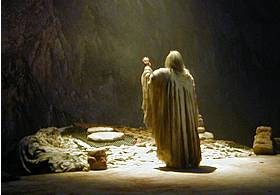
 Exodus 32:9-11 "The Lord said to Moses, “I have seen this people, and behold, they are an obstinate people. 10 Now then let Me alone, that My anger may burn against them and that I may destroy them; and I will make of you a great nation. 11 Then Moses entreated the Lord his God, and said, “O Lord, why does Your anger burn against Your people whom You have brought out from the land of Egypt with great power and with a mighty hand?"
Exodus 32:14 "So the Lord changed His mind about the harm which He said He would do to His people."
Malachi 3:6 “For I, the Lord, do not change; therefore you, O sons of Jacob, are not consumed."
Introduction: God is unchanging and yet scripture states He changes His mind
Today's post deals with a difficult matter of interpretation in the scripture relative to God's nature in relationship to prayer. When we speak of God as "unchanging", the term used to describe this quality of God is called "immutability". Hebrews 1:11-12 (quoting Psalm 102:26) states concerning Christ's Divine nature in relationship to the heavens - "They will perish, but You remain; And they all will become old like a garment, 12 And like a mantle You will roll them up; Like a garment they will also be changed. But You are the same, And Your years will not come to an end.” Malachi 3:6, quoted at the beginning of this post, asserts that God does not change. In James 1:17, we are told that the Heavenly Father is the Father of Heavenly lights, in whom there is no variation or shifting of shadow. Such statements strongly affirm that within God's eternal nature, attributes and moral character, there is a constant, continuous, non-varying manner in His overall Divine life.
But then we run across other passages of scripture that seem to indicate God "changing something". For the purposes of today's post, we find specific cases were God seems to change his mind in the contexts of prayer and people repenting of their sins. Certainly Exodus 32 depicts Moses interceding for the people in light of their treachery of the Golden Calf. Once Moses interceded and appealed to the unvarying promises that Yahweh made to Abraham, Isaac and Jacob (Exodus 32:13), God "changed His mind" relative to the destruction He planned to do against the nation of Israel (see Exodus 32:14). Other texts such as 1 Samuel 15:10-11, 28-29 and Jonah 3:10 portray God "changing His mind" or "repenting" of the judgments He was going to pour out on the people.
So how do we reconcile these two categories of scripture? How do we understand the clear statements of God being "immutable" and thus, not subject to change within His internal character and being, whilst seeing scriptures that assert the "changing of His mind". Furthermore, how does this affect our understanding of prayer relative to God?
Illustration: The sun and melted wax in a hot car
Not too long ago I had been in the back of our family car when I noticed what appeared to be melted wax near one of the cup holders. My wife enjoys wax-warmers. They are little "peanut-butter-cup-shaped" pieces of wax one places in a special device called a "wax-warmer". Once these "wax-warmers" are melted, they emit the given scent of what one would smell from an actual burning candle.
On a particular occasion my wife had purchased some of these little objects and one of our children had been playing with one of them and put it near the cup-holder. In the heat of a hot-summer day, the interior temperature of the car and the sun blazing through the windows had softened the little wax-warmer enough to melt it. Once it had cooled, it turned back into hardened wax and left a nice little task for someone to clean.
Now I tell this little tale to highlight our discussion. What changed? Did the sun change? No. Whether there was wax or not didn't effect the sun shining forth some 93 million miles away. Would the wax warmer had melted by itself if it had not been placed in the hot car on a sunny day? Likely. But now we interpose a car window, infrared radiation heat bouncing around in the car and a hot surface, and lo and behold: a melted wax-warmer. The wax-warmer changed relative to its placement in that hot car. We of course would say that the sun had heated up enough to melt the wax-warmer, even-though the sun's heat and light remained constant. It is from the vantage-point of inside the car that we use the language of change. In this illustration, the wax-warmer was changed, not the sun. It was changed due to what was interposed between it and the sun - namely the window.
We can say for now that the passages that speak of God's unchanging character (or "immutability) are illustrated by the sun in the above comparison. Likewise, the other scriptures that refer to God "changing His mind" compare to the above illustration. With regards to prayer, it corresponds to the windows of the car through which the sunlight is shining. When we pray, we are, as it were, putting forth windows through which God can shine forth His unvarying purposes. In short, the answer to the question of whether or not prayer changes us or God is: prayer is designated by God to change us and our situations.
In the next post we will draw out further implications and conclusions about our discussion on whether prayer changes us or God.
 Matthew 21:5 “Say to the daughter of Zion, ‘Behold your King is coming to you, Gentle, and mounted on a donkey,
Even on a colt, the foal of a beast of burden.’”
Matthew 21:5 “Say to the daughter of Zion, ‘Behold your King is coming to you, Gentle, and mounted on a donkey,
Even on a colt, the foal of a beast of burden.’”
Mark 10:45 "For even the Son of Man did not come to be served, but to serve, and to give His life a ransom for many.”
Introduction:
In past posts we have featured looking at the Person and work of Jesus Christ in both Matthew's Gospel here: http://www.growingchristianresources.com/2016/10/an-overview-of-matthews-gospel.html and Mark's Gospel here: http://www.growingchristianresources.com/2016/11/six-reasons-why-you-ought-to-read-marks.html
Today I thought it would be edifying to consider how Jesus is portrayed in both Matthew and Mark. Whenever we study Jesus in the the Gospels, it is worthwhile to keep in mind each Gospel on its own merit. Equally important too is consideration of how the Gospels interrelate to one another. Such a consideration has been labeled by Bible scholars as the "synoptic problem" ("synopitic" referring to how the first three Gospels "see-together" the life of Jesus in basically the same way). In this post we will consider out each relates to one another, how each was composed and how the testimonies of Matthew and Mark aid us in seeing Jesus Christ in their gospels.
Lining up how Matthew and Mark present the story of Jesus' life, death and resurrection
Eusebius of Caesarea, the greatest church historian of the first three centuries, was one of the first Bible scholars to put together a series of tables that outlined how Matthew and Mark relate together. Such efforts have been studied for centuries in an attempt to understand how Jesus can be seen in two Gospels, three Gospels or all four.
Today a person can buy a tool called a "Harmony" and study how all four Gospels line up with one another. The one I consulted is based off "The NIV Harmony of the Gospels", edited by Robert L. Thomas and Stanley N. Gundry. This particular tool is helpful to the Bible student in how it features all four Gospels side-by-side in continuous, running text.
When we consider how Matthew and Mark relate, as well as what they together show us about the Lord Jesus Christ, here is what we find (note the chapter designations under each Gospel and the themes connecting them all together:
Matthew's Gospel Mark's Gospel
1:1-17 Genealogy
1:18-25 Jesus' virgin birth
2:1-23 Magi and early years
3:1-4:11 baptism, temptation, ministry starts 1:1-13
4:12-22; 8;9;12 Galilean ministry 1:14-6:26
Choosing of the 12
5-8 Sermon on the Mount
13 Parables of the Kingdom 4
8-9,14 Feeding of the 5,000 6
15-16 Peter's Confession of Jesus as the Messiah 9
17 Transfiguration 9
18 Jesus' first instructions about the church 9
19-23 Jesus final week 10-12
24-25 Olivet Discourse 13-14
26 Condemnation by the Jews 14
27 Crucifixion of Jesus 15
28 Jesus resurrection and appearances 16
Other than the omission of the birth accounts from the first two chapters in Matthew and the extended versions of Jesus' sermons, Mark's Gospel represents virtually the same material in slightly different form! Bible scholars have noted that there is 92-93% agreement shared between Matthew and Mark. The question is of course, why?
The relationship between the first three Gospels helps us to understand the relationship between the first two
Early church history tells us that the Gospel of Matthew was composed first. As the Gospel of Matthew came to be used throughout the region of Jerusalem and Judea by the early church, it became apparent that the church was going to need at least one more written Gospel to meet the growth of Christianity across the first century Gentile world. The Apostles Paul and Peter had been preaching the Gospel and eventually, their traveling ministry partners (Mark for Peter and Luke for Paul) would each write down summaries of their preaching. As the Holy Spirit so led Luke, he composed a Gospel for Gentile readers that would be roughly based off of Matthew. In like manner, Peter's preaching of a series of messages on Jesus' life would be recorded by Mark under the inspiration of the Holy Spirit.
According to New Testament scholar David Alan Black, Mark's Gospel was specifically composed to record Peter's preaching from his usage of an already extant Matthew and a new written Luke. We can picture Peter literally consulting both of these Gospels, in effect delivering a shortened version of Matthew, in combination with his eye-witness accounts, to a Roman audience, while at the same time validating Luke's then-newly composed Gospel to be used throughout the Gentile world. This scenario may best explain why Matthew and Mark line-up so well together.
What Matthew and Mark's testimonies tell us about the Jesus they portrayed in their Gospels
Matthew was a tax-collector, considered among the lowest-of-the-low on the social ladder of Judaism. His position would had precluded him from participation in the spiritual life of His people. Matthew's testimony of his call to follow Jesus in Matthew 9:9-13 culminates in that section with one of Jesus' statements about the purpose for which He came in verse 13: "I did not come to call the righteous, but sinners." Mark 2:12-17 also records this same scene.
Mark records himself in a rather awkward episode in Mark 14:51-52 at the scene of Jesus' arrest: "A young man was following Him, wearing nothing but a linen sheet over his naked body; and they seized him. 52 But he pulled free of the linen sheet and escaped naked." Years later Mark would sign onto the first missionary journey of the Apostle Paul, only to defect and leave Paul in the midst of the work, resulting in a near jeopardizing of the work (see Acts 13:13; 15:38-39). Thankfully, Mark would at some point repent of his defection and be restored to Paul as one who was deemed "useful" for the ministry in 2 Timothy 4:11. Undoubtedly by the time Mark would had been composing his Gospel under the inspiration of the Holy Ghost, he would had written with a humility befitting one who knew the Savior's love, forgiveness and reconciliation.
Closing thoughts
Both Matthew and Mark's testimonies as men who had checkered pasts, men who were considered the refuse of society or failures, were given the privilege to record the life, death and resurrection of the One who saved them. Both Gospels in their own right present Jesus Christ in incredible ways. Matthew would record Jesus as the matchless King. Mark would depict Jesus as the suffering servant. Both together give us a beautiful composite of Jesus that seeks and saves the lost. These thoughts represent a taste of the Jesus we see in Matthew and Mark's Gospel.

Jeremiah 18:9-11 "Or at another moment I might speak concerning a nation or concerning a kingdom to build up or to plant it; 10 if it does evil in My sight by not obeying My voice, then I will think better of the good with which I had promised to bless it. 11 So now then, speak to the men of Judah and against the inhabitants of Jerusalem saying, ‘Thus says the Lord, “Behold, I am fashioning calamity against you and devising a plan against you. Oh turn back, each of you from his evil way, and reform your ways and your deeds.”’
Introduction:
The last few posts have been dedicated to addressing a persistent apologetic issue that deals with skeptical attacks on the character of the God of the Old Testament and the narratives of the book of Joshua. The so-called "New Atheism" is marked as not only saying it to be irrational to believe in God, but that such belief is immoral. New Atheist authors like Sam Harris and Richard Dawkins will often cite the narratives in Joshua as "proof" that Yahweh, the God of the Old Testament, was a "moral monster".
It is important at this juncture to remind readers that such apologetic considerations are pertinent to biblical interpretation. How we interpret and apply the difficult sections of Joshua that feature the commands to "wipe-out" the Canaanites is as important for the pulpit on Sunday morning as it is behind a university lectern or debate forum. Today's post will draw to a conclusion what has turned out to be a four-part treatment on this subject.
Why the Context of Joshua Must Be Considered to Demonstrate that Yahweh is not a "Moral Monster"
Authors who regularly criticize the Old Testament narratives and call God a blood-thirsty monster never mention the times God spared those who did repent. When one studies the narratives of Joshua and the wider context of the Pentateuch prefacing the conquest of Canaan, it is clear that the Canaanite culture had went beyond the point of no return and a God who had given it centuries of time to repent (compare Deuteronomy 7; 20). Justice was all that was left. However against the backdrop of judgment stood out those multiplied instances where God showed mercy to those who humbled themselves to Him.
What recent scholarship has had to say about the "holy-war" narratives in Joshua and surrounding Old Testament literature
In recent years some Bible scholars have attempted to take the wider canonical context surrounding Joshua and the ancient extra-biblical documents of the Ancient Near East (ANE) to show that the "Holy War" narratives of Joshua are written in hyperbolic language.
Matthew Flannegan points to a scholar by the name of Nicholas Wolterstorff who has advanced the thesis that phrases such as "do not leave alive anything that breathes" are hyperbolic statements that are part of the genre of "Holy War" literature.1
Admittedly, more research would need to be done in assessing the full scope of this proposal, however it seems that more is given up in trying to harmonize something that may not need to be harmonized. Granted, the tensions of the issue of Joshua and the Hebrews wiping out some of the Canaanite cities must not ever be dismissed. However, if the reader keeps in mind all that has been outlined in this post, the texts in question can be dealt with in an honest and straightforward way.
Why The New Atheists' Attempts to Show Yahweh and the Scriptures as Untrustworthy fail
As was noted at the beginning, Dr. Darrell Bock outlines the typical logical argument made by the New Atheists and Skeptics against the character of God and the Biblical text:
a. Yahweh is portrayed as a Good and Just God
b. Any form of human genocide is evil and unacceptable and morally monstrous
c. The Bible records Yahweh issuing commands to Joshua and the Israelites to destroy the Canaanites in holy war so as to take up residence in the land of Canaan
d. The Bible avows the character of Yahweh and the actions of the Israelites, and therefore the Bible and Yahweh are morally monstrous
What hinges on the plausibility of this argument is premise (b) in regards to whether or not God commanded genocide or another act altogether. In the course of this series, we have shown that the concept of holy war differs from genocide. Hence, the second premise would be disarmed, weakening the overall force of the argument used by skeptics. When the wider context surrounding Joshua (not just a few isolated statements as typically proposed by the skeptics) is considered, coupled with the even wider ANE context, the New Atheists criticisms lose traction and the character of Yahweh and His Word remains intact. By diffusing one part of the argument, the whole argument falls to the ground.
Closing thoughts:
We have spent the past few of posts wading through the thorny issue of Yahweh's commands to destroy the Canaanites. We began by considering seven introductory considerations for approach this issue. We then proceeded to regard a way of framing a discussion that can aid people in navigating through the Book of Joshua and answering critics who attempt to discount God and His word. What remains is the responsibility to explain the "Holy War" texts of Joshua and to understand their application to today's 21st century world.
When God’s justice and wrath are no longer believed, the concept of deity no longer resembles the God of the Bible and the deity that is left is a god of popular culture that is not holy, not just and impersonal. The consequences for such a denial lead to either a diminishing of sin or a denial of its reality. This two fold process renders a culture susceptible to decreased vigilance in defending the sanctity of human life and denial of absolute morality/ethics which is essential for a culture to continue enriched in the practice of freedom and equity for its citizenry. History has shown that over time, the slide towards socialism, communism, tyranny and anarchy will ensue.
The hope and prayer of this blogger has been that this post can aid towards shedding light on a subject that though difficult, yet is not impossible to understand. Thankfully the Holy Spirit of God ever stands to aid the Christian and the church at large in expounding and defending the scriptures and character of God in this cynical and unbelieving age.
Endnotes:
1. Paul Copan and William Lane Craig., General Editors. Come Let us Reason - New Essays on Christian Apologetics. Article by Matthew Flannegan: Did God Command the Genocide of the Canaanites? Broadman and Holman Publishers. 2012. Pages 226-249
Deuteronomy 20:16-18 "Only in the cities of these peoples that the Lord your God is giving you as an inheritance, you shall not leave alive anything that breathes. 17 But you shall utterly destroy them, the Hittite and the Amorite, the Canaanite and the Perizzite, the Hivite and the Jebusite, as the Lord your God has commanded you, 18 so that they may not teach you to do according to all their detestable things which they have done for their gods, so that you would sin against the Lord your God."
Introduction and Review:
The last two posts have aimed to offer a response to those who accuse Yahweh of being a "moral monster" for His command for the Hebrews to defeat and "wipe-out" the Canaanites. Skeptics and more particularly, the so-called "New Atheists", have attempted to use these texts and a basis for calling into question the moral integrity of the God of the Bible and the character of scripture itself. In the minds of such skeptics, the Bible endorses immoral practices such as "ethnic-cleansing". So how can we navigate the response and discussion of these issues as Christians who are concerned for the souls of those who oppose the Bible as well as demonstrating the reliability of God's character and the scriptures? The goal of today's post is to suggest a way of "framing" or navigating this "thorny" issue in light of these considerations.
Suggesting a way of framing the discussion regarding Yahweh's commands to destroy the Canaanites in the Book of Joshua
1. Extra-biblical resources that corroborate the history detailed by Joshua
To begin, one critic has tried to allege that when the Bible reports the immoral and spiritual degradation of Canaanite culture, it does so as propaganda and that there is scant to no outside evidence supporting such a notion. Is that true? When we consider the sources outside the Old Testament that refer to the Canaanite culture, it’s practices and the situation of Canaanland during the time of Joshua and the Conquest, we can look at some of the following ancient documents and/or writings:
A. The Tel El-Amarna corresponsdance between the Canaanite peoples and the Egyptians during the 13th century. In these letters (really tablets) we see the appearance of the Hebrews (called in the tablets the Hapiru).1
B. The discoveries at Ugarit in Northern Syria unearthed numerous tablets with a language akin to ancient Hebrew called the Ugaritic. Scholars have deciphered this language and have found it helpful in discerning Hebrew idioms in the Old Testament. It is here we get more information about the Canaanites and their religion, being that the peoples of Ugarit were closely related.
C. According to the Archaeological Study Bible, page 182, other Archaeological discoveries in the Phoenecian city of Carthage, Moab, Ur of the Chaldees and the like reveal a centuries old pattern of child sacrifices in the region of Canaan, confirming both the Biblical record and reasons as to why the Israelites would later practice such abominable activities in the latter parts of the Old Testament. They had picked it up from their Canaanite neighbors.2
D. The Ras-Shamra Tablets contain information relating to Canaanite worship practices and deities. Dr. Gleason Archer lists all of the deities and some of the practices described in these tablets which help reconstruct the picture of Canaanite culture that we see most fully revealed in the Book of Joshua.3
2. The Mercy and Long-suffering of God is displayed right along with God's Justice and Holiness
In noting the extra-biblical sources that corroborate the cultural context of the Book of Joshua, we can now consider the character of Yahweh Himself. The Old Testament teaching about God’s holy character, long-suffering mercy and covenant relationship with His people must be considered if correct interpretation of Joshua is to be achieved.
In reading Joshua, there are indications that the Canaanites were aware of Yahweh's deliverances of Israel from Egypt, as indicated by Rahab's testimony in the second chapter of Joshua.
3. The concept of Holy war is different from the historic practice of genocide.
Deuteronomy 20:15-18 depicts the rationale of Yahweh in his instructions to Moses for Joshua and the people. God did not want his people to be influenced by their neighbors (Deuteronomy 7:1-5). As a Holy set-apart people, they were to be Holy as He is Holy.
The moral and spiritual conditions in Canaan had deteriorated to such a level as to cross the line where God hands them over to their own base desires and to be set apart for judgment.
Whenever one reads the texts that speaks of God devoting or dedicating something to destruction, Romans 1:18-31 can be used as an interpretive lens for assessing the downward spiral of moral and spiritual degradation.
4. Understanding the Concept of "Holy War" in the Bible and How Yahweh Could Still Show Mercy
The stark contrast between the holy and the profane is central to the Biblical concept of God’s Holiness. The Wrath of God, which is God’s Holiness in action, describes what God hates and is really His love and goodness expressed in relationship to that which is profane and contrary to His character. To love sin or to embrace injustice would make God not a good God. If God were not Holy and did not express His wrath, then He could not be good and be loving. This idea may seem repugnant to a secularized view of reality that denies the God of the Bible or any worldview that does not view God as Holy. God declared Holy War only on those nations and cities who had crossed the line on two main fronts:
a). They ignored previous warnings that came through a prophet or prior judgments God enacted on nearby cultures and
b). were engaging in practices that polluted the land spiritually and posed significant moral and spiritual contamination of other cultures.
Jeremiah 18:8 states – “if that nation against which I have spoken turns from its evil, I will relent concerning the calamity I planned to bring on it.” Two most prominent examples are Rahab in Joshua 2 and the Ninevites in the Book of Jonah.
Whenever an individual (such as Rahab) or a city (like Ninevah) did repent and respond to God’s revelation, God would relent His anger and based upon His equally balanced characteristics of love and mercy spare that individual or city.
More next time...
Endnotes:
1. Dr. Gleason Archer. A Survey of the Old Testament Introduction. Moody Press. 1985. Pages 271-279
2. The Archaeological Study Bible. Zondervan. 2005. Page 182
3. Dr. Gleason Archer. A Survey of the Old Testament Introduction. Moody Press. 1985. Pages 271-279
4. Walt C. Kaiser Jr. Toward Old Testament Ethics. Zondervan. 1991. Page 268.
5. R. Laird Harris, Gleason L. Archer, Jr., Bruce K. Waltke. Theological Wordbook of the Old Testament. Moody Publishers. 1980. Page 741.
Joshua 11:14 "All the spoil of these cities and the cattle, the sons of Israel took as their plunder; but they struck every man with the edge of the sword, until they had destroyed them. They left no one who breathed."
Introduction:
In the last post we had begun considering how we may answer those who level critiques against God's character in the commands He gave to Joshua and the Hebrews to exterminate the Canaanite nations. We had noted the following:
a. Understanding Joshua and the wider context
b. Understanding the cultures and literature outside the Biblical text
c. Formulating an apologetic that defends the character of scripture and God Himself and which also disarms the New Atheist critiques.
Today's post will continue laying out further considerations.
1. Ancient Near Eastern Literature outside the Bible helps us understand why the Biblical text asserted the moral and spiritual degradation of the Canaanites.
In the last post I had inserted a map of the Ancient Near East (ANE) to show the reader what the immediate world of Joshua looked like. Readers need to know that ancient literature outside the Bible records what life was like in Canaan in and around the 15th to 14th century b.c (1399-1300 b.c). http://www.bible-history.com/geography/maps/map_ancient_near_east.html

God had given ample warning, and the Canaanites ignored the warnings of societal, moral and spiritual degradation. ANE literature records all the atrocities done by the Canaanites. God devoted the land to be destroyed. There are those occasions where human beings commit such atrocities that the area in a sense becomes unfit to ever be inhabited again.
2. Yahweh is depicted in other Biblical texts, including Joshua, of sparing people devoted to judgment who repented.
So, do we have evidence in the Bible of cultures such as the Canaanites being devoted to destruction and yet spared as a result of their repentance? Yes. The Book of Jonah records the response of the Ninevites to Jonah’s preaching. In Joshua 9-10, we see God permitting the Gibeonites to live among the Israelites due to the Israelites themselves not treating the Gibeonites rightly. If someone is going to criticize the God of the Bible, they must include the whole testimony of scripture.
3. Understanding the difference between Holy War and Genocide avoids misinterpreting the texts of Joshua and application of the text to today's world.
Whenever we consider the details of what constitutes holy war and compare it to genocide, it is comparing apples to oranges. Genocide is a merciless, random act of ethnic purging by another people group for political purposes. Holy war in the Bible was moral purging and included an extended pre-history of God giving space for the culture to turn from their extreme wicked practices. Genocide does not include possible mercy. Holy War can be reversed if the culture repents of its ways. Jeremiah 18:8 states – “if that nation against which I have spoken turns from its evil, I will relent concerning the calamity I planned to bring on it.”
Closing thoughts for today
The above considerations from today's post and the last post were intended to give "hooks" upon which the reader could hang some thoughts when discussing God's commands in the book of Joshua. In surveying the literature and listening to scholars discuss and debate this issue, the above considerations aid greatly in any discussion we have about Yahweh's commands to "wipe-out" the Canaanites.
More next time.....


