Translate

Wednesday, April 1, 2026

P2 How The Hebrew Old Testament Pointed To Good Friday


Introduction:

    In the last post we noted how the Hebrew Old Testament pointed to Good Friday. I wanted to continue with where I left off by considering in this post the centrality of the lamb in each portion of the Hebrew Old Testament. By noting the importance of the "Lamb of God" in the Old Testament we can then see how Jesus and the Old Testament pointed to Good Friday. 

Lamb of God in the Old Testament.

     I laid out in the last post what Jesus would have had in mind when He spoke to His disciples following His resurrection. How would the Old Testament had pointed to Good Friday? A key idea common to all three divisions is that of “the lamb of God”. The “Lamb of God” is central to Good Friday.

      We firstly see the lamb of God imagery in that first division of the Hebrew Old Testament, what we know as the “Law” and they called “Torah” (Genesis -Deuteronomy). In Exodus 12 we read of God’s institution of the Passover to remind the Hebrew people of His deliverance of them from Egypt in the Exodus 12:6 “Your lamb shall be an unblemished male a year old; you may take it from the sheep or from the goats. 6 You shall keep it until the fourteenth day of the same month, then the whole assembly of the congregation of Israel is to kill it at twilight.”  

      Then notice the second division of what we’d call the “historical books” and “Prophetic books” or what the Jews called together “the former and latter prophets” or “neviim” – “the prophets” (Joshua-2 Kings, Isaiah-Malachi). Isaiah 53:5-6 “gives us a prediction of Jesus and Good Friday: “But He was pierced through for our transgressions, He was crushed for our iniquities; The chastening for our well-being fell upon Him, and by His scourging we are healed. 6 All of us like sheep have gone astray, each of us has turned to his own way; but the Lord has caused the iniquity of us all to fall on Him.”      Jesus would be at Lamb led to slaughter, to be our sin-bearer.

 Now notice with me the third main division of the Old Testament Jesus noted in Luke 24:44, what He called “The Psalms” or what the Jews would have called “the writings” or “Ketiviim”. Now why did Jesus call it “the Psalms”? Just as you and have different names for our Bibles (“The Book”, “Scripture”, “God’s Word”), Jesus did the same. In many Hebrew Bibles today as well as the Old Testaments in Jesus’ time, the book of Psalms headlined the third division known as “the writings”. Psalms is full of predictions concerning Jesus’ death and resurrection.

For instance, Psalm 22:1 points us to Good Friday, starting out with what came to be Jesus’ first words from the cross “My God, My God, why have you forsaken me?”  (compare Mark 15:34). It is in Psalm 118:27 we find reference to the Messiah as God’s sacrificial lamb: “The Lord is God, and He has given us light; bind the festival sacrifice with cords to the horns of the altar.”  It was this very Psalm the people were reciting when Jesus rode into Jerusalem. Psalm 118 was also the final Psalm all Jews sung in the Passover and which Jesus and His disciples would had sung as they concluded (Matthew 26:30). Jesus came to be that Lamb of God, God’s final lamb, on Good Friday. The Old Testament pointed to Good Friday.

More next time...

Monday, March 30, 2026

How The Hebrew Old Testament Pointed To Good Friday

Introduction:

       Why Good Friday is called “Good Friday”. It is an odd name given to a day that recalls the crucifixion of the incarnate Son of God. Good Friday is good because of the incomparable good that He accomplished on the cross (see Romans 5:8). His crucifixion would occur the day after what we’re looking at here in Matthew 26. The Lord’s Supper was Jesus’ preparation for and picturing of what He would accomplish on the cross. The Passover meal Jesus observed would have begun near sundown Thursday in Jerusalem in those days. It was Jesus’ final preparation with His disciples to inform them of three main things:

1. What He was going to endure, the promise of the Holy Spirit’s coming (John 14:16-17; 26-27).

· 2. The institution of the Lord’s Table (recorded in all four Gospels).

· 3. And the announcement of the Holy Spirit’s guiding them to compose what we would know as the New Testament books (John 16:12-15).

    Good Friday was in view and had been so for centuries as we will see from how Jesus either quotes or fulfills the whole of the Old Testament. In this post we will consider how the Old Testament pointed to Good Friday and then consider in the next post how Jesus pointed to Good Friday by way of His institution of the Lord's Supper. 

1. The Old Testament pointed to Good Friday.  Luke 24:44-49

A. Layout of the Hebrew Old Testament.

     To understand how Jesus and the Old Testament pointed to Good Friday, we first must grasp what Jesus had to say about the Old Testament in reference to Himself. Luke 24:27 and 24:44-48 record a conversation Jesus would have with some of His followers following His resurrection. First Luke 24:27 “Then beginning with Moses and with all the prophets, He explained to them the things concerning Himself in all the Scriptures.”  Then Jesus says later in Luke 24:44-48 “Now He said to them, ‘These are My words which I spoke to you while I was still with you, that all things which are written about Me in the Law of Moses and the Prophets and the Psalms must be fulfilled.’ 45 Then He opened their minds to understand the Scriptures, 46 and He said to them, ‘Thus it is written, that the Christ would suffer and rise again from the dead the third day, 47 and that repentance for forgiveness of sins would be proclaimed in His name to all the nations, beginning from Jerusalem. 48 You are witnesses of these things.’”  

     You’ll notice how Jesus describes the Old Testament or Old Covenant books as “Law and Prophets” (note also Matthew 7:12; 22:40; Luke 16:16). The Apostles would use this two-fold description as well (Acts 13:15; Romans 3:21). This two-fold description underscored the key principle behind the Old Testament Canon – God divinely inspiring His words through His God-called prophets (that is, “propheticity”). 

    The three-fold summary by Jesus was the ordering of the Old Testament books in the Hebrew canon. As the late Old Testament scholar R. Laird Harris noted in his helpful book “Inspiration and Canonicity of the Bible”, these were two of the most common ways to summarize what every Jew knew to be what was called the Old Testament Canon. (Josephus’ book “Against Apion” lays out roughly the same ordering as Jesus did in Luke 24:44 above in his discussion about the Old Testament books).  

 Jesus was referring to what we call “the canon of Scripture”. To say “canon” refers to an authoritative group of Divinely inspired books, written by prophets and enabled by God to guide His people, reveal Himself, His salvation, and His Kingdom. If we take that three-fold summary mentioned by Jesus of “Law”, “Prophets”, and “Psalms”, it summarizes how the Jews organized what we know today as the Old Testament books. 

Without getting into too much detail, our 39 books of our English Old Testament were the same in content as what you find in a Hebrew Old Testament today. The Jewish people would combine books together in some places, making what we know as 39 books to be 24 Books in their Hebrew Canon. By taking the book of Ruth and adding it to Judges, and then taking the book of Lamentations to be part of Jeremiah’s prophecies, the total would then be 22. That number “22” corresponded to older versions of the Hebrew alphabet, communicating that the Old Covenant or Testament Scriptures were a complete set or “canon”, just as an alphabet would be.

     Again, without going into extraordinary detail, the three divisions were known as “The Law” or “Torah”, composed of Genesis through Deuteronomy, “The Prophets” or

“Neviim”, Joshua – Malachi, then “the Psalms” or also “the writings” or “ketiviim”, containing Psalms-2 Chronicles. In my library I have a few copies of a typical Hebrew Old Testament with these divisions. Jews refer to it by the acronym “TaNaK” to remind them of the three-fold division (Torah, Neviim, Ketiviim = TaNaK). Jesus stated to His disciples this ordering. Let’s picture what we’ve noted thus far – Jesus layout of the Old Testament. With the layout in place, let’s look at the lamb of God in these divisions.


Law or Torah                    Prophets or Neviim                Writings or Ketiviim

Genesis-Deuteronomy       Joshua-2 Kings (Former Prophets)    Psalms-2 Chronicles

                                      Isaiah, Jeremiah, Ezekiel, @ Minor

                                      Prophets.

 More next time......

Wednesday, March 25, 2026

Post #29 1700 Years of the Nicene Creed - the phrase "whose kingdom shall have no end" and evaluating millennial views


Introduction:

    In the last post of this series on the Nicene Creed, we looked at the Nicene Creed's confession of Jesus coming in glory here Growing Christian Resources: Post #28 1700 Years of the Nicene Creed - "and He shall come again, with glory". I closed out that last post by noting how the Kingdom of God is the domain of the reign of the Son of God. What divides theologians concerns the issue of the millennial kingdom that it referred to throughout Scripture.

    I pondered some on the debate over the nature of Christ's reign as it relates to the doctrine of the millennium. Is the revelation of the glory of the King mainly in Heaven now with a final manifestation meant to then resurrect the saints, judge unbelievers, and usher in the New Heavens and New Earth (the broad outline of so-called "amillennialism" and "post-millennialism")? 

    Or will the glory of God through Christ, through His Kingdom, involve an earthly physical stage of a 1,000 years duration, beginning with the resurrection of the just and concluding with the resurrection of the unjust, final judgment, and New Heavens and Earth?

    For those who want to appeal to the Nicene Creed to support pre-, a-, or post-millennialism, the Creed itself will not lend proof for either school of thought. Suffice to say though the whole debate over the millennium must reckon with which view most clearly shows Christ revealing the glory of His deity in such a way to flood the whole earth and cosmos, as well as to show He is the decisive revelation of God. 

    In today's post I wanted to revisit where I ended in the last post and evaluate the four leading millennial viewpoints against the next statement in the Nicene Creed: "who kingdom shall have no end". What we will do is briefly define what the main schools of thought are on the millennium, how such a discussion is relevant to this phrase in the Nicene Creed, and then offer some final reflections.

Four views of the millennial reign of Christ

    To keep this post at a minimal length, I will confine our survey of the millennial views to the Biblical text of Revelation 20, which tends to be the main hotbed of contention among the four schools. 

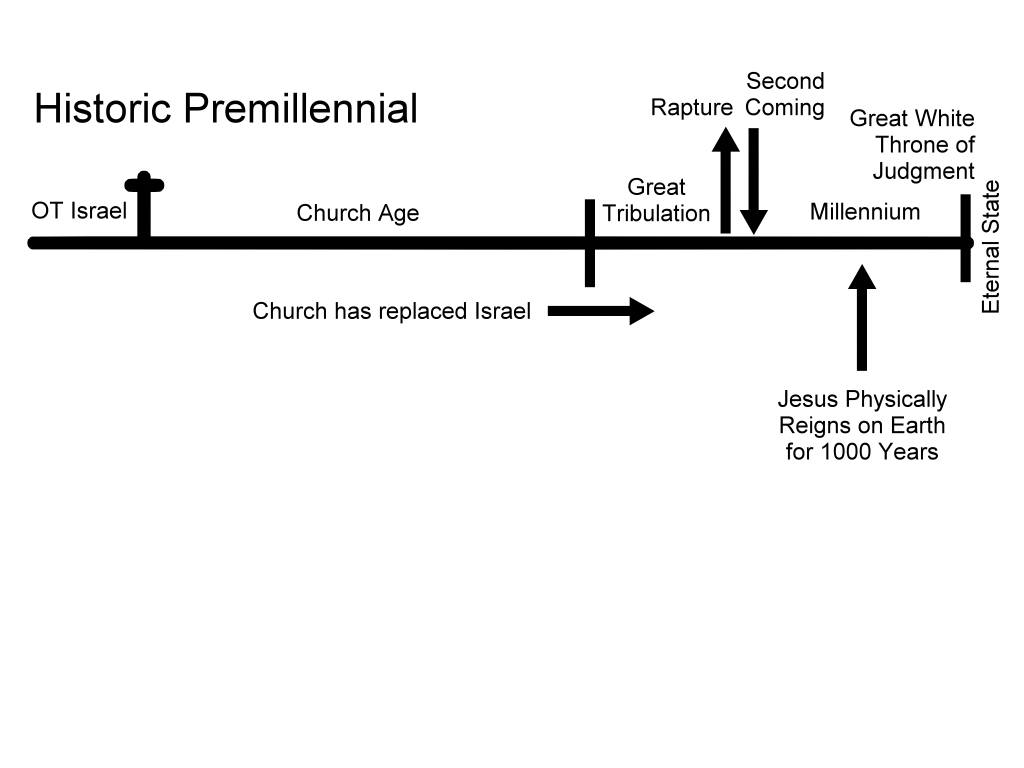
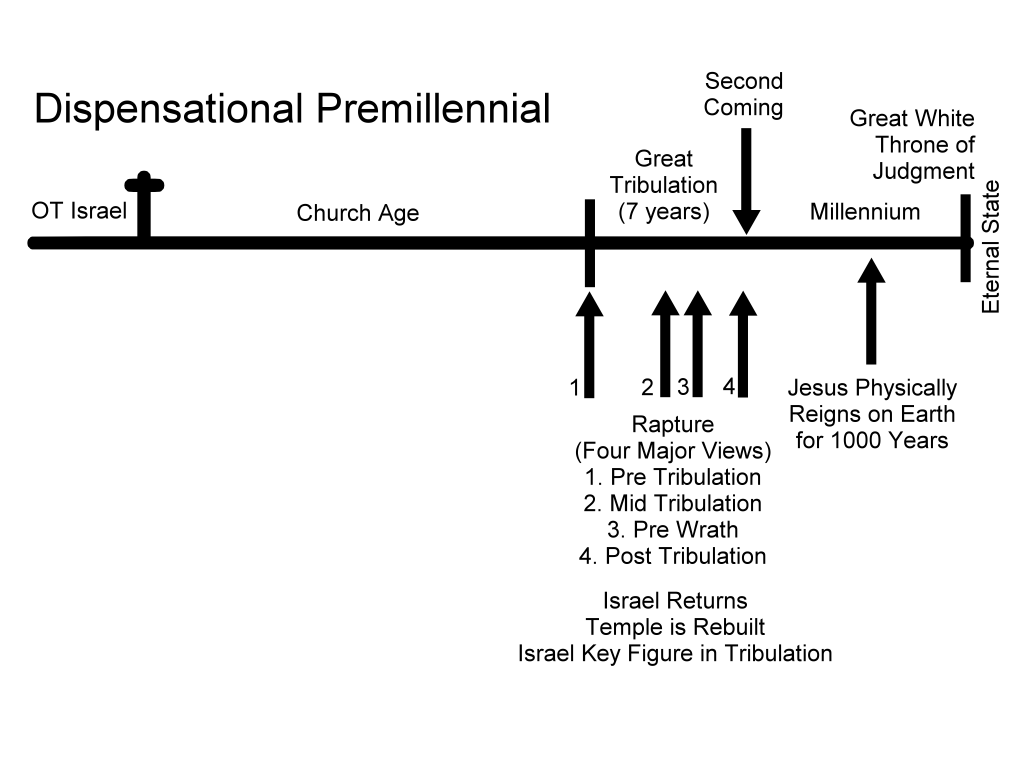
1. Premillennialism - Those who hold to this teach that when Christ returns, He will set up a literal earthly kingdom for 1,000 years, followed by a brief loosing of Satan to deceive the nations, the Great white throne judgment and then the bringing in of the "New Heavens and New Earth". The reason for the name "premillennialism" is due to the prefix "pre" referring to "before" and "millennium" being "1,000 years". Two variations exist within the Premillennial interpretation which for now we will just list their names. These two variations could also count as two of the four millennial views, since each of them have vast amounts of literature associated with them, as well as leading commentators and interpreters. 

a. Classical Premillennialism 

    Sometimes called "Post-Tribulational Premillennialism", this version of premillennialism is so-called because of its claim to be the oldest eschatological view on the millennium, hence "classical premillennialism". Early interpreters such as Irenaeus of Lyons (180 A.D.) and Papias (mid-second century) championed this position, known in their day as "chiliasm". The most notable proponent of this position in recent times was the late George Eldon Ladd.

b. Dispensational Premillennialism.

    Sometimes called "Pre-tribulational Premillennialism", this position is represented by those in the early church who anticipate the soon return of Christ at anytime for His church. Medieval theologians such a Jehoiakim Fiore, and more recently by John Nelson Darby, twentieth century dispensationalism (men such as John Walvoord and J. Dwight Pentecost), and progressive dispensationalists today (such as Darrell Bock) have advocated this view. 

2. Amillennialism.


   This position teaches that Christ began His reign at His ascension into Heaven and is ruling and reigning over a spiritual kingdom right now. Early forerunners of this position didn't so much express themselves as "Amillennial" as they did their opposition of the classical premillennialism noted above - i.e. "chiliasm". One of the earliest forerunners to this view was Cyprian of Carthage, who wrote in chapter 27 of his book "On The Unity of the Church" in the mid-3rd century:

"The Lord’s coming will be sudden; let Him find us vigilant, not distracted by the world’s deceit. If we hold fast to His precepts, the devil will not overcome us. Awake, therefore, and reign with Christ, for only those who watch shall receive the crown."

     Being that it denies a literal 1,000 year reign of Christ, the term "A-millennialism" is used (a=no and millennium = 1,000 years).  History (according to this view) will continue in its downward spiral and at the end Christ will return, judging the world and Satan, and bring about the new heavens and new earth. Cyprian of Carthage was an early forerunner, with Augustine of Hippo (4th-5th century) being the first to truly systematize it into a workable eschatological model. Modern theologians such as Sam Storms and Jay Adams are among more noteworthy defenders of it. 

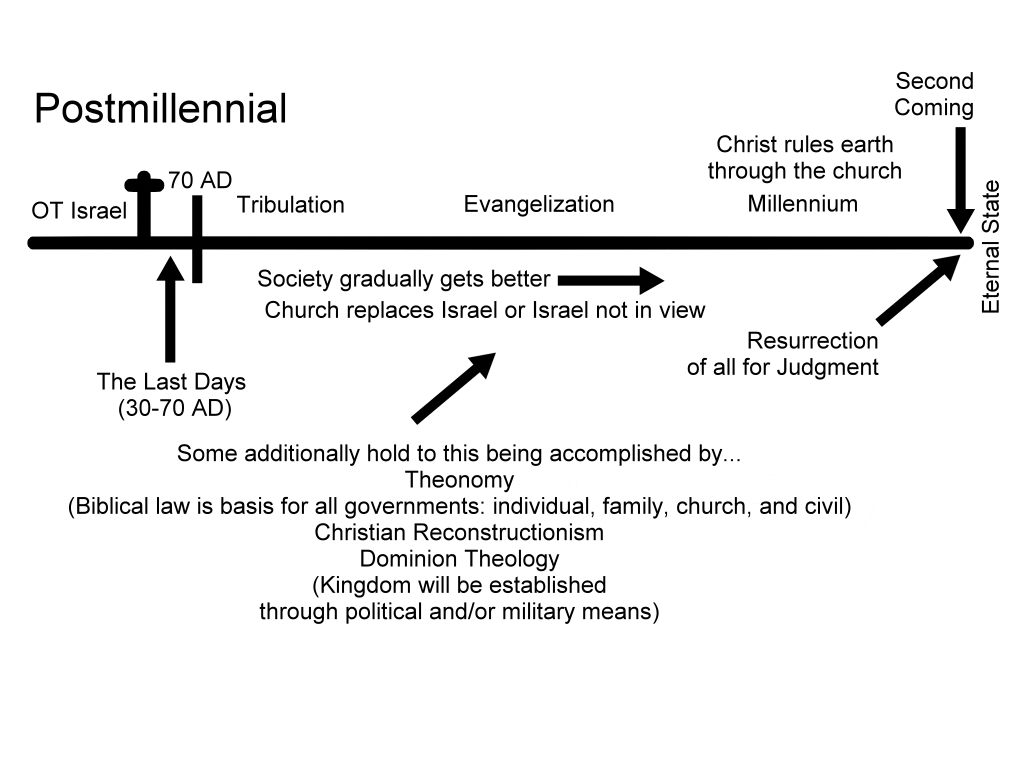
3. Post Millennialism 

    This position teaches that Christianity will continue to increase until the whole world is taken over by the gospel.  Though not every individual will be saved, yet post-millennialists contend that every nation will eventually see many of their people saved.  It generally teaches that the church will continue to evangelize until so many people are converted that Christ will then return at the end of the future golden age or "millennium" )post = "end" millennium= 1,000 years).  

    Post-millennialists take passages such as Psalm 2 and missionary passages such as Matthew 28:18-20 to refer to the triumph of the gospel over unbelief. Admittedly, if there was one view I wish I believed, it would be this one (due to its optimistic outlook on the triumph of the Gospel). Older theologians such as Jonathan Edwards and more recent ones such as the late R.C. Sproul and Greg Bahnsen have ably expressed its tenets. represent this viewpoint. 

    As for myself, I tend to land in the pre-tribulational, premillennial camp. Readers may explore this blogsite, where I have written posts in the past delving into far more detail on the above positions just outlined, as well as my own understanding.

    In the next post I'll continue on to deal with the interpretive issues involved in the discussion about the millennium and the relevance of this discussion to how we understand the Nicene Creed's "whose kingdom shall have no end".


Monday, March 23, 2026

P2 Book Review: Alisa Childers and Tim Barnett's "The Deconstruction of Christianity: What it is, why it's destructive, and how to respond"


Introduction:

    In the last post I began to review the book: "The Deconstruction of Christianity: What it is, why it's destructive, and how to respond" by Alisa Childers and Tim Barnett. On page 26 of their book, Childers and Barnett offered the following definition of faith deconstruction: "Faith deconstruction is a postmodern process of rethinking your faith without regarding Scripture as a standard." 

    In my last post I covered the first two parts of the book that readers may review here: Growing Christian Resources: P1 Book Review: Alisa Childers and Tim Barnett's "The Deconstruction of Christianity: What it is, why it's destructive, and how to respond" In today's post I want to conclude my review of Childers and Barnett's book by summarizing it's third part, followed by some final takeaways.

Part three of the book: #Hope

    The third part of the book offers hope for those who are deconstructing or for those who have loved ones or friends that are undergoing this process. In the opening chapter of this third part, Childers and Barnett share the story of a man who had gone through a decade long period of deconstruction. When he started having children, he realized he needed to know what he was going to teach them about God. 

    He prayed God would guide him to whatever the answer may be. To his shock he felt God leading him to a church where the pastor was, in his words, "fanatical about something called discipleship". The Pastor gently led the man into the Scriptures and would ask questions like "what is the author saying here?" Over time, the man was guided back to the historical view of the Bible as God's Word, was discipled or taught how to think like and live like Jesus and was able to lead His family in that same direction. 

    As the authors recounted that story, they then offered what would be a pathway of hope in the remaining chapters of the book.

    In their next chapter entitled "questions", the authors pointed out how one of the reasons people deconstruct is because they do not feel like they have the liberty to ask tough questions. In sharing findings of a poll conducted by the Fuller Youth Institute, the following statistic was cited:

"According to our study...over 70% of churchgoing high schoolers report having serious doubts about their faith. Sadly, less than half of those young people shared their doubts and struggles with an adult or friend. Yet these students opportunities to express and explore their doubts were actually correlated with greater faith maturity. In other words, it's not doubt that's toxic to faith; it's silence." 

    As the authors go forward, they note the need to make sure the church offers good answers to questions, as well as knowing how to discern when a questioner is asking questions in search of truth versus asking questions for the sake of finding an exit out of the faith (page 218). The ending of the chapter has a good section on what the authors call "how to doubt well". 

    First, express your question. Secondly, express your question in the context of a community of believers whom you trust. Thirdly, understand the question and its implications (this comes about as you and fellow believers work through the question raised). Fourthly, seek the answers with the goal to finding the truth. Fifthly, Jesus can handle our doubts, which implies cultivating a prayer life before the Lord as one works through their doubts.

    The authors then move on to the third chapter of part three they entitle "advice". I really liked this chapter because it aids those who are trying to help someone going through the deconstruction process. The authors note the following steps.

1. Pray for that person.

2. Stay calm and stay in their life. 

3. Do some triage, which is to say, ask evaluative questions about the person deconstructing. 

-What is your relationship to the person?

-Do you have trust built with the person to engage them in conversation?

-How old are they?

-What do they understand deconstruction and what they're experiencing to mean?

-Have they been hurt by the church?

-Are they struggling with their sexuality?

-Have they concluded that biblical ethics are oppressive?

-Are the confused about certain passages of Scripture in the Old Testament?

4. Set boundaries and respect theirs.

    Then in the final chapter of the book, the authors offer closing thoughts on how the disciples were working through doubts between Jesus' crucifixion and resurrection. 

    The final chapter, entitled "Saturday", uses the day after the crucifixion to frame the closing of the book. Tim Barnett summarizes this final chapter with these words on page 249:

"I still have lots of questions. Christianity isn't tidy, and neither is the church. As long as there is a church, there will be church hurt. As long as there is a cursed creation, there will be suffering. As long as there is mystery, there will be unanswered questions. But as long as there is a risen Savior, there is hope."

    The book closes with a prayer for those who are deconstructing. The last two sentences capture the intent of the prayer: "Help me to trust you with this relationship, knowing that you will work all things together for good for those who love you and are called according to your purpose. May the beauty of the Gospel be on display in my life that it might be beautiful to all who see."

Final Takeaways.

    Overall, I found this book helpful in getting introduced to the topic of Christian deconstruction. As I read through the book, I thought through something I heard Norman Geisler, one of the foremost Christian Apologists of our time say was the top opposing worldviews of Christianity. He noted that naturalism, pluralism, and relativism were at the top of his list. 

    When one reads or hears Christian deconstruction accounts, these three worldviews are woven into their process. As Childers and Barnett pointed out in their definition of Christian deconstruction, the denial of objective truth in favor of relativism reigned in the thoughts of those who have went through some sort of "deconversion". 

    Many either reduce their view of God, change Him all together, or deny His existence, with many "exvangelicals" going into progressive Christianity, agnosticism, or secular humanism - hence drifting into a naturalistic worldview. Then, those who deconstruct come to believe that Christianity is among a plethora of options - thus the increase of pluralism. 

    In the recent "State of Theology" poll conducted by Ligonier Ministries and Lifeway Research in 2025, when given the statement, "God accepts the worship of all religions, including Christianity, Judaism, and Islam", 47% of self-professed evangelical Christians agreed with the statement (see the link here The State of Theology) 

    The book challenged me as a Christian leader to take seriously the task of equipping people in the church I pastor with tools for defending their faith, discipleship opportunities, and making sure people know that they can ask their questions and find reliable answers. May the Lord help us in this troubled age with the only hope: Jesus Christ in the Gospel. 


Friday, March 20, 2026

P1 Book Review: Alisa Childers and Tim Barnett's "The Deconstruction of Christianity: What it is, why it's destructive, and how to respond"

Introduction:

    I recently finished reading a book that highly recommend for anyone who is either struggling with their Christian faith or who knows someone who has went through the process known as "deconstruction". In this post and the next, I'll offer a review of Alisa Childers and Tim Barnett's book: "The Deconstruction of Christianity: What it is, why it's destructive, and how to respond".

What is deconstruction?

    On page 25, Alisa Childers cites online personality Melisa Steward, a former professing evangelical Christian, whom she says epitomizes the deconstruction process. Childers then observes: 

"Deconstruction is not about getting your theology right. It's not about trying to make your views match reality. It's about tearing down doctrines that are morally wrong to you to make them match your own internal conscience, moral compass, true authentic self, or whatever else it's being called these days."

    On page 26, the authors offer their definition of deconstruction:

"Faith deconstruction is a postmodern process of rethinking your faith without regarding Scripture as a standard."

    As the authors go further in explaining deconstruction, they note how certain people have tried to use the term in a good and bad sense to describe anytime someone critically examines their Christian faith, the doctrines they profess, and the institution of the local church. The authors conclude that trying to utilize the term deconstruction is inadvisable. They describe deconstruction as follows on page 19:

"For the majority of people from the broader culture in the deconstruction movement, the Bible is seen as a tool of oppression to be rejected, not a standard of truth to be affirmed". 

They later add: "In fact, most major deconstruction platforms bristle at the idea that anything other than one's personal conscience should guide an individual toward breaking free from oppressive systems (perceived or actual) and toxic theology, which is defined as any doctrine or practice that someone deems harmful"

Overall contents of the book.

    Childers and Barnett's book is divided into three main sections. 

Section One of the Book: #Exvangelical

    The first is called "#Exvangelical", dealing with the movement known as deconstruction, its beginnings, and helpful definitions. Alisa Childers went through a period of time where she deconstructed her faith. Tim Barnett is a Christian apologist and main speaker for the Christian apologetics ministry "Stand to Reason". 

    By the combination of Childers' experience and Barnett's Christian apologetics expertise, the opening chapters of the book provide helpful explanations of what deconstruction is and does. In the one chapter they call "fallout", they cite those who have deconstructed and the loved ones of those who have done so as describing the process filled with claims of "freedom" mixed with a profound sense of grief. 

Section #2 of the Book: #Deconstruction.

    The second section of the book delves into "deconstructing deconstruction" or explaining the process in detail. Barnett and Childers note on page 77:

"Every act of deconstruction contains three basic elements: (1) a process of deconstruction, (2) a belief being deconstructed, (3) a person deconstructed." 

    So, what factors contribute to a person starting the process of deconstructing? In Childers and Barnett's research, as well as what I've observed in the lives of those whom I've known going through this process, the following factors are noted.

1). The problem of evil and suffering. 

2). Perceptions that certain Christian doctrines are toxic (examples being male headship in marriage, purity culture or the idea of sexual abstinence before marriage, the Bible's rejection of homosexuality, church scandals and hiding of such, abuse in the church, perceived contradictions in the Bible or inconsistencies).

3). Any present or past political climate and Christians equating Christianity with objectionable platforms of political parties involved.

4). Not knowing how to handle doubts and thus concluding it's better to jettison Christian beliefs than to deal with the doubts.

    As they rightly point out, deconstruction doesn't happen overnight but represents what has been a long-term process of gradual pulling away from church life, prayer, and Bible reading. In my own research I've listened to around a dozen or so deconstruction stories over the years and have even experienced close people in my own life go through such situations. Anecdotally, Childers and Bernett's conclusions are on point.

    Perhaps the most valuable section in the second part of the book had to do with the matter of objective truth. As they note, all who undergo deconstruction embrace a relativistic or subjective view of truth. On pages 102-103 the authors discuss objective truth vss the relativistic view of truth. First, they cite Christian philosopher Douglas Groothius:

"A belief or statement is true only if it matches with, reflects or corresponds to the reality it refers to....In other words, for a statement to be true, there must be a truth maker that determines its truth."

    When Groothius speaks of a "truth-maker", he is talking about any object outside of ourselves to which our mind observes, sees, and concludes to be there as a real detail of the external world. Whenever anything matches with that reality, it is said to fulfill the conditions of truth, since truth is (in the words of the late Christian apologist Norman Geisler) "telling it like it is". For example, my cat is in the same room I'm typing this blogpost. The cat would be a "truth-maker", an object outside of my mind with which I can perceive with my senses and which I can say to myself: "there is truly a cat in front of me, trying to get my attention". My conclusion about the cat is true (it corresponds with reality) because the cat himself is there. 

    This idea of "objective truth" or "correspondence view of truth" contrasts with the deconstructionist's view of "relative truth". As the authors note, and as I myself have noted in listening to former professing evangelical Christians who have deconstructed, they'll speak of "what is true for them". 

    In the deconstructionist view of truth, objective truth claims are nothing more than "power claims" that attempt to oppress those around them. Reading life and doctrine through the dual lens of "oppressor/oppression" is drawn from the popularity of critical theory which makes truth out to be what personally enables someone to align with what culture defines as an oppressed group and opposing an oppressor group. For those who deconstruct, evangelical Christianity is full of "oppression" and people getting their way, all in the name of so-called "objective truth". 

    Ironically, to deny objective truth and claim that no one has the corner market on truth is itself an objective truth claim. As the authors go along throughout the rest of the second part of the book, they rightly note that with the denial of objective truth also comes the denial of the possibility of meaning. 

    Deconstruction as a process among former-professing evangelicals draws its impulse partly from a philosophical movement known by the same name. That movement, promoted by such philosophers as Jacques Derrida and Paul Riceour, claimed we could never know the true meaning of an author or any given text. Time and distance between us and the author, coupled with the changing meanings of words makes the quest for "what the author means" a fool's errand per the literary critics who espouse deconstruction. In the end, the reader is the one who has to determine the text's meaning. 

    It is this impulse that feeds into the contemporary movement of Christian faith deconstruction. In the final analysis, the goal in faith deconstruction is not to arrive at "truth" (since there is no one truth) or even new meaning (since meaning eludes even the most persistent seeker according to their view). Instead, the person who deconstructs can only hope to arrive at inner peace with themselves and chart a course that will help them live out their own personal view of truth. 

    In the next post I'll continue with this book review, noting what we find in the third part of the book and important takeaways for the reader. 

Wednesday, March 18, 2026

An Overview Of The Doctrine Of The Trinity P5: Concluding Truth Pair: The Trinity in unity and the unity in Trinity.


Introduction:

    We've spent the last several posts exploring what I have called "an overview of the doctrine of the Trinity". In these posts I have proposed four pairs of truths about the God of the Bible that can help us summarize this teaching.

1. Truth Pair #1 God's oneness of being and plurality of Personhood. 

2. Truth Pair #2 God the Father's eternal act of begetting and God the Son being eternally begotten.

3. Truth Pair #3 God the Father and the Son's eternal out-breathing of the Holy Spirit and the Holy Spirit's procession from the Father and the Son.

4. Truth Pair #4 The Trinity in unity and the unity in Trinity.   

Truth Pair #4 The Trinity in unity and the unity in Trinity. 

    We arrive today at the series conclusion by what will be a focus on that final truth pair. I have decided to call this final pairing of truths by this title by what we read in the Athanasian Creed, dating back to at least the sixth century. Here is how the opening portion of the Creed begins:

"Whosoever will be saved, before all things it is necessary that he hold the catholic faith. Which faith unless every one do keep whole and undefiled, without doubt he shall perish everlastingly. And the catholic faith is this: that we worship one God in Trinity, and Trinity in Unity; neither confounding the Persons, nor dividing the Essence. For there is one Person of the Father; another of the Son; and another of the Holy Ghost. But the Godhead of the Father, of the Son, and of the Holy Ghost, is all one; the Glory equal, the Majesty coeternal. Such as the Father is; such is the Son; and such is the Holy Ghost."

    The reader may notice that this final truth pair sounds somewhat similar to the first truth pair we observed at the beginning of this series. God's oneness of being and plurality of Personhood states the twin pillars upon which the doctrine of the Trinity is built. How these two pillars of the Biblical revelation of God relate and unite is a matter of mystery on the one hand and one of utmost priority to embrace by the Christian on the other hand. 

    When we then look at the second and third truth pairings, we see an attempt to expound the fact of the Three Persons of the Trinity relating to one another eternally in their continual origination from the one Divine essence which they all share. To clarify: the Father begets the Son as the unoriginated Father, with the Son being eternal and without beginning from Him; then the Holy Spirit proceeding from the Father and the Son, equal to them and being the bond between them. 

    We see the terms "beget" (John 3:16 for example) and "proceed" (John 15:26) in the Biblical text that tell us "that" the Father, Son, and Spirit are distinct from one another as otherwise co-equal Persons while note revealing "how" exactly the undivided oneness of being is shared between them. The Baptist Faith and Message 2000 states in its opening paragraph of its article on God:

"The eternal triune God reveals Himself to us as Father, Son, and Holy Spirit, with distinct personal attributes, but without division of nature, essence, or being."

    It is upon reflecting on the relating activities of the Father, Son, and Spirit that we arrive at our fourth true pairing, noting how we observe a "Trinity in unity" on the one hand, while observing at the same time we are witnessing a "Unity in Trinity". This final truth pairing is an attempt to give us the clearest summary of the total witness of Scripture on the revelation of the Triune God. Three passages of Scripture, each dealing with the practical ramifications of the doctrine, will help us see this final point. 

The Triune God in our evangelism

Matthew 28:19 "Go therefore and make disciples of all the nations, baptizing them in the name of the Father and the Son and the Holy Spirit." Here we see Jesus expressing the making of disciples and believer's baptism in "the name", signifying the One Divine nature or essence, then the three Persons of the Trinity "Father, Son, and Holy Spirit". The entirety of the Christian life centers on the God who is Trinity in unity and Unity in Trinity. 

The Triune God in our prayer life.

Ephesians 2:18 "for through Him we both have our access in one Spirit to the Father." Paul here writes of the order by which we proceed in prayer. We aim or direct our prayers to God the Father how? "Through Him", that is, the Son, who is the mediator between God and men (1 Timothy 2:5) and most certainly the one way of access to the Father in prayer (Hebrews 10:19-25). 

    But then, how are we assured that our prayers make it to the Father? By having "our access in (or by) one Spirit". Paul echoes this in passages such as Romans 8:26-27, where even there we see the mediation of the Son who "searches the hearts and knows the mind of the Spirit" and of course the Spirit Himself who "intercedes with groanings to deep for words". 

    In prayer, our requests go along the circuit of the Spirit bring the request to the Son, who in turn intercedes with the Father on our behalf in Heaven, and then the answer comes back down to us by the Spirit. This is where we see the doctrine of the Trinity increasing confidence in prayer. 

The Trinity in the resurrection of Jesus Christ.

    As Paul writes in 1 Corinthians 15:20ff, "unless Christ be raised from the dead, we are of most men miserable". All Three Persons were involved in the resurrection of the incarnate Son in an inseparable way from one another. For sure, it was the Son who died on the cross, experiencing death through His humanity. Jesus proclaimed in John 10:17 that the Father loves Him due to His ability to lay down His life and to take it up again. 

    This "inseparable operating" work of the Trinity in the resurrection gives us the basis for the whole Christian faith. The Spirit of God is the One who worked to bring forth the Son in His humanity from the dead by way of raising His body from death to glory and immortality (see Romans 8:9-11). The Father is the Person in the Trinity who validated the Son's once and for all work by raising Him from the dead (Romans 6:3-6). 

    In short: The Father authorized the resurrection, the Son acted forth by His humanity in His own resurrection, then the Spirit applied the same power of God as God to the animating and transformation of Christ's humanity to a physical resurrection from the dead. All three Persons were a Trinity in Unity and Unity in Trinity, preserving their distinct roles in the resurrection on the one hand (the Son was raised from the dead, not the Spirit nor the Father); while on the other hand the resurrection was an act of God, by God, for God. 

Closing thoughts:

    It is really my hope these last several posts have caused the reader to see the doctrine of the Trinity in a clearer light. May we see the doctrine of the Trinity as so central to Christian thinking that we can scarcely imagine living for Jesus Christ without it. 

Monday, March 16, 2026

An Overview Of The Doctrine Of The Trinity P4: The Holy Spirit as the ambassador of the Trinity


Introduction:

    In our last three posts we have looked at what I am calling "four pairs of truths" that we can use to summarize the Biblical doctrine of the Trinity.

1. Truth Pair #1 God's oneness of being and plurality of Personhood. 

2. Truth Pair #2 God the Father's eternal act of begetting and God the Son being eternally begotten.

3. Truth Pair #3 God the Father and the Son's eternal out-breathing of the Holy Spirit and the Holy Spirit's procession from the Father and the Son.

4. Truth Pair #4 The Trinity in unity and the unity in Trinity.   

    We have so far looked at the first two pairs of truths and intend to explore the third pair in this post. 

The doctrine of the Trinity is a compound doctrine

    The doctrine of the Trinity is what I sometimes call a "compound doctrine", meaning it is arrived at by careful considerations stemming from other areas of Biblical doctrine. Let me lay out three other key doctrines which the Bible links together to form the doctrine of the Trinity.

Theology proper or the doctrine of God

      We have found that when we look at the doctrine of God or theology proper, we conclude from Scripture the teaching of monotheism or the oneness of God's being and attributes. But then, we also see the Bible emphasizing the revelation of God as Personal by firstly identifying Him as the Father. We can note three senses of what is meant by God as the Father. To begin, God is the Father to the people He chose to redeem, adopting them as His own (Exodus 4:22; Romans 8:14-16). That is, He is Father to saved sinners as their Adoptive Father, and they as His adopted sons and daughters. He is the source of their salvation.

    Second, God the Father is the source of all things as the Creator of all things (see Deuteronomy 32:6 and Acts 17:25-26). Now why does this matter? Biblical monotheism reveals God as not only transcendent and infinite in His perfections, but also immanent or deeply in contact with every point in creation and more importantly - a Personal God.

    Then thirdly, God as the Father is eternally the Father who begets the Son. This final designation was covered in the last post. To say God the Father begets the Son is not a relation of Creator to creature, but instead an eternal relation of origin wherein the Father and Son have co-eternally, co-equally related to one another in the Godhead, with the Father viewed as the source of the relation and the Son the eternal recipient thereof. In this understanding, the Father cannot be "the Father" apart from the Son. Furthermore, the Father's communication of His own essence to the Son is what ensures the eternal co-equality of the Son while distinguishing the Son from the Father in regards to the Son being the only-begotten Son of the Father. 

     Thus, the doctrine of God is the first major doctrine that is used in bringing us to the doctrine of the Trinity.

The doctrine of Christology or the doctrine of Christ. 

   We also observe the revelation of a second personage connected to the Father, which the Old Testament reveals indirectly through the theophanies of the Angel of the Lord, the pillar of fire and cloud, and through visions such as Isaiah's heavenly king vision in Isaiah 6. Once we arrive in the New Testament, this second personage is revealed as the Word (John 1:1) or the Son (Hebrews 1:5-11), co-equal and as much God as the Father, incarnating Himself to be also truly man at the same time (John 1:14). 

    Not only in the Person of the Son do you have another acting subject within the Godhead (i.e. the Divine essence or nature) that is the same in power, authority, and perfections as the Father, but One who is distinct from the Father in regards to His identity. 

    To put it another way, the Son is God as much as the Father is God, yet Scripture reveals the Father is not the Son nor the Son the Father. I've already spelled out in the last point what is entailed when the Scripture reveals the Son as "only-begotten". It is these revelations of the power of the Father and the deity of the Son that point us to the need for the doctrine of the Trinity.

The Person and work of the Holy Spirit

    It is in the Bible's revelation of the Holy Spirit that we see the full circle of God's revelation completed. The Holy Spirit brings to us the inner-life of God, the relating of the Father and the Son, and Himself is united to them as One God. The Baptist Faith and Message 2000 confesses the Holy Spirit in its opening sentences on its article about the Holy Spirit:

"The Holy Spirit is the Spirit of God, fully divine. He inspired holy men of old to write the Scriptures. Through illumination He enables men to understand truth. He exalts Christ." 1

    The way the Holy Spirit is related to by the Father and the Son and in how He goes forth from them as the totality of the revelation of God will comprise our focus in this post. 

Truth Pair #3 God the Father and the Son's eternal out-breathing of the Holy Spirit and the Holy Spirit's procession from the Father and the Son.

    As we've observed the three main doctrines that comprise the doctrine of the Trinity terminating upon the Person of the Holy Spirit Himself, we can now see why our third main truth pair is important for our overall study. 

    Let me bring our discussion into clearer view by nicknaming this point as "The Holy Spirit as the Ambassador of the Trinity". Why? When I was a boy growing up, my father had ordered a weekly subscription to Schwan's ice cream delivery. Every Friday the Schwan's truck would pull into our driveway to bring us a 3-gallon tub of ice cream and frozen novelties. The tag-line that advertised the Schwan's deliver person was this: "The Schwan's man is the ambassador of goodness". When he came, he would open up the truck and pull out the goodies, so to speak. We got to sample all that was inside the truck.

    When I think of the Person of the Holy Spirit, He brings to us the inner life of God, since He Himself is truly God by nature as much as the Father and the Son are truly God by nature. John 16:13-15 is where I base this analogy:

"But when He, the Spirit of truth, comes, He will guide you into all the truth; for He will not speak on His own initiative, but whatever He hears, He will speak; and He will disclose to you what is to come. 14 He will glorify Me, for He will take of Mine and will disclose it to you. 15 All things that the Father has are Mine; therefore I said that He takes of Mine and will disclose it to you."

    The Holy Spirit as the "Ambassador of the Trinity" does what He does because He comes forth from the Father and the Son or "Proceeds" forth from them as breath from a person's mouth. The combined testimonies of John 14:26-27 and John 15:26-27 are taught by Jesus to reveal the Holy Spirit's procession from the Father through the Son. In Romans 8:9 the Holy Spirit is called "the Spirit of God" (referring to His relating to the Father) and in the same verse, along with Philippians 1:19; and 1 Peter 1:11 He is called "The Spirit of Christ" (referring to His relating to the Son). 2

    This procession or "coming forth" of the Holy Spirit from the Father and Son keeps in mind two important truths about all three Persons. 

    First, the Father and the Son being the relational source of the Holy Spirit shows their equality of power and glory to one another - a point we've noted already in our last two posts. Then second, the Holy Spirit's divine nature is upheld, since He as "the breath" of deity means He is as much God as the Father as God and as the Son is God, with all three being One God. 

    We will end there for now. My hope is the reader is beginning to gain a sense of the wonder, the splendor, and the awe the doctrine of the Trinity evokes. The Triune God of the Bible is certainly knowable as it pertains to His revealing of Himself in the Bible. Nevertheless, as we trace the contours of this precious doctrine, we find there are points and places within it that evade full comprehension. We can never cram God into a box that comprehends Him, since He exceeds the bounds of the human mind. We can though know Him since He has revealed Himself by the Spirit's by-product of the Divinely revealed Scriptures and the incarnation of the Son in Jesus Christ. 

Endnotes:

1. Baptist Faith and Message 2000 - The Baptist Faith and Message

2. I've laid out in simple form the historic doctrine known as "the filoque", which stands for in Latin "and the Son". It was a phrase added to the Nicene Creed by the Council of Toledo in 589 A.D. to specify the equality of the Father and the Son in their relating to the Holy Spirit, and He with them. This move was rejected by the Eastern Orthodox Church and consequently would lead to an eventual schism reaching its full head in 1054 A.D. between Eastern Orthodox and Roman Catholic Church bodies.